Modeling Alphabet, Part 1: Search, Gemini, and YouTube
With the busy period of this earnings season behind us, I have been meaning to take a fresh look at modeling two big tech companies, Meta and Alphabet.
With the busy period of this earnings season behind us, I have been meaning to take a fresh look at modeling two big tech companies, Meta and Alphabet. I would have started with Meta given my significant exposure, but decided to dig deeper into Alphabet first, as it may be one of the larger beneficiaries if Nvidia finds itself in a bit of turmoil in the post-Jensen world. The discussion on Alphabet’s position in the post-Jensen world will have to wait for tomorrow though, as Part 1 of this Alphabet modeling update will primarily focus on its very own “problem child”: Search!
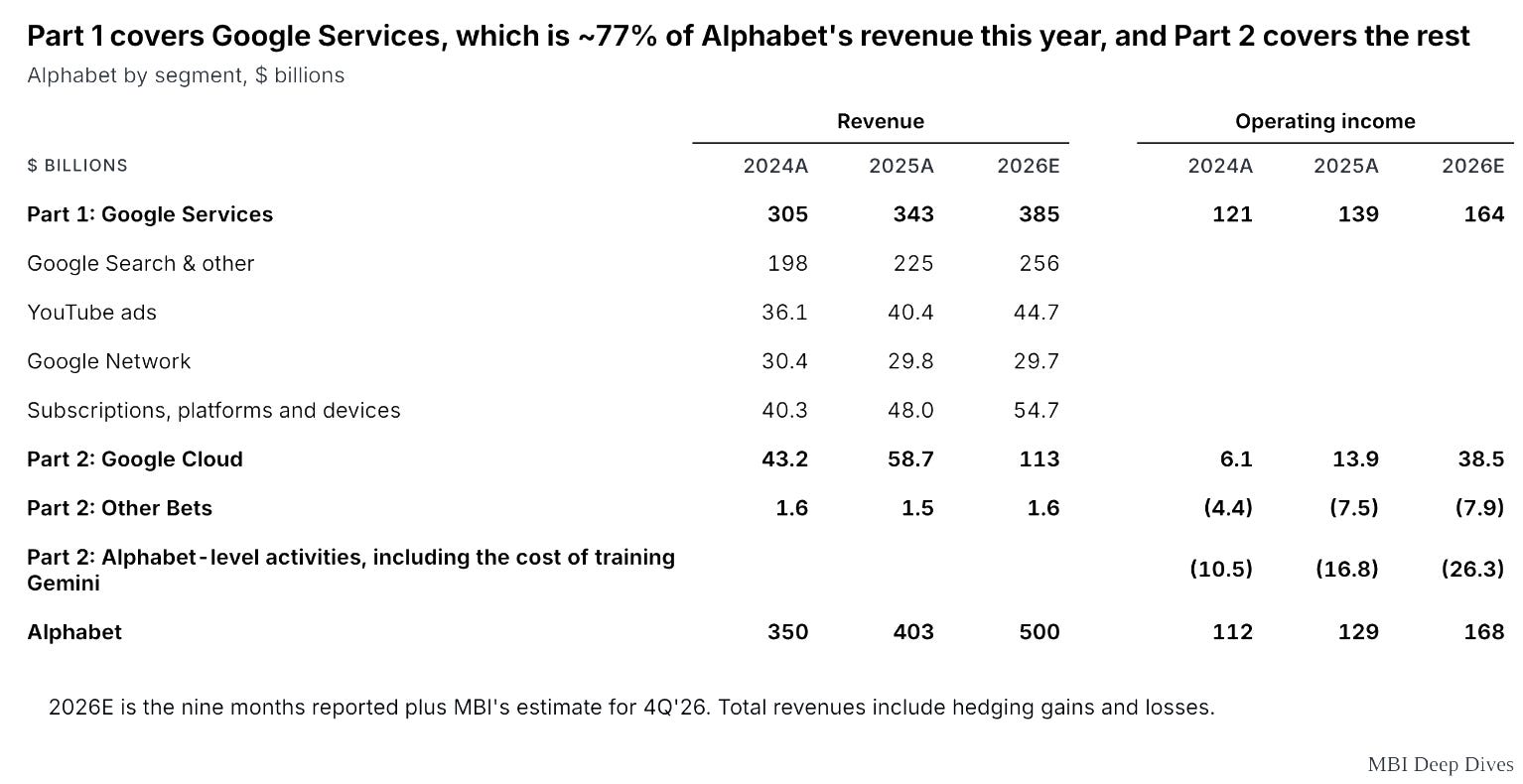
Search may be the problem child, but it still pays most of the bills. Google Services, i.e. Search, the Gemini app, YouTube and subscriptions, is ~77% of Alphabet’s revenue this year, and it is ultimately what funds the capex buildout. It is also what lets Google stay at the frontier without having to worry too much about how much of its compute goes to inference or what each GW of it earns.
So I will go through all of Google Services today, with most of the time on Search. Part 2 tomorrow will cover Google Cloud, the cost of training Gemini, capex and valuation, and I will share the downloadable spreadsheet with it tomorrow.
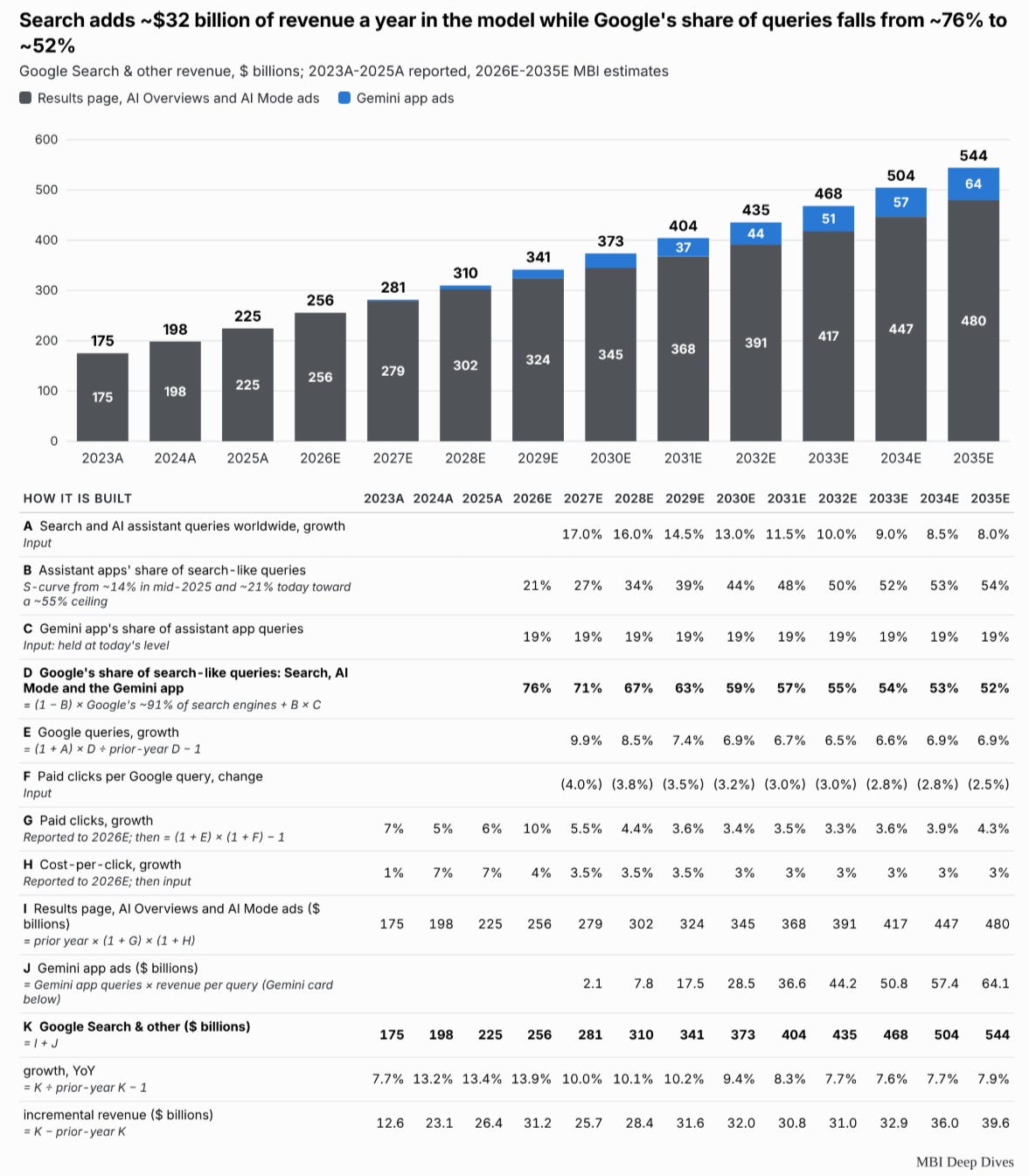
After 3Q’26 earnings, I wrote that Google is almost certainly destined to be a perennial share donor in the query market, and that what investors, including me, are really wondering is how much that will affect its numbers. This model is my attempt at an answer. I have Google’s share of queries falling from ~76% today to ~52% by 2035, and Search still adding ~$32 Billion of revenue a year on average. For context, Search added $6.8 Billion of revenue YoY in 3Q’26, or ~$27 Billion annualized, and that was a quarter that disappointed the market. So the model is basically assuming slightly faster growth than what 3Q’26 implied, mostly because ads are expected to arrive in the Gemini app.
How can Google lose that much share and still grow?
Search revenue is paid clicks times cost per click. Let me break paid clicks drivers in three pieces: a) how fast the overall pie of queries grows, b) how much of that pie Google keeps, and c) how many ads get clicked per query.
Let me start with the query share question. Earlier this month, OpenAI said ChatGPT handles ~20% as many search-like queries as Google. I sized Gemini and the other AI assistants against ChatGPT using app and web usage data, added Bing and the other search engines, and Google (Search plus the Gemini app) comes out at ~76% of all search-like queries today. On the same math, it was ~81% in mid-2025. There is definitely some margin of error in this estimate, so I would treat these as ballpark numbers and pay more attention to the direction. Google gave up ~5 points of share in a little over a year.
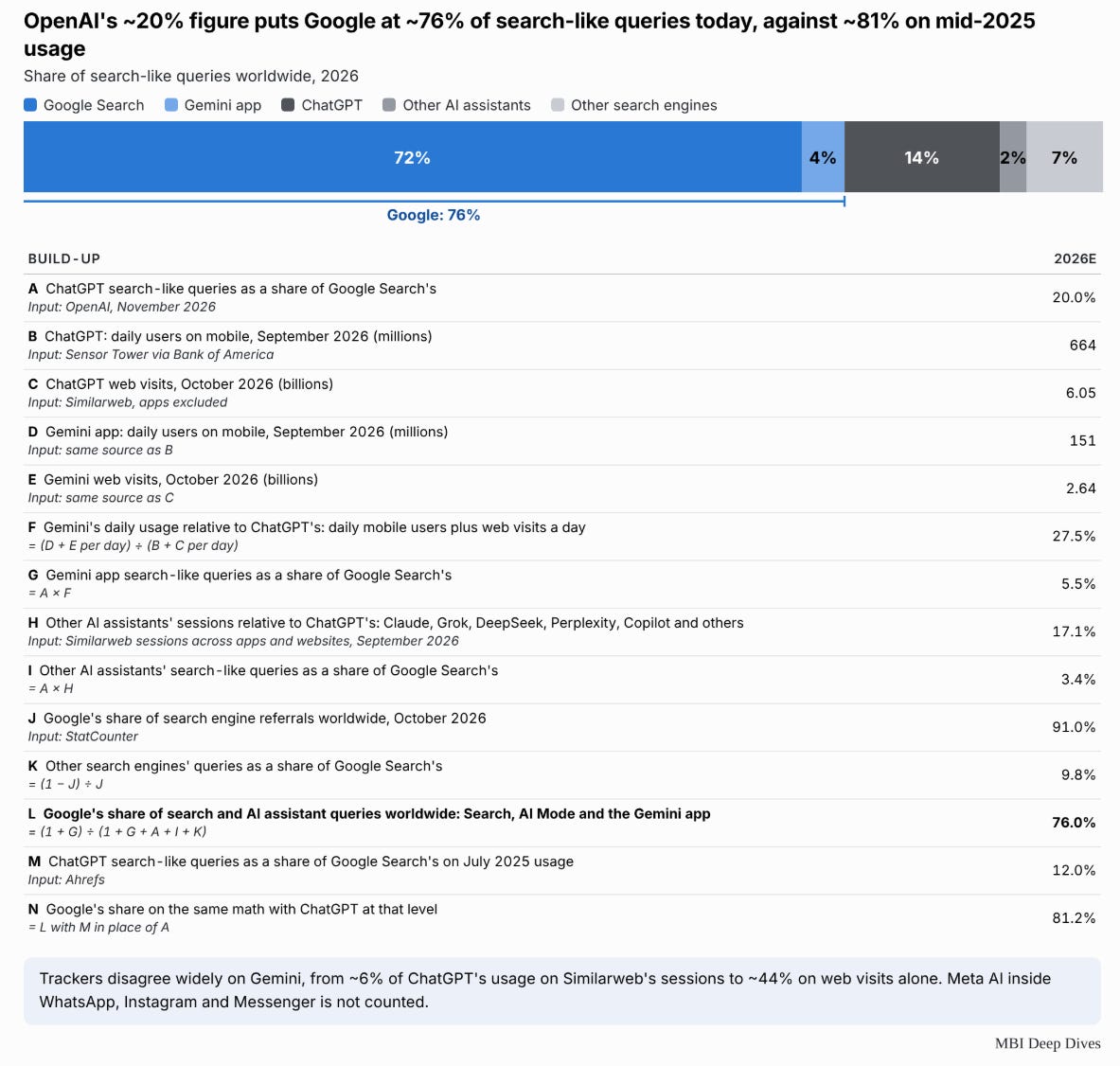
And yet Google’s own query growth this year was the fastest in five years. Both can only be true if the pie itself is growing very fast, and the math implies search-like queries grew ~16-19% a year since mid-2025. That makes intuitive sense to me. People ask ChatGPT a lot of things they would never have typed into a search box. I assume the pie grows 17% next year and gradually slows to 8% by 2035.
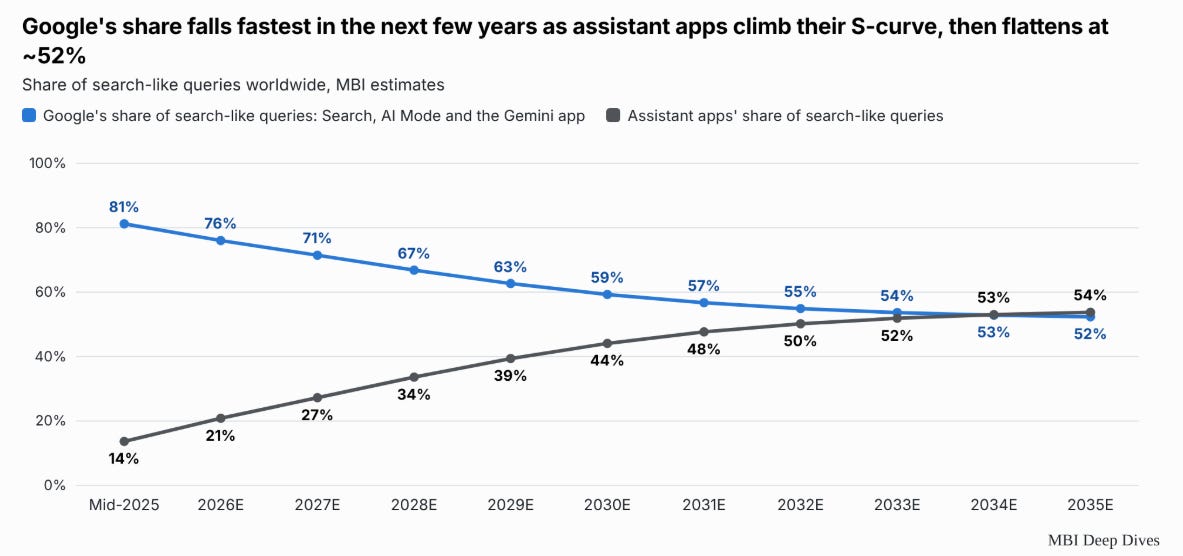
Where does Google’s share go from here? This is the most important assumption in Part 1, and admittedly it’s hard to be very confident about it. New products tend to be adopted along an S-curve, so I didn’t want to draw a straight line. AI assistants went from ~14% of all queries in mid-2025 to ~21% today, and I let that curve run until it flattens at ~55%.
Why 55%? About half of Google searches are informational, which is the kind of question assistants answer well, while about a third are navigational (think typing “amazon” into the search box) and are likely to stay within Google. I also assume Google keeps ~91% of the queries that stay with search engines, about where it has been since 2024, and that Gemini holds its current ~19% of assistant queries.
That takes Google’s share to ~59% by 2030 and ~52% by 2035, so most of the loss comes in the next four years. If assistants flatten at ~65% of queries instead of ~55%, Search revenue would be ~$48 Billion lower in 2035. If they stop at ~45%, it would be ~$50 Billion higher.
Even with that much share loss, Google’s own queries still grow ~10% next year and ~7% a year by 2035, simply because the pie grows faster than Google’s slice of it shrinks. Google ends up handling almost twice as many queries in 2035 as it does today. So volume is unlikely to be the problem, but the question remains how much Google will earn on each of those queries.
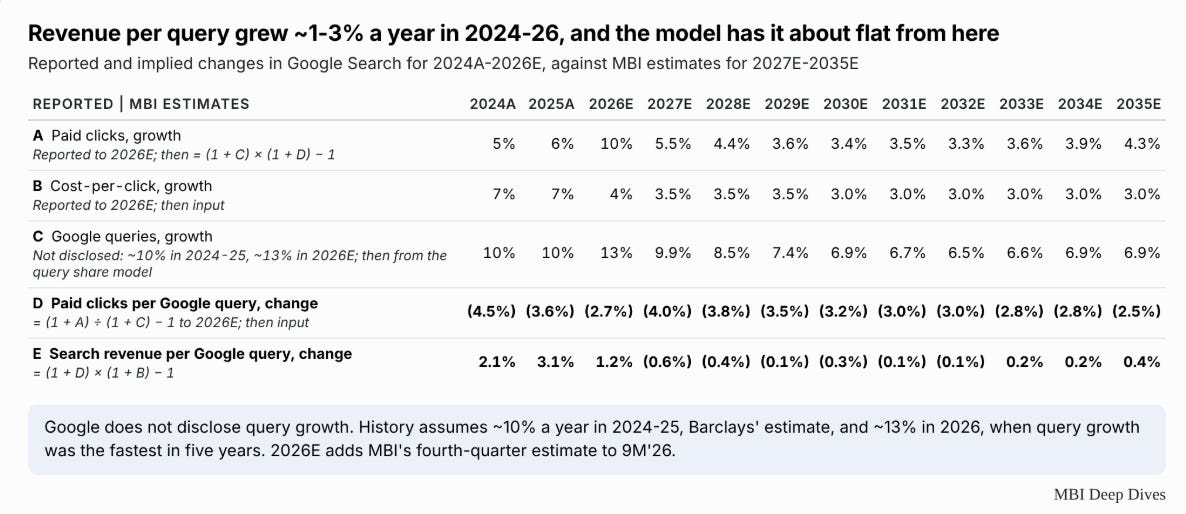
Google doesn’t disclose paid clicks per query, but you can back into it. If Google’s queries grew ~10% a year after ChatGPT’s launch, as Barclays estimated, paid clicks per query was already falling ~4% a year in 2024 and 2025, before AI Mode even existed. Then in 3Q’26, paid click growth slowed to 8% while query growth hit a five-year high. I think the decline is likely to continue for a while. AI Mode queries are longer and more exploratory, and the ads have barely shown up there yet. They reached the first markets outside the US only late last month. So I have paid clicks per query falling ~4% next year, with the decline easing to ~2.5% by 2035 as the ads catch up.
For cost per click, I assume ~3-3.5% growth a year, close to what Google has averaged since 2022. You could perhaps argue for more. An AI query carries a lot more context than a few keywords, so ads should be better matched, and Microsoft says ads in Copilot convert 16% better than its search ads. But Google will no longer have ~90% of searches to itself. As queries spread across ChatGPT, Muse and other assistants, advertisers get more places to buy intent, and that may weigh on how much Google can charge.
Put the two together and revenue per query stays about flat through 2035, after growing ~1-3% a year in 2024-26. So query growth basically drives the search revenue in my model. These two assumptions matter as much as share does. Every point a year on either one is worth ~$47 Billion of Search revenue in 2035.
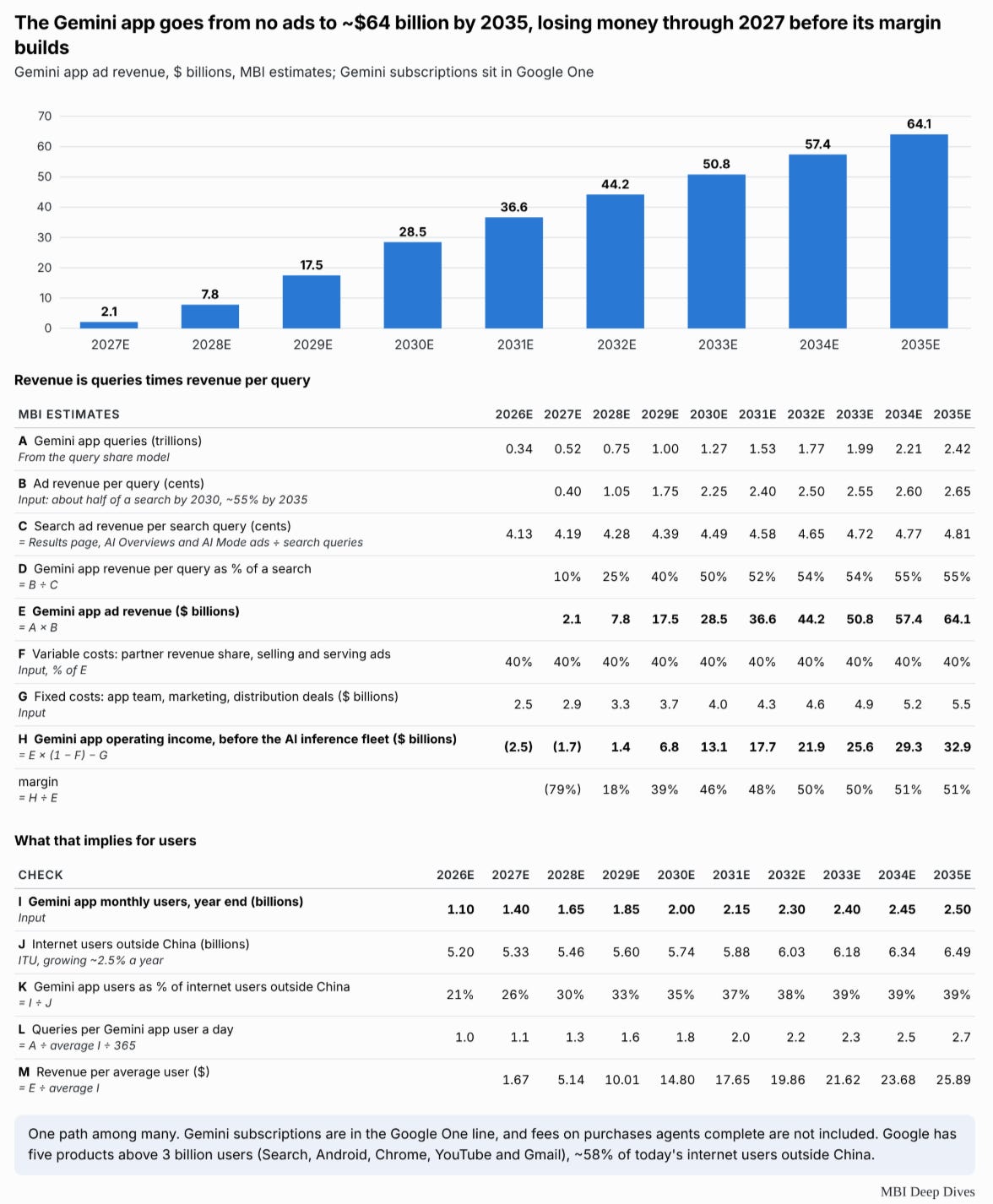
Then there is the Gemini app, which doesn’t make any money from ads yet. Gemini subscriptions are part of Google One, which I will come back to later. The share math above gives it ~0.3 Trillion queries this year and ~2.4 Trillion by 2035. Management was quite clear on the 3Q call that ads have a place in agentic interfaces, so I assume ads arrive next year.
I also assume the ads ramp fast, to about half of what a search earns per query by 2030 and ~55% by 2035. Unlike OpenAI, Google doesn’t have to build an ad business from scratch. Ads in AI Overviews and AI Mode are served from advertisers’ existing campaigns with no opt-in, and Google says AI Overviews monetize at approximately the same rate as search, so the demand should be there as soon as Google turns ads on in the app. It probably won’t reach parity with a search though. People ask assistants fewer monetizable questions than they type into a search box, and an answer has less room for ads than a page of results. Each ad should be better targeted, but probably not enough to make up the difference. That gets me to ~$29 Billion of revenue by 2030 and ~$64 Billion by 2035, or ~12% of Search. It won’t make money right away though. By my estimate the app already costs Google ~$2.5 Billion a year in fixed costs, including payments to phone makers such as Samsung to preinstall it. Once ads arrive, there are variable costs as well, mainly the share of ad revenue paid back to those phone makers and the cost of selling the ads, which I put at ~40% of the app’s revenue. So I have it losing money next year and reaching a ~50% margin by the early 2030s (before the AI compute which I treat separately below).
I would hold the Gemini app’s revenue very loosely. It is a bet on consumer behavior, which is hard to capture in a spreadsheet. We don’t know how people will split their time between Search, AI Mode and the Gemini app, and we know even less about how Google will make money once agents start doing the shopping, i.e. how much will come from ads, how much from fees on purchases and how much from subscriptions. I don’t model fees on purchases at all, so if agents end up completing a lot of purchases via Gemini or AI mode, there is likely upside here. OpenAI reportedly projects ~$100 Billion of ad revenue for ChatGPT alone in 2030, which tells you how wide the range of outcomes is. What I have here is one reasonable path, but I wouldn’t claim high conviction on these numbers.
What about margins? Alphabet doesn’t disclose Search’s margin, so I estimated margins for everything else in Google Services, and whatever is left is Search. That gives a ~58% operating margin this year. Google Services’ margin has expanded by more than a point a year since 2024, but I don’t want to extrapolate that as growth slows. I let Search’s margin rise ~0.3 points a year, which takes it to ~60% by 2035.
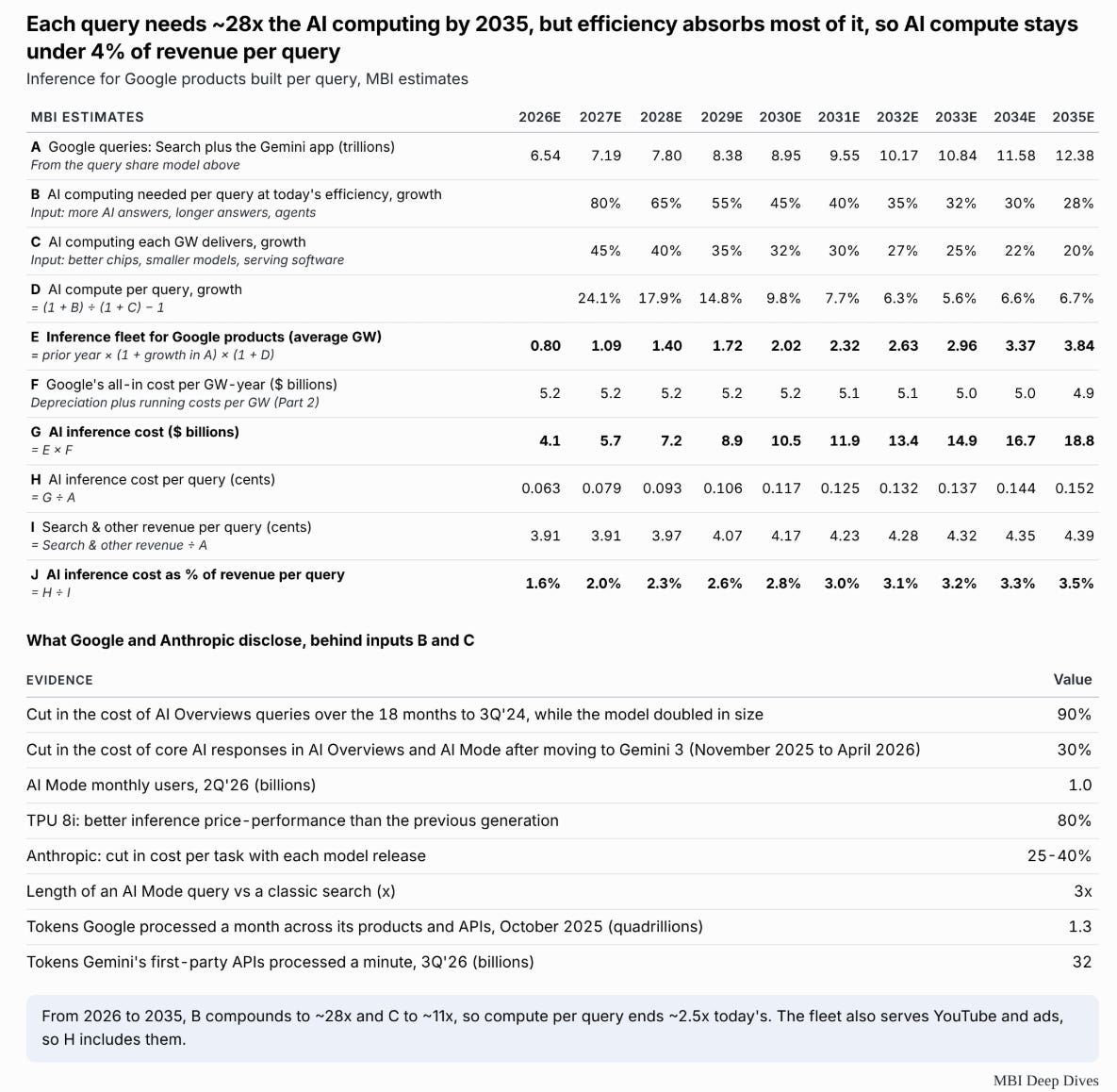
The obvious pushback is that AI answers cost a lot more to serve than ten blue links. So I modeled the compute behind AI Overviews, AI Mode and the Gemini app as its own cost line, and two things pull it in opposite directions. Each query will need a lot more computing, since more queries will get AI answers, the answers get longer and agents start doing multi-step tasks for you. Think of it as the number of tokens a model has to read and write to answer you, and I assume that rises ~28x per query by 2035. At the same time, better chips, smaller models and smarter serving software keep cutting the cost of each token, and I assume each GW of compute can handle ~11x more by then. That may sound aggressive, but Google cut the cost of AI Overviews queries by more than 90% in just 18 months.
On these assumptions, the bill goes from ~$4 Billion this year to ~$19 Billion in 2035, which is still less than 4% of what Google earns per query. Even if efficiency improves only ~20% a year instead of the ~30% I assume, the bill would be ~$40 Billion against ~$544 Billion of Search revenue. It is obviously a real cost, but I don’t think it dramatically changes the economics of Search.
Okay, that’s about it for Search.
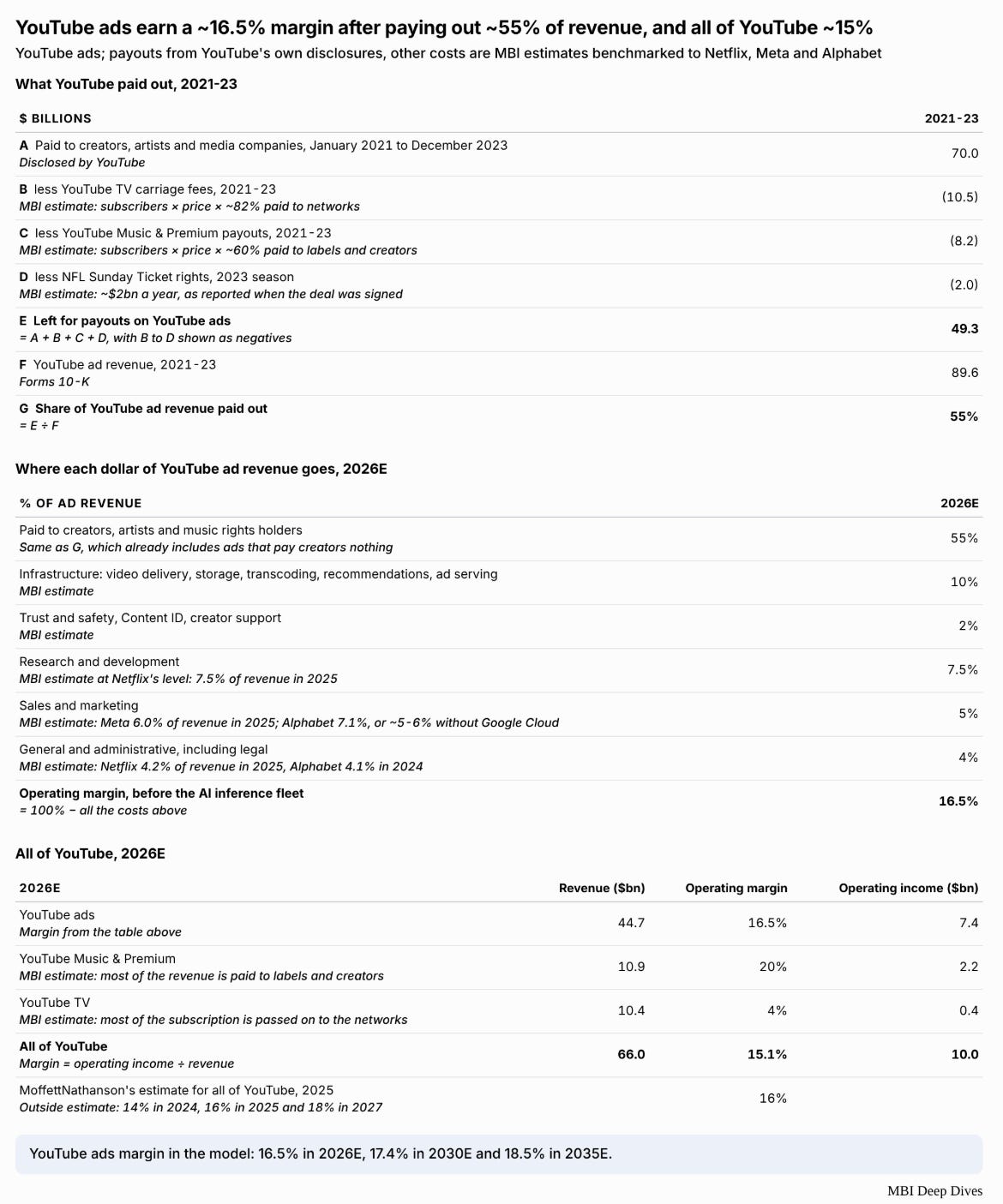
YouTube is relatively a bit simpler. Ad growth has slowed from ~15% in 2024 to ~11% this year, and every viewer who converts to Premium stops seeing ads. I fade growth from ~9% next year to ~7% by 2035, which doubles revenue to ~$88 Billion. It is structurally lower margin business than Search though. Creators keep ~55% of the ad revenue, and YouTube doesn’t disclose what it spends on anything else. So beyond the cost of storing and delivering all that video, I assume it spends about as much as Netflix does on R&D and overhead relative to revenue, and a bit less on sales and marketing since it doesn’t probably have to advertise as much for subscribers. That leaves YouTube ads with a ~16.5% operating margin, and since payout rates are contractual, I have it rising to just ~18.5% by 2035. YouTube TV passes most of its revenue on to the networks, so all of YouTube, including Music & Premium, comes to ~15% this year. That is a little below MoffettNathanson’s estimate of ~16% for all of YouTube in 2025.
Google Network is about flat this year, but in 3Q’26 that took a 14% rise in price per impression to offset a 14% drop in impressions. I don’t think that will last, and I have it declining ~2% a year. At a ~10% margin after paying partners, it hardly matters either way.
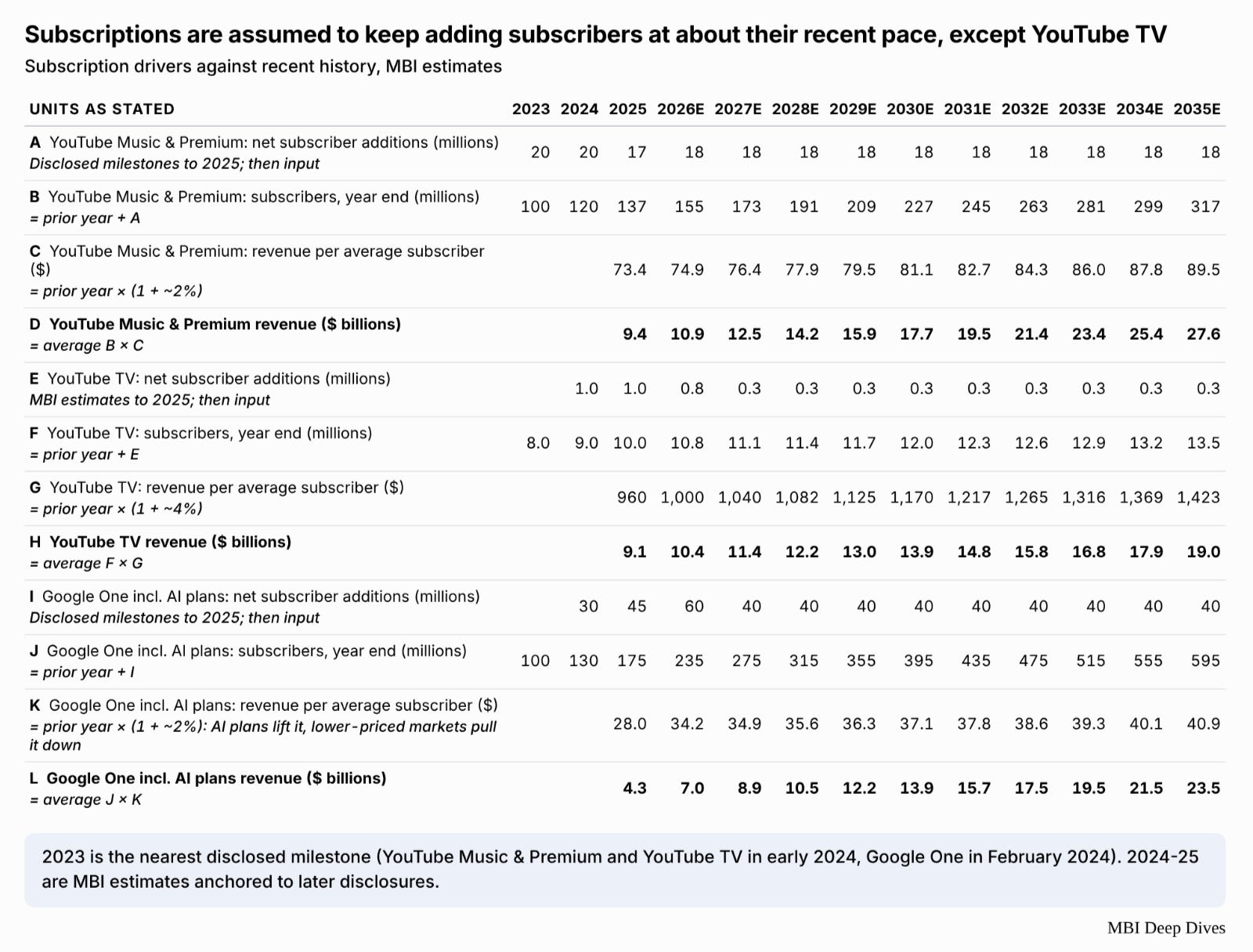
Subscriptions, platforms and devices deserves more attention. It is already bigger than YouTube ads, and I have it almost doubling to ~$108 Billion. I model each product as subscribers times revenue per subscriber, and mostly just extend the recent pace of subscriber additions (table below).
The interesting one is Google One, which is where consumers pay for Gemini. It was adding ~40 million subscribers a year, and probably more this year as the cheaper AI Plus plan rolled out. Going back to ~40 million takes it from ~235 million to ~595 million. What each of them pays is harder to call. More subscribers taking the AI plans should lift revenue per subscriber, but many of the new ones will likely come from markets such as India, where Google sells AI Plus for under $5 a month and has been giving AI Pro away for 18 months to Jio customers. I don’t know which one wins, so I let revenue per subscriber rise just ~2% a year, from ~$34 to ~$41. Alphabet doesn’t disclose any of this, so the starting points are my estimates based on the milestones it has shared.
Add it all up and Google Services grows ~8% a year, from ~$385 Billion this year to ~$765 Billion in 2035. Operating income doubles from ~$164 Billion to ~$347 Billion, and the margin edges up from ~43% to ~45% even after the AI compute bill.
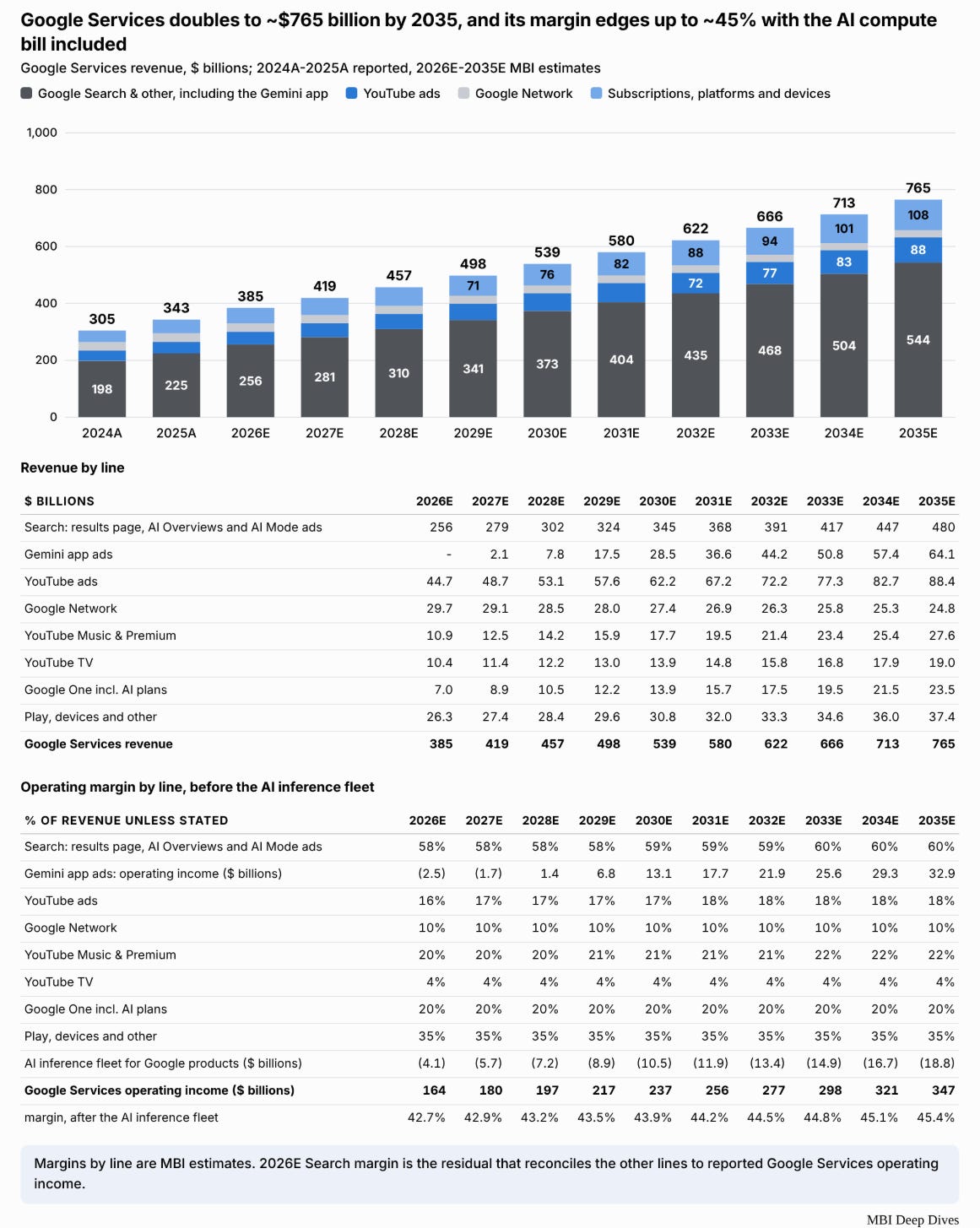
If I have to boil Part 1 down, six assumptions move the needle. Four of them drive Search, i.e. how fast total queries grow, where assistants’ share of those queries flattens, how many paid clicks survive as queries move to AI Mode and what happens to cost per click. The other two are how quickly the Gemini app monetizes and how fast the cost of serving an AI answer keeps falling. A reasonable change in any one of them moves Google Services’ 2035 operating income by ~$20-30 Billion (~6-9%), far more than anything I assumed for YouTube or subscriptions. That may not sound like much, but they can also go wrong together. If all six went against Google at once, 2035 operating income would be 36% below what I have here. Of course, the same is true in the other direction.
In Part 2 tomorrow, I will cover Google Cloud, where I would explore most of the growth, the capex debate and the post-Jensen question, along with the cost of training Gemini and valuation. I will share the full model with it so that you can change any assumption and see what it does.
Subscribers get the daily journal and five+ years of Deep Dives, i.e. full-length analyses with financial models on 70+ companies. The daily is just how I think out loud between the Deep Dives!
Current Portfolio:
Please note that these are NOT my recommendation to buy/sell these securities, but just disclosure from my end so that you can assess potential biases that I may have because of my own personal portfolio holdings. Always consider my write-up my personal investing journal and never forget my objectives, risk tolerance, and constraints may have no resemblance to yours.
My current portfolio is disclosed below: