How I Am Using AI
AI is clearly a moment of significant change. Anyone who is somewhat involved in any “knowledge work” must have tangibly felt it by now.
AI is clearly a moment of significant change. Anyone who is somewhat involved in any “knowledge work” must have tangibly felt it by now. Given the pace of change, I wouldn’t be surprised if I feel the urge to write “How I am Using AI” every six months going forward!
So, how am I using AI today?
Let me start with two arguably extreme camps on how anyone writing online should use AI. One camp wants to protect the “personal voice” at almost any cost, and many readers perhaps prefer an assurance that the content they are reading was written entirely by hand. Ben Thompson, who I really admire, is a good example of this camp. He mentioned (I’m paraphrasing) on a recent Sharp Tech podcast that he doesn’t enjoy making charts and tables by hand, and AI can now do that job well, but he still avoids using it even for those because he doesn’t want readers to think AI is producing his work.
Venkatesh Rao sits at the other end. In case you’re not familiar with Rao, his Gervais Principle is probably one of the pieces that will survive the test of time on the internet. In a recent post, Rao wrote that AI is now his default for writing and that a fully handwritten piece is the exception. He edits the model’s text lightly, treats it as a collaborator, and doesn’t try to hide its “voice”. His motto for all this is “Be Slightly Monstrous”, which basically means letting the technology change how you work instead of guarding an older idea of what a writer should be. Some of his long-time readers have apparently written to him saying they feel betrayed, but he’s clearly made up his mind. After reading one of his recent pieces “Cognitive Mercantilism”, I can tell why he is so adamant about it. If AI can help him write something like that, I can see why he doesn’t want to fall into a version of “audience capture”, where he keeps writing the old way mainly because that is what his readers expect.
I fall somewhere between the two, and I think where you fall depends a lot on what you consider your job to be.
When I think about what I do at MBI Deep Dives, there are three distinct jobs. The first is analysis, which means going through filings, listening to earnings calls or podcasts, looking into the numbers and other people’s views, and coming up with my own. The second is writing, i.e. structuring those thoughts and putting them into words. The third is allocating capital. I manage my own and my family’s savings, which is obviously a very important responsibility.
I have always thought of these three jobs as a flywheel. Better analysis gives me more to write about, and since writing is thinking, writing it down often sharpens the analysis much more. The better analyst I become, the better shot I have at allocating my family’s savings well. Given how closely Thompson’s identity is tied to his analysis and writing, I can understand his instinct to protect his writing voice.
For me, the bigger change is in how the thinking happens. Writing is thinking, and I still do believe that, but it is a slow way to think. Before AI, I would guess my time was split about evenly between doing the work (going through filings and other people’s views, running the numbers etc.) and writing it up. Writing would often raise new questions, which would send me back to do more work, and that loop could only turn so many times before I finish a piece.
Steve Jobs called the computer a bicycle for the mind, and to me AI feels more like an accelerator for thinking. Writing is no longer the primary way I think. I come up with questions from many different directions, AI goes off and does much of the work on each of them, and when it comes back, I probe, push back and sometimes have a real debate with it. Those back-and-forths can open up more avenues than writing alone usually did. Writing is still thinking, but it is now one part of a much bigger thinking process, and my job is shifting from doing the analysis and writing it down to orchestrating all that thinking and editing what comes back. I do understand the concern that this can make it too easy to let AI do the thinking for you, and frankly speaking, it is a real risk. It is on me (and everyone else using AI) to not be lazy and take advantage of the thinking acceleration that is possible today.
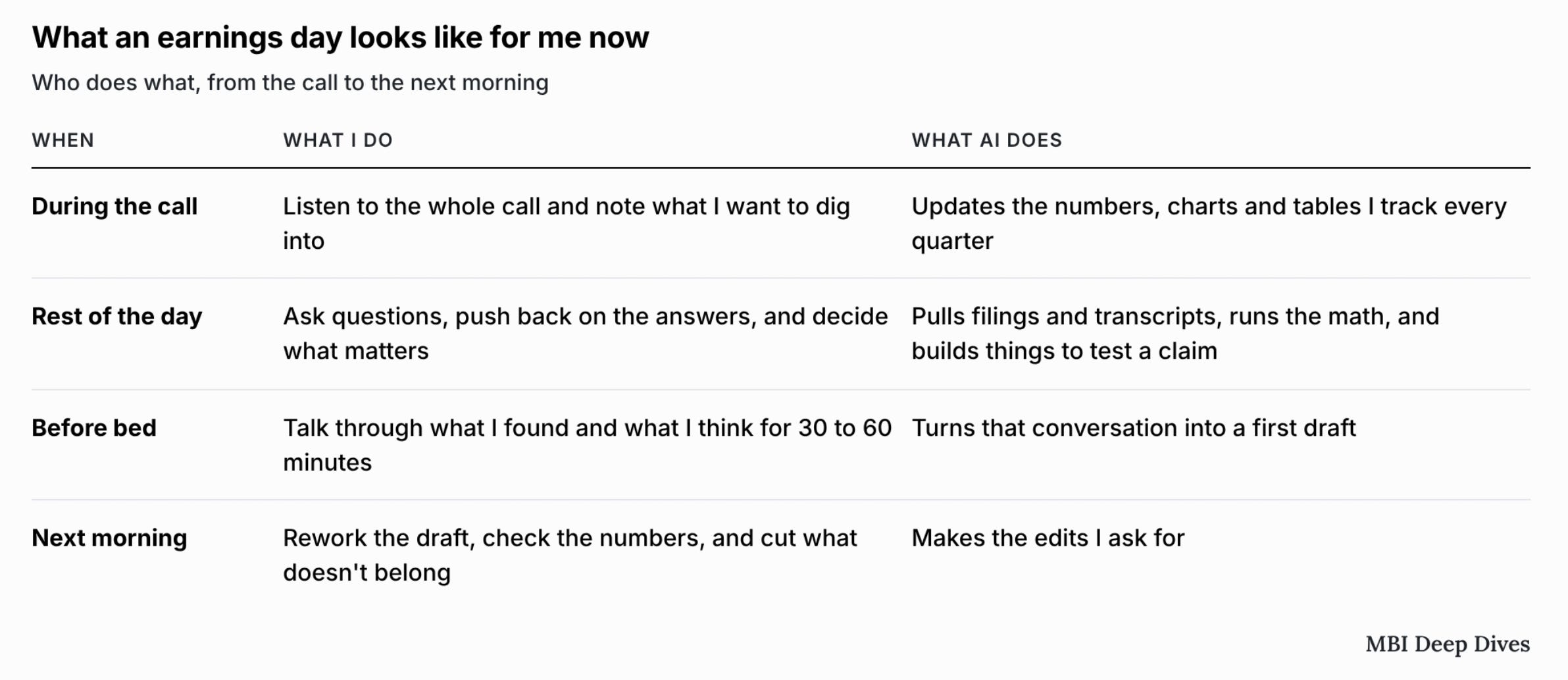
This earnings season showed me what that acceleration looks like in practice. Earnings seasons are usually exhausting. A lot of information arrives at once, it goes on every day for weeks, and it is easy to feel a bit jaded by the end of it. I didn't feel that way this time, mostly because AI did a lot of the grunt work. As each company reported, it updated the numbers, charts and tables I track every quarter, and it did that job better than I ever did. My charts are better labeled and look a lot better than what I used to make by hand. I still listen to every call. What changed is that I no longer spend the hours after the call updating spreadsheets.
I spent that time on questions I never had time to explore during earnings season. For example, when I was working on covering Uber’s earnings, I wanted to work out what fee a robotaxi fleet could rationally pay Uber given how many more trips Uber says it can send each car. These are the kind of questions that would be too time constraining to explore during the earnings season, but clearly it is the question of paramount importance. Similarly, when I was listening to Airbnb’s call, I heard Brian Chesky arguing that general agents are the wrong interface for something as visual and social as planning a trip. So I asked Muse to plan a trip for my family and build a page we could all use to rank the houses. Seeing that firsthand was far more useful to me (and I suspect to most people) than reasoning about it in the abstract.
A typical earnings day for me now looks something like the table below.
The core idea of MBI Deep Dives has always been to understand the world through the lens of investing. The way you understand anything is by asking questions and following them in many different directions, reading widely and taking in views that don’t match your own. AI now lets me follow far more of those directions than I ever could on my own.
Rao argued in his “Cognitive Mercantilism” piece that a lot of AI anxiety treats intelligence the way mercantilists treated gold, as a fixed supply to be hoarded and guarded, while barely thinking about demand. If intelligence becomes much cheaper, the more useful question is how much of it people will find uses for. He also mentions that he is willing to work harder than he did a year ago because “a lot more is suddenly within reach.” I don’t go nearly as far as he does in letting AI write the full piece for me. But that line describes my experience this earnings season quite well. It turns out I had far more questions than I ever had time for.
That brings me to the irony I myself have been experiencing since the ChatGPT moment in 2022. Every time AI accelerates in its capabilities, it somehow ends up making me work more. If you read MBI Deep Dives in your inbox, you may have noticed the emails arriving later than they used to.
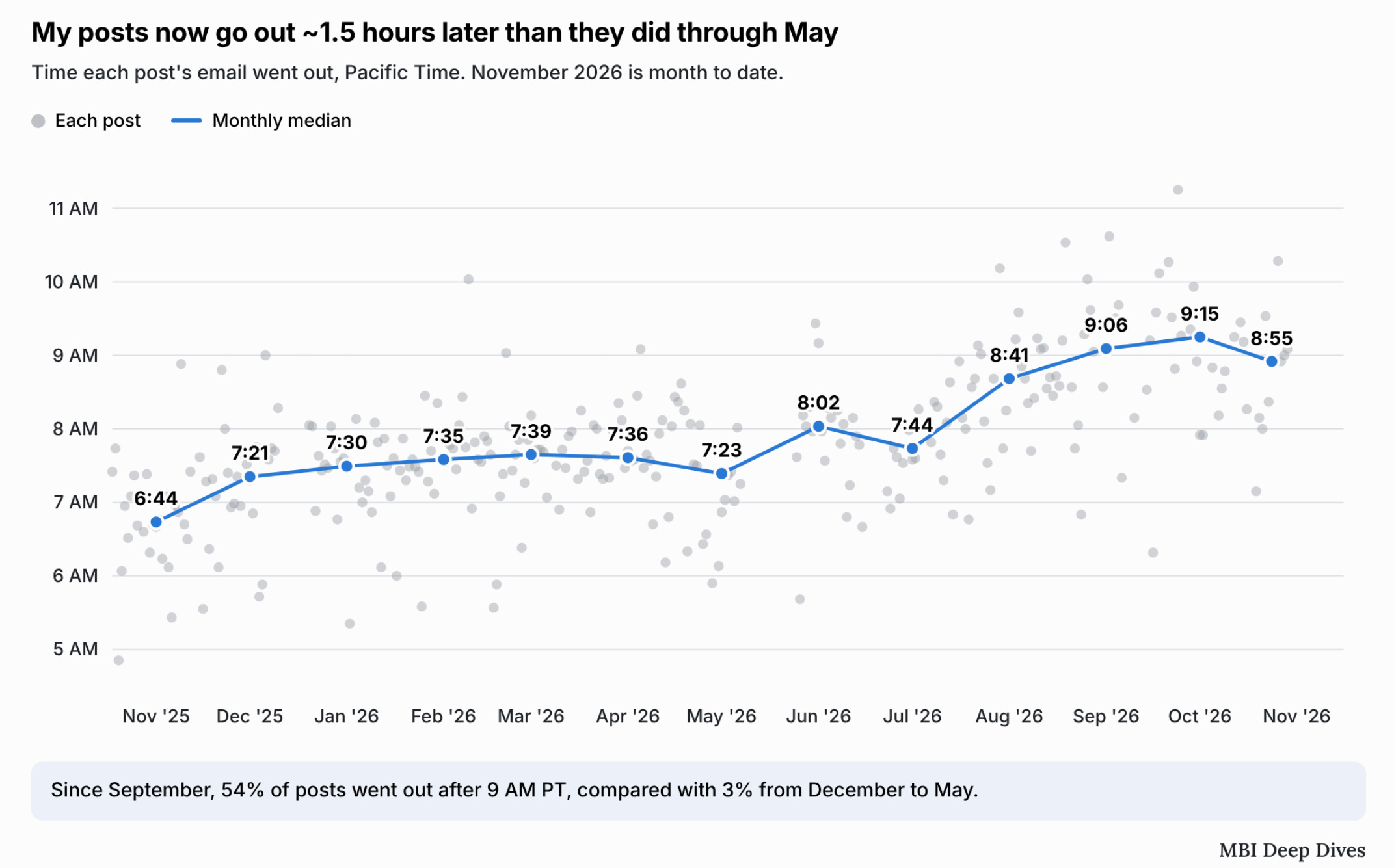
Through May, my posts typically went out ~7:30 AM PT. Since September, the median has been ~9 AM. February and May were earnings months too, and posts still went out ~7:30 then, so I don’t think the earnings calendar explains it. I still wake up at 4 am PT everyday, so no changes there either. What changed is how much material I end up with. During the day I explore a piece from several directions. Before going to bed, I talk to Claude for 30 minutes to an hour about what I found and what I think, and ask it for a draft. I wake up and start working on that draft, and pulling everything into one coherent piece takes me longer than it used to. In fact, it does feel like there is a learning curve associated with it and I think I am early to mid innings in that learning curve in how to work more seamlessly with AI, and make my thoughts into a better first draft so that I don’t have to spend four hours editing it.
We have all been told that AI will free up our time. So far, at least in my case, I see little evidence of that. Rao, drawing on Joyce Appleby’s history of capitalism, points to the industrious revolution, when people in 17th and 18th century Britain chose to work more days because there were suddenly more things worth buying. I suspect something similar is happening with questions.
There is a tension in all this that I am still working through and need to get better at. When you can chase almost any question, the challenge evolves to choosing which answers belong in the piece. The more directions I explore, the more tempting it is to put all of it in.
My objective is to understand businesses better so I can allocate my family’s savings better, and I trust that the “market” will keep finding my paywalled investing journal useful enough to pay for. So I will keep using AI where it does the work better than I can, and keep reshaping my workflow so that my own attention goes where it matters most.
Subscribers get the daily journal and five+ years of Deep Dives, i.e. full-length analyses with financial models on 70+ companies. The daily is just how I think out loud between the Deep Dives!
Current Portfolio:
Please note that these are NOT my recommendation to buy/sell these securities, but just disclosure from my end so that you can assess potential biases that I may have because of my own personal portfolio holdings. Always consider my write-up my personal investing journal and never forget my objectives, risk tolerance, and constraints may have no resemblance to yours.
My current portfolio is disclosed below: