Floor & Decor 3Q’26: Déjà Vu, But Priced For A Lost Decade
I know perhaps you are thinking and reading mostly about Jensen Huang today. I will spare you from the Huang saga and take this opportunity to catch up on earnings of a company that has absolutely nothing to do with AI: Floor & Decor (FND).
I know perhaps you are thinking and reading mostly about Jensen Huang today. I will spare you from the Huang saga and take this opportunity to catch up on earnings of a company that has absolutely nothing to do with AI: Floor & Decor (FND).
It’s bit of a deja vu, but FND lowered its 2026 outlook again. Management called it a “narrowing,” but the top end of the comp guide went from flat to -2%, and the new adjusted EBITDA range of $535-550 million sits entirely below the previous $550-585 million. That is the second cut in Brad Paulsen’s first three quarters as CEO, and 2027 store openings were slowed to 10-15 from 20. Since this is becoming a pattern, I went back through every earnings release since 1Q’23 to see how FND’s guidance has actually held up.
Of the 12 mid-year updates since then, six were cuts, three were “narrowings” in which the top end came down, two were holds, and one was a raise (last quarter’s five-cent EPS bump). The midpoint of the sales guide was lowered nine times and raised zero times.
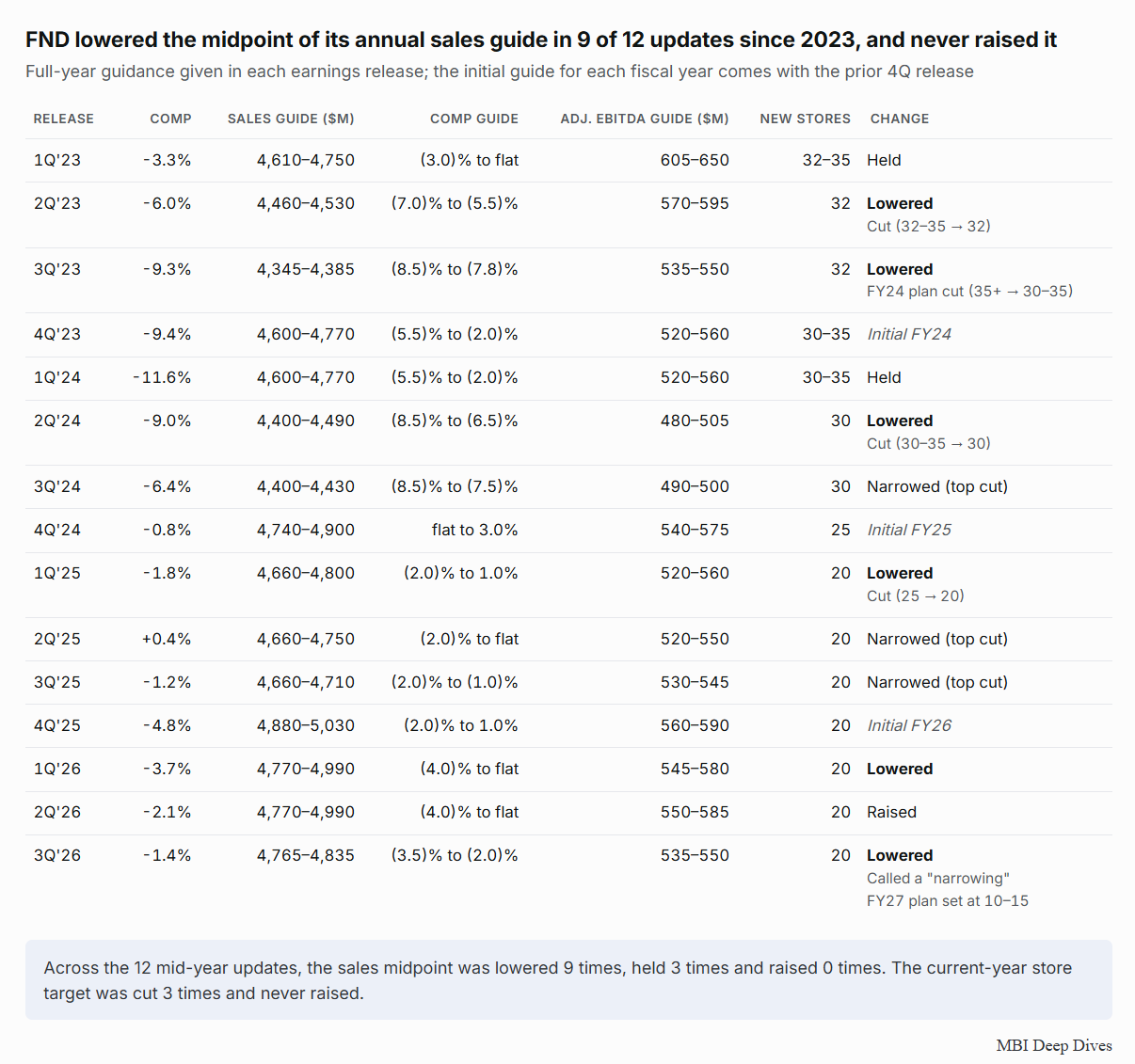
What annoys me more is where each year ends relative to where it starts. In 2023, 2024 and 2025, sales, comps and adjusted EBITDA all finished below the low end of the February guide, yet all three beat or landed inside the lowered October guide every year. So the pattern is to start too high, cut midway, and finish above the lowered bar.
Look, I understand that forecasting became a particularly punishing job for FND. FND's annual guide is essentially a forecast of Existing Home Sales (EHS), and each February management has assumed housing turnover would at least stabilize. Well, it hasn't. As I mentioned after 1Q, I am a bit surprised they haven't given up on annual guidance altogether, or at least anchored it on a stated housing assumption. Until they do, I think the market should largely ignore whatever FND guides for 2027 in February.
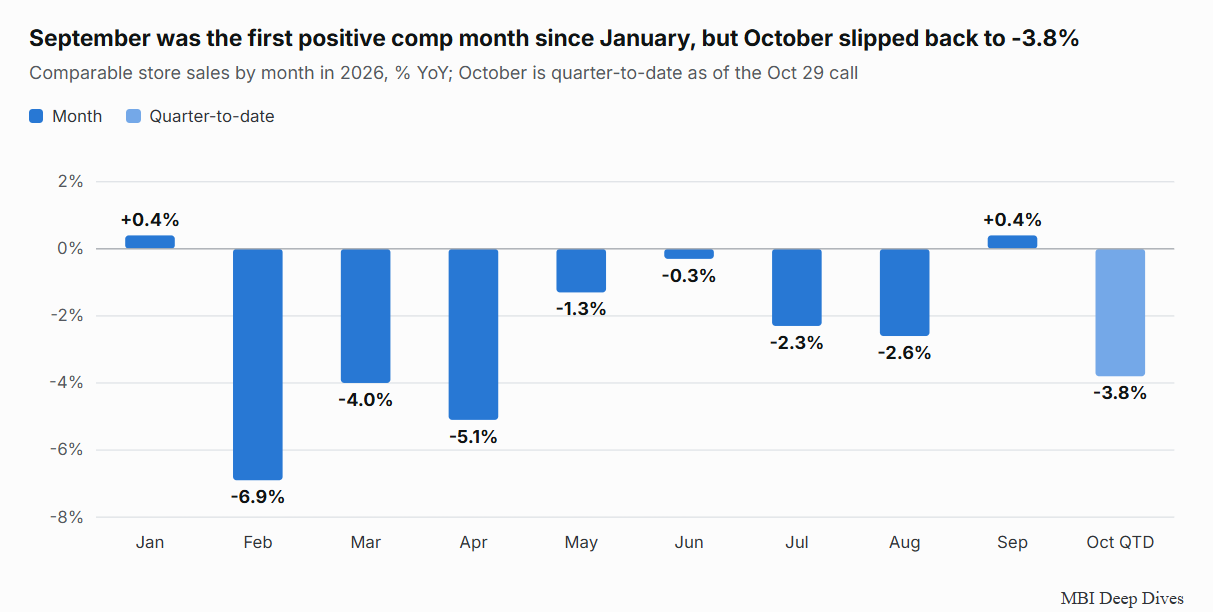
Anyways, the quarter itself was okay. Comps declined 1.4%, the 14th negative quarter out of the last 15, but July was -2.3%, August -2.6% and September +0.4%, the first positive month since January, and 12 of 16 districts were positive excluding cannibalization. Unfortunately, October slipped back to -3.8% quarter-to-date as 30-year mortgage rates moved back above 7%. October EHS, released just this morning, fell 5.5% from September to 3.75 million annualized, down 8.8% YoY and the lowest since August 2010! It really is pitch dark and it’s hard to know when we may see the light at the end of this what increasingly appears to be never ending tunnel!
FND is, of course, not alone in facing the burnt of this very poor EHS backdrop. Mohawk, the largest flooring manufacturer, reported the day after FND and described the same October. From Mohawk’s 3Q’26 call:
“Following the recent rises in rates, demand weakened exiting the quarter and has remained soft across most products and channels during October, particularly in the builder channel... In residential repair and remodel, which we estimate represents approximately half of our U.S. sales, consumers continue to defer larger projects, and the outlook for existing home sales has weakened, entering seasonally slower months.”
Mohawk is also planning for market volumes to decline in 2027, and Home Depot’s CFO said in August that housing turnover has “never been lower as a percentage of the housing stock,” with “no sign of an inflection point.” Against that backdrop, slowing 2027 new store openings seems reasonable to me. 10-15 openings is ~3-5% unit growth vs ~7% in each of the last two years, which would be the slowest since FND went public in 2017. Paulsen framed it as “pacing”. From the call (emphasis mine):
“As we kind of look from 2026 into 2027, we are making the assumption that some of these headwinds that we are faced with today will last into 2027, and we consider the environment right now more challenging than what we saw in 2025 and the early part of 2026... we can slow the pace of openings to 10 or 15, and we can do that because we do not have a fast follower competitor... As soon as we see any type of improvement in those demand drivers, then we will plan to re-accelerate.”
Given that context, it is not surprising to see deteriorating new store productivity. The CFO said the 2025 and 2026 classes are tracking slightly below the 2024 class, and mature stores now average ~$20 million of sales (from ~$22 million a year ago), although still at ~23% four-wall EBITDA margins. My March model assumed 370 stores by 2030. FND should end this year at 290, and 10-15 openings in 2027 means it would need ~22-23 a year from 2028 to get there, a bit above its 2025-26 pace but well below the 30+ a year it opened in 2023-24. I will come back to this when I discuss valuation.
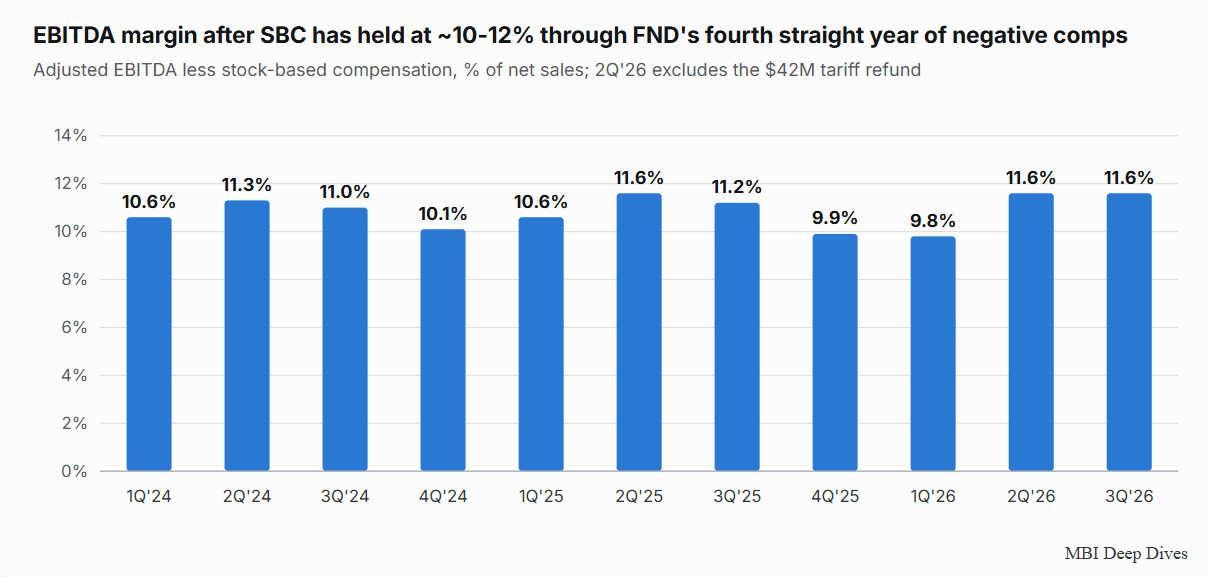
Below the comp line, EPS grew 15% to $0.61 and adjusted EBITDA grew 7.4% to $149.1 million, or ~11.6% of sales after SBC. Gross margin of 43.7% was up 30 bps, but ~$14 million of tariff refunds still sitting in inventory flowed through this quarter. Excluding it, gross margin was down ~90 bps, mostly due to diesel prices up ~70% YoY. Still, holding a ~10-12% EBITDA margin through four years of negative comps is probably better than what I would have expected if I knew such a persistent negative comp.
However, 2027 gross margin will face some headwinds. FND laps ~$22 million of refund benefit and adds loyalty program dilution, while suppliers are pushing price. Mohawk said its cost inflation has risen to mid-single digits and it has announced January price increases, arguing that “the whole industry needs to absorb the same inflation.” So the base case for 2027 gross margin should likely assume a modest decline.
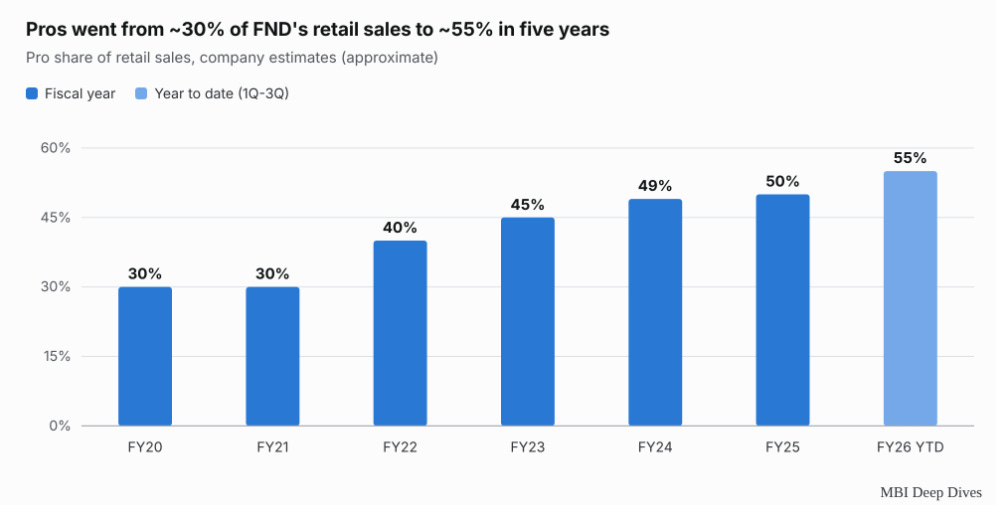
The Pro side keeps getting better. Pros were ~55% of retail sales vs ~50% a year ago, September Pro sales grew 9%, the best month of the year, and installation materials, which installers buy by the job lot, grew 10%. The Pro Digital Loyalty program is in a three-market pilot ahead of a national launch in 1Q’27, and since Pro mix went from ~30% to ~55% in five years without one, I don’t think the mix shift has peaked.
Laminate and vinyl remains the weak spot, down 3.0% after -10.4% in 1Q and -4.6% in 2Q, and its share of FND's sales has fallen from ~28% in 2022 to 23%. Management blames an oversupply of imported vinyl and expects the category to stay negative into 2027.
I will discuss FND’s capital allocation and share some thoughts on valuation behind the paywall.
Subscribers get the daily journal and five+ years of Deep Dives, i.e. full-length analyses with financial models on 70+ companies. The daily is just how I think out loud between the Deep Dives!