License to Chase the AI Frontier
While looking at Artificial Analysis Intelligence Index, I was quite struck by what they all have in common. The top model developers except one all have one thing in common: they are all currently founder-led companies. Alphabet is the sole exception. But even in Alphabet’s case, the company is still founder controlled; given that Sergey Brin is reportedly back in assuming direct oversight of Gemini, you can argue that even Alphabet is not quite an exception here.
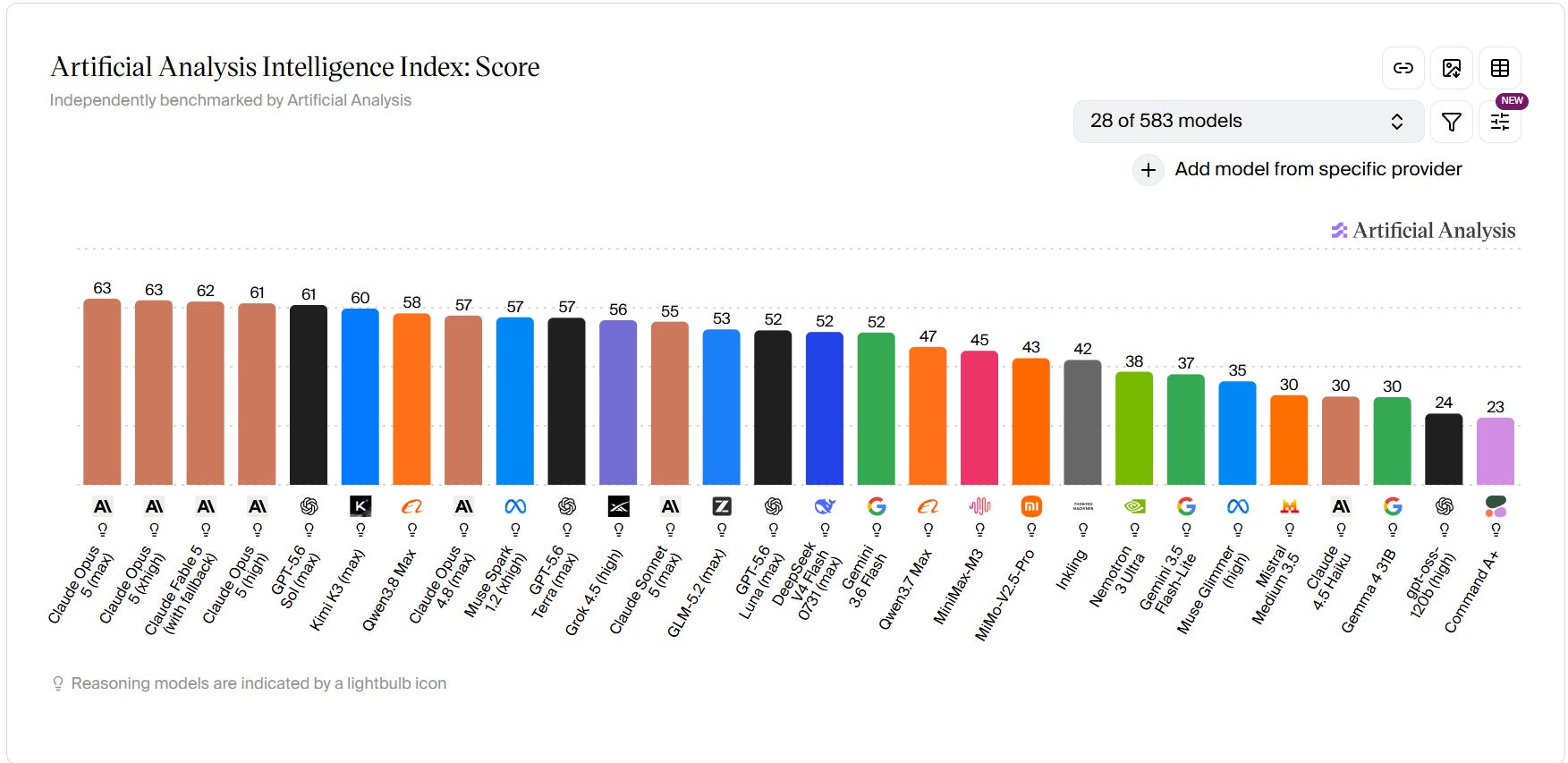
Then I wondered about the big tech companies who are NOT in the list of top model developers but somewhat tentatively building models: Apple, Microsoft, and Amazon. Can you spot the commonality of these companies? We cannot run the counterfactuals, but I did wonder if Jobs, Gates, and Bezos were still at the helm of their respective companies, would they make a different choice? This isn’t necessarily criticism of the “manager class” and yet another ode to “founder mode” mantra. The reality is building, and (perhaps more importantly) staying at the frontier will be incredibly capital intensive endeavor with very uncertain payoff. The reason founders can pursue such endeavor is due to myriad of factors such as voting control, and cultural buy-in from broader stakeholders (e.g. investors and employees) due to their past successes. Managers, by definition, do not have access to such reservoir at their disposal, at least not to the extent founders typically do.
I do not, however, believe the pursuit of the frontier by these founders comes down to mere whims, adventure, or voting control. I sense the primary motivation to be entirely different: relevance! While I have had somewhat skeptical tone in the past about the economics of frontier models, I have been gradually updating my view that owning the frontier will likely prove to be very, very useful even if the precise knowledge of long-term economics is somewhat unknowable today. I carefully chose the words “long term economics” because it is not enough to generate attractive economics today, rather the ability to sustain such economics for a very long period is what will drive valuation for these companies. My skepticism of the frontier primarily stemmed from my inability to spot a source of long-term competitive advantage for the frontier labs such as Anthropic and OpenAI. However, I have updated my view here as I have started to internalize the likely source of their long-term differentiation: data. It is quite revealing how Meta is willing to essentially give away its latest coding model “Muse Spark 1.2” for “free” if you are fine with sharing the data with them.
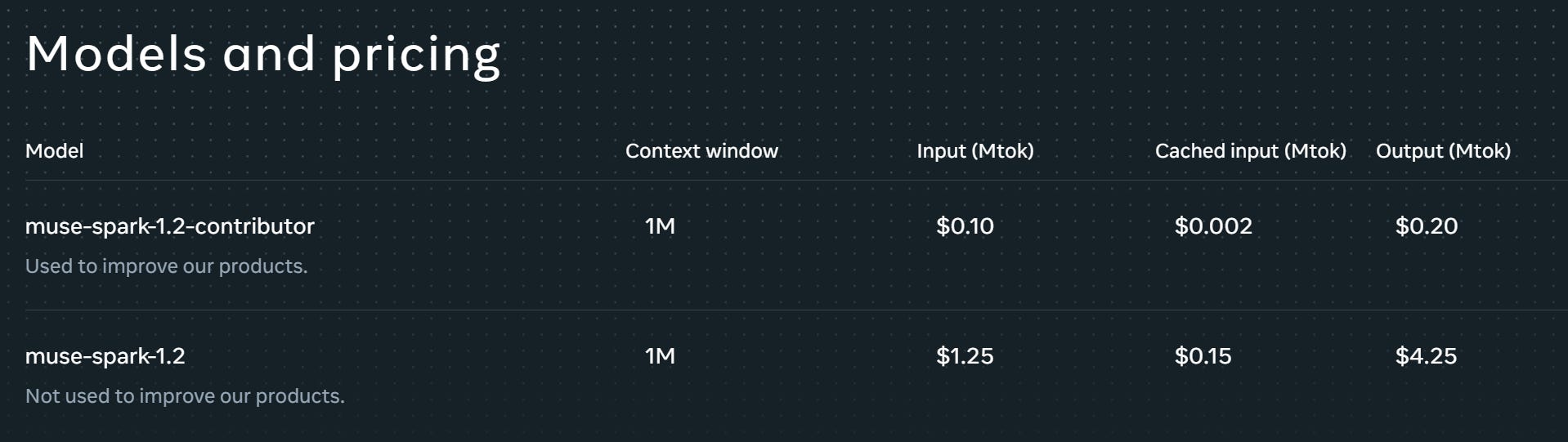
Going back to my point about relevance, I suspect frontier models will unlock newer products and revenue streams in the future which can only be accessed if you are at the frontier. These founders intuitively understand the long-term arc of this technology and are willing to swing for the fences to stay relevant despite the uncertain payoff. They also seem to understand that the fate of these foundational technologies can potentially be decided early in their lifecycle. Indeed, Android was released just one year after iPhone was launched.
In some sense, owning the frontier may mean you are at a new branch of technology, and thanks to potentially recursive self improving (RSI) nature of these models, it may be lot easier for such company to jump to the next branch. Almost nothing may be off limits for these models in the long term (which admittedly may not be “long”) if the bottleneck to your problem is intelligence. From chip designing to Riemann hypothesis, everything may be a fair game once you’re at the frontier.
The reality is investors probably care less about Riemann hypothesis and want to know more about how much these companies will make money. Unless your estimates are going up and you can articulate clear ROI for your capex buildout, public market investors do not seem to share these founders’ fascination around pursuing the frontier. If anything, given the uncertain payoff of such pursuit, investors are much more willing to sell compute capacity to the lagging model developers. It is not hard to understand the appeal for selling capacity. Given that almost every buyer is repeating ad nauseum “demand is outstripping supply”, it just seems lot easier to underwrite a data center buildout for third-party customers. On the other hand, it is a lot more difficult exercise to underwrite the curve of the pay-off structure from the most leading frontier model company to the second to the third and so on.
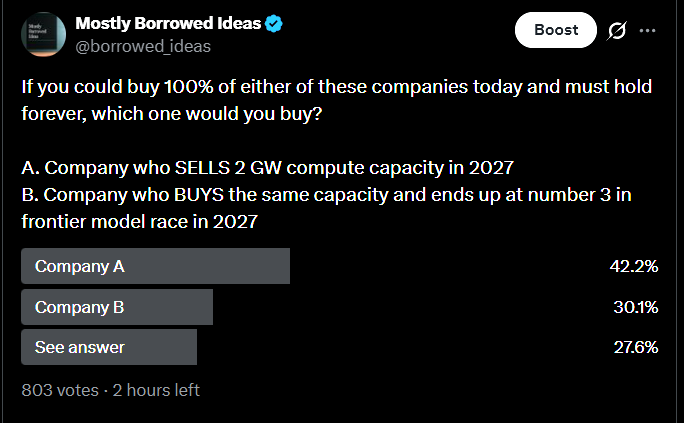
Given that context, it is perhaps no surprise that “managers” feel a lot more comfortable in supplying the capacity to companies pursuing the frontier than chasing it themselves. Managers understandably do not feel they have the license to pursue the speculative frontier as vigorously as founders might. I was a bit hesitant to even include Apple in this list as they clearly are not in frontier model race. Amazon, on the other hand, still does not exhibit such clarity. After articulating why Amazon doesn’t need a frontier model to succeed, Andy Jassy went onto then explain why Amazon is still choosing to build “frontier” models:
“…we are pursuing our own Frontier model. And we’re doing it for a few reasons. First of which is it just gives us additional control over cost, cost for our own consumer applications, but also we’re trying to drive costs down for customers. And having a player like ourselves, it’s always focused on trying to take the price performance and the cost down for customers all the time, we think will help keep the models more cost effective for customers.
I think also it allows us to have more control over prioritization of what models focus on. And we have, both from our own external customers as well as our internal customers inside the company, certain priorities that matter that we want the models trained especially well for. And then it gives us some control on speed.”
Like Ben Thompson, I also suspect Jassy may have a very different definition of “frontier” than what is typically understood. My best guess is what he’s essentially saying is Amazon will have a model on their own and for some reason, he’s just labeling it as one of the many “frontier” models the world will have. As I have mentioned before, the frontier has not been as dynamic this year as it was in 2025 when Gemini was the best model for a brief period.
Oh Gemini! Last year, I have written quite a few pieces (see here, or here) articulating why I believe Alphabet has a deep, structural advantage in pursuing the frontier model race. Unfortunately, they have been mostly missing from the race this year. While Alphabet remains founder controlled company, it is led by a manager. I do have a more positive perception about Pichai than most Alphabet skeptics out there, but as I have alluded earlier, managers inherently likely will find it very challenging to navigate the race to frontier given the speculative pay-off vs more amenable spreadsheet math of building capacity for serving 3P customers. Brin only seems to show up intermittently, but given the competitive intensity here, I’m less confident than ever before that such intermittent appearances will be sufficient to lead the frontier. Larry Page is allegedly willing to go rather bankrupt to pursue the elixir of AI, but I cannot actually recall the last time we heard from him and I do not have a good sense how deeply he is still involved in the company’s strategy.
While Alphabet’s deteriorating position in the model race is surprising to me, I am actually somewhat similarly surprised by the absence of any Microsoft model in the aforementioned Artificial Analysis Index. If someone asked me three years ago to estimate the probability of Microsoft staying in the vicinity of frontier models in 2026, I would actually give them a decent chance given they have access to all the IP of OpenAI. The fact that they are still nowhere to be found in that index should be a source of at least some annoyance from their shareholders. Given their near term estimates are going up, I guess such annoyances can be kept at bay for now. I haven’t followed Microsoft as closely as I have followed Meta, Amazon, or Alphabet over the years, but after covering Microsoft’s earnings for the last several quarters, I have noticed that management has a vexing propensity to decide on a narrative that they want investors to believe about Microsoft and then ONLY disclose objective-looking numbers to fit such narrative. As I have covered before, Microsoft’s goalposts seem to change every quarter depending on whatever the “current” narrative they believe in. It was particularly amusing when Microsoft management mentioned that 90% their “cloud revenue” came outside of frontier model companies. Such disclosure can assuage unsuspecting shareholders about lack of concentration risk of frontier model companies for Microsoft’s incremental growth, but I do want to highlight what consists of “cloud revenue”: Microsoft 365 Commercial cloud, Azure and other cloud services, the commercial portion of LinkedIn, Dynamics 365, and other commercial cloud properties. Presumably, most Microsoft shareholders actually want to know how much of Azure’s revenue came from OpenAI. This clever disclosure (or lack of) actually prompted me to make this meme which I then sent to a group chat I am in!

Thankfully, even though Microsoft management is coy about certain disclosures during the call, OpenAI is an equity method investee which qualifies as a related party under ASC 850. That forced Microsoft to disclose in their SEC filing how much of their revenue came from OpenAI and that number is $24.1 Billion in FY26. Nearly all of these revenue likely flow through Azure which makes Azure revenue the more appropriate denominator to understand the concentration risk of the capex buildout. Microsoft, of course, doesn’t even disclose Azure revenue consistently (only the growth), but they did mention Azure revenue exceeded $100 Billion in FY’26. I guess it doesn’t quite fit with the Microsoft’s current preferred narrative that nearly one-quarter of Azure’s revenue is coming from one customer! I do suspect that as long as OpenAI and Anthropic continues their meteoric and frankly incredible growth trajectory, shareholders need not worry about such concentration. But we will get much more clarity where the skeletons are hidden in the seemingly “easy” business of selling capacity to frontier labs if that trajectory ever stops.
To be fair, as of today, there is nothing in the horizon that will make you think such ever increasing annual revenue run-rate trajectory is about to slow down. But these things are inherently unforecastable. SpaceX is talking about building up to 10 GW capacity by 2027, and both Microsoft and Amazon promised to double their capacity by 2027. On top of this, Jensen Huang seems to be on a mission to teach hyperscalers a lesson for building their ASICs and want to further fragment the broader compute market. There is an incredible amount of supply of compute that’s coming in the next 18-24 months and if there is any hangover at all from such spike in supply, this business won’t seem as “easy” as it seems today.
One company that seems to be making a very difficult choice today is Meta Platforms. Like Amazon, they too want investors to believe that their core business can succeed without owning a frontier model which I do find to be credible. Unlike Amazon, Meta’s financials are visibly saddled with the massive talent and compute requirement to stay at the frontier. In the latest call, Zuckerberg tried a scattershot approach to assuage investors that such massive investments will lead to new revenue streams in the coming years. From the call:
“The opportunity in front of us is massive. First, we are now at a point where our investments in AI are accelerating every major part of our core business. They’re improving the experience for people using our apps, driving better performance for advertisers and helping our teams build new experiences and ship faster.
Second, we are developing new personal agents that will be the foundation for our next wave of products and revenue lines in the months and years ahead. And third, we see a large enterprise opportunity to sell to businesses, including APIs, business agents, potentially selling compute directly and other services that we’re building for large customers.
…we also expect to grow a large business serving large customers as well.
We’ve built our API. We’re rolling out business agents. We’re getting a lot of offers for compute at a significant premium over what we paid for it. And we have more coding and productivity tools on our road map as well.”
The only problem is apart from the first one, the rest of these potential revenue streams are at best nascent and at worst mere ideation stage. In the most recent Sharp Tech podcast, Ben Thompson criticized such scattershot approach which he thinks ended up confusing (or worse, alarming) investors. However, he was actually quite constructive about all of the monetization opportunities mentioned by Meta except the large enterprise opportunity. He pointed out how long it took for Google Cloud to be where they are today and Meta doesn’t have any credible “go-to-market” strategy to make a dent. I believe Google Cloud is the wrong analogy here. A more appropriate analogy might be OpenAI or Anthropic. Why are OpenAI and Anthropic running circles in enterprise market today? The OpenAI case study is perhaps much more instructive. To borrow Thompson’s own words, OpenAI was the “accidental consumer company” company and despite being late to the enterprise opportunity, they are clearly putting up a fight against Anthropic. Observing OpenAI’s success closely, I believe the limiting factor here is actually having a frontier model, and IF you have it, you can take care rest of the details much more quickly than ever before.
Imagine for a moment that Meta manages to build a credible frontier model with equally impressive harness. I suspect all the hyperscalers will be tripping over each other to host Meta’s closed models and sell the API to their customers. As much revenue as these hyperscalers are making today from the frontier labs, they also know they don’t want to live in a world where the labs have monopsony power over their suppliers. In this scenario, I don’t think Meta needs to build a GCP-sized platform to monetize their model appropriately; they just need to make their models available everywhere to at least recoup the training cost. They make plenty of money from other ways anyway.
But…this is a hypothetical scenario! And as mentioned earlier, the pay-off is lot more speculative today than supplying capacity to frontier labs. But when I imagine myself what would I do if I owned 100% of these companies, it becomes more clear to me that indeed I too would pursue the frontier despite such uncertain pay-off. Zuckerberg is doing exactly that and I suspect every Meta shareholder who would make a different choice may want to leave the boat before it gets potentially messy.
Subscribers get the daily journal and five+ years of Deep Dives, i.e. full-length analyses with financial models on 65+ companies. The daily is just how I think out loud between the Deep Dives!
Current Portfolio:
Please note that these are NOT my recommendation to buy/sell these securities, but just disclosure from my end so that you can assess potential biases that I may have because of my own personal portfolio holdings. Always consider my write-up my personal investing journal and never forget my objectives, risk tolerance, and constraints may have no resemblance to yours.
I made a slight change to my portfolio yesterday.