Constellation Software 2Q'26: Soft Organic Growth, but Encouraging Deployment Pace
Constellation Software (CSU) delivered a quarter that can be considered bit of a Rorschach test. Organic growth printed the weakest number in nearly 6 years while capital deployment pace is running pretty hot. I cannot speak for other shareholders, but if you own it (as I do) for CSU’s ability to deploy ever increasing amounts of capital at attractive ROIC, I do not expect you will lose much sleep following this quarter.
Let’s start with the “problem child”: organic growth. Maintenance and other recurring revenue, which is ~77% of total revenue, grew just +2% (FXN) organically in 2Q’26, decelerating from +4% in 1Q’26 and +6% in 4Q’25. Excluding Altera, recurring organic growth (FXN) was +4%, down from +5% in 1Q’26 which still looks somewhat uninspiring.
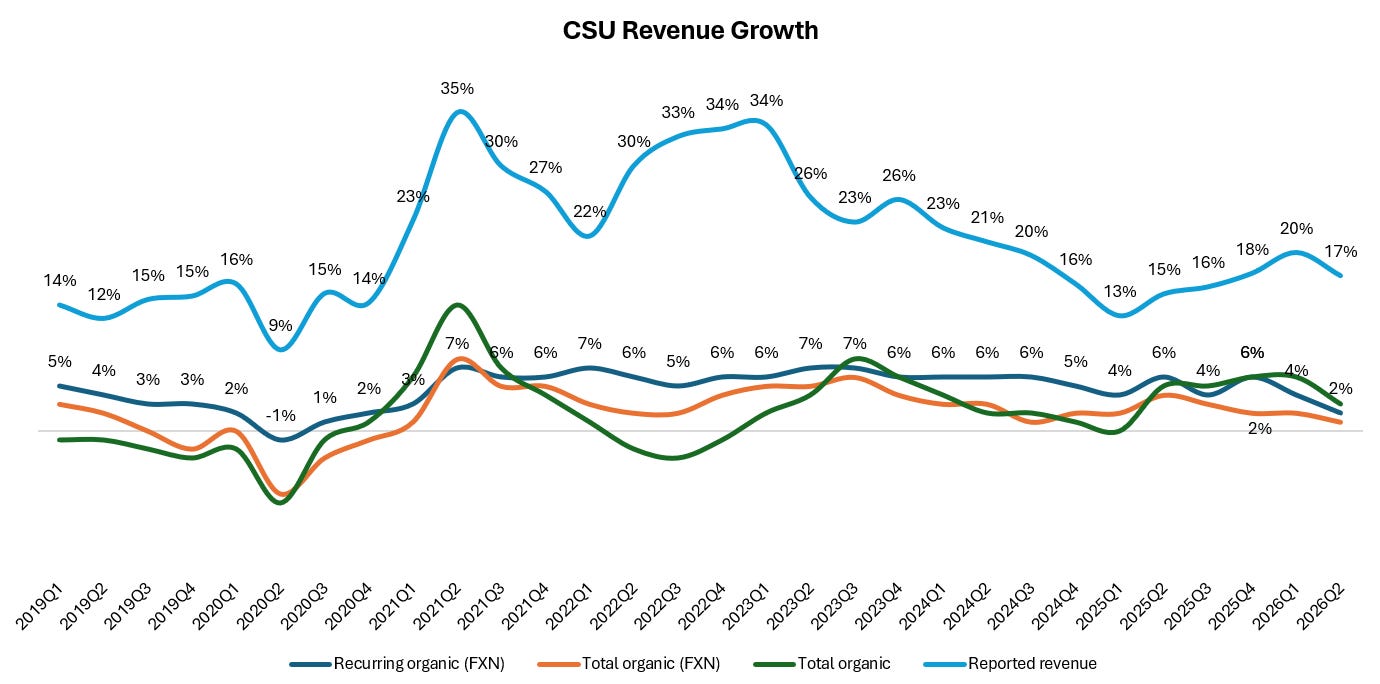
Management came armed with a bridge of one-offs. Altera actually had a strong 2Q’25 comp (+1% organic vs -19% this quarter) because IFRS forced upfront recognition on a couple of new-name contracts; the underlying business remains a managed “slow shrinker.” Dark Matter, a turnaround they are still fixing, posted +10% organic in 2Q’25 and -18% this quarter off that comp. Lumine’s organic growth was just +1% as they digest their own recent acquisitions. And a South American business lost one large customer, a departure they knew about at the time of acquisition which alone was a ~30 bps drag on CSU’s consolidated number. From the call (emphasis mine):
“If you back out those three, four things, you would normalize back down to that sort of 5% number that we have always trended at… Based on what we own today… I would expect these anomalies to sort of revert back. I am not expecting another large customer leaving or anything based on what we have today.”
While one could argue that perhaps CSU management should have disclosed all these one-off benefits when it helped them in 2Q’25, I would point out that CSU only started organizing their earnings calls from 4Q’25. They never really elaborated these one-offs in their MD&A, including this quarter’s. So, I don’t think they were “hiding” such good news when it benefitted them. I guess CSU needs to be larger and even more fragmented company for its consolidated numbers not be affected by these one-off events.
And in case you are worried about 22% total revenue decline for Altera in 2Q’26, management mentioned that IRR on the deal is still tracking ahead of what they initially underwrote. Four years since the Altera acquisition, it has generated ~$400 million of cumulative free cash flow while revenue shrank from over $800 million to ~$646 million LTM. For context, CSU paid ~$700 million for Altera (half of which was financed by non-recourse debt which helped the deal IRR even more).
On AI, the message was consistent with the last two calls: development productivity gains are there and spreading across the portfolio, but there is no revenue impact yet…in either direction.
Mark Miller’s framing on why AI didn’t make a dent on revenue was actually a good reminder of the nature of vertical market software : “you can build products fast, but selling them is a whole other thing.” Then he almost jokingly mentioned that CSU is essentially “using a blowtorch to light a cigarette” which speaks to not only how powerful today’s AI models are but more importantly, the trivial nature of R&D for CSU’s customers. The codebase was never quite the difficult part for CSU, but identifying the customer problem, and solving such problem on an ongoing basis is why CSU gets to keep the recurring subscription revenue. Miller also floated an angle that AI can potentially make CSU a faster fast-follower. If a horizontal AI player validates demand in one of their verticals, a business unit with the customer relationships can now copy the functionality in months rather than years.
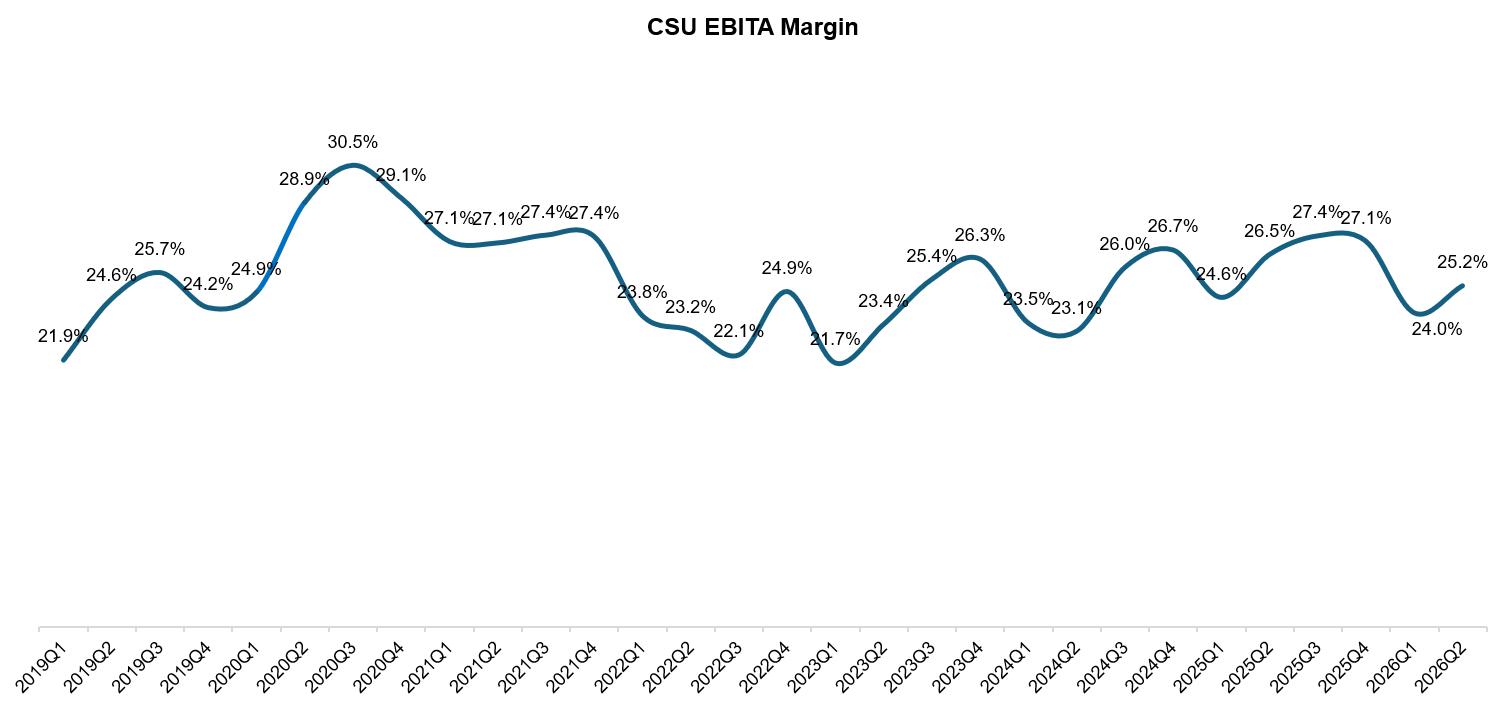
EBITA margin came in at 25.2%, up sequentially from 24.0% (Q1 payroll-tax seasonality reversing, as usual) but ~130 bps below 2Q’25. The driver for such margin contraction was that the recent large acquisitions are coming in at low margins even though still being marched up the curve over time. The CFO disclosed that the 2026 cohort swung from -16% margins in Q1 to +16% in Q2, the 2025 cohort has climbed from ~16-17% to ~20%, while the pre-2025 cohorts sit in the high-20s to 30s. This is basically the standard CSU playbook: buy it cheap and messy, and then fix it over time, but it is worth acknowledging that as large deals become a bigger share of deployment, reported margins may structurally carry such drag at any given time.
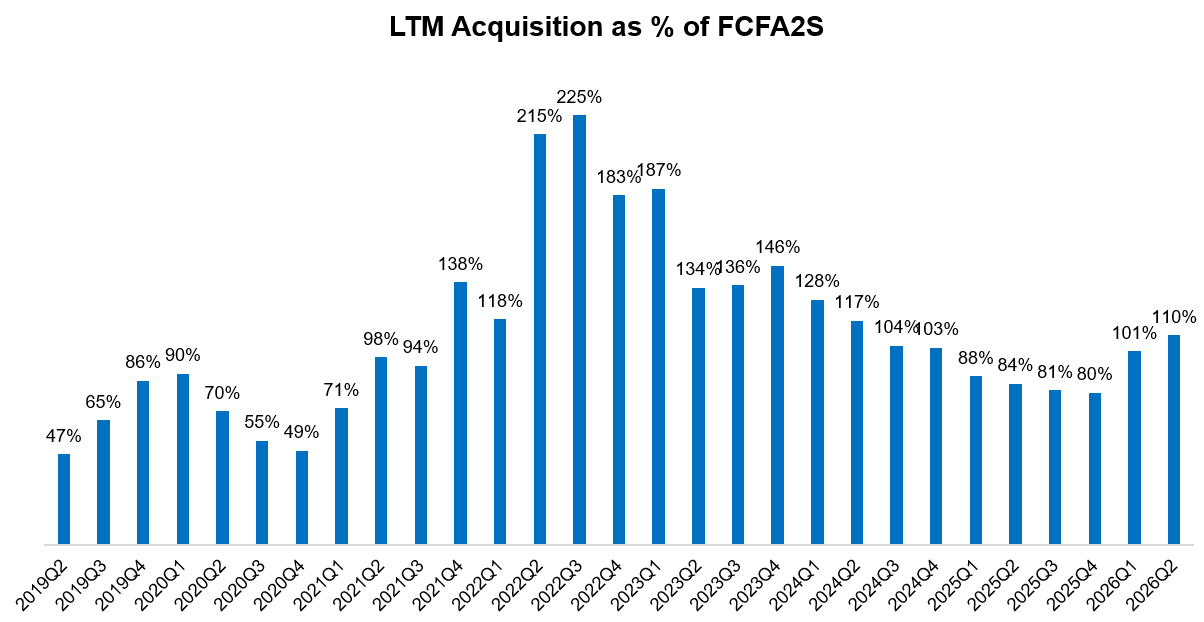
As alluded earlier, acquisitions and deployment pace was the major positive from 2Q’26. CSU deployed $893 million in Q2 ($732 million cash plus $160 million estimated deferred), and the filing discloses another $818 million closed or committed in the first six weeks of Q3. Add Q1’s $809 million and CSU has put ~$2.5 billion to work in about seven and a half months which is more than $1 billion above their entire 2025 deployment, with more than four months of the year still to go. LTM acquisitions as a percentage of FCFA2S remains above 100%. Of course, today’s acquisitions will lead to next year’s growth and pace of capital deployment this year should bode well for next year’s topline growth.
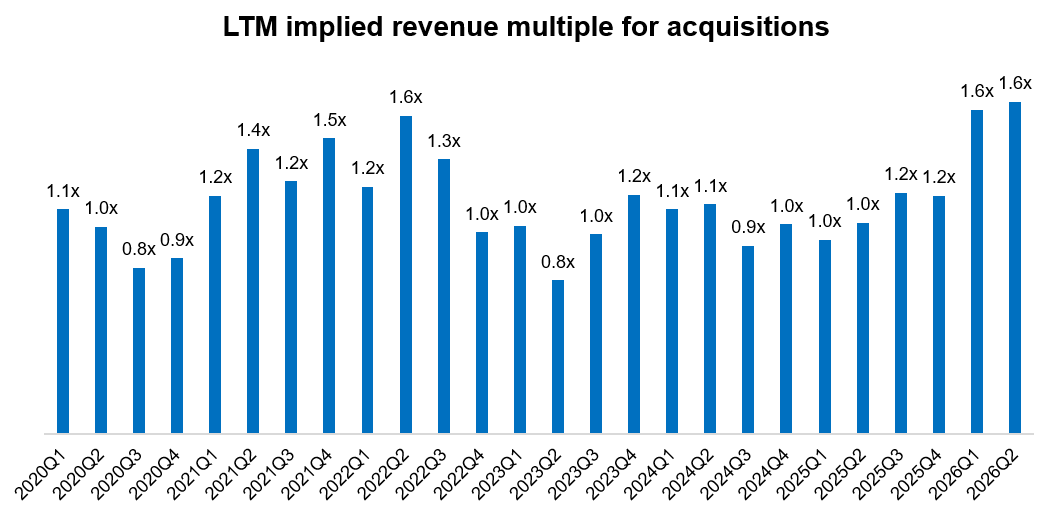
The texture of the deployment is somewhat evolving though. The quarter’s marquee deals came out of PE portfolios, and DerbySoft in particular was bought at ~4x revenue by one analyst’s math (~C$400 million for ~C$100 million of annualized revenue), which management did not dispute during the call. That is a very different fish than the ~1-1.5x revenue CSU has historically paid. Management called DerbySoft a “very successful organization… growing nicely” and noted they used leverage on the deal while reiterating that “hurdle rates aren’t changing.” Management also sort of pushed back on the idea that PE sellers are capitulating as competition for VMS assets remains “very robust,” the copycats are all still out there, and only “at the high end” is he seeing some pricing weakness.
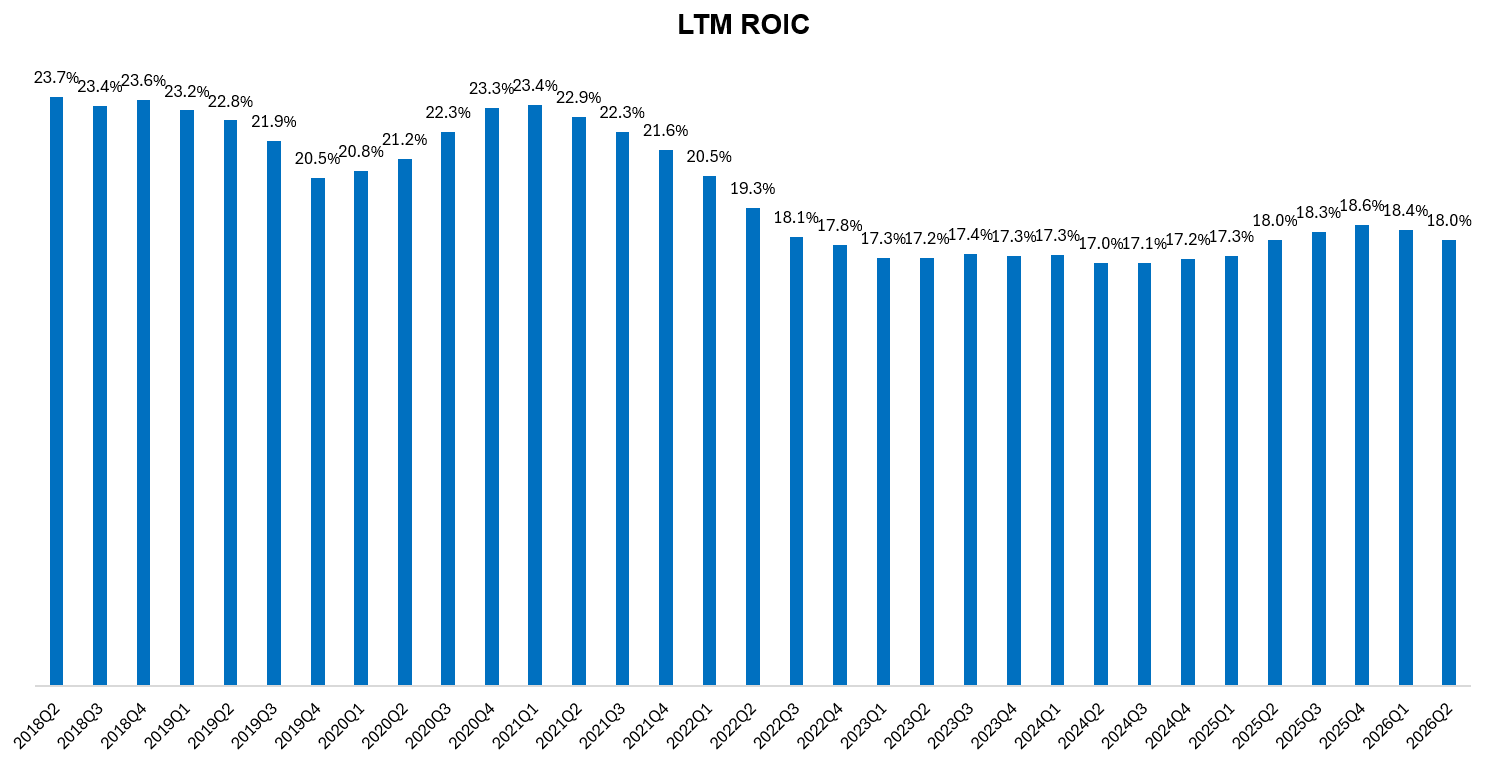
Of course, most CSU shareholders care about their ability to deploy all these capital and more importantly the ROIC trajectory of such capital deployment. While LTM ROIC remains stable at high-teen, it did tick down by ~40 bps this quarter. (FYI, read this post to understand how I calculated CSU’s ROIC. Also note that I have excluded equity investments from invested capital base since the associated return is not incorporated in numerator.)
Given ROIC is backward looking, it cannot quite give you a forward signal about what may happen in the future. But it is nonetheless encouraging to see high-teen stable ROIC for the last four years even though invested capital base increased from $6.4 billion in 3Q’22 to $14.4 billion in 2Q’26!
I will expand on CSU’s current valuation behind the paywall..
Subscribers get the daily journal and five+ years of Deep Dives, i.e. full-length analyses with financial models on 65+ companies. The daily is just how I think out loud between the Deep Dives!