DoorDash: The Infrastructure of Local Commerce
Programming Note: MBI Deep Dives will be off tomorrow, and the regular cadence of daily posts will resume on Thursday when I expect to cover Meta’s 2Q’26 earnings. You can listen to the Deep Dive here The very first Deep Dive I ever wrote for MBI Deep Dives back in 2020 was on Uber.
Programming Note: MBI Deep Dives will be off tomorrow, and the regular cadence of daily posts will resume on Thursday when I expect to cover Meta’s 2Q’26 earnings.
You can listen to the Deep Dive here
The very first Deep Dive I ever wrote for MBI Deep Dives back in 2020 was on Uber. While discussing Uber Eats in that Deep Dive, I made the cardinal mistake of doubting the American eaters! I thought the pandemic likely pulled forward consumer propensity of ordering food online and once things normalize, people would likely go back to dine in restaurants and food delivery companies would face noticeable headwind afterwards. Six years later, as I was studying DoorDash over the last few weeks, I can now confirm that I was, in no uncertain terms, wrong!
My mistake was viewing food delivery purely through the lens of pandemic-era consumer convenience, rather than as a fundamental infrastructure bottleneck for local commerce which was unleashed during Covid to become increasingly integral part of everyday life for millions of Americans. To understand why the habit stuck, let’s go back to when that bottleneck was first identified.
In the fall of 2012, four Stanford students: Tony Xu, Stanley Tang, Andy Fang, and Evan Moore were working on a class project in the GSB’s “Startup Garage” course, interviewing small business owners around Palo Alto to figure out what technology they could build for them. One of those interviews was with a one-person macaron shop. During the interview, the shop owner pulled out a thick booklet pages and pages of delivery orders she had been forced to refuse because she had nobody to deliver them. As Xu recalled in Sequoia’s “Crucible Moments” podcast, small businesses running on 17-18 days of cash don’t have the luxury of turning away business and yet, the owner was forced to do it since there was not quite any viable solution.
The four of them spent the following weeks interviewing another ~150-200 small businesses and kept hearing the same complaint: everyone wanted delivery, but nobody could afford to staff it. So, they thought they might be onto something here. In an afternoon, they stood up a landing page called PaloAltoDelivery.com with PDF menus of local restaurants and a Google Voice number that rang their own phones. DoorDash’s S-1 mentioned what happened next: on January 12, 2013, “…the first DoorDash consumer ordered prawn pad thai and spring rolls”, and one of the founders drove it over himself. For months, the founders were the dispatchers, the customer support, and the delivery fleet. Xu himself was among the company’s very first Dashers, a tradition that survives today in the form of “WeDash,” a program under which every salaried US employee must do delivery shifts each year. The company went through Y-Combinator in the summer of 2013 and renamed itself DoorDash.
In some ways, restaurant food is perhaps the worst thing to deliver as they can be perishable within minutes, ordered in unforgiving lunch and dinner spikes, with customers who expect the whole thing done in under 45 minutes for a minimal fee. Indeed, Xu wrote for Sequoia that when they started, they had exactly three questions to answer: “Would customers be willing to pay $5 for this service?” “Would restaurants be willing to pay us a certain percentage?” “Would drivers be willing to work for this wage?”
If you can build a logistics network that can reliably move hot scrambled eggs across a suburb in 30 minutes, you can probably move basically anything else in local commerce later i.e. groceries, convenience, flowers, the tube of toothpaste...you name it! Restaurants also happened to be the largest category of local commerce with essentially no delivery infrastructure of its own; outside of pizza and Chinese food, most American restaurants simply didn’t deliver. Today, we take food delivery for granted, but it’s actually not that long ago it was far from the norm. Given that context, even though DoorDash’s ambition is to build last-mile logistics for every merchant on Main Street, restaurants were probably the hardest, AND the largest beachhead which means it made a lot of sense to solve that problem first!
While Grubhub, Seamless, and Postmates fought over Manhattan and San Francisco, DoorDash deliberately went to the suburbs. When DoorDash finally launched in San Francisco in 2015 (two years after founding), Xu told TechCrunch that they had wanted to first learn in cities that looked like the average American city rather than the largest market next door. Suburbs had less competition, higher car ownership, easier parking, larger family order sizes, and more importantly, households for whom delivery was a genuinely new capability rather than a substitute for walking a block. Even though suburbs may have looked like a niche strategy at the time, it turned out to be one of the most important pieces of the puzzle to solve the broader problem.
However, for a long time investors were highly skeptical. When Xu and his co-founders were raising money, more than 100 investors said no since on-demand delivery still carried the stench of the dot-com graveyard (Webvan, Kozmo etc), and the margins looked impossibly thin. Sequoia’s Alfred Lin, who would later lead a round and take a board seat, initially called Xu just to pass on the seed. Xu later admitted that solvency worried him for three years as he recalled in this podcast:
I always was nervous, and I think a lot of people involved with DoorDash were very nervous about, you know, our solvency. We were always worried about running out of cash and it was three years of being worried.
…Besides just the constant financial stress, we had people lose confidence in the company, right? Even internally—about maybe a quarter or 20 to 25 percent of the company—voluntarily left over those three years.
Xu and DoorDash went through those dog years to eventually become the dominant player in food delivery market.
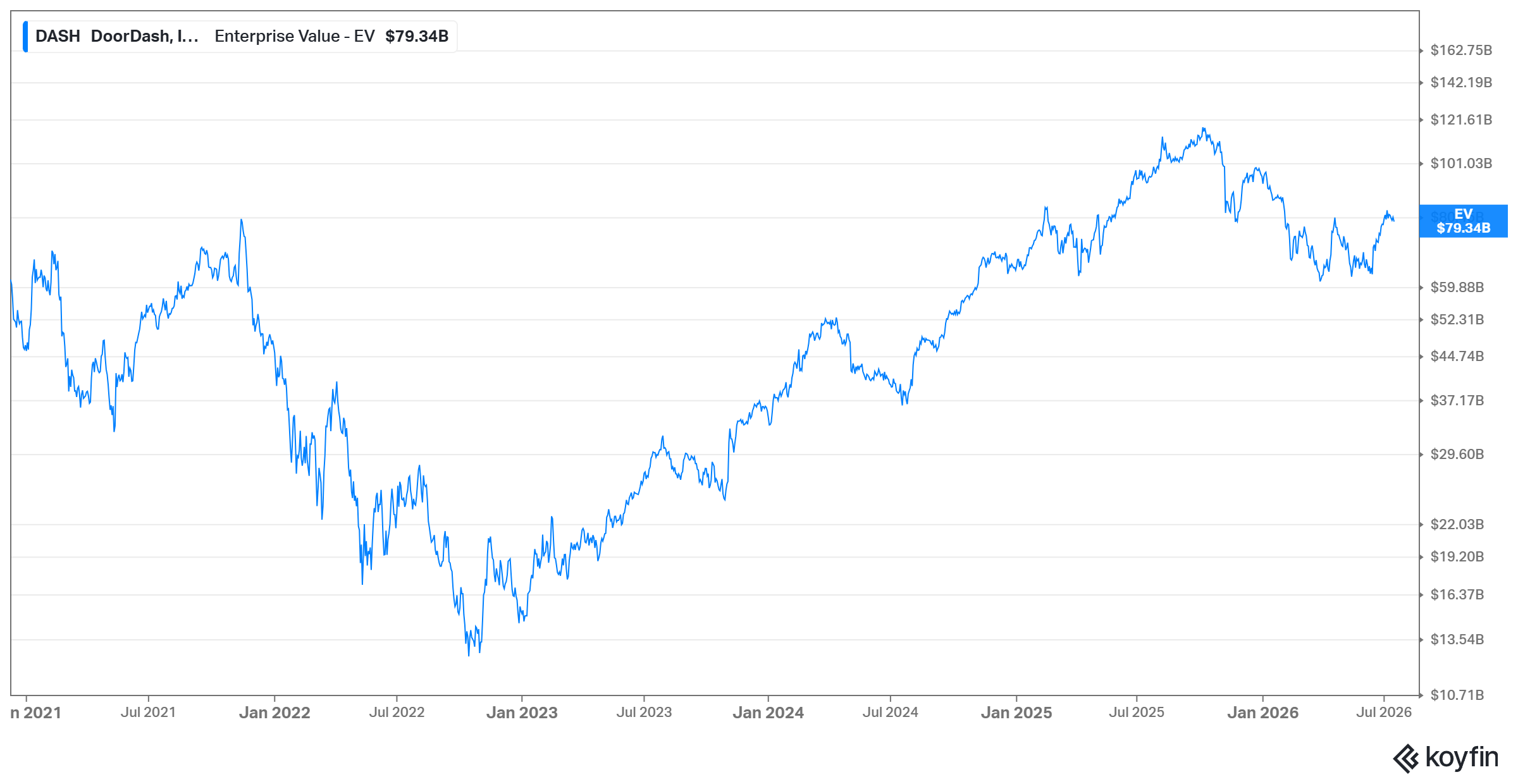
On December 9, 2020, DoorDash IPO’d at $102 per share. Then the pandemic-era market did exactly what it did to every 2020 IPOs: shares popped ~80% on the first day of trading, briefly pushing the market cap toward $60 billion. Enterprise Value (EV) reached ~$80 Billion during the 2021 peak and then crashed to just ~$15 Billion in 2022. Since then, the company has recovered in value but EV is still hovering around $80 Billion.
In 2025, DoorDash processed ~$102 Billion of Marketplace Gross Order Value (GOV) across 3.2 billion orders, generated $13.7 Billion of revenue, posted its first meaningfully profitable GAAP year, and after acquiring Wolt in 2022 and Deliveroo in 2025, it now operates across more than 40 countries with over 56 million monthly active users. Not bad for a company that started with a PDF menu website with a Google Voice number.
In the rest of this Deep Dive, I will first walk through how the three-sided machine actually makes money and dissect the unit economics of an order. I will then discuss the competitive dynamics: whether food delivery is recession proof, whether the model is actually net beneficial to all three sides, why DoorDash beat Grubhub and the competition it faces against Uber, its chances in grocery against Amazon, Walmart, and Instacart, and whether AI is an opportunity or a disintermediation threat. Finally, I will cover capital allocation and management incentives before getting into valuation.
Subscribers get the daily journal and five+ years of Deep Dives, i.e. full-length analyses with financial models on 65+ companies. The daily is just how I think out loud between the Deep Dives!
Business Overview
DoorDash is a local commerce platform which operates a three-sided marketplace connecting consumers who want something brought to their door, merchants who want incremental demand, and Dashers who want flexible earnings.
When you order $25 of pad thai, you pay the food subtotal, sales tax, a delivery fee, a service fee, and hopefully a tip. The restaurant pays DoorDash a commission on the subtotal, and the Dasher receives a base pay amount from DoorDash plus 100% of your tip. DoorDash is an agent in this transaction, so its reported revenue is only commissions plus consumer fees plus membership/advertising, less Dasher payout and refunds, credits, and promotions.
So what does the toll booth actually collect from each side?
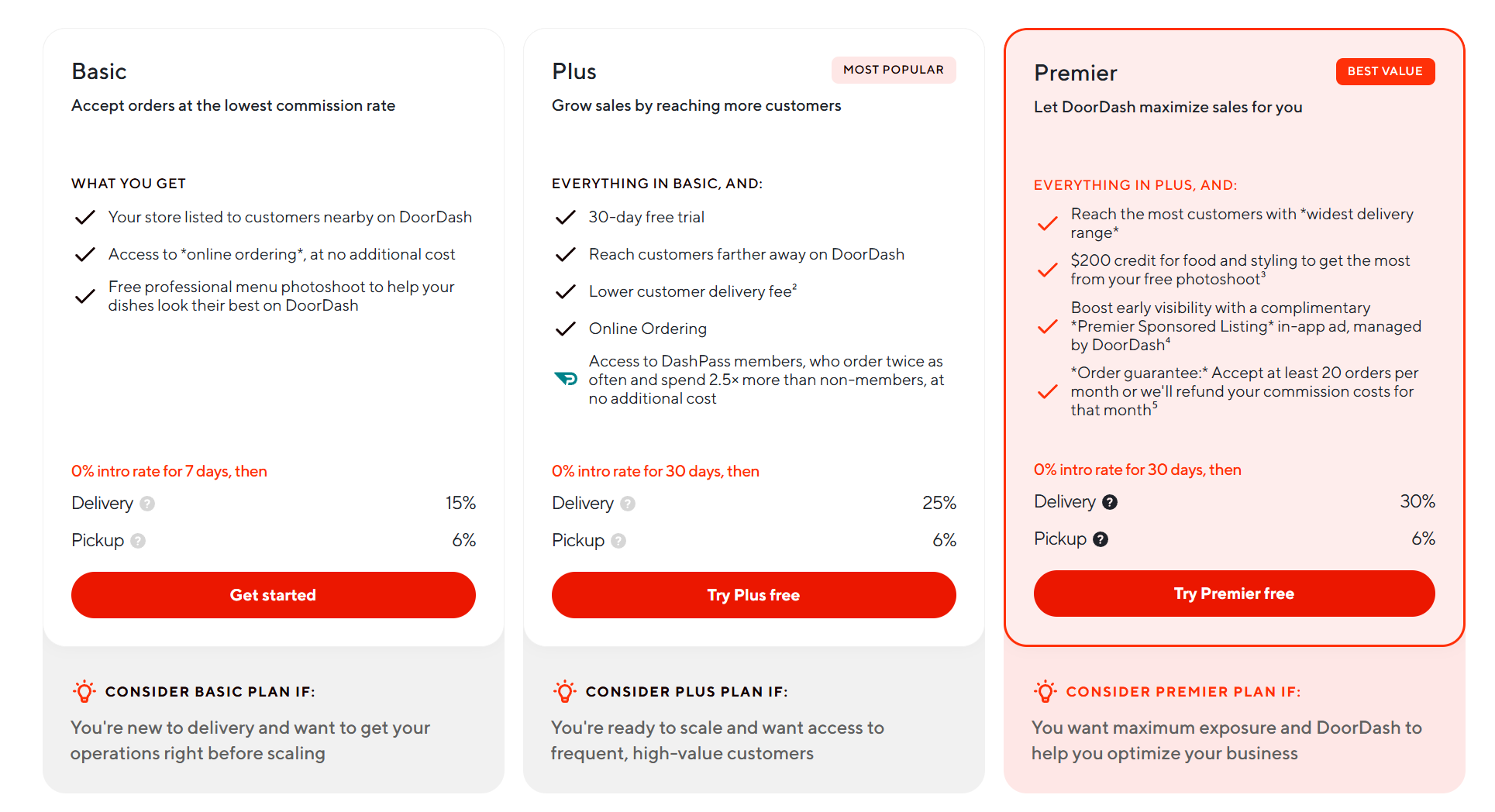
On the merchant side, US restaurants choose between three Partnership Plans: Basic at a 15% delivery commission, Plus at 25%, and Premier at 30%, with the higher tiers buying a larger delivery radius, DashPass eligibility, and lower consumer fees. Pickup orders are 6% across all plans.
On the consumer side, there’s a dynamic delivery fee though DashPass and promotions waive a large share of them outright, a service fee of 15% of the subtotal with a $3 floor and a $14.99 cap, and small-order and city-specific regulatory fees where applicable. DashPass, launched in 2018 at $9.99/month, waives delivery fees and reduces service fees on eligible orders, and functions basically like Amazon Prime: it converts your marginal ordering decision into a sunk cost and meaningfully lifts order frequency in the process. And then there is the margin lever: advertising. Merchants and CPG brands pay for sponsored placement inside DoorDash; DoorDash Ads crossed a $1 Billion annualized run rate in 2024 with more than 150,000 advertisers across 30+ countries.
Before we get to how the pie is split, let’s start with what the consumer actually pays. A few months ago, some students from Columbia Business School pitched DoorDash as a long at the 19th Annual Pershing Square Challenge in 2026. It’s an informative deck even if you disagree with some conclusions. They had a very useful and helpful breakdown of all the fees consumers pay for a $20 meal which I have shown below. So a $20 meal has ~8% menu markup that takes the subtotal to ~$21.63, the service fee adds $3.26, the average paid delivery fee adds just $0.54, tax adds ~$1.62, and you land at ~$27.50 before tipping. That’s ~$7.50, or ~37% above the menu price. Add a customary ~$4 tip and the all-in cost of not leaving your couch is about $31.50, roughly $10 more, or ~45-50%, than picking up the same meal yourself. To be clear, as I will discuss later, the popularity of services such as DoorDash may not be good a proxy for laziness among its customers since for many customers, DoorDash is mere necessity. I mean it might be good proxy for laziness, but I just don’t have compelling evidence to claim that.
Perhaps it speaks to my upbringing, but so many times I had opened either DoorDash or Uber Eats to want to order something if I need a quick bite and almost recoil after realizing that even though I thought it was just a $20 meal, the final bill may be ~40-50% higher which admittedly tend to paralyze me to complete the order. I honestly cannot remember the last time I ordered a delivery even though I do use DoorDash every once in a while. I just drive to pick up my food from the restaurant.
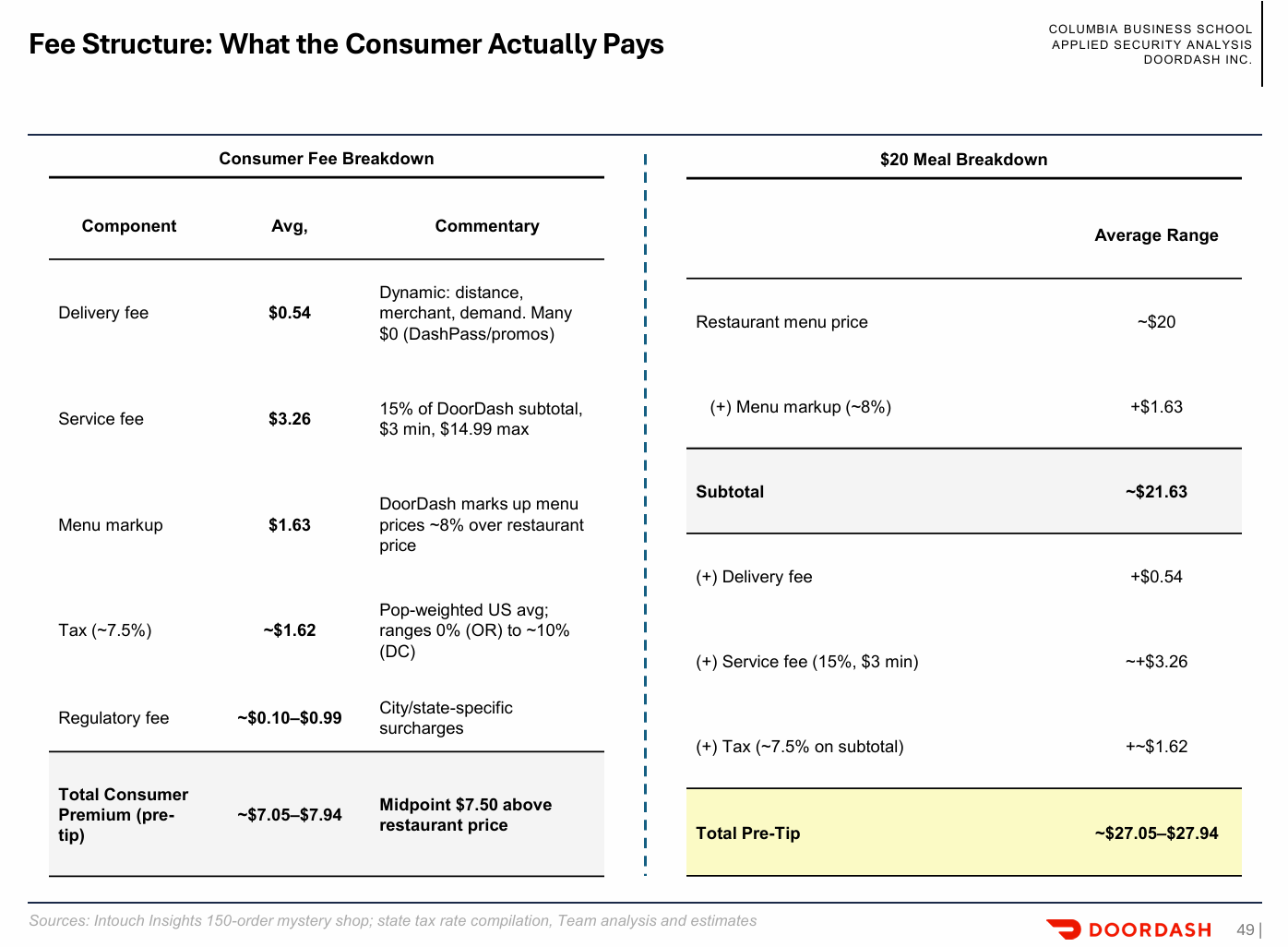
It is, however, quite interesting to look at who is charging what. The single biggest line in the consumer premium after the service fee is the menu markup, which merchants largely set themselves to claw back a chunk of the commission. On a 25% Plus-plan commission, an ~8% markup recovers roughly a third of it, meaning the true incidence of DoorDash’s take rate is effectively shared between merchant margin and consumer wallet.
Now let’s flip the lens from the consumer’s wallet to DoorDash’s P&L. DoorDash doesn’t disclose a per-order P&L, but we can easily reconstruct one.
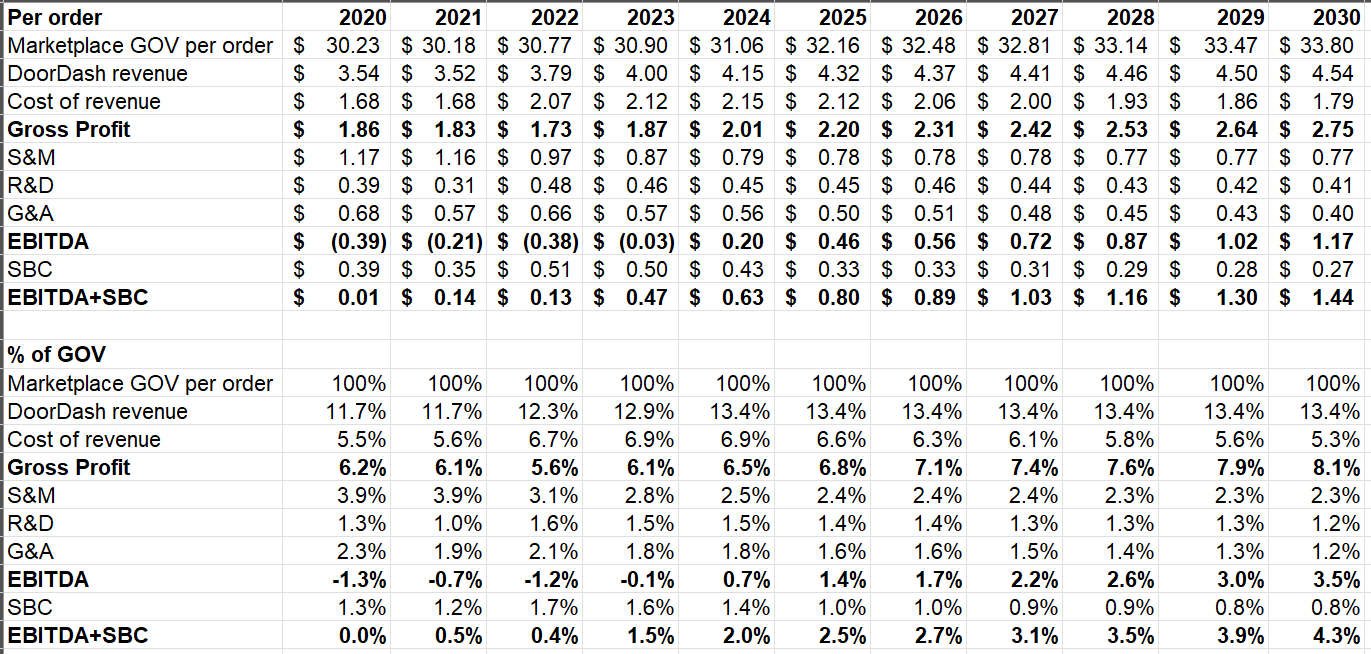
The thing I want to focus on this table is how thin the residual is relative to the gross dollars sloshing through the system. If DoorDash touches $100 i.e. marketplace GOV, only ~$13 is theirs to spend and out of that ~$13 they still have to pay for support agents, payment processing, insurance, refunds beyond promotions, engineers, and marketing. After doing all of that, the average $32 order in 2025 led to only 46 cents of EBITDA per order for DoorDash (without ignoring SBC)! You can be annoyed at your expensive delivery bill, but DoorDash isn’t skimming enough for anyone to be angry at them.
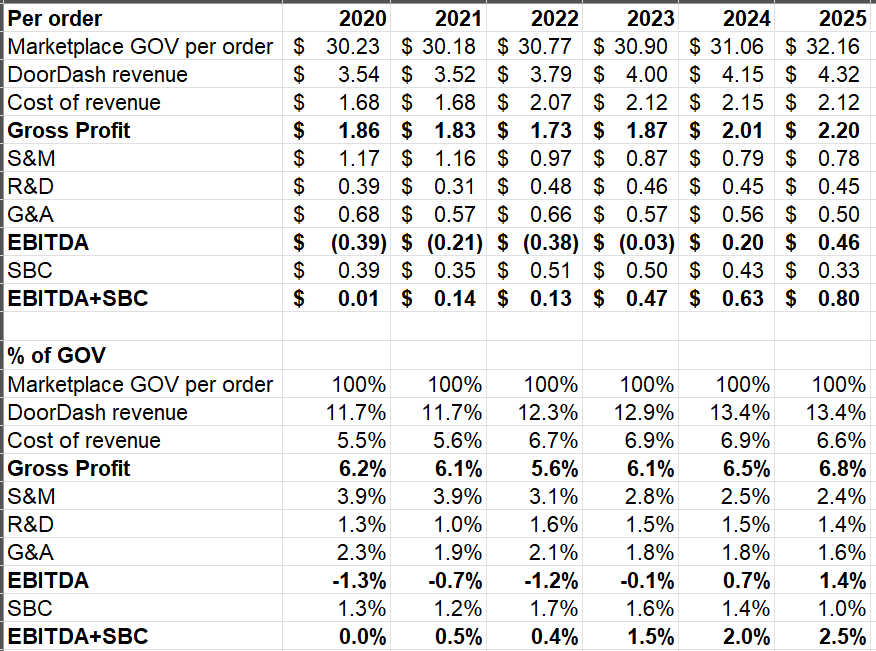
After thirteen years, more than $100 Billion of GOV, and market leadership in the US, DoorDash earns less than 50 cents per order! Of course, the slope matters far more than the level here; that number was negative 38 cents per order as recently as 2022, and adjusted for the ~$1 Billion of SBC (shouldn’t ignore for overall true economics, but just making an observation on per order cash economics) and growing ad mix, the underlying cash economics per order are meaningfully better and inflecting. More importantly, this is what aggregator economics look like in a category with real-world atoms: the true leverage comes from multiplying a modest per-order profit by an order count that grew from 83 million to 3.2 billion in seven years. To say it differently, per order profit increased by ~50 cents in the last three years. If DoorDash can double the aggregate order count and increase per order profit by another 50 cents in the next five years, we may be looking at ~$7 Billion operating profit in 2030. So DoorDash doesn’t need to generate eyepopping profit per order to make it a very, very good business at scale. Even $1 operating profit per order can turn it into a very profitable business!
What moves the needle, in order of importance for DoorDash’s economics are: take rate (ads, fees, DashPass mix, refunds), Dasher cost per order (batching, network density, and perhaps eventually autonomy), and order frequency (which spreads fixed costs and acquisition spend over more transactions). Everything DoorDash does strategically perhaps maps to one of those three levers.
Let me spend some time on these economic levers.
DashPass first. At $96/year (also available at other intervals and different price points in different countries), the membership waives delivery fees and cuts service fees on eligible orders, and its strategic function is identical to Amazon Prime’s: it front-loads the cost of convenience so that every subsequent order feels “free,” which is fuel for frequency. However, given the waived delivery fees, on a per order basis, DashPass orders are actually margin-dilutive even though they are very much accretive to gross profit dollars due to higher frequency/engagement. From DoorDash management:
“As we drive increased mix of DashPass orders, I'll remind folks that with our DashPass orders, we have lower unit revenue but significantly higher engagement as a result of which that's a trade-off we're happy to make.” (2Q’21 call)
“…The ROI is strong because profit dollar production is going to be high, largely because it’s very simple — subscribers retain more, they order more, which means that they produce more gross profit dollars.” (4Q’25 call)
Drive and the broader “Commerce Platform” (Drive, Online Ordering, Storefront, and now SevenRooms) basically white-label fulfillment. When you order directly from a chain’s own app and a Dasher shows up, merchants pay a flat per-order fee for DoorDash to fulfill demand merchants themselves generated. Given Drive orders are included in Total Orders but not in Marketplace GOV, the headline take rate (revenue/GOV) is slightly overstated as a “commission rate,” and AOV computed as GOV/orders is slightly understated. Strategically, Drive is DoorDash’s hedge against its own disintermediation: if a merchant decides to fight the marketplace and push customers to order direct, DoorDash monetizes that too thanks to this service, just at a lower rate. Of course, white label orders economics are not as great as marketplace orders are, but it ensures that if the marketplace is disintermediated (easier said than done), DoorDash may still have an active role to play in the world of fulfillment.
Finally, advertising is the highest-margin revenue stream. The mechanics are the standard retail-media playbook: restaurants buy sponsored listings and promotions to jump the queue in an increasingly crowded feed; CPG brands buy placement against grocery and convenience baskets; and it all rides on closed-loop attribution (the ad and the purchase happen in the same app, so attribution is pretty clear). From a standing start in 2021, DoorDash Ads crossed a $1 Billion annualized run rate in 2024. Advertising was cited as a key driver of net revenue margin expansion in every quarter of 2025, so my guess is it may have reached around $1.5 Billion revenue run rate by 2025.
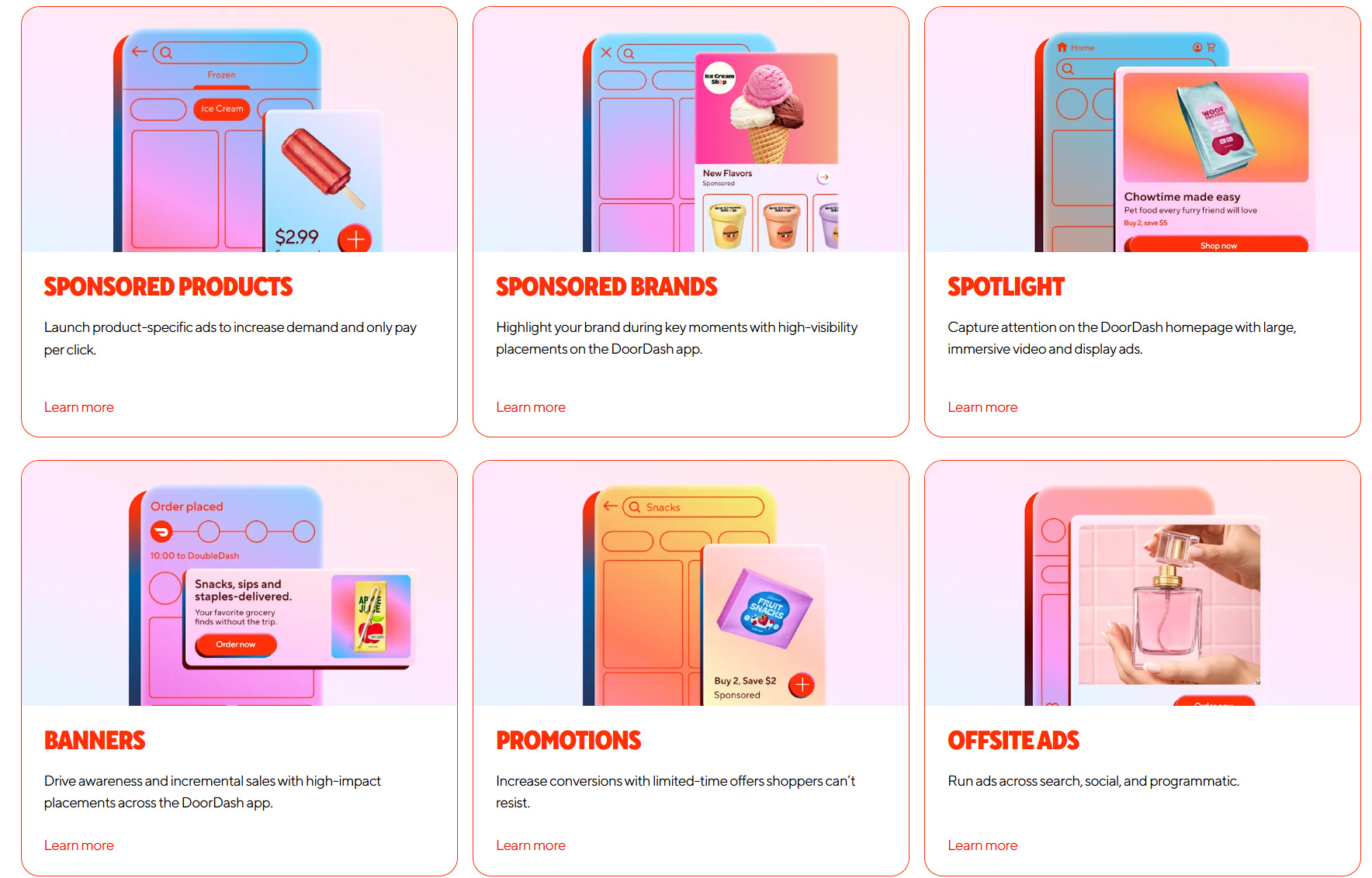
For context, Uber’s CEO Dara Khosrowshahi noted in 2025 that advertising revenue was growing "over 50%" and exceeding $1 billion in annual revenue run rate for Uber as well. By Q4 2025, advertising penetration in Delivery was confirmed to have exceeded Uber's prior 2% of Delivery bookings target, with management highlighting significant further runway from enterprise customers and new verticals. From Uber’s 4Q’25 call:
“we had, many years ago, talked about 2% as the potential ceiling for, penetration with delivery advertising. What we are seeing is that, the opportunity size here is potentially much larger. And, as we think through where, where we are on the journey with enterprises versus SMBs, SMB ad penetration is a lot higher than 2%, and enterprise year-on-year growth is now outpacing SMBs by a lot more. So, in a way, enterprise advertising is catching, playing catch-up, and that, that means there's gonna be a lot of runway here.”
Given DoorDash’s $102 Billion GOV last year, their ad penetration is highly likely to be well below 2%. So if Uber is operating at 2% ad penetration and still growing rapidly while sensing 2% is no ceiling at all, you can sense that the runway for DoorDash in ads may be quite substantial…unless they face the “DoorDash problem”. More on that later.
Following Wolt and Deliveroo acquisitions, international markets now make it a quarter or so of the DoorDash’s GOV. The economics presumably resemble the earlier phase of the typical journey: lower take rates, lower frequency, sub-scale ads but improving fast. The playbook is explicitly the US one run again: selection, quality, affordability, membership, then ads. Even though DoorDash doesn’t really disclose such granular details, it is important to remember the overall metrics that we see in financials almost certainly understates DoorDash’s profitability in more mature, US restaurant segment.
Speaking of understated profitability, one of the other primary reasons for DoorDash’s understated profitability is their new verticals such as grocery delivery in the US. If the founding insight was that restaurants were the hardest, largest beachhead of local commerce, the last five years have been about cashing the second half of that check. DoorDash entered convenience in 2019-2020, launched DashMart which is its own network of micro-fulfillment “dark” convenience stores in August 2020, added grocery the same month, alcohol in 2021, and has since layered on pets, beauty, flowers, home improvement (Lowe’s), electronics, and general retail. Management buckets all of this as “new verticals,” and it has become one of the most important growth engines in the model.
Why grocery, specifically? Restaurants gave DoorDash frequency, but grocery is where much larger dollars reside. A customer who buys milk, snacks, napkins, and Tylenol from you weekly is structurally more retentive than one who orders Thai food twice a month, and every incremental use case makes the DashPass subscription harder to cancel. It’s perhaps the same philosophy for every incremental new verticals as well.
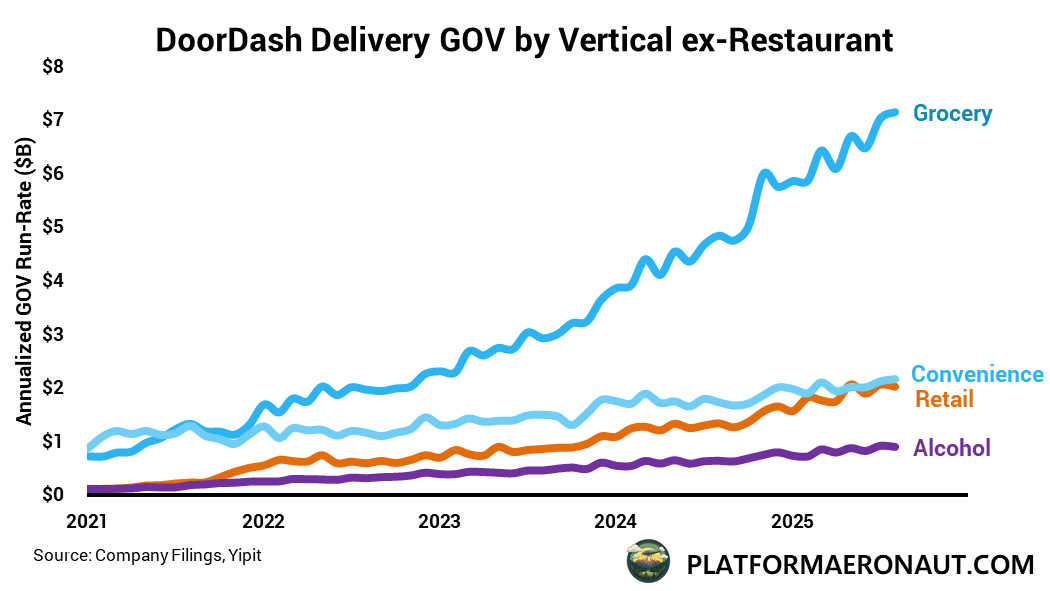
Unfortunately, DoorDash is yet to tell investors how much GOV comes from grocery. I find the opacity a bit annoying for a segment becoming more and more important to growth runway. The even more annoying thing is institutional investors perhaps do have a much better way to gauge/track the grocery adoption through third-party data, so it would be great if DoorDash at least intermittently discloses grocery GOV. In my Instacart Deep Dive last year, I mentioned some data around DoorDash grocery GOV based on 3P data. From my Instacart Deep Dive:
You can see how DoorDash can be a real concern for Instacart over time. DoorDash doesn’t disclose their Gross Order Value or GOV by vertical. However, Thomas Reiner from Altimeter recently shared some third-party data to breakdown DoorDash’s grocery GOV which shows DoorDash’s grocery annualized run-rate GOV increased from ~$1 Billion in 2021 to ~$7 Billion in 2025. For context, if this data is right, it means DoorDash’s grocery GOV increased from ~4% of Instacart’s GTV in 2021 to ~15-20% in 2025. As mentioned earlier, I do think there are some skillset required to efficiently perform grocery delivery, but it is not too difficult for shoppers to learn over time once they visit the grocery store a few times to become familiar with the store. Although these data are not publicly available, I am sure Instacart is likely faster today than DoorDash in grocery delivery, but will that remain the case in 5 years? In 10 years? I am inclined to say no.
Reiner also mentioned that consumers mostly still use DoorDash for smaller top-ups and not the $100+ weekly big basket where much of the profitability of the grocery delivery resides. Again, this may just be a function of time; as customers get habituated with a new use case within DoorDash, they may eventually use it for additional reasons, especially if/once they consolidate their local delivery purchases into one app.
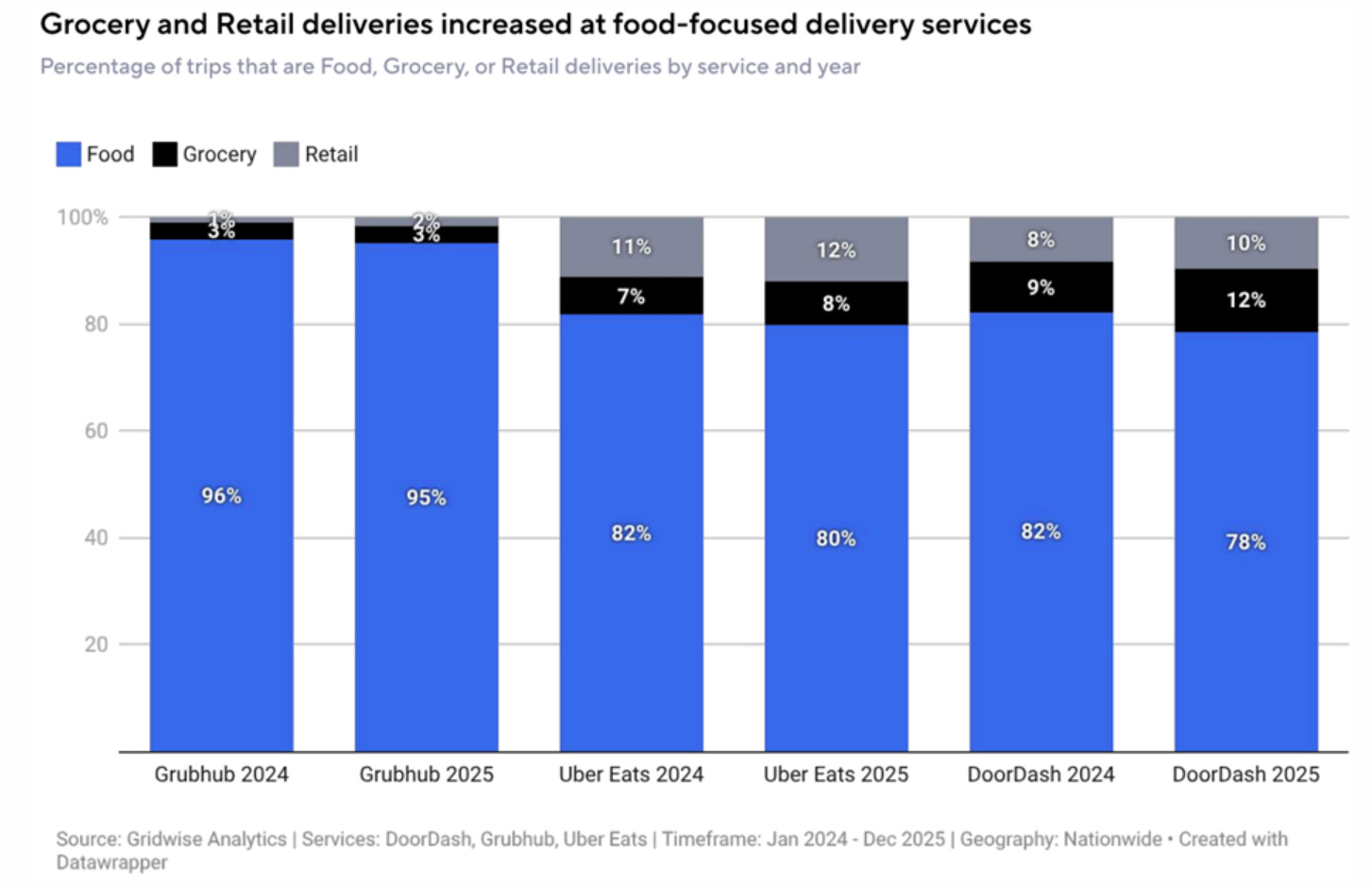
DoorDash did give some disclosures such as more than 25% of MAUs ordered groceries in Q1’25; ~30% of MAUs order from non-restaurant categories as of early 2026; new verticals GOV growing at roughly twice the pace of the core; and unit economics that are still negative but expected to turn gross-profit positive in the second half of 2026. DoorDash itself trumpeted Yipit’s data in February 2026, showing DoorDash became the #1 third-party marketplace in US grocery and retail order volume in 2025 (with the caveat that DoorDash also mentioned with an asterisk that YipitData’s analysis of third-party food delivery service providers only and is a small fraction of the overall industry.); and Food Institute data suggesting grocery/retail now accounts for ~22% of DoorDash’s deliveries, up from 17% in 2024.
Management has also flagged the next frontiers beyond grocery: “Going Out” (the SevenRooms acquisition brings reservations and in-store CRM), DoorDash for Business (catering and meal programs), and in-store rewards.
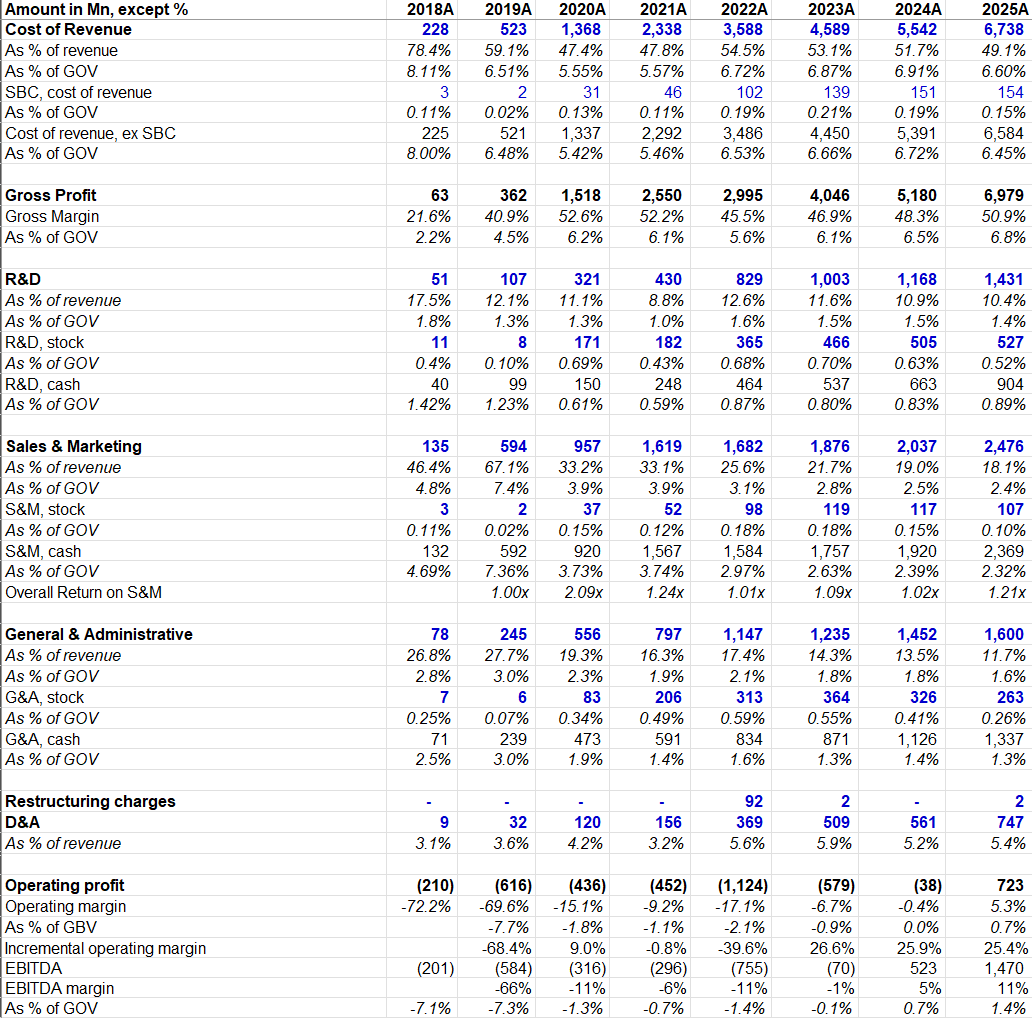
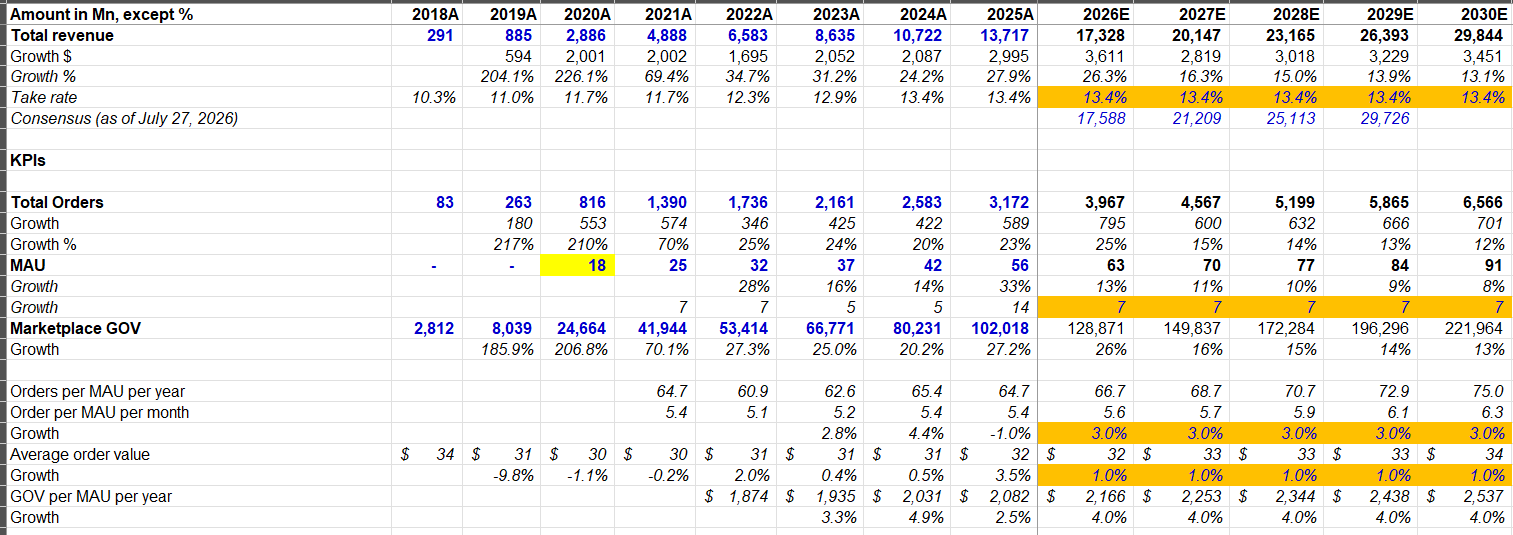
Let’s now look at what all of this produced financially. The table below is from my model:
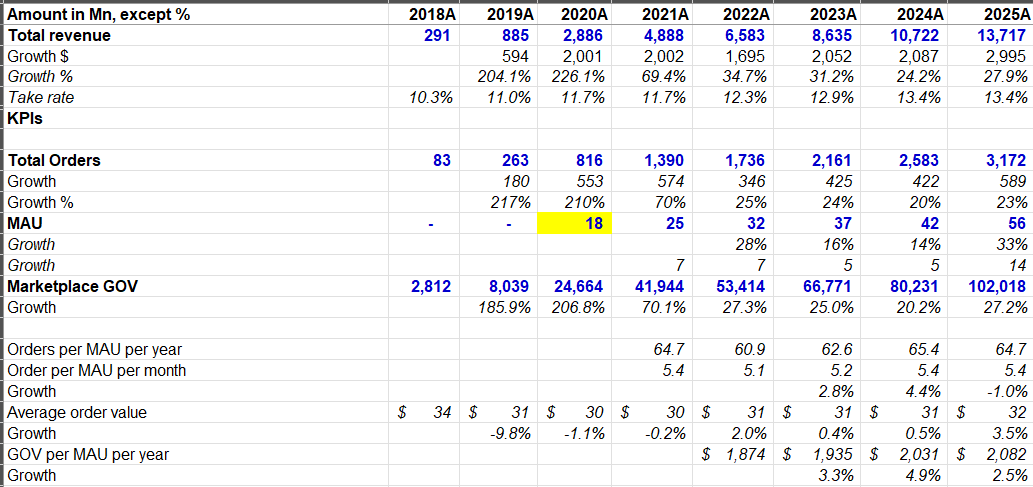
Since DoorDash made some acquisitions, some of these YoY numebrs are a bit distorted. Caviar (acquired from Square for $410 million in late 2019) was small acquisition, but Wolt was not. Wolt was announced in November 2021 as an ~$8.1 Billion all-stock deal (worth far less by the time it closed in mid-2022, given DASH stock had collapsed ~60%+ in between). Wolt was consolidated from June 2022. Then Deliveroo acquisition closed on October 2, 2025 for an equity value of £2.8 Billion, which is why 2025 shows MAU jumping 33% to 56 million and GOV growing 27%. Excluding Deliveroo, GOV grew 23% in 2025. Deliveroo also explains the slight dip in blended order frequency in FY25 and will continue to muddy comparisons through Q3’26 (Q1’26 revenue grew 33% reported vs. 21% ex-Deliveroo). SevenRooms ($1.15 Billion, closed 2025) adds software revenue with no GOV attached; its contribution is small today, but it can nudge the take rate optics up over time.
While these acquisitions distorted the clear comparability across the years, we can still gauge that DoorDash has multiple drivers for growth. Even if we exclude Wolt and Deliveroo MAUs, my guess is DoorDash MAU in 2025 was around 40 million which means MAU more than doubled since 2020. While monthly order frequency has been almost eerily stable at ~5.1-5.4 orders per MAU, I read that stability as a mix effect rather than stagnation. Every new cohort starts at lower frequency and matures upward, and DoorDash added a LOT of new cohorts (plus lower-frequency international users via Wolt), so flat blended frequency actually implies rising engagement within cohorts. Back in 4Q’21 shareholder letter, DoorDash shared how their cohort level GOV data improved over time:
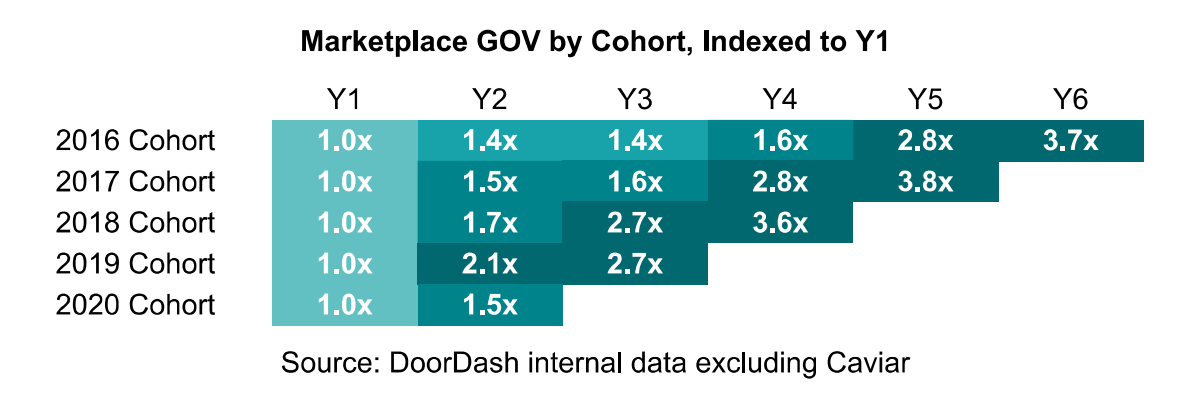
My guess is the data probably doesn’t look as good as it did back then; otherwise, they would keep publishing this cohort data. But the broader point about mix effect remains: newer cohort ramps up over time which is a headwind on reported order frequency even if older, mature cohort data is steadily improving. CFO Ravi Inukonda confirmed the trend on the 2Q’25 call: “[Mature] cohorts are engaging with us more, which means order frequency has continued to increase. So when you look at the underlying cohort performance, it’s very strong.”
I would also highlight the take rate’s noticeable lift from 10.3% in 2018 to 13.4% in 2025. The drivers are advertising (from zero in 2021 to a ~$1.5 Billion today), Dasher cost efficiency per order (batching and network density mean the same consumer dollar requires less Dasher payout), lower refunds/credits as quality improved, and DashPass membership fees. What’s remarkable is that this happened while lower-take-rate grocery grew as a share of the mix. Note the take rate plateaued at 13.4% in 2025 and actually dipped to 12.8% in Q1’26 which is primarily because of the Deliveroo consolidation.
Let’s take a closer look at DoorDash’s cost structure.
Since DoorDash reports revenue net of Dasher pay, the single largest cash outflow in the whole system i.e. what Dashers earn doesn’t show up in cost of revenue at all; it has already been netted out of the top line. What remains inside cost of revenue is the machinery of running the network i.e. order-management and support, platform hosting, payment processing, chargebacks and fraud, and of course, insurance. Insurance costs can be volatile (management has named it a swing factor in multiple quarters), but structurally far smaller than Uber Mobility’s because a Dasher’s coverage attaches to a personal car carrying burritos, not a commercial vehicle carrying humans.
On the numbers, cost of revenue fell from 78% of revenue in 2018 to ~49% in 2025, but a better denominator is GOV, where it went from ~8% to ~6.6%. The gross-margin arc falls out is really three phases.
Phase one (2018–2020): brute-force scale: margin ran from 22% to 53% as support, payments, and infrastructure per order collapsed over 10x the volume.
Phase two (2021–2022): the give-back, down ~700bps to 45.5% as Wolt consolidated at lower margins, the 2022 cost shock inflated insurance and Dasher-adjacent costs, and new verticals scaled with negative unit economics (a grocery order carries more picking labor, substitutions, and support contacts per dollar than a burrito).
Phase three (2023–2025): the grind back to 50.9%, with gross profit reaching an all-time-high 6.8% of GOV, powered by take-rate expansion, per-order logistics efficiency, falling refunds, and ads mixing in at exceptionally high margin.
Below gross profit, it’s not hard to see the operating leverage story. Sales & marketing went from ~7.4% of GOV in 2019 down to ~2.4% in 2025. The return-on-S&M line has climbed to 1.21x in 2025, up from ~1.0x in 2022, which is the quantitative fingerprint of a brand whose demand is increasingly organic. Please note that most consumer promotions are booked as contra-revenue, not S&M, so reported S&M understates true demand-generation spend since a slug of it hides inside the take rate. Since take rate also largely expanded over time, it does indicate DoorDash isn’t playing some funny game here. Gone are the days when your lunch delivery will be financed by DoorDash promotions.
Perhaps a bit surprisingly, R&D line item hasn’t exhibited as much operating leverage as S&M did. While S&M declined from 3.9% of GOV in 2021 to 2.4% in 2025, R&D went the other way increasing from 1.0% of GOV in 2021 to 1.4% in 2025. In some ways, the 2021 was more of an anomaly than baseline: a still-lean, restaurant-only engineering org measured against a COVID-inflated GOV denominator. The step-up that followed lines up almost exactly with Wolt consolidating in mid-2022. R&D doesn’t scale with order volume the way S&M leverage does with a maturing brand; R&D essentially scales with the surface area of what you’re building and DoorDash spent these years widening that surface on three fronts at once. M&A bolted on whole engineering organizations and, more expensively, redundant tech stacks: a single new feature has to be built three times, once each for DoorDash, Wolt, and Deliveroo. New verticals weren’t “more restaurants” rather grocery, convenience, and retail each of which demanded net-new platform builds (item-level catalogs, inventory integrations, substitutions logic, pick-and-pack tooling like DashMart Fulfillment Services and SmartScale) instead of reusing the restaurant stack. And because the acquired international GOV monetizes at a lower take rate, the same engineering dollar simply looks heavier against a GOV base that now skews toward lower-yielding geographies.
The more important point is that flat-to-rising R&D intensity here is a deliberate reinvestment. Some of that spend is the classical ML that grinds Dasher cost per order and defect rates lower; but a growing slice is forward option value that scales with ambition rather than current volume: agentic commerce and, above all, the capital-intensive autonomy program (the Dot robot and the Autonomous Delivery Platform). We should see some operating leverage in the future though as they are not going to launch grocery shaped bet every year. Moreover, the global re-platforming meant to collapse three codebases into one by ~2027 which should let R&D dollars go further going forward. Management guides R&D plus G&A toward ~2% of GOV over the medium term. In the medium to long term, both R&D and G&A should exhibit material operating leverage.
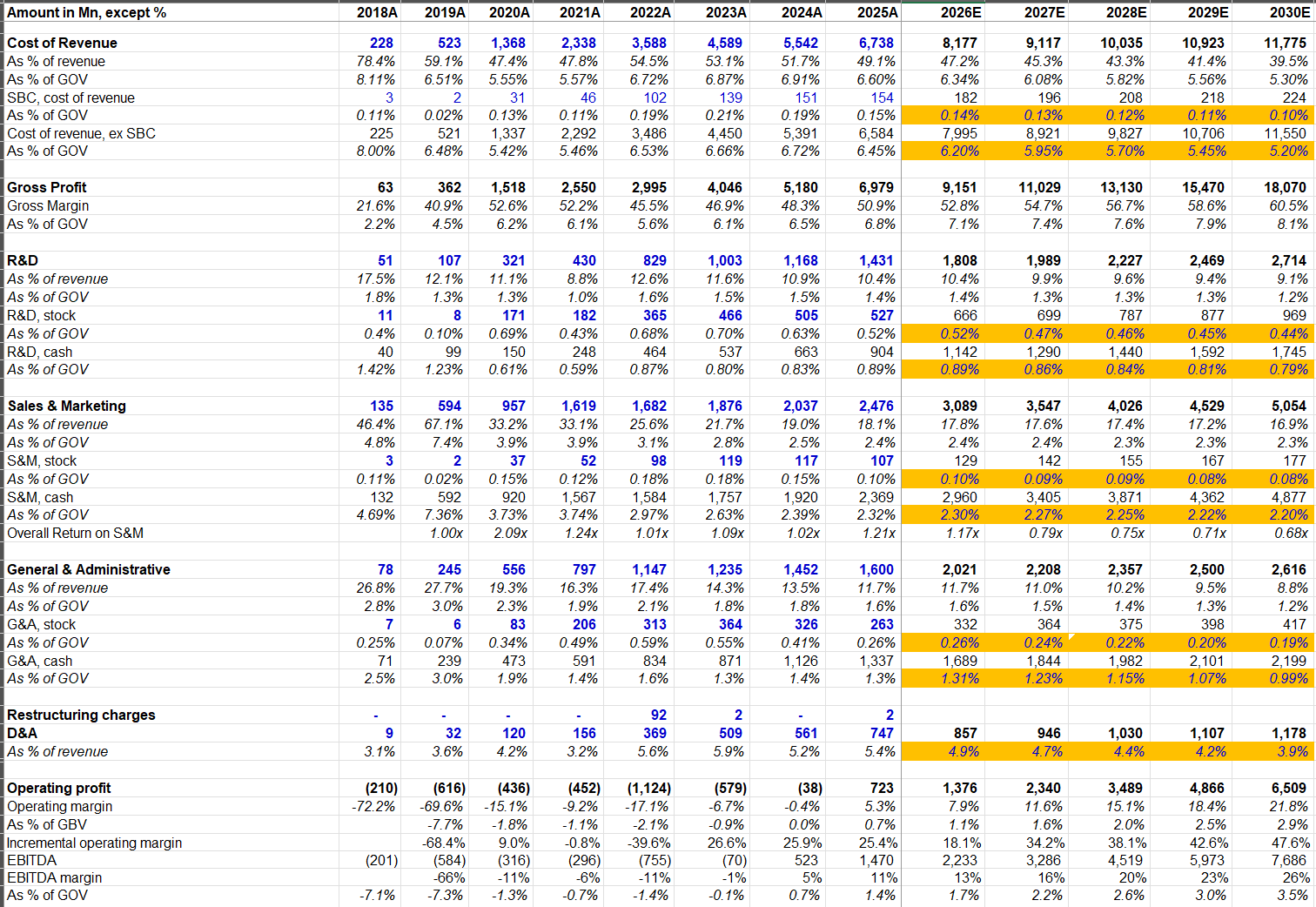
Overall, DoorDash’s operating profit went from a $1.1 Billion loss in 2022 to a $723M profit in 2025, an incremental operating margin of ~25% on each new revenue dollar over three years. The true incremental margin in just their original core US restaurant business is perhaps already materially higher than 25% which may be a better proxy for their long-term economics as well.
Competitive Dynamics, and Key Questions
The bear case on DoorDash has an intuitive appeal. Paying 30-40% more in fees and tips to avoid a ten-minute drive may prove to be pretty discretionary line item in the American household budget, and that habit may die in the first quarter of a recession. Indeed, that’s what my gut felt while writing the Uber Deep Dive back in 2020. Admittedly, we don’t fully know; restaurant delivery at scale has simply never lived through a genuine US recession. In fact, restaurants as a category barely experienced any recession in the last six decades in the US. Tony Xu pointed out this in this podcast:
“…if you looked at the census data in America now, and this is also true in China, but if you looked in America, in the last 60 years, I think there’s only a couple of years where the number of restaurants in the current year didn’t exceed that in the previous year. Even though they are such difficult businesses because of our love for food, for socializing, being with each other and what a meal represents and how it can connect different people, it continues to grow. In fact, it’s the number one type of establishment that malls and a lot of shopping centers want the most of.”
If restaurants barely experienced any recession, food delivery obviously didn’t either. 2020 was a demand bonanza for the category, and the economy has grown every year since. So the question of how food delivery may actually fare during recession has to be answered with the imperfect natural experiments we do have.
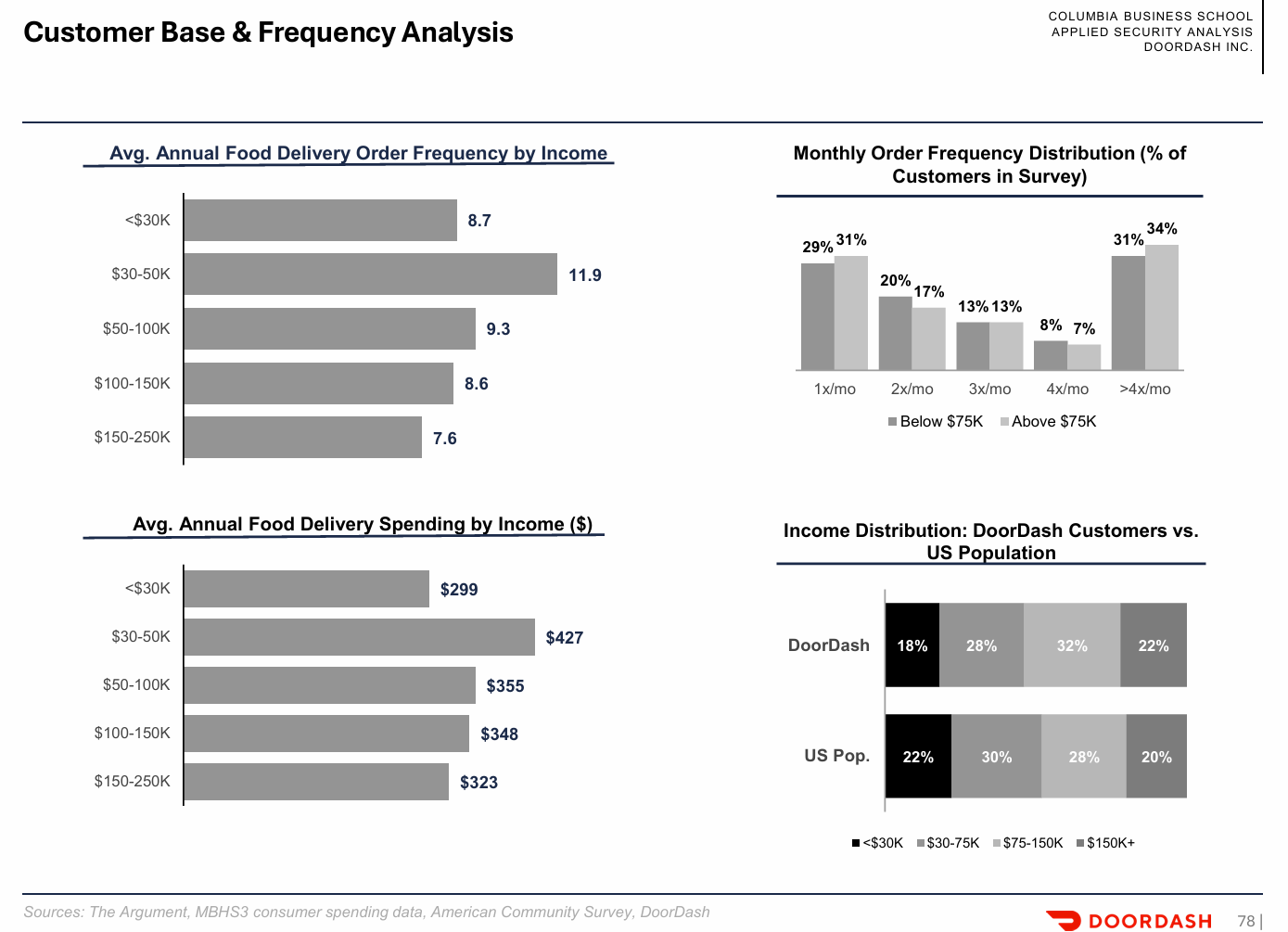
2022 was perhaps closest we could get to such experiment. The 2022 inflation shock is when US consumer sentiment hit multi-decade lows, gas hit $5, and food-away-from-home inflation ran hot. DoorDash’s US revenue growth held at 20%+ in every single quarter of 2022-23, and in what was arguably the worst macro quarter of the stretch off a COVID comp, no less. Perhaps one of the counterintuitive findings that I have noticed in that CBS students’ DoorDash pitch is that the average annual food delivery order frequency is actually highest in the $30-50k income bracket. If you are a low income household with multiple jobs that takes a lot of physical energy, I can totally understand why you may not have the time or energy to cook at home. This is why I was hesitant to label the popularity of DoorDash as a mere proxy for indolence. Data such as these are perhaps indicative of the fact that food delivery is still utilized as more of a necessity than convenience in the US by a good chunk of the population. To the extent the average household in the US can form a habit of ordering food delivery online and see it as more of a convenient alternative to cooking food at home, we are far away from such potential terminal state. An average MAU orders DoorDash ~5 times per month today, but it actually overstates the order frequency. For example, MBI household rarely orders food and over the last 12 months, we may have ordered food 3-4x on DoorDash (and ~2-3x on UberEats). So, dividing total orders by MAU may overstate the order frequency per MAU today. In the very long term, if food delivery indeed graduates to “habit” formation stage for the average MAU, can the order frequency per MAU per month eventually be ~10x per month? That doesn’t strike as too crazy to me over the course of a decade or so. Of course, in 10 years, DoorDash may not be synonymous with food delivery either as they encroach into grocery, and broader retail fulfillment over time. So, dreaming 8-10x order frequency per MAU per month in 10 years may indeed be in the realm of possibility.
There’s also bit of a countercyclical hedge on the cost side in a recession as Dasher labor supply rises and gas prices typically fall, both of which lower delivery costs when demand may get tested.
While we don’t have a good way to study how food delivery may fare during soft macro environment in the US, perhaps Europe 2022-23 may give us better hints. There, the cost-of-living crisis did bite: Deliveroo cut its 2022 Gross Transaction Value (GTV) growth guidance from an initial 15-25% down to 4-8%, Just Eat Takeaway’s orders shrank outright, and the entire European cohort spent two years restructuring. So the category clearly isn’t immune. My synthesis of the transatlantic divergence is that European platforms were hit by a sharper real-income shock (energy), had shallower suburban penetration, thinner selection, weaker membership programs, and, perhaps more importantly, were simultaneously pulling back marketing to hit profitability targets, which converted a demand slowdown into collapsing growth.
There’s also a structural argument for why the category may behave less cyclically than intuition suggests. Food spending itself is a staple; what’s discretionary is the format. In a downturn, the $200 restaurant dinner for four is the first thing to go and a $60 delivery order is perhaps, in fact, one of the places that spending trades down to. Delivery sits in the middle of a substitution ladder, if you assume the ladder as something like fine dining to casual dining to delivery/takeout to groceries. Food delivery may actually take share from above in bad times and from below in good times, making it more secular than most people may intuitively think. On top of that, add the membership effect i.e. a sunk $9.99/month that psychologically converts fees from per-order pain into a bundle you want to “get your money’s worth” from, and the sheer habit formation of 5+ orders per month tens of millions of MAU have already built.
Overall, I think DoorDash is procyclical at the margin but far less than investors assumed in 2022, with the true tail risk being not a demand collapse but a mix-down (smaller baskets, fewer fees absorbed, more promo intensity) that may compress the take rate for a few quarters. The economics will still be hurt of course, but it’s probably something the food delivery companies can absorb through.
So, food delivery may be a resilient business, but there is an even more fundamental question that people (including me) often wonder.
Does the marketplace actually benefit all three sides?
A three-sided network that systematically extracts from one side eventually invites regulation, defection, or both. DoorDash certainly invited its fair share of concerns from different stakeholders over time. Let’s take the sides one at a time.
Merchants first. The 15-30% commission on thin restaurant margins produced a backlash cycle in 2020-21. There were emergency fee caps in dozens of cities (some made permanent), lawsuits, and a torrent of “delivery apps are killing restaurants” think pieces. And some of the early behavior deserved the criticism; the definitive piece of that era is Ranjan Roy’s “Doordash and Pizza Arbitrage”, in which a pizzeria owner discovered DoorDash had listed his restaurant without consent and was selling his $24 pizza for $16 as a “demand test,” whereupon he profitably ordered his own pizzas through the app. It remains one of the funniest indictments of blitzscaled unit economics you may ever come across. But the more rigorous evidence, now that the category has matured, is much more favorable than the past discourse.
A Management Science study of restaurants that joined on-demand platforms found that, on the whole, restaurants benefit: platform delivery increased total takeout sales rather than merely cannibalizing the restaurant’s own channels, and even created positive spillovers to dine-in visits with the important caveat that effects are heterogeneous (independents and chains, takeout-heavy and dine-in-heavy restaurants experience it differently). And when it comes to research on the fee caps themselves, I came across this interesting paper that had some surprising findings. From the paper (emphasis mine):
Our empirical analyses show that independent restaurants in regulated cities (i.e., those paying reduced commission fees) experience a decline in orders and revenue (Figure 1), whereas chain restaurants (i.e., those paying the original fees) see an increase in orders and revenue (Figure 2). Net profit for independent restaurants also declines, which suggests that reduced commission fees do not compensate for the loss in orders. This intriguing finding suggests that chain restaurants, not independent restaurants, benefit from the regulations that were intended to support independent restaurants.
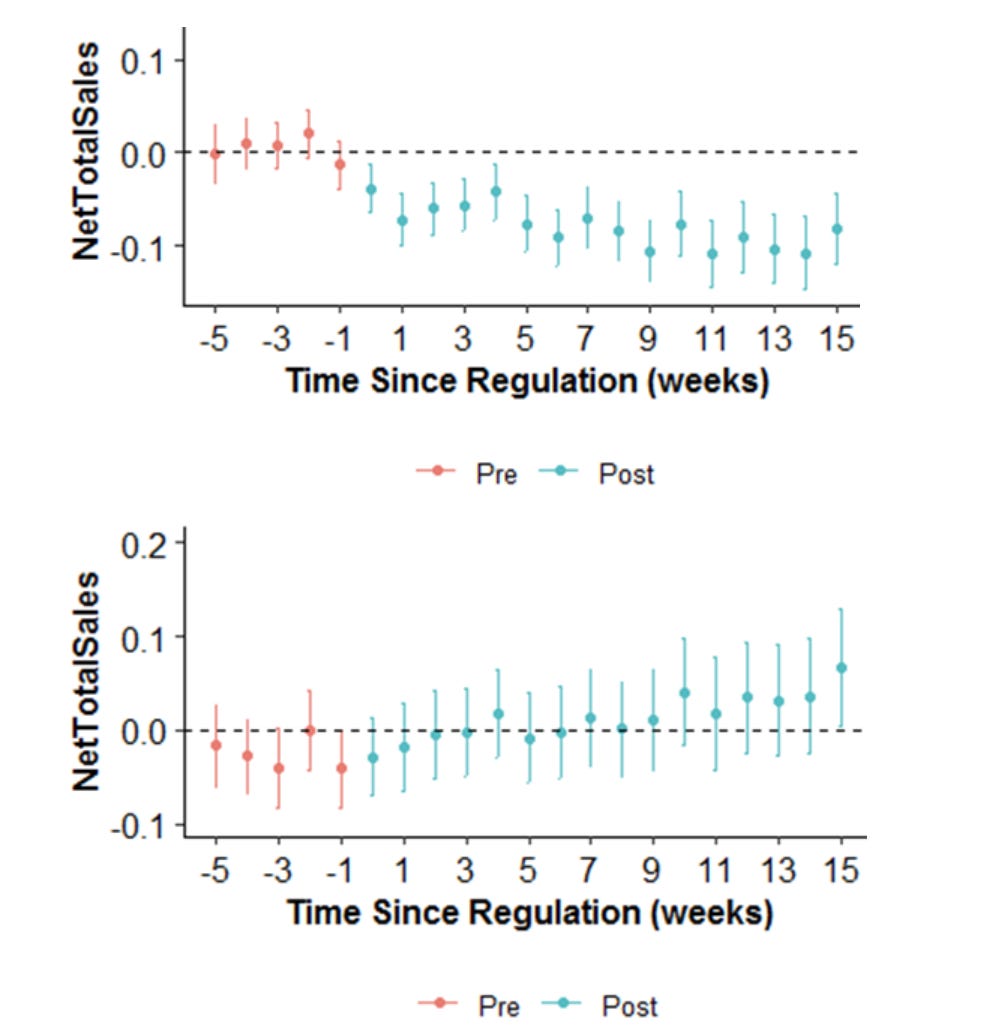
What explains such a phenomenon? Again, from the paper:
“First, delivery platforms can tweak the recommendation algorithms to promote chains and restaurants just outside a city’s limits, where they can collect their rates in full. After cities enact commission fee caps, delivery platforms become less likely to recommend independent restaurants to consumers, and instead turn to promote chain restaurants. Second, delivery platforms increase their delivery fees for consumers in regulated cities, suggesting that these platforms attempt to cover the loss of commission revenue by charging customers more.
As you can imagine, once you aggregate the demand, you really have an asymmetric bargaining power against any of your stakeholders, especially if they are deeply fragmented. The regulators, who often lack the understanding of the true source of aggregators’ power, are more likely to create unintended consequences for the very group they’re trying to “help”.
The Dasher side also has similar vibes. You have all heard about the gig-work critiques: no benefits, no wage floor etc. But the empirical literature keeps landing on the same inconvenient finding: workers value the flexibility enormously. The canonical paper, Chen, Chevalier, Rossi, and Oehlsen in the Journal of Political Economy, estimated using Uber’s own hourly data that drivers earn more than twice the surplus under flexible arrangements than they would in equivalent inflexible jobs and would cut their hours supplied by over two-thirds if forced into fixed shifts at prevailing wages. Whatever one thinks of gig work’s place in the labor market, ~8 million+ people chose to Dash in 2025 and earned $18 Billion+ doing it, overwhelmingly as a part-time top-up (most Dashers work only a few hours a week). Nonetheless, regulators and politicians don’t have to be rational as long as something has popular support. Someone like you or me who will never have to live the reality of a gig worker may want to support the seemingly “good” policy of gig workers being classified as employees. If that’s the case, who knows perhaps even bad policies can become reality even if it actually does more harm than good for the very people it is trying to help.
The consumer side is the easiest: nobody is forced to pay for convenience, ~56 million people a month volunteer to, and the revealed-preference verdict of frequency rising even as the 2021-22 fee discourse peaked is a good indication how consumers are voting with their wallet. The caveat is fee opacity; the stack of service fee, delivery fee, regulatory fee, and expanded-range fee is certainly hard to parse at checkout, and I’d argue the biggest consumer-trust risk for the category is the gap between the advertised menu price and the final all-in cost. I mean everyone loves to complain about cleaning fees on Airbnb which eventually forced Airbnb to show “total price”. If food delivery shows the full cost of the delivery at first, there might be real sticker shock to some consumers. It’s hard to imagine DoorDash will be forced to do so though. DashPass is partly an elegant solution to this and partly a way to make the comparison harder.
On net, while nothing is quite black and white, food delivery does seem to be more positive sum than many might think. Eric Seufert also pointed some other ancillary, less talked about value provided by food delivery marketplaces:
“Delivery apps are pro-consumer: they increase competition and expand consumer choice by giving smaller restaurants access to shared logistics infrastructure that otherwise only large chains could build. That’s obvious.
A less obvious observation is that they also pool customer acquisition. Restaurants still have to market themselves, but Uber Eats and DoorDash concentrate consumer demand within a small number of discovery surfaces.
Concentrating small businesses' marketing efforts within a small number of channels yields a material benefit: the ability to reach net-new customers without investing in a sprawling and often prohibitively expensive stack of advertising tools.
In this way, delivery apps pool both logistics and demand, making each far more accessible than it would otherwise be.”
Okay, food delivery marketplaces may be net positive for the stakeholders, but one question I wondered why/how DoorDash ended up being the dominant player instead of the incumbents in this space.
When DoorDash was founded, Grubhub-Seamless was already a decade old, profitable, dominant in America’s biggest delivery markets, and months away from a successful IPO. Grubhub was, by every 2014 metric, the obvious winner. Its arc since is one of the great strategic collapses in consumer internet: Just Eat Takeaway bought it for $7.3 Billion in 2021 and sold it to Wonder for $650 million in late 2024, a ~91% haircut in three years.
What happened?
Grubhub was a pureplay marketplace. It didn’t have any control over the logistics. Its original model listed restaurants that already had their own delivery drivers and clipped a commission for demand generation; beautiful economics if you can endure it (it was consistently profitable pre-2018), but it structurally capped the supply side to the ~10% of restaurants that could self-deliver, i.e., pizza and Chinese. DoorDash’s full-stack model i.e. they bring the “fleet” meant any restaurant could be on the menu, and in the suburbs that meant the difference between 30 options and 300. Xu has consistently said selection is the #1 driver of consumer choice in this category.
Grubhub’s fortress was “Manhattan” type areas, but DoorDash went where Grubhub wasn’t and it turned out that the suburbs, with bigger family baskets, easier logistics, and zero incumbents, were indeed the better market. By the time Grubhub noticed, DoorDash had already built the density.
Perhaps just as importantly, Grubhub optimized for reported profitability during exactly the years (2016-2019) when the game was being decided, while DoorDash, armed with SoftBank’s $535 million funding in 2018, spent every dollar of contribution profit on customer, dasher, and restaurant acquisition as well as on the quality of the product. DashPass, also launched in 2018, was the category’s first real membership program, and Grubhub didn’t have a credible response. Once a household’s delivery habit is annuitized inside a subscription, the switching question changes from “which app has this restaurant?” to “why would I pay fees somewhere else?” and the fight was essentially over.
Grubhub’s management actually dismissed money-losing delivery economics as irrational right up until its diners defected. It was a textbook innovator’s-dilemma sequence: the profitable incumbent couldn’t bring itself to torch its P&L to defend share, and the insurgent with worse reported numbers but better unit economics compounded straight past it.
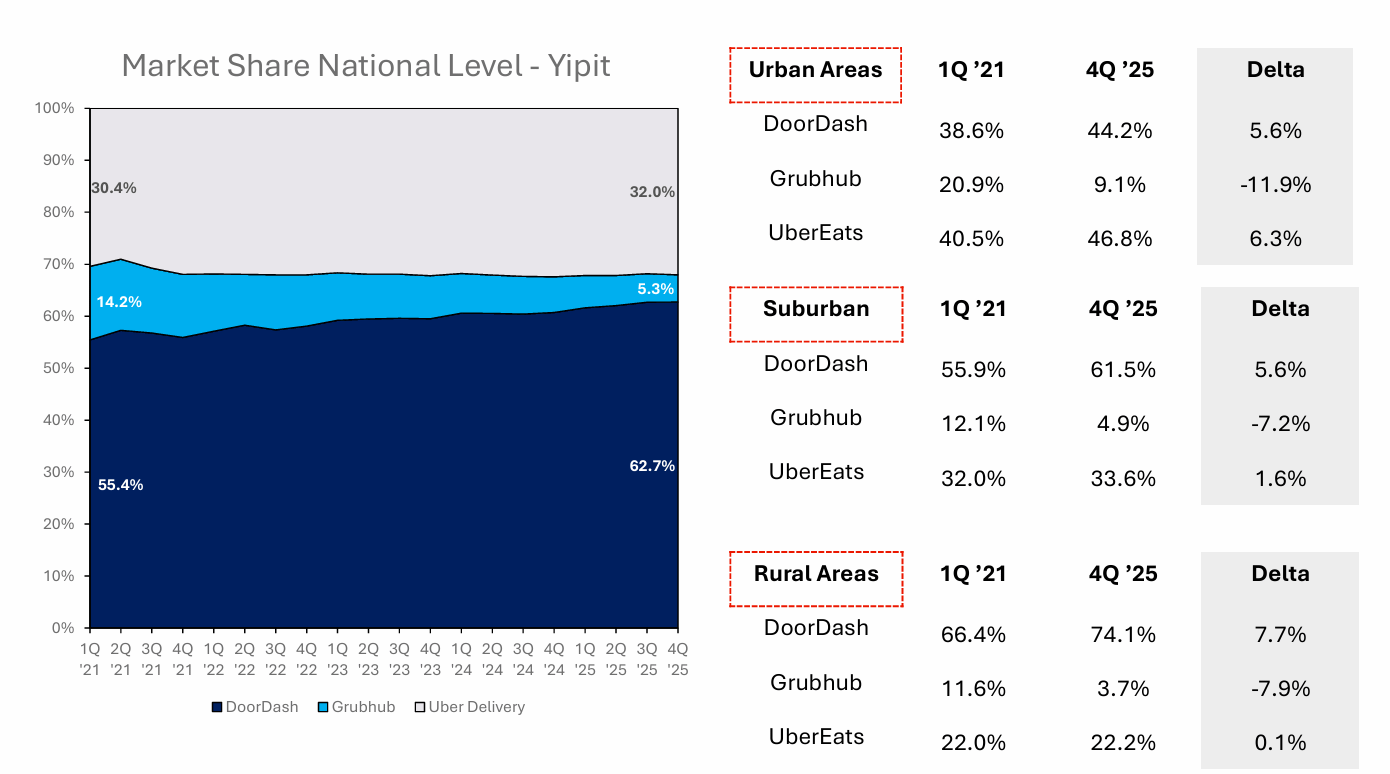
YipitData’s panel (via the aforementioned CBS deck) tells a pretty vivid story of DoorDash’s growing dominance in food delivery market in the US. While DoorDash gained share in urban, suburban, and rural areas, Grubhub melted pretty much in all regions. UberEats, however, is by far the most credible and competent competitor to DoorDash and unlike Grubhub, UberEats also has been gaining share in the US food delivery market. In fact, it raises a more pertinent question: is Uber a real threat to DoorDash?
The Uber question
Uber is the more interesting competitive puzzle, because on paper Uber should have crushed DoorDash. It had (and has) everything that should matter: a global brand, hundreds of millions of users, an existing driver network to cross-utilize between rides and food, an order-of-magnitude larger balance sheet in the formative years, and the ultimate bundling weapon in “Uber One”. And yet in the US, Uber Eats hasn’t been outpacing DoorDash in share gains, even after swallowing Postmates for $2.65 Billion in 2020. The geographic data (see above) shows where each company holds ground: as of 4Q’25 DoorDash commands 74% of rural markets and ~62% of the suburbs, while the dense urban cores are the most hotly competed area: 44% DoorDash vs 47% Uber Eats, and notably the only geography where Uber has actually gained meaningful share since 2021.
Part of it is the same suburbs-and-selection story. Uber Eats was launched from Uber’s ride-hailing strongholds i.e. dense urban cores while DoorDash locked up the suburban majority of the country and the national chains. Part of it is focus. Through the decisive 2015-2020 window, Eats was one division inside a company fighting simultaneous wars in rideshare, freight, autonomous vehicles, and a dozen international markets . And part of it is that the supposed synergy was smaller than advertised: a driver network tuned for moving people isn’t automatically great at restaurant pickup flows, and cross-selling a rides customer into food turns out to be much easier in markets where you’re the market leader already (which Uber is in much of the world, just not in the US). Indeed, despite DoorDash dominating in the US, it was actually a smaller player globally relative to Uber Eats until DoorDash’s acquisition of Wolt in 2Q’22. Then the Deliveroo acquisition in 4Q’25 made the comparisons more favorable for DoorDash. However, there are also some other nuances. The definition of Gross Bookings is not exactly the same as Uber exclude tips whereas DoorDash includes it.

Nonetheless, the broad conclusion is pretty clear. Uber is a beast in international markets and DoorDash is the clear laggard there. Lewistown Capital had a good discussion on the competitive dynamics between DoorDash and Uber Eats in the international market. From their piece:
“internationally Uber Eats is DoorDash (i.e. Uber Eats is the dominant provider in many of the largest non-US markets). This dynamic is only further enhanced by Uber’s acquisition of Delivery Hero. See below my highly unofficial (i.e. pieced together through various one-off datapoints) table of the leading food delivery players by geo.
As we can see, Uber Eats leads in Japan, the UK, France, Canada, Australia, Mexico, Turkey and Taiwan. By way of the Delivery Hero deal, Uber Eats also now leads in South Korea, Saudi Arabia, Argentina, Egypt, the UAE and more. Amongst the major, non-US markets, in fact, DoorDash only leads in Italy, and only by way of its recent acquisition of Deliveroo.”
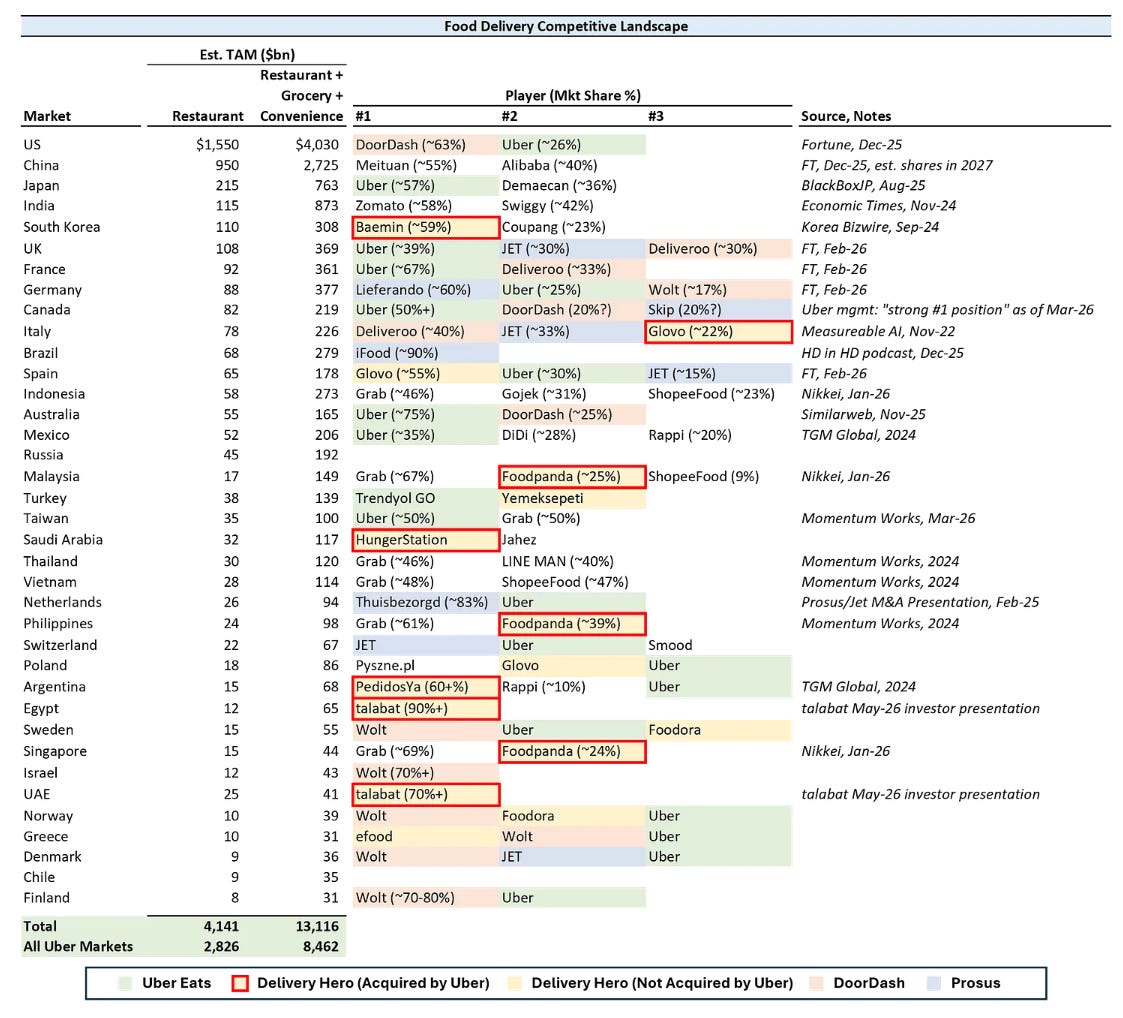
So, while Uber is a very, very credible and competent competitor to DoorDash, it’s also worth appreciating what the endgame is likely to be: a rational duopoly. As the third player gets reduced to a rounding error in most markets, DoorDash and Uber Eats may no longer need to torch capital stealing each other’s customers with 40%-off coupons. In fact, with Wolt, Deliveroo acquisitions by DoorDash and this month’s Delivery Hero acquisition offer by Uber, it is increasingly clear that they are also the most natural buyers of more regional/local players. Both players now run positive and expanding unit economics, and both have pivoted the fight to higher ground: membership, grocery, ads, and autonomy. One negative thing about Uber (or positive for DoorDash) is they may get distracted a bit from the size of the delivery opportunity as they’re amidst a much more urgent battle in their mobility segment as the AV threat is much closer to home there. The threat of AV is very much a current thing for Uber and market (and perhaps management too) is likely to pin the company in the near term depending on how that narrative evolves. Nonetheless, I expect both DoorDash and Uber to operate more rationally across different markets and focus on profitable growth.
Beyond Uber, there is another set of competition DoorDash faces in their new verticals, especially grocery.
The grocery wars: DoorDash vs. Amazon, Walmart, and Instacart
In grocery, instead of being the incumbent DoorDash is the insurgent walking into the territory of the three scariest names in American retail. Walmart is the largest grocer in the country, reaching ~95% of US households with sub-3-hour delivery while owning its inventory, pricing, and stores. Amazon has Prime, Whole Foods, Amazon Fresh, and is expanding same-day perishables aggressively with a $9.99/month unlimited grocery delivery subscription bolted onto Prime. Instacart was the category creator for third-party grocery, still leads in large-basket weekly shops, and has spent years embedding enterprise software (Carrot) inside the grocers themselves. Against that lineup, why do I give DoorDash a real chance?
DoorDash owns the highest-frequency consumer behavior in local commerce: food which is ordered ~5+ times a month per MAU. So, grocery for DoorDash is a cross-sell into an app people already open weekly, at near-zero acquisition cost. DoorDash management mentioned during 1Q’26 call that one of every two consumers new to grocery delivery industry now enters through DoorDash. Moreover, the wedge is different. DoorDash isn’t yet fighting for the $100+ planned weekly stock-up where Walmart’s price and Instacart’s pick-quality win. Rather, DoorDash is winning the $35 “we’re out of milk, diapers, and dinner ingredients” top-up trip, where speed and the existing Dasher network are the moat and where incumbents’ economics work poorly. Convenience-need grocery is a different job than pantry-loading. More importantly, the pitch to grocers is incrementality plus optionality: a regional grocer terrified of Walmart gets access to 56 million consumers, ad tools, and now DashMart Fulfillment Services infrastructure. Grocery market isn’t going to be a monopoly or duopoly ever in the US, so anyone not named Walmart and Amazon would like to partner with a neutral third party such as Instacart or DoorDash to get their foothold in grocery delivery.
To be clear, DoorDash’s grocery unit economics are still negative; management guides to gross-profit-positive only in H2’26. Grocery is a brutally unforgiving operational category: item-level inventory accuracy, substitutions, cold chain, and pick labor are problems Instacart has spent 13 years on and Walmart solves by owning the store. A Dasher shopping an unfamiliar aisle will, on average, pick worse than a dedicated Instacart shopper or a Walmart employee, and out-of-stock disappointment is the kind of defect that can kill nascent habits. DoorDash’s answers e.g. retailer inventory integrations, DashMart’s owned inventory, SmartScale-style verification, and increasingly in-store tech via Dash Fulfillment Services are credible but expensive. Nonetheless, given the size of opportunity and relative fragmented nature of grocery market, I think the upfront investment makes sense. Every grocery/retail MAU deepens DashPass, fattens the ads business with CPG budgets (the same budgets that built Instacart’s high-margin ads engine), and raises the platform’s overall frequency.
Given the grocery wars is more of a live debate, I will follow this topic closely. So, expect MBI Deep Dives to track this topic in future coverage.
Speaking of live debate, AI definitely fits that description.
AI: opportunity, threat, or both?
If AI agents become the front door to commerce, does DoorDash get commoditized into a fulfillment API? Let me steelman the threat before I push back on it. The aggregator’s power comes from owning demand. If consumers migrate their intent upstream to ChatGPT, Gemini, or an OS-level assistant, then in theory the agent aggregates the demand, plays the delivery networks off against each other on price, and most dangerously, vaporizes the discovery real estate on which DoorDash’s beautiful, exceptionally high-margin, ~$1.5 Billion advertising business is built. The OS version of this threat is even sharper: Apple and Google sit between the consumer and every app, and an OS-level Siri/Gemini that completes food orders natively could tax or intercept the transaction the way the App Store taxed mobile gaming. Notice that the ads business, the single biggest driver of the take-rate expansion, is precisely the piece agents would disintermediate first.
Tony Xu was asked about this disintermediation risk during 4Q’25 call and he offered some historical lessons:
“…actually Google launched called Google Food Ordering, which they launched in, I believe it was like 2016 or something like this, where they offered the ability for restaurants to offer delivery directly through Google Maps and other Google services. And look, they drove a ton of traffic, multiple-fold traffic of what DoorDash could generate to these restaurants. But when you look at the retention and the frequency of use of that channel versus companies like DoorDash, it really was a fraction of what DoorDash could provide. Why is that? Well, because after a checkout, things can happen in the physical world. For example, a driver might be late or an item might be missing or some substitution on a spoiled carton of milk needs to be made or not the exact brand of whatever produce that a customer was looking for needs to be changed.
So the end-to-end job at the end of the day, I think, is how customers will ultimately judge where they do their shopping. And at the end of the day, wherever the customers keep going back to, that’s where the audiences will flow. And where the audiences flow, so will the advertiser budgets as well as the interests along that dimension. And so when I put all this into perspective, the historical context into where I look at DoorDash today, I think DoorDash is really well positioned because we’re actually solving the end-to-end job for a customer, which is to get them some item brought to them in the condition they expect on time, every time. That’s actually really hard to do. You’ve got to map the physical world, all of which that information does not exist anywhere on the internet. That’s data that DoorDash has to collect in a proprietary way.
You have to actually be excellent at the execution of the operations. You have to be excellent at collecting all the metadata as well for all of these different items as well as the personalization you can perform if you actually have all of the customers and all of the customer information. And I think when you put it all together, we’re going to be the best place to solve the end-to-end job for customers. And so long as we are that best place, we will also attract all of the audience and all of the advertiser dollars that comes from that audience. But look, I think with respect to how that informs our partnerships with some of these AI assistants, I view them as channel partners and we’ll see how much traffic they can drive in a very similar way to how companies like Facebook and Google did the same for DoorDash in the past.
Even more recently, ByteDance tried also their luck in food delivery and their experience is perhaps instructive about the moats of three-sided network such as food delivery marketplaces. From Foodtalks in 2025:
Douyin’s exploration of food delivery is actually a tortuous journey that began four years ago.
In July 2021, Douyin ambitiously launched the internal testing of “Xindong Takeout”, inviting more than 300 partner merchants in cities such as Beijing, Shanghai, and Guangzhou to participate in the pilot, trying to replicate the classic “traffic + delivery” model.
However, problems soon emerged. Due to its complete reliance on third-party transportation capacity such as Dada and Shansong, delivery timelines were difficult to control. “No riders to accept orders” or delivery delays occurred frequently, which became an obstacle to business development.
The deeper problem lies in the misalignment of user behavior. People open Douyin to watch videos and content for entertainment, rather than actively search and order food. This conflict in core scenarios doomed “Xindong Takeout” to be shut down at the end of the year.
Unwilling to give up, Douyin shifted gears in May 2022, launching “Group Buying and Delivery,” hoping to leverage the power of short videos and livestreams to sell deliverable packages and bridge the gap from “seeking customers” to “fulfillment.” Initially, it attracted chain giants like KFC and Pizza Hut, but amid the excitement, small and medium-sized businesses were deterred by the high barriers to entry for short video production and livestreaming operations.
Until November 2024, the original “group purchase and delivery” was upgraded to “free group purchase”. The newly launched “one product, two sales” model is more flexible - after buying a group purchase voucher, you can use it in the store within 60 days or choose to have it delivered to your home.
In June this year, Douyin tightened the entry threshold further, changing it to a targeted invitation method, which is only open to national chain brands and qualified high-quality merchants.
Much of the difficulties will remain true even in AI world. An LLM can compose the perfect order, but it cannot make the burrito arrive hot, and the party that consistently delivers the outcome is the party the consumer trusts, and pays. This is also visible in how the actual integrations are being structured: DoorDash shipped a grocery app inside ChatGPT in December 2025, but pointedly kept checkout on DoorDash and declined OpenAI’s Instant Checkout. DoorDash is happy to take the top-of-funnel distribution (900 million+ ChatGPT users), keep the customer relationship, the payment, and the data. OpenAI’s own Operator agent, notably, demoed by driving DoorDash’s website rather than around it. And DoorDash’s Symbiosys acquisition is perhaps their ads hedge: if discovery migrates off-platform, sell merchants the ability to buy demand across Google, Meta, and TikTok with DoorDash’s closed-loop attribution i.e., follow the funnel wherever it goes and clip it there instead.
Could the agent layer still hurt? Yes, in two specific ways. One: if agentic ordering meaningfully grows, price comparison across DoorDash/Uber gets frictionless, and the fee opacity that pads the take rate today becomes untenable since agents are the perfect fee-transparency machine. Two: exclusivity economics. If an OpenAI or Apple ever demands a revenue share for preferred placement, the “new Google” analogy gets uncomfortably literal (ask travel companies what TAC feels like). Never say never, but so far the execution from AI companies on some of these consumer use cases has been pretty poor and if anything, they all seem to be much more interested in getting into the enterprise bandwagon than dealing with finicky consumer behavior with long tail of challenges that come with it. As I have explained recently, even though ChatGPT captured everyone’s imagination through a consumer chatbot experience, it hasn’t quite lived up to people’s expectation in terms of executing on their consumer opportunity and for such execution, there appears to be some structural barriers:
The difference in momentum in consumer vs enterprise also makes sense when you think about who owns the failure. Inside a company, a failed tool call automatically turns into a ticket. Somebody’s job, be it an internal platform team, or the vendor’s forward-deployed engineers, is to convert that failure into a fix, and their salary or renewal revenue depends on the thing eventually working. What the Skift reporter did, prodding the model until it cooperated, is what enterprise integration engineers do all day because it’s their job. However, when the same connector fails for a consumer, nothing probably happens. No ticket gets filed and the failure never reaches anyone’s eval suite. The user probably just returns to Google, which sits one tap away and has worked reliably for the last couple of decades. As a result, AI’s failure inside an enterprise becomes raw material for the next sprint while the consumer’s failure evaporates without leaving a trace.
While AI risks are front and center today for marketplaces such as DoorDash, DoorDash does have AI-adjacent opportunity across a wide surface: Machine Learning (ML) can keep grinding Dasher cost per order and defect rates down (the decade-old DeepRed advantage), SmartScale-style tools reduce refunds, support automation cuts one of the biggest cost-of-revenue components, and autonomy (Dot, drones, sidewalk robots) orchestrated by the Autonomous Delivery Platform attacks the ~$5-7 of Dasher cost per order that is the largest single expense in serving the marketplace GOV. The Autonomous Delivery Platform exists precisely so that whichever form factor wins, the dispatch decision and the customer stays with DoorDash. If even a modest slice of deliveries shifts to vehicles that cost cents per mile in the long run, the affordability flywheel (lower fees to more frequency to more density to lower cost) will spin faster, and it’s DoorDash that decides which robot gets the job. From a pure moat perspective, I’d rather own the network that dispatches the robots than the robot maker hoping for a dispatch. Of course, it all depends on whether the robot manufacturing market is fragmented or more of a monopoly/duopoly situation with a potential pathway to aggregate demand. It’s perhaps too early to get worked up about this since there are too many things we don’t know yet, but it’s something I will certainly need to keep a close eye on while evaluating the evolution of DoorDash’s moat.
Capital Allocation and Management Incentives
The dominant use of capital so far has been M&A, with a very specific pattern: consolidate the global category at moments of distress, using whichever currency is cheapest. As mentioned earlier, Wolt was announced at the November 2021 top as an ~$8.1 Billion all-stock deal which appeared expensive optically, but paid in what turned out to be equally inflated DASH stock, so the effective price at the June 2022 close was only ~35% of the headline number after the drawdown. Deliveroo was the mirror image: ~£2.9 Billion in cash agreed in May 2025 for a UK/Europe/Middle East leader that had IPO’d at ~£7.6 Billion, i.e. bought for roughly a third of its 2021 sticker after European delivery spent three years in the penalty box. Both DoorDash and Uber are essentially playing the same game of converting their US profit engine into global scale and new toll booths and it wouldn’t surprise me if sellers become more willing to give up over time and just sell to DoorDash/Uber, creating a duopoly in most markets globally. I was particularly intrigued when David Senra shared an anecdote about why Wolt’s founder decided to sell to DoorDash in this podcast:
I was in Stockholm about a year and a half ago, and Daniel Ek was very kind to host me and a handful of European founders.
And one of the European founders that was sitting next to me and Daniel at dinner was somebody I had never met before, and it's Miki from Wolt. But he told me something interesting because, basically the story was, he's just like, "Listen, I built the DoorDash of Europe," I guess is how Wolt was described.
And he's like, "I always thought of myself as an entrepreneur. I never thought I would work for anybody." And he's just like, "We were in a head-to-head battle," right? And he's like, "I had a term sheet in front of me." If I remember the number correctly, he was getting like a... He had the ability to raise a another fresh billion dollars of capital.
And he was looking at the term sheet, thinking about signing it, and then he said, involuntarily something came out of his mouth, and he says, "I can't beat him." He's like, "I can't beat him." And he's like, "I cannot believe that came out of my mouth." And then he looked down, he's like, "I can either light this money on fire, or I could sell my company for life-changing money and go work for Tony and learn a lot."
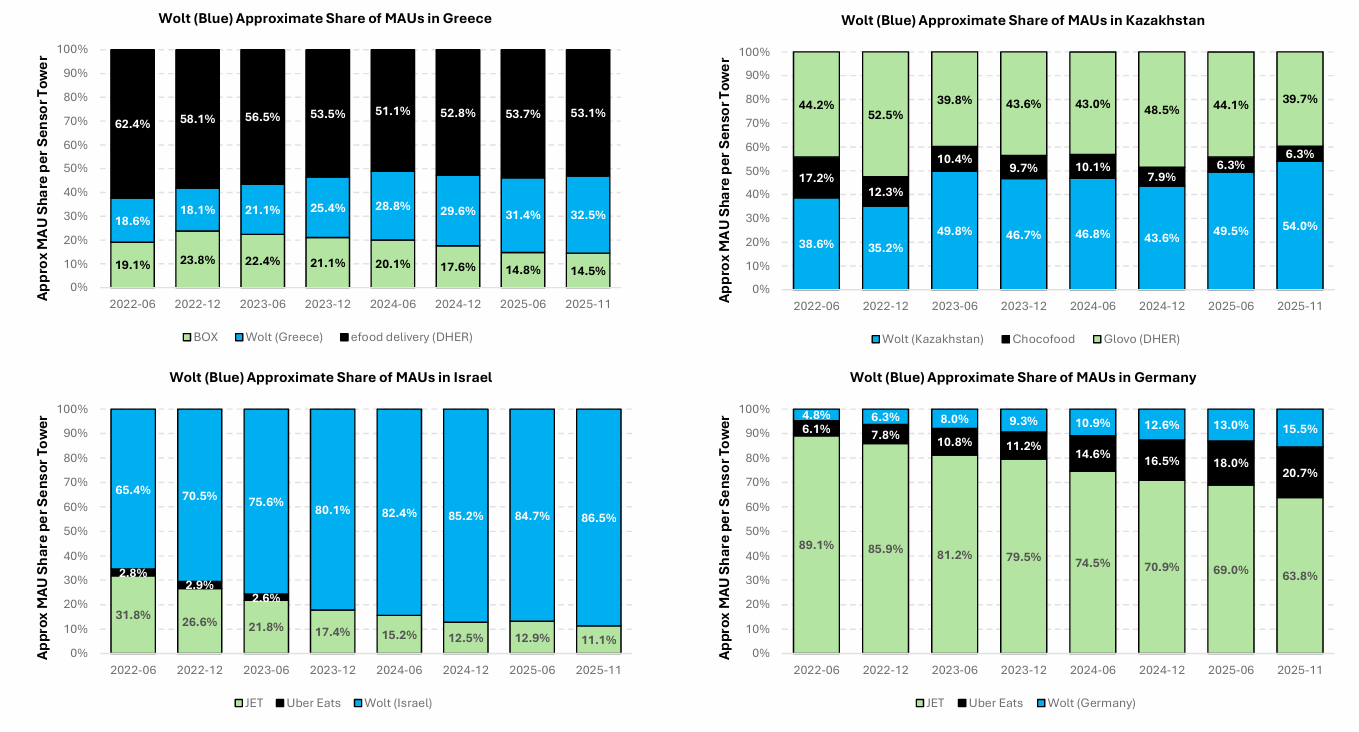
It does appear Wolt founder may have taken the right decision to sell the company to DoorDash instead of engaging in a long, arduous battle against companies who are willing to use the profit pool from another country to gain market share in another. Sensor Tower data (cited by the aforementioned CBS presentation) also shows Wolt has made further inroads in terms of market share since the acquisition in many of the countries they operate their business in. I wonder if such success of Wolt and recent acquisition spree of Delivery Hero and Deliveroo will make it more urgent for other sub-scaled regional players to also look for exit and sell themselves to Uber/DoorDash. So, I expect acquisitions remain a key source of capital allocation for DoorDash going forward.
Let’s talk about management incentives now.
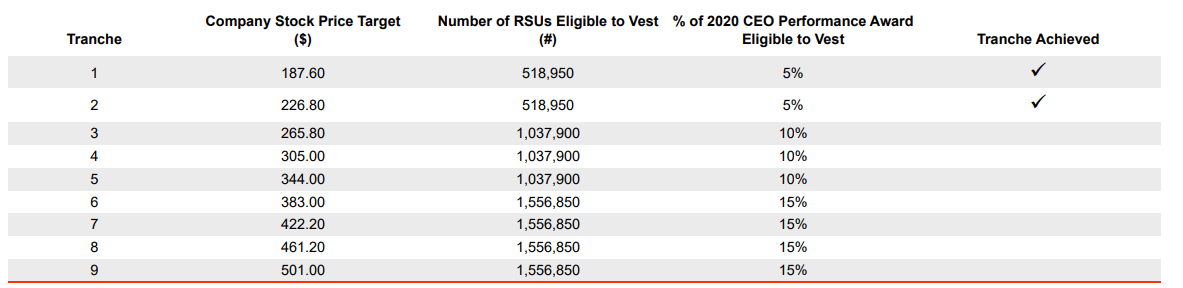
Tony Xu draws a ~$300K salary, no bonus, and since 2020 essentially no new equity. Instead, his entire economic incentive is (a) his founder stake which is worth ~$2.1 Billion now and (b) the 2020 CEO Performance Award: 10.4 million RSUs across nine tranches that vest only if the stock sustains 180-day average prices from $187.60 up to $501.00, over a window running from mid-2022 to November 2027, with a two-year post-vest holding requirement. Per the 2026 proxy, the first two hurdles ($187.60 and $226.80) have been cleared, the next sits at $265.80, and full vesting requires stock price to hit ~$501 or almost ~3x the current price before the clock expires next year. When the stock collapsed more than 80% in 2022 and the award looked pretty hopeless, DoorDash’s board did not cancel and replace it with a conventional grant. Xu simply sat with zero incremental comp until performance recovered. That is what “at-risk” is supposed to mean, and I am glad to see that the DoorDash board seems to understand the spirit of it.
Another interesting thing is the proxy highlighted that since 2021, DoorDash hasn’t provided a cash bonus or other short-term incentive compensation to any Named Executive Officers (NEO). So, it’s just base salary and long-term equity incentive for the NEOs. However, all the NEOs except CEO receive just time-based RSUs. It would be great if these were PSUs instead of time-based RSUs and NEOs comp were tied to operational metrics such as marketplace GOV.
DoorDash also has dual class shareholding structure with Xu essentially having the last say here. After studying Xu’s journey and listening to half a dozen of his podcast appearances, I think Tony Xu may be one of the CEOs that I would be willing to partner for years, if not decade+. Building and operating a three-sided marketplace at a global scale is something that perhaps requires a very, very savvy operator and Xu fits the description very well. It does seem unlikely though that Xu’s equity tranches will exceed the stock price hurdle and the board will likely award him a new grant after it expires in 2027. While I cannot be certain, my hope is the next “CEO Award” will be just as challenging as the current one has proved to be.
Valuation and Model Assumptions
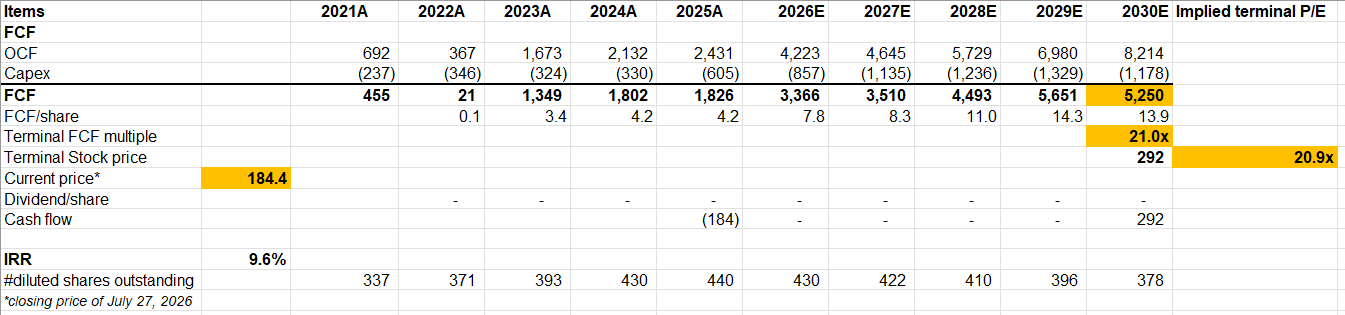
If you are reading my deep dive for the first time, I strongly encourage you to read my piece on “approach to valuation”. Please read it at least once so that you understand what I am trying to do here. I follow an “expectations investing” or reverse DCF approach as I try to figure out what I need to assume to generate a decent IRR from an investment which in this case to be ~10%. Then I glance through the model and ask myself how comfortable I am with these assumptions. As always, I encourage you to download the model and build your own narrative and forecast as you see fit to come to your own conclusion. None of us have the crystal ball to forecast 5-10 years down the line, but it’s always helpful to figure out what we need to assume to generate decent return.
You can download the DoorDash model below:
In my model, I assumed ~3% growth in order per MAU per month in the next 5 years. Average order value was assumed to grow at just ~1%; it’s less than inflation mostly due to mix shift to more international markets. With just 7 million incremental MAU in each of the next 5 years, DoorDash can maintain mid-teen organic GOV growth during 2027-30 period (please note that 2026 numbers carry the Deliveroo acquisition impact which closed in October 2025).
I didn’t assume any take rate expansion, especially given the risk of advertising being potentially under pressure if some percentage of GOV shifts to agentic orders. Maybe agentic order may never gain much adoption, but for now I didn’t want to assume noticeable take rate expansion through advertising amidst such uncertainty. I may update it later once we gain further clarity about AI’s disintermediation risks for marketplace such as DoorDash. You will notice that my revenue estimates are noticeably lower than consensus estimates which perhaps hints that buy-side consensus expectations are probably running lower than sell-side for out years.
As explained earlier in the Deep Dive, I expect much of the opex to enjoy operating leverage over time relative to GOV. Due to the acquisitions such as Wolt and Deliveroo as well new verticals such as grocery whose lack of profitability masks the recent years’ far more attractive profitability in the core restaurant segment in the US. I model low 20s GAAP operating margin in 2030, but it wouldn’t surprise me if the terminal GAAP EBIT margin proves to be ~30% or higher when you look at much higher incremental margins of 40%+. To be clear, I’m less married to projecting precise time when the company may start exhibit such operating leverage, and more interested in pointing out the reality of long-term economics. Perhaps tokenmaxxing may lead to temporary surge in R&D costs in 2026-27, but in a more longer timeframe, operating leverage should appear on financials.
Looking at DoorDash’s operating numbers in terms of per order makes it more clear the compelling economics of the business at scale. I have mentioned this math before, but let me reiterate the back-of-the envelope pitch for DoorDash. This company generated just 46 cents EBITDA (without ignoring SBC) last year per order. There is no compelling reason for much of their cost line items in their cost structure to increase over time on a per order basis. They might all prove to be “deflationary” on a per order basis. So, over time as operating leverage kicks in, just by generating only $1 profit per order DoorDash can post ~$7 Billion operating profit if their overall orders doubles in 5 years. Given the secular nature of food delivery industry and the twin engine of order growth (both frequency and MAU growth), doubling the order count over 5 years is indeed my base case.
Valuation: To get to ~10% IRR, I assumed ~21x exit FCF and earnings multiple (after taking SBC into account). Given that I think the marketplace should have plenty of headroom for double digit revenue growth beyond 2030 and potentially ~30%+ operating margin in the terminal state (vs ~22% in my model in 2030), I find such exit multiple to be pretty reasonable.
Final Words
You can perhaps make a compelling case why this is a bad time to be DoorDash shareholder. You can worry about oil price in the short-term and make legitimate long-term risks such as AI disintermediation risks at the OS layer. But presence of such legitimate risks are perhaps also why Mr. Market is underweighting the upside case: a market leader in a secular industry with attractive unit economics and increasingly rational global duopoly industry structure can compound their earnings power much longer than it is being priced in if the OS-layer operators come to the very likely conclusion that it is far harder to control a distribution layer that deals with three-sided marketplace.
I am, admittedly, quite intrigued by the upside case (my 2030 topline estimates are likely too low with comfortable headroom for higher terminal margin than is modeled in 2030). Hence, I decided to shift ~500 bps of my Airbnb position to DoorDash yesterday. I am open to make it a larger position over time if the situation demands it. For now, expect MBI Deep Dives to cover the food delivery industry much more closely going forward.