Meta 2Q'26: Not Amazing, Not Bad, and Still Compelling
2Q’26 wasn’t the quarter that propelled Meta out of the penalty box. While revenue came ahead of estimates, operating earnings fell short due to one-off expenses such as legal and severance related costs. I believe market was smart enough to see through that, so it’s the somewhat soft guide (relative to expectations) that likely led the investors sour a bit on the earnings. More on that later; let’s take a closer look into 2Q’26 first.
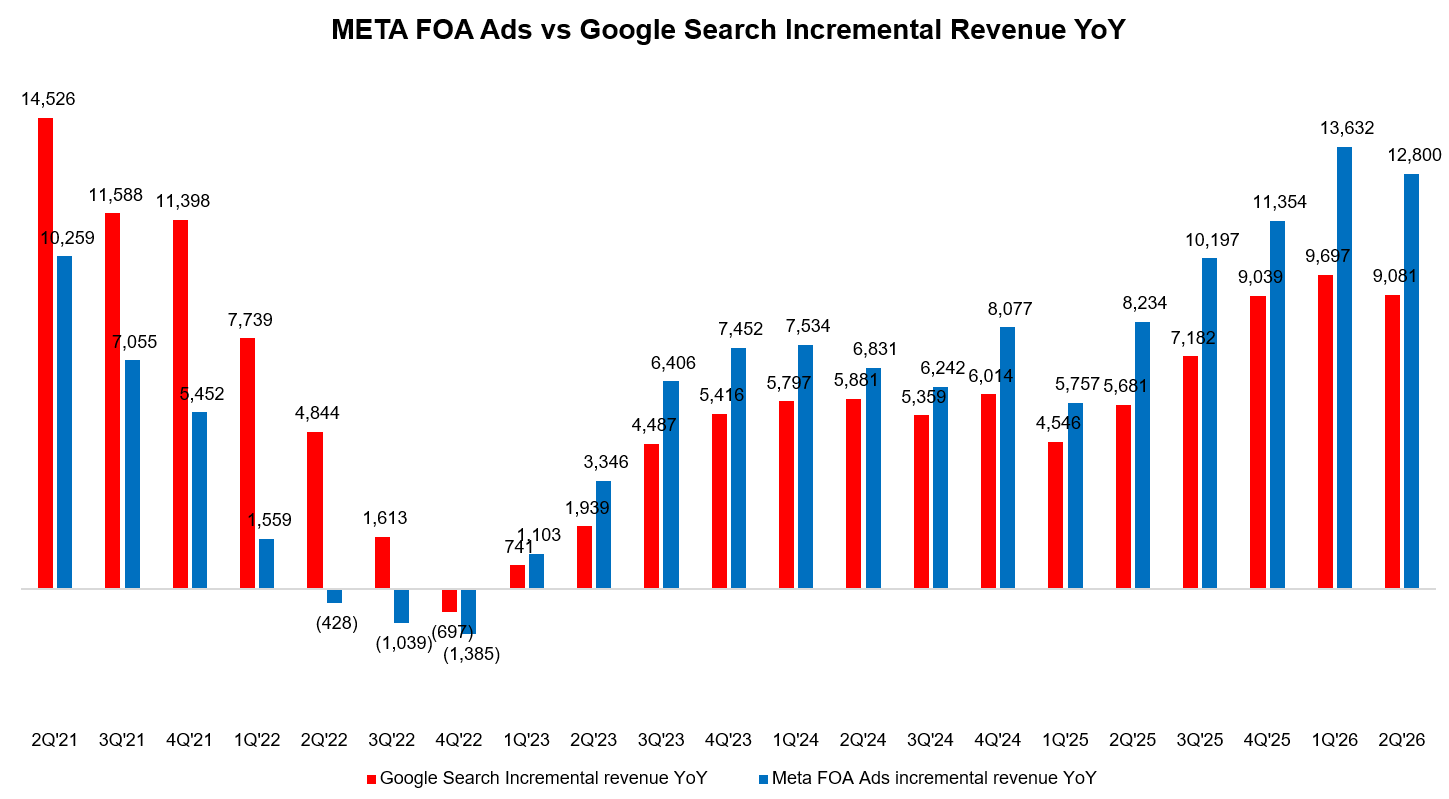
I will begin with the comparison of incremental revenue YoY between Meta’s Family of Apps (FOA) and Google Search. Just like in 1Q’26, FOA’s incremental revenue was ~41% higher than Google Search revenue. By 2Q’27, I think it’s likely that the LTM ad revenue of Meta’s FOA will exceed Google Search revenue. For context, back in 2Q’22 Meta’s FOA ad business was just ~72% of Google Search revenue. So to go from there to exceed Google Search revenue by 2Q’27 would be quite remarkable indeed. Of course, Google Search hasn’t been a sloth either which only highlights the rapid pace of growth in FOA despite the ever increasing larger base.
Daily Active People (DAP) on Meta increased by 40 million QoQ and 120 million YoY to reach 3.6 Billion. Instagram now has 2 billion Daily Active Users (DAU) and Threads has 500 million Monthly Active Users (MAU).
The geographical revenue trend was quite interesting in 2Q’26. I would specifically highlight that revenue in North America accelerated and was above 30% YoY for the first time since 3Q’21. Of course, 3Q’21 was benefitted substantially due to pandemic and ZIRP era quirks; so it’s notable that Meta North America ads grew >30% despite revenue being double that of 2Q’21. Europe and APAC were the reasons why Meta’s overall ad revenue growth decelerated by ~544 bps despite North America’s acceleration. Ad impression growth was actually fairly consistent across the regions, so it was mostly the price per ad that drove the deceleration in Europe. A good chunk of that is likely explained by FX trends, but I suspect less personalized ads in Europe was also the reason that explains relatively soft ad prices in Europe. In fact, in the follow-up call Meta highlighted the latter aspect to explain somewhat softer (again, relative to expectations) guide for Q3 too (emphasis mine):
First, we are lapping a quarter of accelerated impression growth, which benefited from engagement-related ranking improvements, mainly on Instagram feed and reels, as well as some ad load optimization on Instagram feed and stories. Second, we’re seeing the impact of less personalized ads offering in Europe now that it’s fully rolled out, and that may be an additional headwind. And we’re also expecting an impact from our continued integrity enforcement efforts.
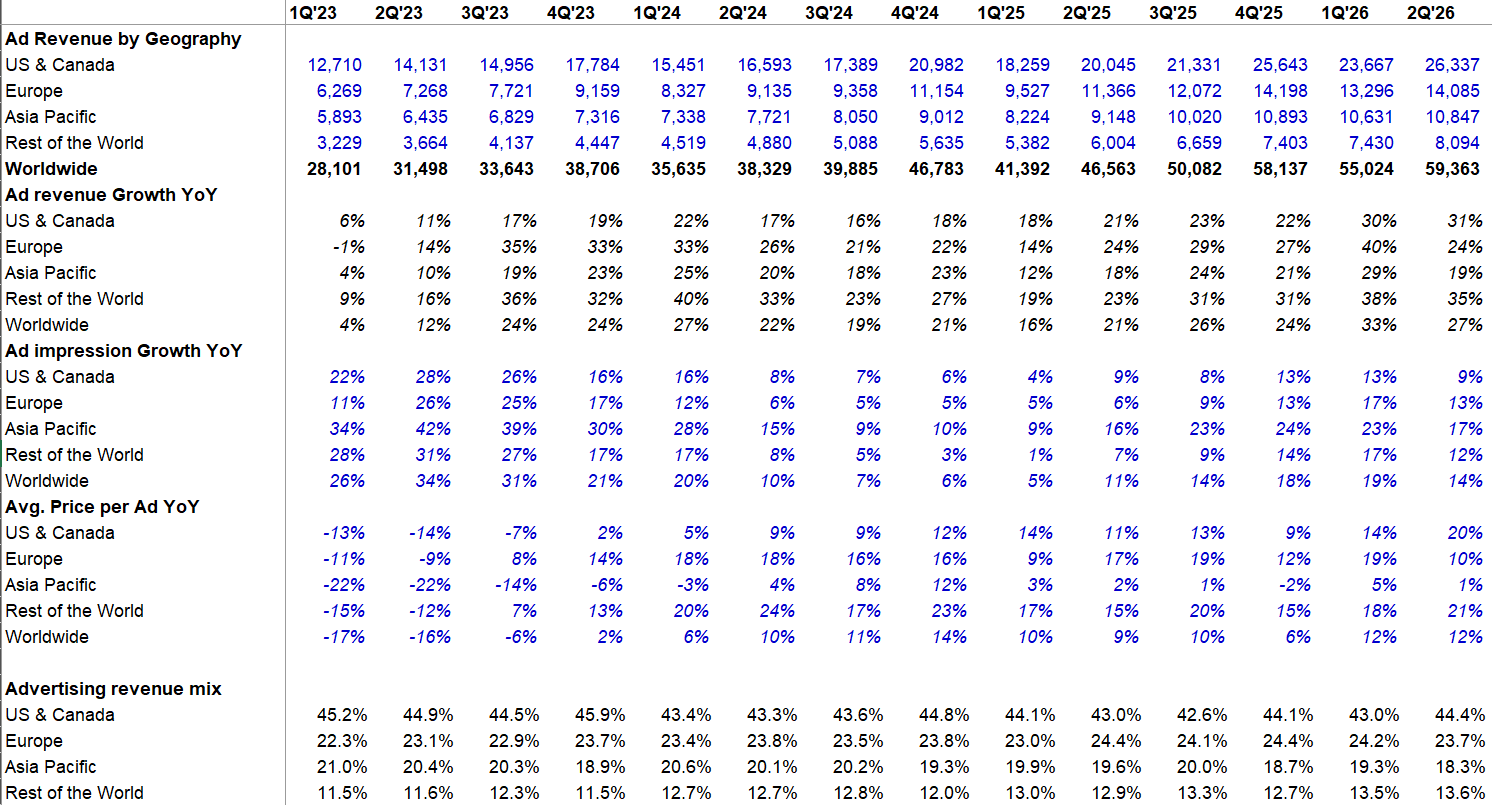
Worldwide average price per ad was flat QoQ while impression growth decelerated by 500 bps. However, Meta shared data points to substantiate that their ranking and algorithm improvements are still throwing decent payoffs in impression growth.
Instagram time spent grew double digits globally, Facebook video time grew 9% globally (10%+ in the US & Canada) on top of Q1's gain, and over half of recommended content on Instagram Feed is now less than a day old, more than double a year ago. Meta also shipped what it called its largest single ranking release ever on Reels, worth 15 bps of incremental Instagram sessions.
During the call, Meta shared more granular details to explain why they expect further improvements in their ranking and recommendation infrastructure. Some key excerpts from both the earnings call as well as the follow-up call (emphasis mine):
“This quarter, we introduced Meta Generative Recommender, a paradigm shift in how our ad system works. Rather than scoring every possible ad individually, we are now using LLM to reason about ad content and user preferences together and predict the best ad for each person. This makes our ad matching more intelligent and more precise, which compounds performance gains for advertisers.
We deployed the first generative model into our ads retrieval system and saw notable improvements in ads performance. Early pilots using LLM to better understand user preferences drove a 1% increase in app event conversions on Instagram.
In Q2, we also advanced our user understanding models to analyze ads and organic activity and simultaneously improve both user experience and advertiser performance. Combined with our GEM model for ads ranking and sequence learning, these advancements generated an 8.3% increase in ad clicks and a 15.7% uplift in conversions on Facebook.
“we certainly see further headroom to continue improving recommendations over the rest of the year and into 2027. And we expect that will help us drive additional gains on both engagement on Facebook and Instagram.”
eventually, we hope to get to a place where we can collapse our current multi-stage recommendation model to a simpler unified model that, similar to how LLMs do next-token prediction, can directly produce a set of tokens to show users, which we can then match to either organic or ads content within our inventory. So we’ve already begun early validation work on LLM-native recommendation systems, and we’ll look to ship components of that to complement parts of the current stack.
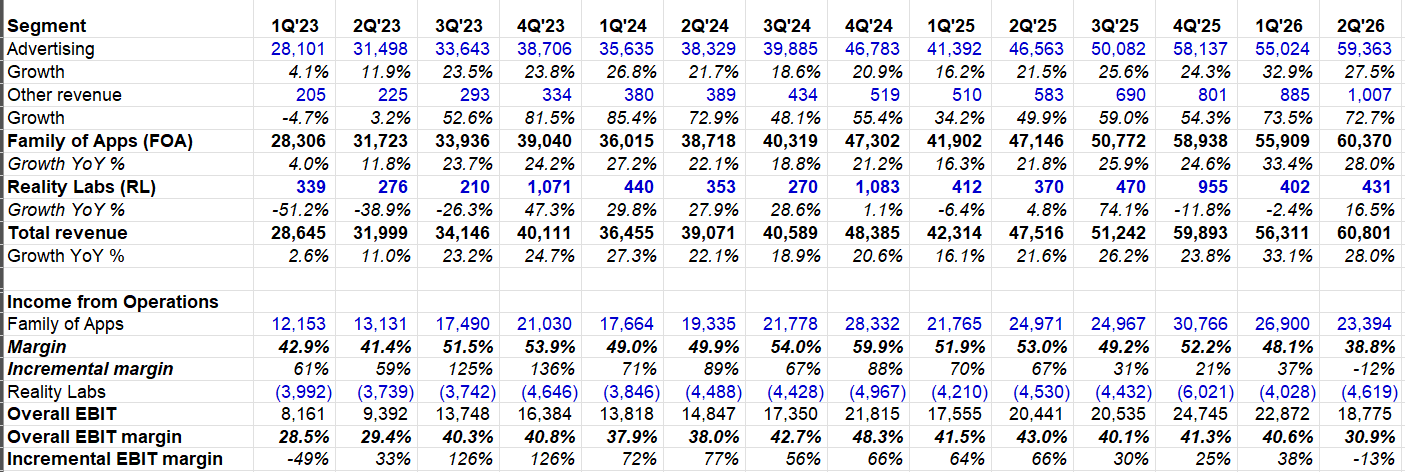
While FOA’s ad business understandably gets all the attention, its “other revenue” is making some noticeable progress. For context, Meta’s other revenue doubled between 1Q’23 and 1Q’25, and then nearly doubled again from 1Q’25 to 2Q’26. It wouldn’t surprise me if it doubles again by 2Q’27. While other revenue is still below 2% of FOA’s total revenue and hence doesn’t get much attention, that may start to change in coming years. They just launched Meta Business Agent platform which does have the potential to become a more material contributor over time. Meta management actually sounded more excited about this opportunity during the follow-up call (emphasis mine):
“we also launched the Business Agent Platform earlier this month, which includes a suite of APIs and tools that allows enterprises to customize their business agent, integrate it through their existing systems, so they can connect to systems like catalog, CRMs, inventory management, giving their business agents the ability to take action on behalf of the business and to deploy those conversations on WhatsApp. So we are just getting started here.
So we’re very excited about this. We think the product is getting ready to scale. We’re investing in driving greater awareness of it, while also continuing to improve the discoverability and onboarding and user experiences. And we’ll be introducing more capabilities into the business agent over the rest of this year and into ‘27. And we’ll also keep improving our models, which we think will drive increased performance and demand for Meta Business Agent going forward. So overall, I think this is an opportunity that we think is pretty unique. We are building a turnkey solution that’s going to leverage existing social media posts, ad campaigns, web presence, making it really easy for businesses to set up. And we want Meta Business Agents to work day one for each business. And we think there will be a big opportunity here again, given the size and scale of advertisers on our platform.
Additionally, earlier this month, we announced a volume-based pricing model for messages sent using Meta Business Agent. And effective August 1st, we’re planning to charge on a per token basis for Meta Business Agent messages with one token base charge that will encompass both AI agent processing and message delivery”
It’s probably a bit too early to get excited about this, but I would expect this may become a source for potential upside in estimates in 2027 (and beyond).
In terms of margins, overall reported EBIT declined by 6%, but adjusted for one-off expenses mentioned earlier, EBIT would have grown by 9% YoY. Of course, in an era when capital is becoming more of a constraint, the ever persistent $4-5 Billion losses in Reality Labs is increasingly even a more pronounced source of embarrassment for Meta. LTM losses here may have peaked, but that is hardly much of a solace as Meta management should start to promise a more concrete path to much lower losses in the medium term. Eric Seufert characterized “Meta’s metaverse initiative from a few years ago as an albatross around the company’s neck that has left a trust deficit with public markets related to large-scale infrastructure investments.” Well put!
Meta Compute and AI Ambitions
One encouraging data point that Meta shared is that once they integrated Muse Spark to their AI assistant, number of people interacting with the assistant daily increased by 60% and continues to grow week-over-week.
Predictably, the call had a lot of tidbits around what Meta plans to do with the massive capacity they are building despite not having a 3P cloud business. Zuckerberg mentioned Meta is getting “a lot of offers for compute at a significant premium” over what Meta paid for it. In the follow-up call, Susan Li also reiterated that the offer they’re receiving is “multiples” of what they paid for it. However, they’re still focused much more on internal uses first. Let me quote the detailed explanation (long excerpt, but important to understand) Meta provided during the call to explain their philosophy here (emphasis mine):
“Our approach to building capacity is strongly influenced by several key elements. First, the broad environment for building infrastructure is dynamic and uncertain in both near-term and longer-term time horizons. The industry has underbuilt historically for the wave of AI adoption, making existing capacity, including our own extremely valuable. Longer term, the supply chains need to be built out to support the capacity that we anticipate we and others will need for AI-powered experiences. Second, we have high confidence in our ability to utilize capacity to scale and build on top of our existing experiences as well as continue to invest in foundational models that will create substantial new opportunities.
Consequently, our current plans are geared towards maximizing 2026 and 2027 capacity. When we have had incremental capacity in the past, it has proven extremely valuable in scaling experiences like Reels. And we are confident that this will be true in this time frame as well.
Longer term, it’s harder to predict the exact usage scaling curves, but we believe that our distribution advantages will give us the opportunity to serve AI products that are valuable for everyone, both our 3.6 billion users and millions of businesses. This should be true regardless of whether our models are on the frontier, but we believe that being on the frontier will unlock new markets and opportunities for which we may need additional compute. Therefore, our longer-term capacity strategy aims to give us the flexibility to continue growing compute in 2028 and beyond by laying down data center and network foundations to accommodate future server decisions.
The long-lived nature of these assets inherently provides the flexibility that will make it possible to adjust our investment to the pace of AI adoption. In addition, we have been making strategic investments in areas like our internal custom silicon effort, which will provide long-term strategic flexibility and supply chain leverage. This will be helpful in driving better returns on those long-term investments.
Finally, we believe that overall industry capacity is going to remain tight for the foreseeable future. As we’ve said earlier, we strongly believe that the models, consumer experiences and enterprise offerings that we are building will be the best and highest ROI use of our infrastructure. Those enterprise offerings have the potential to take multiple forms…agentic tools, our API or monetizing compute directly given outsized market demand. We expect that remaining nimble about these opportunities will help us fund our build-out more efficiently while preserving our strategic flexibility to have the compute when we need it and provide us multiple pathways to generate returns on invested capital.
…we believe that there will continue to be a significantly higher margin on selling intelligence rather than selling compute directly. But we think that there is a big opportunity, obviously, to sell compute as well.
Now in terms of running the business, obviously, a common trade-off that we need to make is around how much do you monetize something today versus develop future assets for the future? And I think that it’s always a portfolio, right? It’s not like you don’t want to only do long-term things and you know like and not kind of prove the markets out that exist in the near term. But I also think it would be foolish to basically just sell all of the compute and take a short-term profit. But when you have the opportunity to build intelligence on top of it, which will be a kind of a multiple and that compounds the value of the compute on top of that.
So I think the answer is what we’re doing, which is to basically use a lot of our capital to build out compute, having confidence that we have the ability to monetize the compute directly when that makes sense, but also knowing that we have quite a number of different use cases to monetize the intelligence on top of the compute, including the enterprise cases that we talked about and including some of the consumer and cases that we talked about, and including just the core business, which is not even necessarily new products that we haven’t talked about, but just in terms of using that to be able to further add intelligence and improve the ranking and recommendations and ads in the core services.”
My read from this long excerpt is that Meta will mostly sell compute when the offer is so good that they cannot quite refuse. If some of the frontier labs underestimate compute demand and need some capacity soon to serve the demand, they might want to pay an arm and a leg for a short period of time. It can make a lot of sense for Meta to serve that market.

The other possibility is market may simply be too impatient to see Meta’s non-advertising monetization and force management’s hand to sell some capacity. In either of the cases, I don’t think consensus estimates still embed much revenue from such deals. This perhaps explains why the stock rallied so hard when market thought such deals may happen lot sooner than they realized. Now that Meta management somewhat downplayed the immediacy of such deal coming online, the stock gave up all such gains. Nonetheless it’s perhaps a useful message to Meta’s management what can reverse the flailing stock price which can be a competitive disadvantage in a hot AI talent market and potential capital infusion requirement from secondary equity offerings.
While investors remain fixated on Meta’s ROIC, I am yet to be concerned. I will expand on my relative nonchalance about such concerns behind the paywall.
Subscribers get the daily journal and five+ years of Deep Dives, i.e. full-length analyses with financial models on 65+ companies. The daily is just how I think out loud between the Deep Dives!