The Fleet Owners' Push for Aggregating Demand
Last week, Financial Times reported that Waymo notified Uber that it intends to launch its own app in Austin and Atlanta in January 2028. These were the two cities where Waymo’s robotaxis have been exclusive to Uber’s platform after the two already unwound their Phoenix pilot earlier this year.
Last week, Financial Times reported that Waymo notified Uber that it intends to launch its own app in Austin and Atlanta in January 2028. These were the two cities where Waymo’s robotaxis have been exclusive to Uber’s platform after the two already unwound their Phoenix pilot earlier this year.
The divorce has been sort of telegraphed for months. Waymo hasn’t added a new Uber city since Atlanta in June 2025, and the two sides have traded accusations over safety incidents and “unsustainable” economics.
Uber has actually been lobbying for “hybrid network” rules which means if you call an Uber in a market with AVs, you can get matched with either an AV or a human driver. If such a regulation were enacted, this all but guarantees Uber’s primacy in ridesharing for years (decades?) to come. TechCrunch laid out plainly:
If Uber is successful and its hybrid network idea is adopted in D.C. — or elsewhere — it would leave AV developers like Waymo with two choices: put their robotaxis on ride-hailing apps like Uber’s, or employ human drivers who provide ride-hailing services alongside the robot cars that have taken years and hundreds of millions of dollars to develop.
Uber’s “AV transition white paper” is very eager to make the case that they are on the same side as labor which is a bit ironic given the company has for years on the opposite side of this labor and tech platform owner debate. Some interesting excerpts from their white paper (emphasis mine):
We owe people the truth. Autonomous vehicles may expand mobility overall, but they could also mean less work for many drivers over the long run, including people who rely on platform work as a flexible safety net. We believe a phased transition to a hybrid model where drivers and autonomous vehicles work side-by-side offers the most promise for workers and greater reliability for consumers and cities. A too-rapid shift to driverless fleets risks exposing gaps in today’s labor and benefit systems, pushing the burden onto the workers and communities to absorb the disruption. If we want an autonomous future that holds together socially, we have to plan for any workforce disruption with the same seriousness we bring to the underlying hardware and software.
In San Francisco and Los Angeles, where drivers compete against AV-only networks, driver utilization and hourly earnings declined last year. Given that the vast majority of drivers work part time, and an AV is online most of the day, we see that in California, one AV does the work of about four drivers.
The right path is phased and hybrid, moving fast but not all at once. This reduces real risks: worker displacement, uneven access, and pressure on city infrastructure and safety systems.
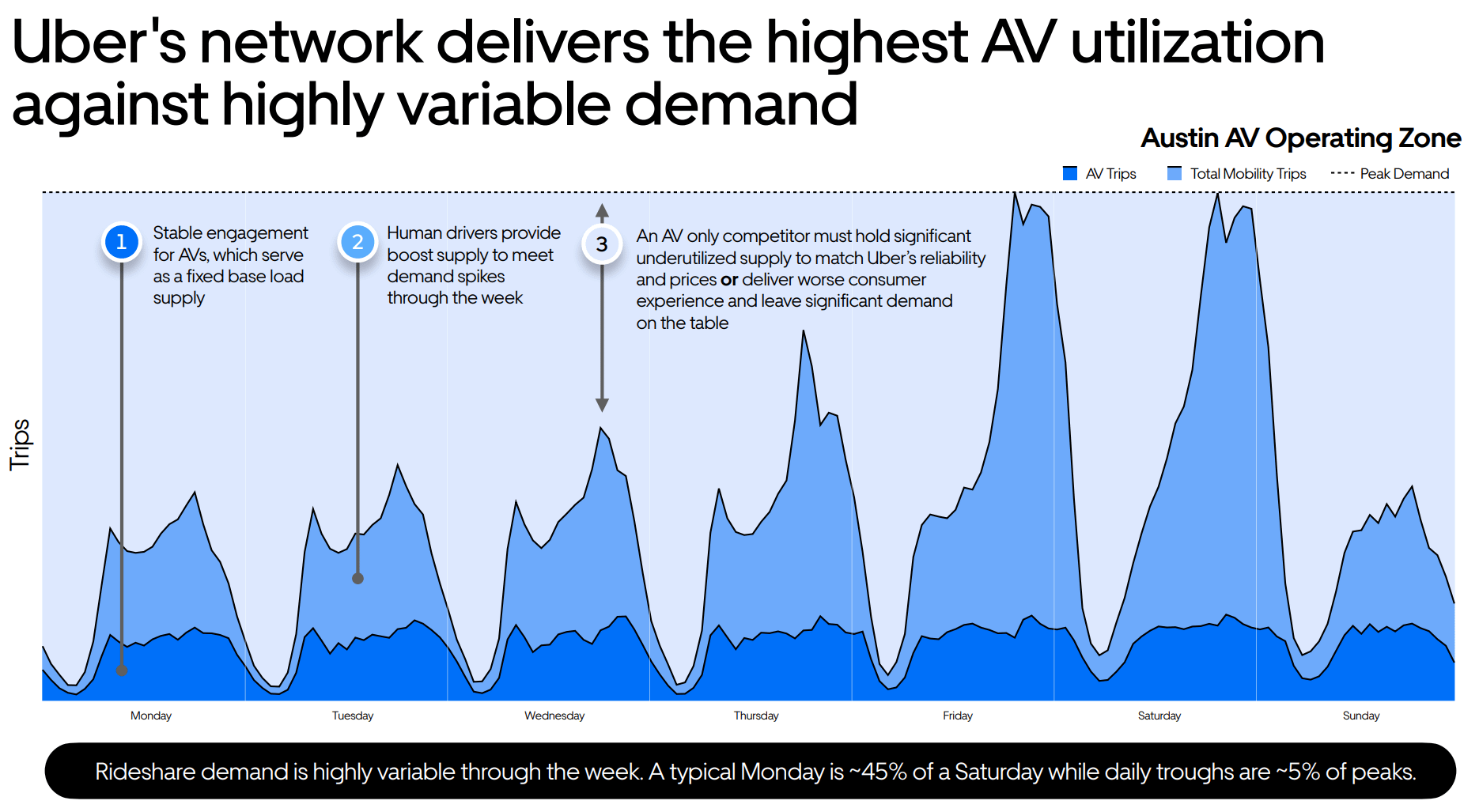
While Uber is making the argument for hybrid network to the regulators, it’s simultaneously making the case to investors that AV-only competitor is simply bad business. For example, during 4Q’25 call, Uber pointed out that any AV-only competitor must either hold significant underutilized supply to match Uber’s reliability and prices, or deliver a worse consumer experience and leave demand on the table.
There’s an interesting academic paper titled “Sharing economy in the era of full automation,” that was published earlier this month. The paper never mentions Uber vs Waymo debate and actually touches mostly on Elon Musk’s dream of your privately owned autonomous car moonlighting as a robotaxi while you sit in meetings at work. But if you look past that framing, it is a general model of the exact problem underneath the Uber-Waymo debate: how a platform facing spiky, spatially lopsided demand should combine always-on, capital-heavy base-load supply with flexible third-party supply. In the paper, the flexible layer is private AVs rented by the hour instead of being owned by the platform itself.
The paper sides with Uber’s case that a rational fleet owner sizes to base load, which structurally leaves the peaks, the bad-weather surges, and the tail geographies to a flexible layer. Whoever aggregates that layer pays it marginal opportunity cost and keeps the spread.
However, the paper models exactly one platform, and its result shows that whoever owns demand and dispatch captures essentially all the economics, while flexible suppliers (human or robotic) get paid opportunity cost. That is wonderful for Uber only so long as Uber is the one doing the dispatching, but as the news flow suggests, Waymo obviously understands the reality of the long-term economics here if they don’t own the demand directly.
In fact, an analyst actually asked Elon Musk during last week’s Tesla’s 2Q’26 earnings call if Tesla would like to consider third-party distribution partnerships, such as with rideshare providers, to increase utilization. Elon Musk doesn’t appear to be interested as he said: “We expect to be vertically integrated with robotaxi as we are in the rest of our business.”
The truth is both Elon Musk and Waymo deeply understand the underwhelming economics of being at the mercy of the demand aggregator. It would make long-term strategic sense only if they see no path at all to control the demand aggregation layer. So, I would expect both Tesla and Waymo to give their best shot at being at the demand aggregation and only succumb to partnership with incumbent ridesharing companies if they come to the conclusion that there is no viable path to aggregate demand themselves. We may not have to wait years to get our answers how the debates will be settled here. Driverless Digest Substack pointed out that while AVs are being launched in more and more cities, in the next 12 months Waymo will likely transition from mere footprints to building density in many of these cities. From “Driverless Digest”:
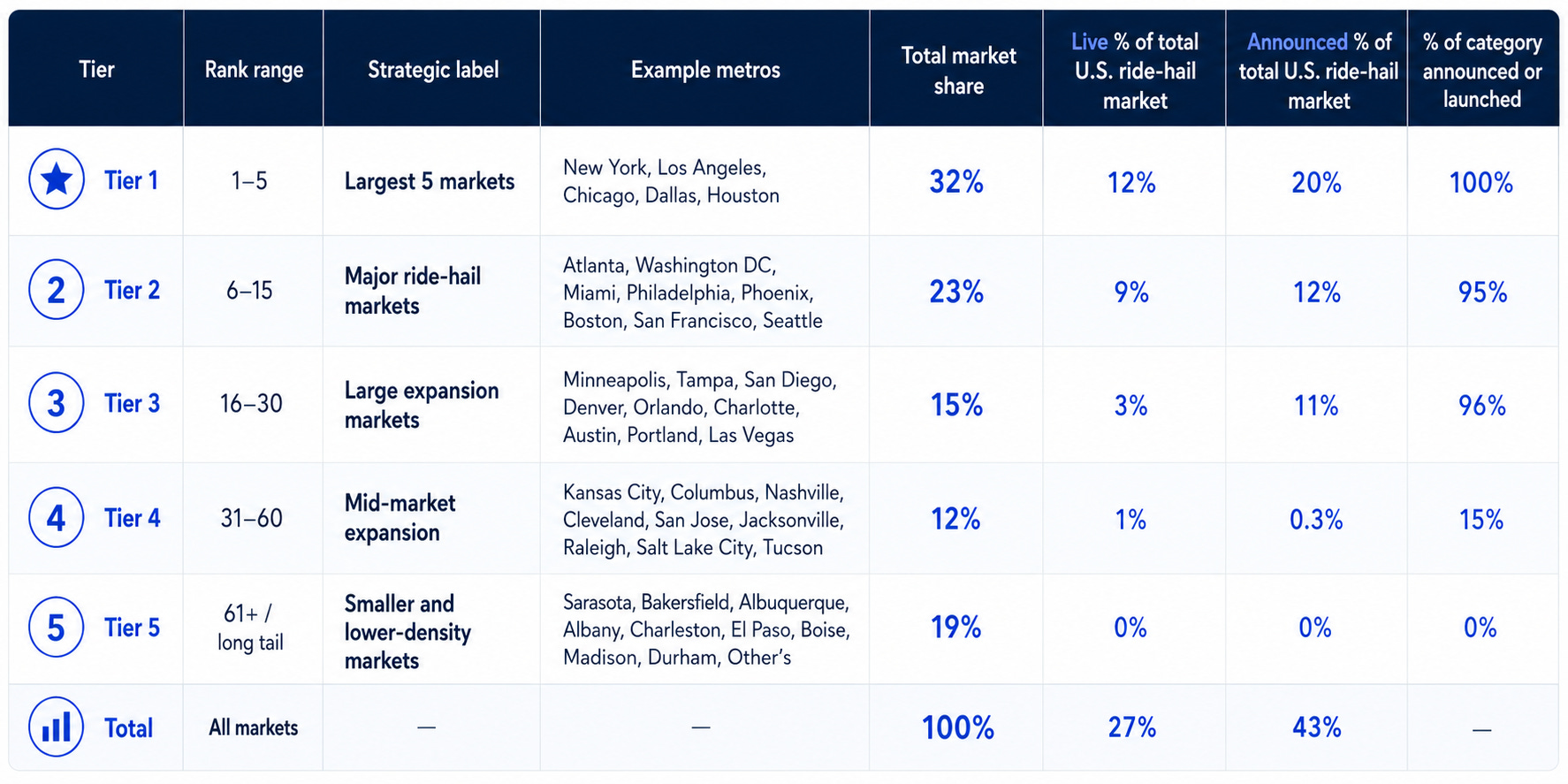
Waymo has already entered or announced many of the largest markets. Based on my demand-weighted view of U.S. ride-hail, it is currently live in metros representing roughly 27% of estimated demand and has announced or signaled markets representing another 43%. In other words, Waymo now has a presence—or a stated intention to establish one—across close to 70% of estimated U.S. ride-hail demand.
That does not mean Waymo serves 70% of the market today. Nor does it mean its service areas cover entire metros. This is a metro-level demand proxy, not a measure of actual coverage. I count Los Angeles as a live market because Waymo operates there, for example, even though its service remains concentrated within a limited portion of the broader metro area.
But that still matters. Waymo is already in, or heading to, many of the markets that drive U.S. rideshare demand. Now it needs to make the service meaningfully available in each one: more vehicles, shorter wait times, broader coverage, airport access, and more consistent reliability.
In robotaxis, availability is the product. A service that works great but comes with long wait times or is not available in your area is still not a true substitute for Uber or Lyft.
The key point is simple: Waymo has established the market footprint. The next 12 months are about building density within it.
That is both the opportunity and the risk. Waymo’s next chapter is less about proving the Driver and more about industrializing the fleet.
Ultimately, the only question that may matter is whether Uber will continue to be the aggregator with dominant market share in ridesharing. If regulators demand hybrid network in all platforms, it pretty much ensures Uber’s prime position in ridesharing. Without such regulatory blessing, it appears the intensity to be at the demand aggregation layer will intensify in the near term. Uber competed tooth and nail over the last decade to dominate ridesharing today, and this decade is supposed to be the harvest decade for all the cash it deployed last decade or so. Such harvesting period may need to wait a bit if Waymo and Tesla start a new war in the demand aggregation layer in the next couple of years. I don’t have any strong point of view yet how such battle will be settled, but I intend to follow it more closely going forward to see if the picture is getting any clearer over time.
Subscribers get the daily journal and five+ years of Deep Dives, i.e. full-length analyses with financial models on 65+ companies. The daily is just how I think out loud between the Deep Dives!
Current Portfolio
Please note that these are NOT my recommendation to buy/sell these securities, but just disclosure from my end so that you can assess potential biases that I may have because of my own personal portfolio holdings. Always consider my write-up my personal investing journal and never forget my objectives, risk tolerance, and constraints may have no resemblance to yours.
My current portfolio is disclosed below: