Shopify at the E-com OS Layer
Shopify shipped its Spring ’26 Edition this week with 150+ updates. Given the plethora of updates, thankfully Eric Seufert had Venkat Prabhu (Director of Product for Shop Campaigns at Shopify) on the Mobile Dev Memo podcast to discuss the key highlights of Shopify’s recent product updates.
One such highlight is Campaign Autopilot which is essentially a virtual marketing agency built into the admin. You set a monthly budget and some guardrails; the system recommends, launches, and optimizes campaigns across channels. The product seemed quite compelling when Prabhu explained how sellers who never ran paid advertising could find it very useful based on real data that only Shopify has access to (emphasis mine):
“I think the cross-channel optimization is a component of the benefit of Campaign Autopilot. The foremost benefit from our perspective is just the ability to access. This is an experience that sits right within the admin. I will give you simple examples of how this experience is different from a merchant going and running campaigns on their own. If I am a new merchant just getting started with my ads on Meta, I have to make a bunch of decisions. I need to make decisions like what should my budget be or what should my ROAS targets be. These are not easy decisions for merchants to figure out. One of the ways that we add value as Shopify through Campaign Autopilot is by helping merchants come up with out-of-the-box suggestions. We as Shopify sit on tons of transactions that happen across the Shopify network. To date, we have processed about 1.7 trillion of GMV through the Shopify platform. All of that has given us intelligence into really understanding what are the right campaign settings that actually help a merchant get started with the maximum probability of being successful. I would say that is one of the foremost things in terms of just getting started, because the reality is the majority of merchants on Shopify never run paid advertising. Just the ability for them to get started with paid advertising in a very easy manner is one of the most foremost benefits of Campaign Autopilot.”
Autopilot sits above the channels. If Shopify thinks it can win back a lapsed customer through an email flow, it routes there before spending on paid advertising i.e. organic vs paid arbitrage no channel-specific optimizer would ever do for you, because obviously Meta, for example, has no reason to tell you not to spend on Meta. Moreover, as Gavin Baker once said, “in advertising, amateurs discuss targeting while professionals discuss attribution.” It seems important to note that Shopify owns the conversion event once you have campaign autopilots on. From the podcast (emphasis mine):
“Imagine somebody who has now gotten started and they have activated a range of different channels. That is where the cross-channel coordination piece becomes important. For example, if we feel we have a high probability of getting an existing user re-engaged through an email marketing program, then that would be a more preferable path than actually paying money on paid advertising for that specific user. That is an example of an organic versus paid channel coordination piece. In the same way, if you think about attribution, today we end up passing basically all signals back to all platforms. For the same order, we may have three different platforms that might be claiming credit for that same order. By virtue of Shopify being the operating system for the merchant, we can very easily figure out which channel should get that attribution. In a future state, we may realize that there were three different transits that happened from three channels that resulted in an order, and so we could do weighted attribution as well. All of these things will help merchants figure out what is the best next place to put their next hundred dollars of marketing spend. There is a targeting component, there is an attribution and then a signals component, and Campaign Autopilot and the cross-channel coordination piece helps across all of that.”
Shop Campaigns, which was made available a year and half ago, also continues to expand its tentacles by adding more and more channels where Shopify’s sellers can run their ads. Since Shopify only makes money if the seller makes an additional revenue and doesn’t need to care about whether the incremental revenue came from Meta advertising or an email flow, there is no such conflict of interest. Every incremental order is incremental GMV, and Shopify monetizes GMV through the rest of the stack (payments, Merchant Solutions etc). Again, from the podcast (emphasis mine):
“Shop Campaigns continues the promise of the premise of being a risk-free advertising product, and all of the expansion is a way for us to help merchants drive more incremental orders, drive more incremental GMV through Shop as the surface area. As a part of this expansion, all of these surfaces for the most part that we have expanded onto, most of our merchants don’t advertise on these surfaces. If you think about Microsoft, the integration through Microsoft Monetize, advertising on the open web, you spoke about D2C advertisers as really being at the forefront as it pertains to digital advertising, but still the number of D2C advertisers that are reaching the inventory that is on the open web through some sort of an SSP is going to be very few. This is effectively a capability that is now going to make every Shop Campaigns advertiser be able to surface their products in the form of ads across the open web. Our launch encompasses a lot of premium websites and apps, different news outlets, lifestyle blogs, review articles, places where shoppers already are browsing for relevant recommendations.
In fact, on a lot of these surfaces, the costs for us to reach net new customers is actually much lower. One of the things with all of the third-party expansion of Shop Campaigns, Shopify ends up taking the risk from an advertising perspective. The way all of our third-party advertising programs work is Shopify is acting as the uber advertiser and Shopify is putting its ad dollars on each of these channels with the goal of driving these outcomes for merchants. Shopify ends up taking this risk to drive outcomes for merchants, and our whole goal here is we sort of operate in some ways like an infrastructure. Our goal here is with most DSPs and so on there is a markup. Our goal here is to not make any money in this whole third-party advertising business. We want to scale this program in a way that can drive the highest amount of incremental GMV for merchants.”
Once Shopify can see the full funnel, own the conversion, and strike deals at a scale no merchant can replicate, all these product updates/features end up elevating Shopify to the “operating system” level for the sellers which you cannot really vibe code away to build your own system even if the models keep improving. Michael Morton, senior research analyst at MoffettNathanson, also made the same point even more emphatically in yesterday’s Stratechery interview:
“Today we actually did a call with a former Shopify employee who managed these large relationships, the infrastructure behind an e-commerce stack is so complicated that, for starters, it’s effectively impossible to recreate the Shopify stack you’re offered for less than you’re paying for it. Even if I had unlimited resources, an army of engineers, and a blank check from Anthropic, my ability to do that at a lower cost is almost impossible, due to the negotiating leverage Shopify brings to the table with all of their partnerships. They have a better fee structure with Stripe than I could ever get, they have CAPI [Conversions API] integration with Meta, because [Shopify CEO] Tobi [Lütke] and [Meta CEO] Mark Zuckerberg are personally acquainted and worked on this deal together, so Shopify merchants get one-click CAPI integration. It’s a long list of reasons why you’re not going to vibe-code your way to a Shopify stack.”
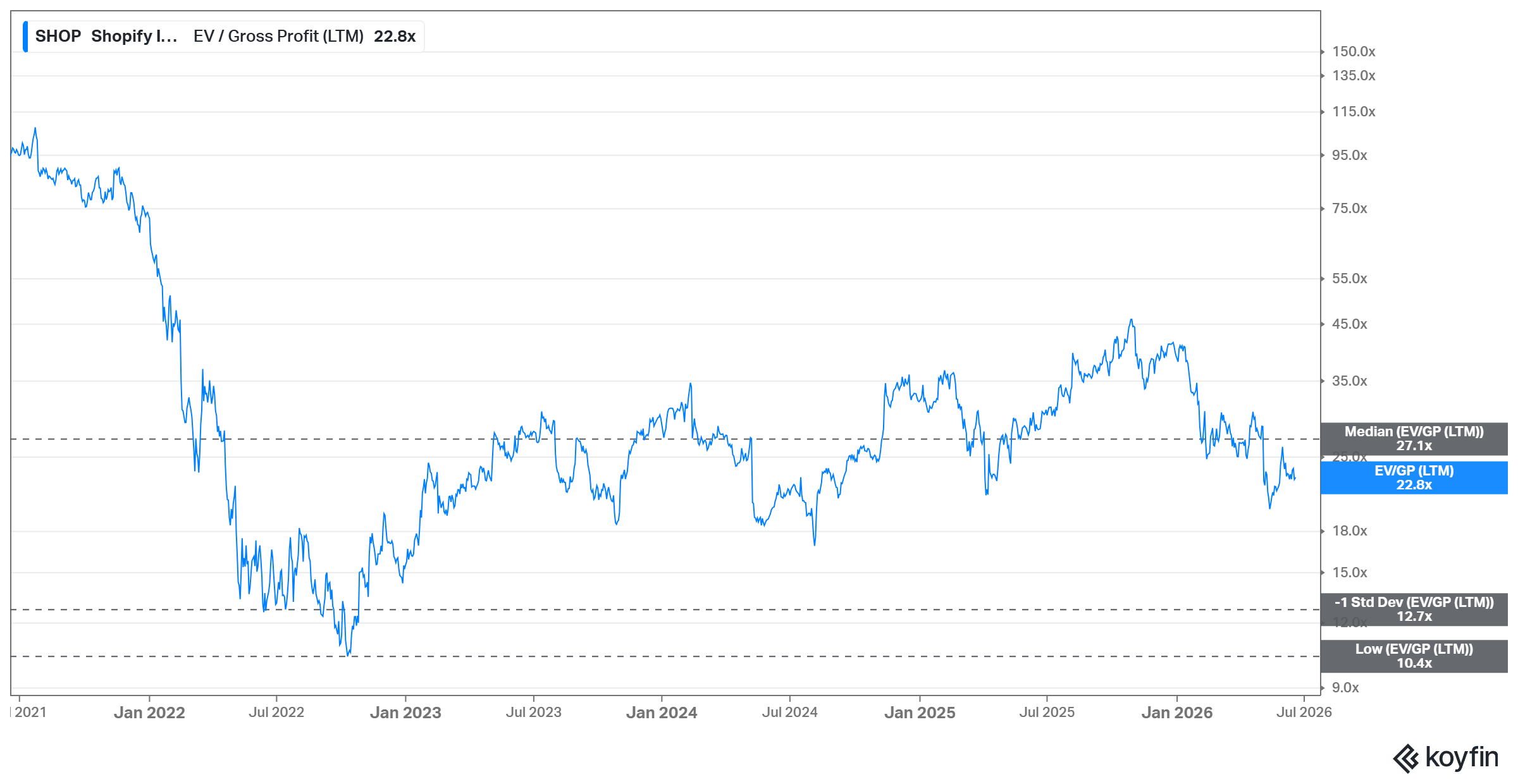
Anyways, just because Shopify stock is down ~33% YTD, I don’t quite subscribe to the idea that it has been discarded to the “AI loser” basket. I mean it’s possible that the stock has suffered because it’s situated around the bad neighborhood of enterprise software in 2026, but most software companies would love to trade at Shopify’s gross profit multiple today. If there is any slowdown in growth due to macro or whatever reason, Shopify’s multiple may have lot more room to fall. Shopify does seem to be positioned very well and is indeed a terrific business, but investors don’t seem to be oblivious to that fact.
Subscribers get the daily journal and five+ years of Deep Dives, i.e. full-length analyses with financial models on 65+ companies. The daily is just how I think out loud between the Deep Dives!
Current Portfolio
Please note that these are NOT my recommendation to buy/sell these securities, but just disclosure from my end so that you can assess potential biases that I may have because of my own personal portfolio holdings. Always consider my write-up my personal investing journal and never forget my objectives, risk tolerance, and constraints may have no resemblance to yours.
My current portfolio is disclosed below: