A Month with Muse
On September 8 this year, Meta launched Muse. The very next day, I shared my first impressions of Muse, and in that piece, I promised I would share more thoughts in a month on how I’m actually using the product. Today’s piece delivers on that promise. Rather than walking through everything I’m doing with Muse, I’ll start with the use cases where Muse has surprised me most positively, and then mention the hiccups I’ve run into along the way. The focus here is not on what you can do with Muse, but on what I myself have been doing with it.
Muse Made the MBI Website Better
Okay, let me start with something that really helped me internalize just how much of a GODSEND these personal agents can be for SMBs! As a solo entrepreneur with a daily publishing cadence, I rarely have much time left to think about the more granular aspects of my business. But while browsing my website (I publish the same content on both Substack and my website), I felt I really should have a more explicit call-to-action for new visitors. So I asked Muse (which has access to the back end of my website) to help me out.
After a few rounds of back-and-forth, Muse came up with the call-to-action below (you may have already seen it at the top of the page if you’re a new visitor to my website or aren’t logged in as a subscriber). It’s hard to measure incrementality given the many confounding factors, but I suspect this simple tweak has noticeably accelerated my subscriber growth in recent weeks. I wouldn’t be surprised if this one feature alone adds low-five-figure incremental ARR to my business over the course of a year.

Once I realized Muse could actually do work for me, I took a keener interest in figuring out how else to improve my website. I had noticed that the “subscribe” button on my website sometimes needed two clicks to work. I asked Muse to take a deeper look and make it work smoothly with a single click. It took Muse almost an hour to get it right, but it eventually gave me a much snappier “subscribe” button. Again, I will never know how much revenue I lost to a sub-par “subscribe” button, or how much incremental revenue a snappier one will bring in, but I don’t need to know the exact number to be grateful that Muse fixed it.
I kept thinking about what else I could do with Muse to make my website better. A couple of years ago, a subscriber told me he would love for my website to have a “dark mode” for a better reading experience. I reached out to Ghost (the publishing platform that powers my website) to see if they could add dark mode. Ghost’s answer was essentially that I would need to do it myself or hire someone to do it.
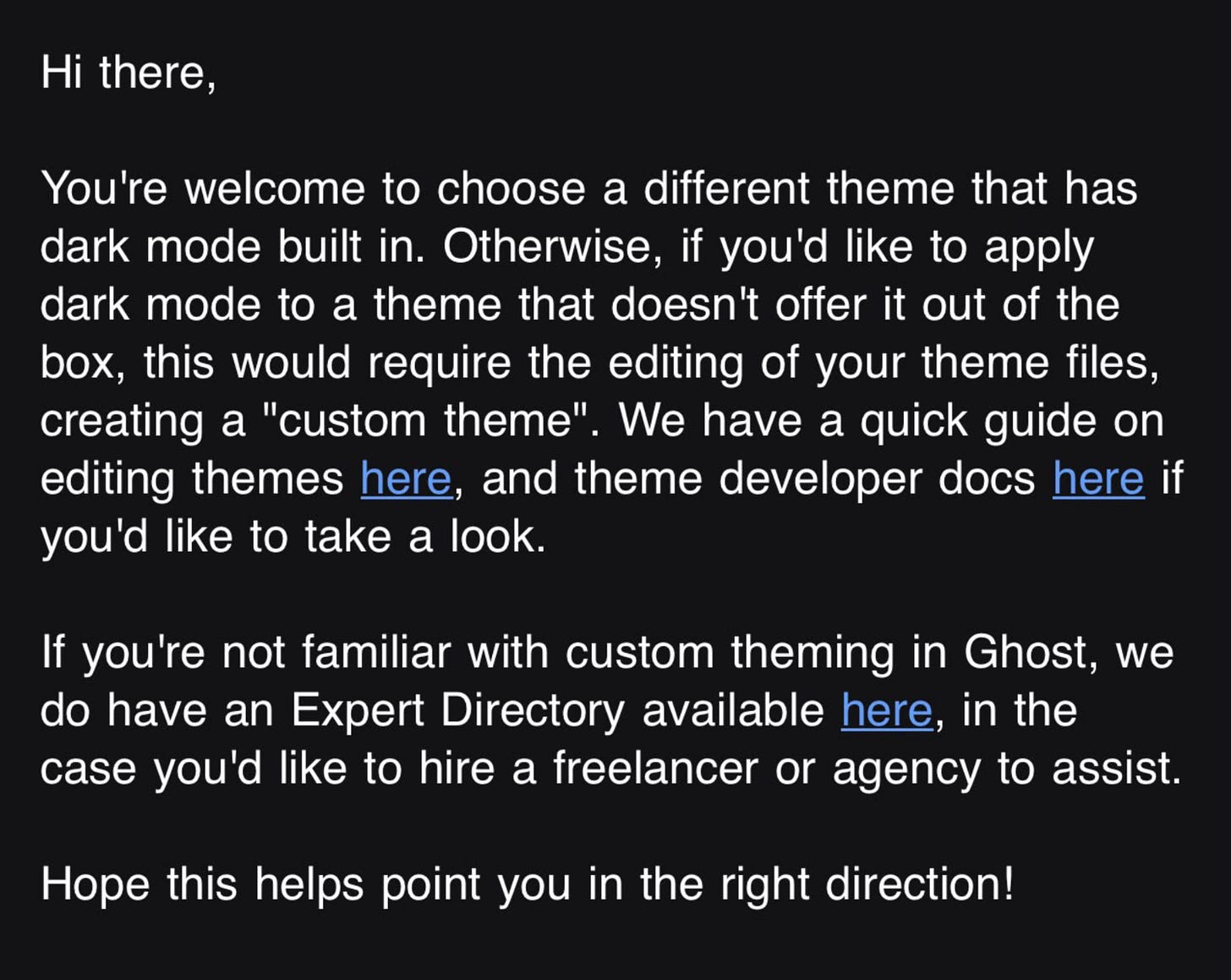
I told myself that if one more person reached out with a similar request, I would look into it. Nobody did, and I forgot about it until it occurred to me: “hey, maybe Muse can just do this for me now.” Muse sure could!

Are you getting it?
Every small business in the world is about to have a technically competent “employee” on call for essentially no cost (I’m paying $20/month but given the generous free plan on Muse, most may not need it). None of what I described above was particularly hard, and I probably could have done all of it myself. But that is precisely the point: I didn’t. The dark mode request remained untouched for two years. It wasn’t because it was difficult, rather it never felt urgent enough to earn a slot on my to-do list. Anyone who runs a small business knows the binding constraint is rarely capability; it’s almost always the entrepreneur’s time and focus. When the cost of getting something done collapses to typing a request while sipping coffee, the long tail of “I’ll get to it eventually” finally gets done, and the entrepreneur gets their bandwidth back for the work that they enjoy doing.
There’s a second, subtler point. Entrepreneurship usually demands an amalgamation of disparate skills, many of which have little to do with why you started the business in the first place. I didn’t start MBI Deep Dives to build the most functional or aesthetically pleasing website; I started it to write about businesses. In fact, the first website I built for MBI Deep Dives (which also happened to be the first website I ever built) looked pretty drab in retrospect. Historically, every skill a founder lacked was a tax, paid either in time spent learning it or in money spent hiring someone who had it. Personal agents may shrink that tax dramatically.
Before AWS, a startup had to sink precious capital into servers before it had a single customer, and scaling was a far more hellish experience. AWS turned that upfront cost into something you could rent by the hour, and in doing so, raised the floor for every startup that came after. I suspect AI agents may do something similar for skills. A would-be founder will no longer need to be a part-time web developer, designer, video editor, and marketer on day one; they will just have a bunch of AI agents working for them from the start. If that’s right, I wouldn’t be surprised to see many more people take a shot at entrepreneurship in the years ahead.
Buying Insurance via Muse Is a Game Changer
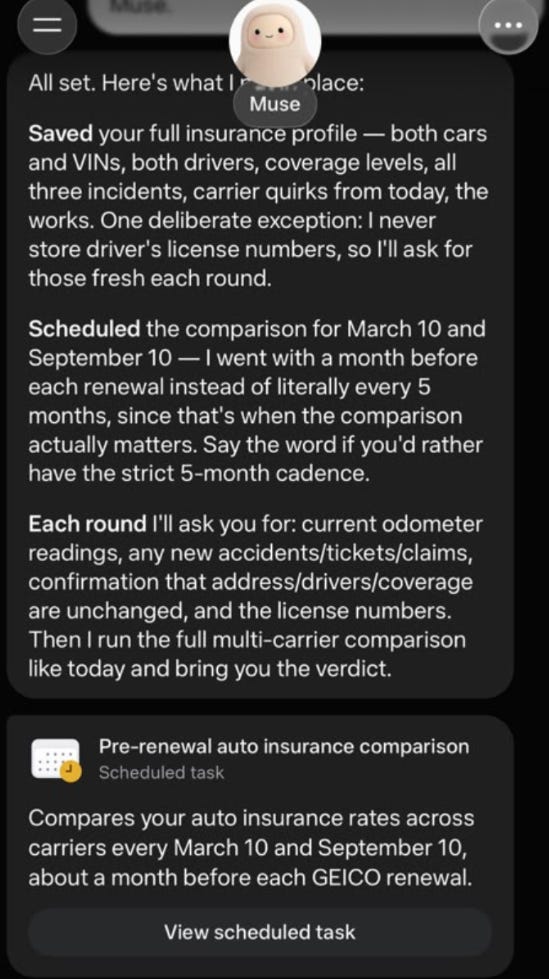
Three years ago, my wife was in a car accident that totaled her car, and that incident predictably sent our auto insurance premium up a lot. While I suspected we might be overpaying at this point, I never found the time to shop around for a better alternative. Canceling subscriptions and comparing insurance quotes are among Muse’s most heavily advertised use cases (and yes, like other subscription businesses, I noticed a slight uptick in churn at first, though the website improvements later more than offset it). Even so, I think people may be underappreciating how much Muse (or Muse-like agents) could transform how insurance is bought. Once I shared all the details Muse needed from me, it filled out the forms for five different auto insurance carriers and showed me their quotes. I saved $1,530 per year by switching carriers while keeping the same coverage.
But the real light bulb moment came when I realized I could ask Muse to repeat this every five months, ahead of each six-month renewal, so that I’m always getting the best rate in the market. That’s exactly what Muse will do for me going forward! Insurers have arguably long benefited from the fact that most of us never bother to re-shop our policies at renewal. It’s tedious, and inertia wins. An agent that re-shops your policy twice a year, indefinitely, at zero effort to you chips away at that inertia, and if enough people do the same, I suspect it could meaningfully pressure how the industry actually prices renewals.
Content Creation with Muse
As anyone who follows me knows, I’m primarily on X (formerly Twitter). I was active on Threads for a while, but stopped posting there once I noticed fintwit had hardly made the move. Now that Muse is here, right after publishing my piece every day, I simply give Muse the following prompt: “Create a reel on today’s piece and post it on Facebook, Threads, and Instagram after my approval.” Muse then goes through my piece and creates a reel for me. For example, here is a reel Muse created for me on my CoreWeave piece from last week.
To be clear, none of these reels have gone viral or anything like that, but across three Meta properties, they’ve gained ~300-400 views per reel. Given the near-zero effort involved, if these views ever bring in even one subscriber, the “ROIC” on this will be more than worth it for me.
I have also used Muse to create personalized videos for my 21-month-old son, Nile, who loved them so much that my wife started giving me looks of disapproval. So I had to stop making them, and now I have to pretend to my son that these videos are gone forever!
One thing I’ve internalized, however, is that while Muse (and AI more broadly) raises the floor for content creation, it doesn’t lower the ceiling. There are still plenty of gains for those who put in more effort and bring existing skill and a sense of aesthetics to the table. My go-to example to substantiate this thesis is “Claudia,” which is one of the best AI-generated songs and music videos I have seen so far!
I gave Claude another 18 hours.. and I think this one is the best one yet
— anabology (@anabology) October 2, 2026
Macrohard: Windows XP
I'm blown away https://t.co/rGAqT4VbTh pic.twitter.com/euF7NRsWqA
In case you’re wondering, Claudia wasn’t created with some lazy, one-shot prompt; you can find all the background details here. In fact, the same is true for almost everything I’m describing in this piece. I’m only sharing the end results, but in most cases, it took quite a bit of back-and-forth to steer Muse in the right direction. You do have to be a bit persistent at times to make sure these AIs are doing what you actually want. But the fact that I could do all this while walking or sipping coffee makes it a pretty tolerable, even enjoyable, experience.
Using Muse to Run Ads on Meta
I also asked Muse to run ads for MBI Deep Dives on Meta. Frankly speaking, Meta’s Ads Manager is a bit hideous to navigate, and I suspect many SMBs will breathe a sigh of relief once they figure out they can just ask Muse to run their ads for them. I joked with my friends that Meta’s Ads Manager doesn’t feel like something built by a trillion-dollar company; it feels more like something built by a random business unit within Constellation Software! Before this, I had never run an ad on any platform. I had to guide Muse quite a bit before my first ad went live, but Muse handled all the execution. The only thing I had to do myself, in the end, was put in my credit card before the ad went active on Meta.
The whole experience reminded me of what Zuckerberg said during Meta’s 3Q’25 earnings call:
"The one opportunity that we usually talk about on these calls but hasn't come up as much here is just the ability to make it so that advertisers are increasingly just going to be able to give us a business objective and give us a credit card or bank account and have the AI system basically figure out everything else that's necessary, including generating video or different types of creative that might resonate with different people that are personalized in different ways, finding who the right customers are. All of the capabilities that we're building, I think, go towards improving all of these different things. I'm quite optimistic about that."
In my case, the “business objective and a credit card” part was quite literally true; the remaining gap was how much hand-holding Muse still needed from me to get there. Meta seems very close to pulling this off! Unfortunately, after running two ads for a couple of weeks, I decided to pause them as the cost per lead was approaching $20. For what it’s worth, the experiment helped me appreciate all the subscribers I’ve been getting organically, mostly via X, for free! Now I know what a free subscriber is “worth” in the marketplace.
A True Personal Agent
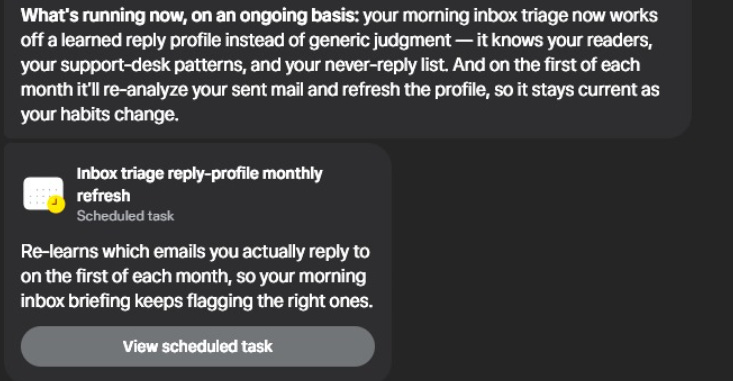
I’m an inbox-zero guy. I maintain four Gmail accounts and make sure all of them are at inbox zero before I go to bed. So while I didn’t really need Muse to manage my email, every once in a while an email or two slips through without a reply. I asked Muse to go through all my sent emails to learn what sorts of emails I typically respond to, and to ping me whenever it thinks I’ve left something unanswered that I’d likely want to respond to. Muse will repeat this exercise every month to keep its understanding of my habits up to date.
I grew up watching and playing cricket in Bangladesh. In fact, listening to English cricket commentary is mostly how I learned to speak English. Ever since moving to North America, I’ve found it a bit challenging to keep up with cricket. Now Muse sends me a daily summary of what’s happening in the cricket world. I’ve also asked it to track a number of data points I’m interested in and report on them daily (e.g., GPU prices, the number of App Store ratings for Muse vs. ChatGPT vs. Gemini, insider buy/sell transactions of stocks I own, etc.).
I could probably go on, but I think you now have a good sense of the range of ways I’m using Muse on a daily basis. I’m currently using ~200 million tokens a week, well below the 500 million weekly token limit on the $20 monthly plan. I suspect that as I discover more and more use cases over the next few years, I’ll eventually get close to that weekly ceiling. One interesting side effect of using Muse as my personal agent is that I can now reserve Claude for the queries where I want the absolute highest intelligence. I basically use only Fable 5.1 (extra) for all my queries on Claude and don’t worry about hitting my limits.
Muse Hiccups
Perhaps the most recurring hiccup I’ve faced is whenever I’ve tried to shop with Muse. Although Amazon blocking Muse received a lot of attention, the reality is that almost every shopping website seems to have an adversarial relationship with Muse. I tried to order something from Lululemon yesterday, but Muse was unable to do it. I can understand some of the retailers’ reluctance: an agent that buys on your behalf may skip the browsing, the upsells, and the sponsored listings that many retailers monetize. Still, Meta really needs to figure out a win-win arrangement with retailers as soon as possible.
Nearly every shopping site I try is now blocking Instinct and Muse.
— matthew sigel, recovering CFA (@matthew_sigel) October 10, 2026
Are we cooked? pic.twitter.com/9RKCwRbBUm
Even canceling subscriptions has become a more onerous task for Muse as more and more websites seem to be blocking it. For example, I tried to cancel my subscription to The Verge yesterday, and Muse was unable to do it on its own.
Another hiccup I stumbled on every once in a while: Muse would ask me to do something even though it had done the very same thing on its own before. When I reminded Muse of that, it would try again and finish the task.
Since I’ve been using Claude’s most intelligent and capable models for work while using Muse mostly for personal use cases, I could “feel” the intelligence differential between the two. For the vast majority of my use cases, Muse doesn’t need frontier intelligence. But once you get a taste of frontier intelligence, it’s hard not to miss it, and I admit I sometimes did while using Muse.
Back in 2015, Alex Rampell wrote a now-famous line: “The battle between every startup and incumbent comes down to whether the startup gets distribution before the incumbent gets innovation.” It’s not fair to characterize the likes of Anthropic or OpenAI as mere startups given that their private market valuations equal or exceed Meta’s own, but the race between frontier AI and frontier-adjacent AI may have a similar corollary. Meta has the distribution and, with Muse, increasingly the product; Anthropic and OpenAI have the intelligence. The battle may come down to whether the frontier labs get product (and the distribution that comes with it) before frontier-adjacent players like Meta catch up on intelligence.
If Zuckerberg’s post today is any indication, it appears Meta will launch the much-anticipated Watermelon model this week. I am very curious to see whether I feel any tangible difference once Muse switches over to the new model. If it narrows the gap I’ve been feeling, that would be an early data point on the corollary above.
Muse ordered me 🍉 how thoughtful! pic.twitter.com/1M2lImJdkB
— Mark Zuckerberg (@finkd) October 12, 2026
Overall, after a month of heavy use, I am fairly confident that Muse and Muse-like agents are here to stay. Anyone proclaiming that personal agents are destined to fail may look smart in the short term, but will almost certainly be wrong in the long term. I’m not wedded to any prediction about the exact shape of the adoption curve, and as I alluded to earlier, I am the bottleneck here in figuring out what else I can use Muse for. Remember, the wheel is more than five thousand years old and the suitcase is a century old, yet putting one on the other took until 1970. “Obvious” is an inherently retrospective category; in prospect, every obvious idea is blocked by something that isn’t necessarily technology at all. So I’m sure ironing out the hiccups will be a slog for Meta (and anyone entering personal agent space), but the benefits are substantial enough for this solo entrepreneur that I’d be surprised if these agents don’t lead to an acceleration in entrepreneurship and higher overall economic growth in the coming decades!
Subscribers get the daily journal and five+ years of Deep Dives, i.e. full-length analyses with financial models on 70+ companies. The daily is just how I think out loud between the Deep Dives!
Current Portfolio:
Please note that these are NOT my recommendation to buy/sell these securities, but just disclosure from my end so that you can assess potential biases that I may have because of my own personal portfolio holdings. Always consider my write-up my personal investing journal and never forget my objectives, risk tolerance, and constraints may have no resemblance to yours.
My current portfolio is disclosed below: