First Impression of Muse
Meta launched Muse yesterday which is Meta’s attempt to be your personal agent to get things done for you. Meta’s launch blog post as well as its approach to security are both worth reading.
Meta launched Muse yesterday which is Meta’s attempt to be your personal agent to get things done for you. Meta’s launch blog post as well as its approach to security are both worth reading. In my post, however, I will share my personal experience of using Muse since yesterday.
Before Muse, I poked around a bit with Instinct, a startup that has created a bit of buzz in the personal agent space but still in private beta. My very first impression of using Muse was that it seemed a pretty good clone of Instinct. But once I spent more time on Muse, I thought labeling Muse as a clone of Instinct is a very uncharitable framing.
Like Instinct, you can use Muse on WhatsApp (I didn’t see iMessage integration which you can do with Instinct). But Muse also has its own app which I installed to play around throughout the day. While the WhatsApp version seems just as barebone as Instinct, the app is much more feature rich. The app is available only in the US so far. Given ~40% of my subscribers are from outside the US, I wanted to give you a better feel about the app just by going through my own experience with ample screenshots along the way.
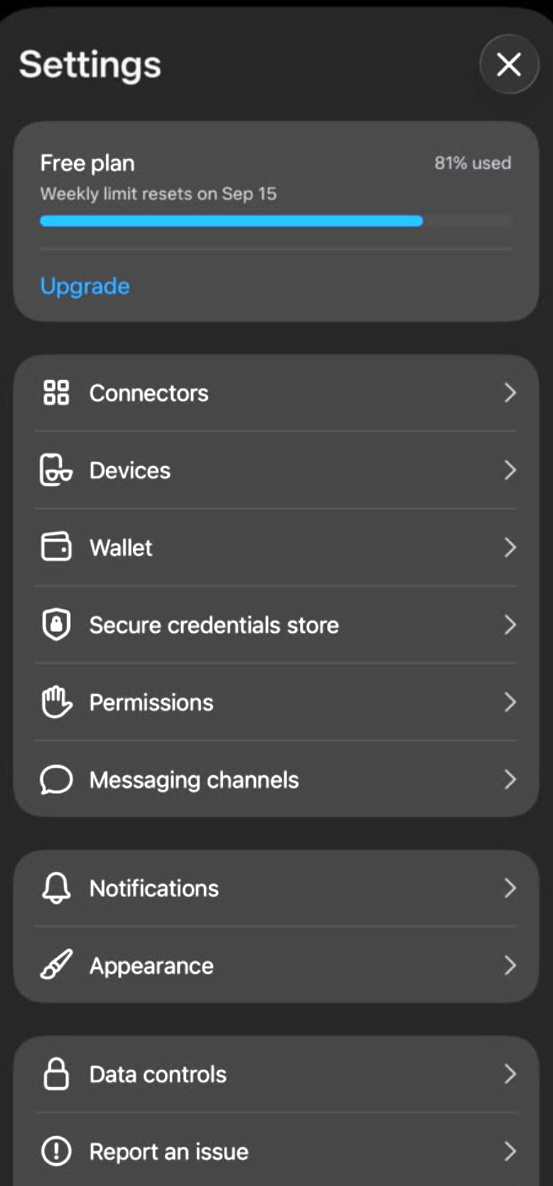
Muse has a very generous free tier. Zuckerberg mentioned in an interview yesterday that the free tier has up to a 100 million weekly token usage limit. While that sounded plenty to me at first, as of this writing, I have already used 81% of my free plan’s weekly limit. I have an option to upgrade to two plans: a) Power ($20/month with 500 million weekly Muse tokens), or b) Maximum ($100/month with 3 Billion weekly Muse tokens).
First of all, the app is FAST! The fluidity of chatting and the snappy feeling of Muse’s response just kept the conversation flowing.
The best use case that I have found so far is I can finally connect all my Gmail accounts with Muse. While using Claude or ChatGPT, one of my persistent problems has been that I can only connect one Gmail account (for what it’s worth, Instinct can do this too). Unfortunately, I have four separate Gmail accounts (one for personal, one for business, one from Cornell, and one that I randomly opened and very sporadically use). The problem is I have used three of these Gmail accounts in different settings and given Gmail’s own poor search functionality, I actually need an AI to go through all my Gmail accounts simultaneously to find a specific email I am looking for. For example, for tax purposes I needed to find the exact date we moved from Ithaca to Sacramento in 2023. If I could find the flight ticket from my email, I can easily figure out the exact date we reached in Sacramento. But I don’t exactly remember which email exactly has that flight details. But Muse can look into all my Gmails simultaneously to let me know the exact date. I have also set up a recurring task with Muse that lets it triage all my emails every day at 5 am and surface the most important emails I need to respond to and nudge me again if I haven’t responded by 6 pm.
I also liked Muse’s “Connectors” which let me connect a bunch of apps from my phone. Once connected, it’s a lot faster for Muse to do the work that needs the data from the app. As I will show later, even if you don’t connect the app, Muse can manually work in its own browser to try to complete a task.
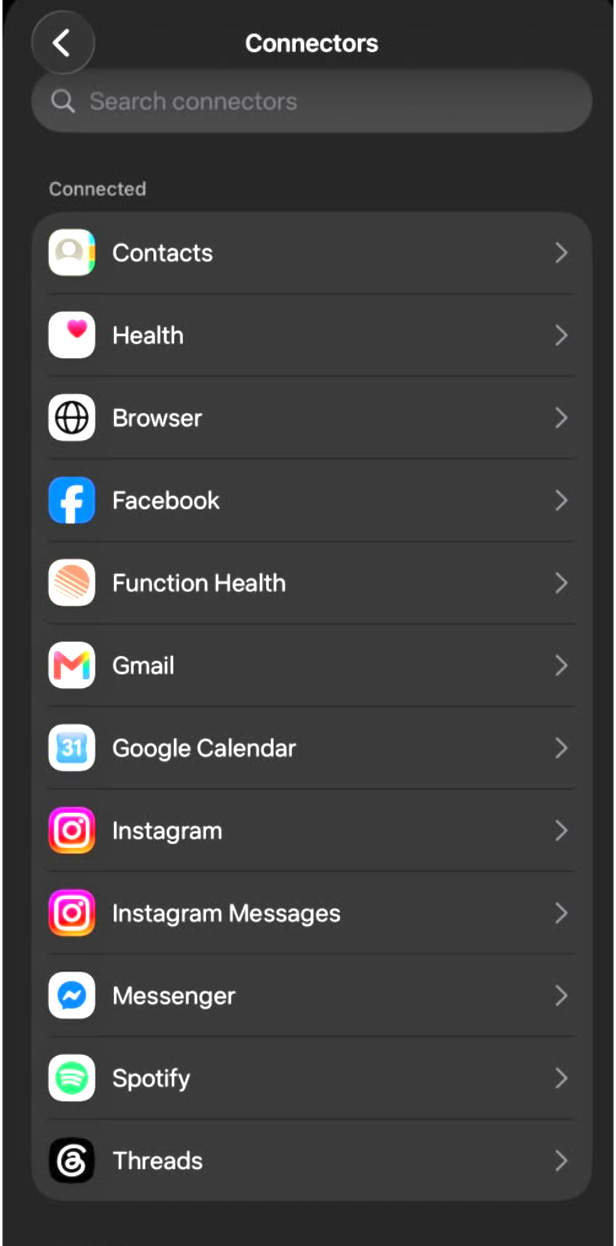
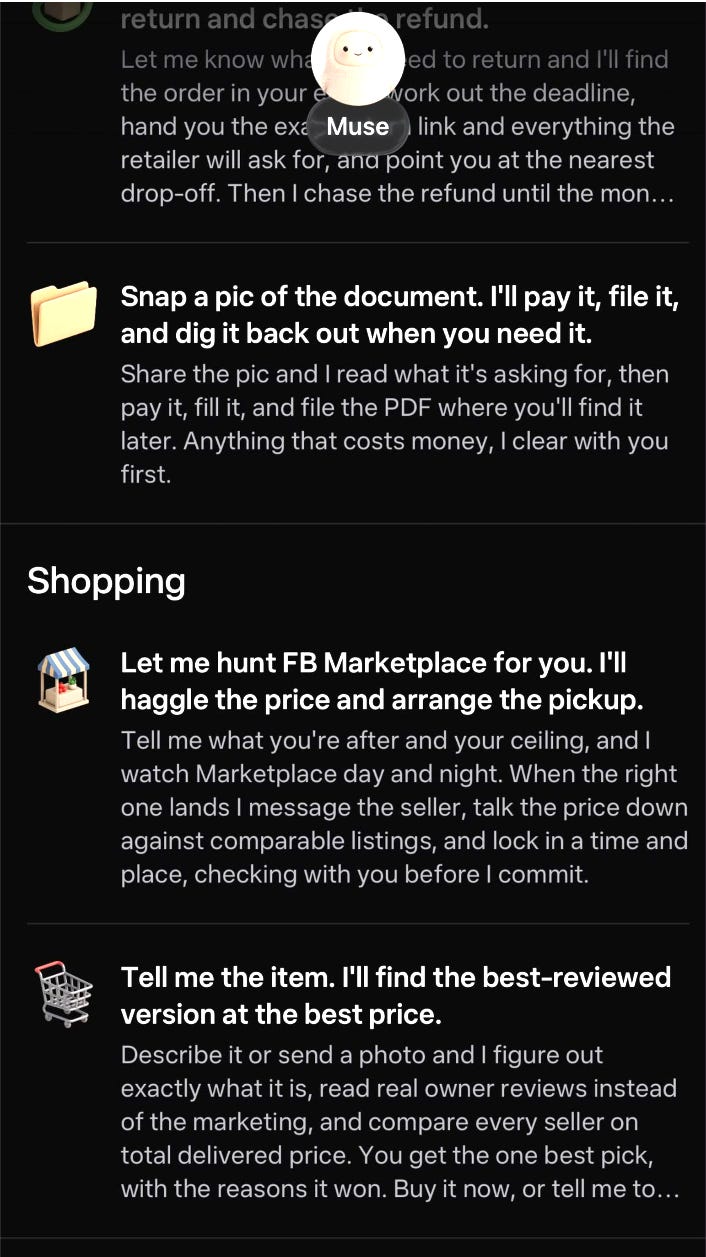
Such integration can also be handy if you’re trying to buy or sell something on Marketplace. I haven’t tried this myself, but it is one of the highlighted use cases by Muse itself.
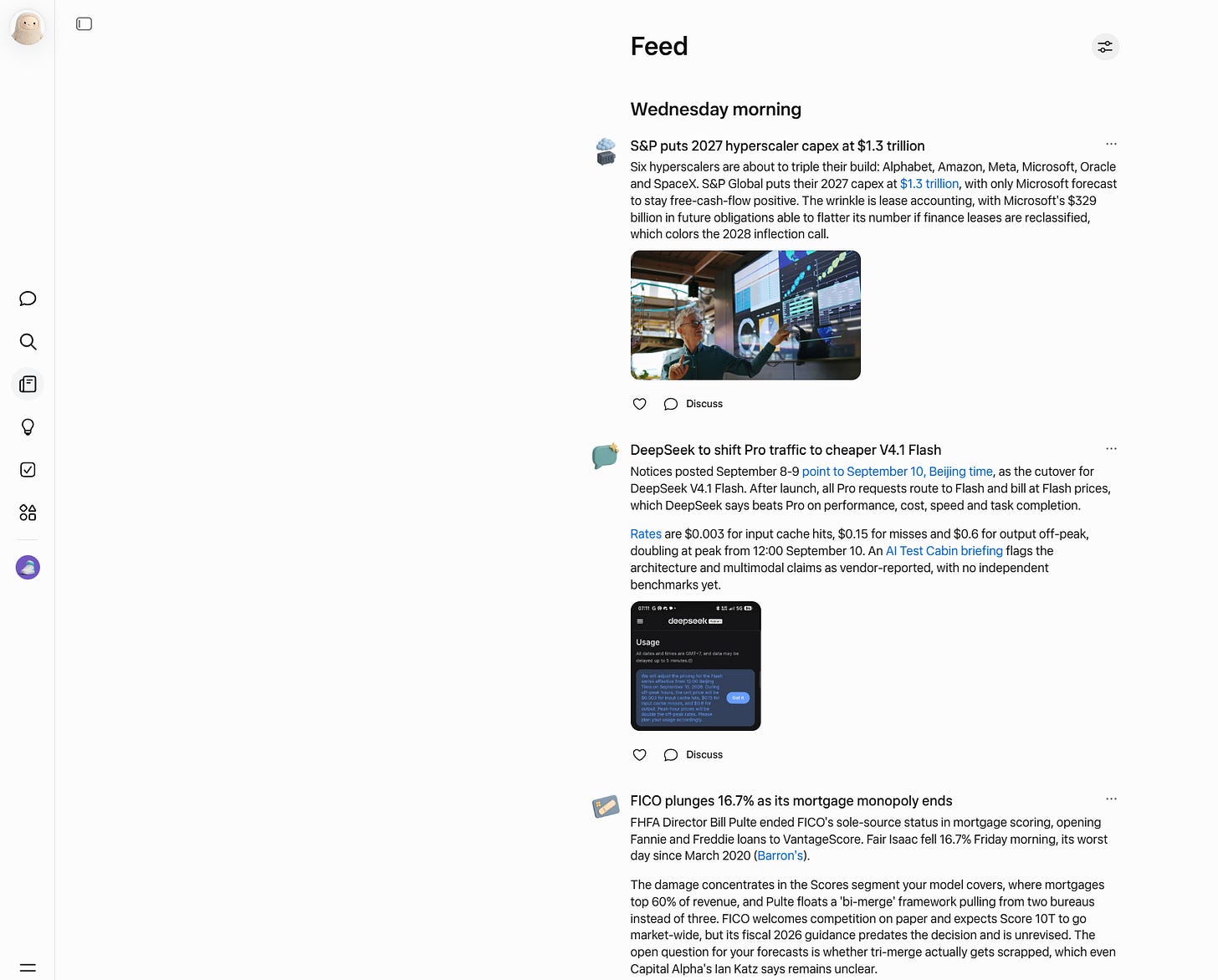
While the whole conversation happens on a “main chat”, I could also create a “side chat” to talk about a specific thing there. I dropped a couple of podcasts on the “side chat” and asked key points discussed in the conversation. Muse initially resorted to browsing and the media coverage of the episode instead of actually going through the conversation itself. I asked it to actually go through the podcast and then find me the 10 most interesting direct quotes from the conversation. It didn’t do this right away, rather did the job overnight and surfaced the quotes when I opened the app next morning. I also could connect it to Quartr and ask it for summaries from the sell-side conferences that’s going on at Citi and Goldman Sachs. This isn’t, of course, unique to Muse as any chat bot can do the same. But since it learns from my queries, the “feed” continuously keeps surfacing the news flow I might be interested in. If I want to engage in a particular news item, I can chat specifically on that news item by clicking “discuss”.
Theoretically, Muse can do pretty much anything I can do on my phone. Okay, let’s go through some tasks then one by one.
Let me start with booking accommodation, which has been pretty much every consumer chat bot’s highlighted use case, including Meta. So, I asked Muse to look for an Airbnb for a family trip (8 adults) near Mendocino from December 26 to 31 this year. I was just testing Muse’s capability, so an actual query would require me to share much more contexts than I did. Anyways, Muse used its browser functionality and basically approached it the way any human would: go to Airbnb, fill in the destination, dates, number of guests etc. and go through the search results. After it went through search results, it showed me a wall of texts with different options which you can see below. Brian Chesky has been quite adamant that text based interaction will not work very well for travel booking and a more visual search is required to bridge the gap between hype and actual consumer behavior. When I went through Muse’s suggestions, there are two ways I could go about it: a) just accept whatever Muse is suggesting, and b) actually click through each of the suggested options and carefully assess which one I actually prefer. I’m skeptical that most people will choose the former, and if you choose the latter, are you really saving much time here instead of just going directly to the Airbnb app itself?

Again, just to test out the capability, I played along with Muse and asked it to pick the first one. It then went ahead and worked to finish the booking until Airbnb asked for payment. I denied the payment since I wasn’t actually trying to book the Airbnb.
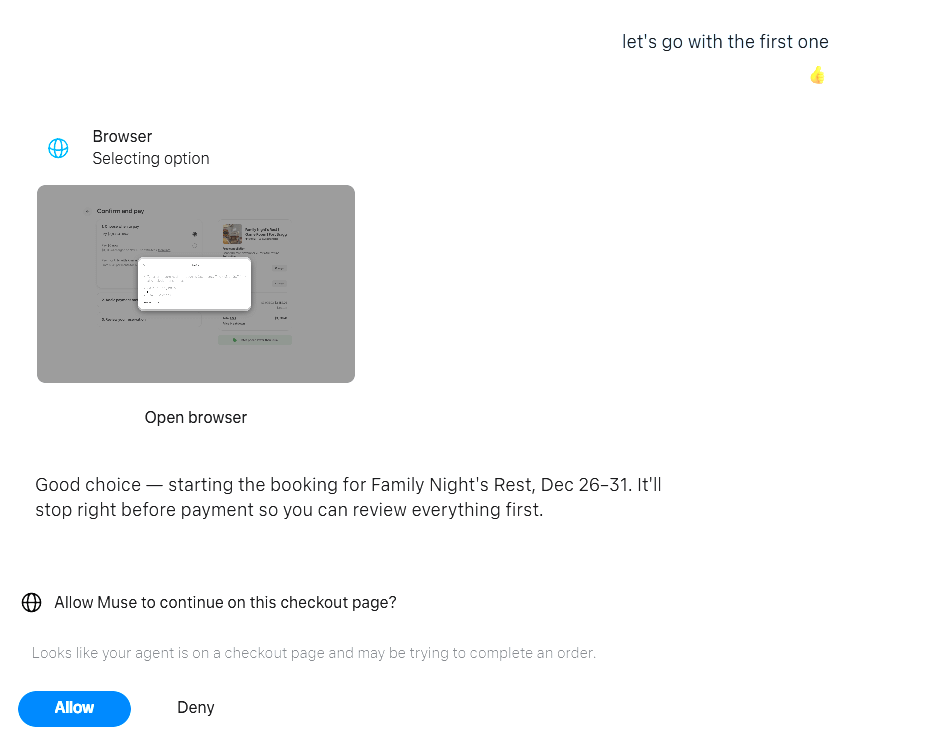
Muse then sent me an interesting message. It explained even if I allowed the payment, it wouldn’t be able to finish the booking itself as Airbnb requires an account to complete the reservation. I could give it my Airbnb sign-on details after which it could finish the booking. So, it’s very much theoretically possible, but I don’t see how this is a better way to book an Airbnb than just going to the app directly…yet.
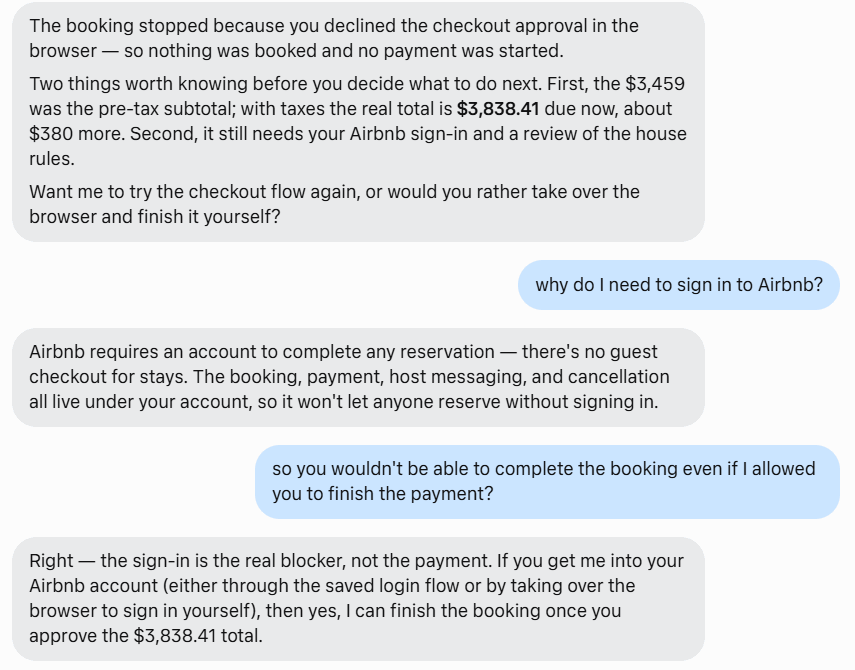
There is, however, a tangible risk for Airbnb or any OTA out there. I could ask Muse to find out whether the Airbnb it picked is available at a lower price anywhere else on the internet. Muse tried, saw two options, but eventually found those listings to be inactive on those platforms. Airbnb may look fine in this example, but obviously there are indeed plenty of inventory that is multi-listed on different platforms or their own websites. In fact, I don’t have to manually ask this to Muse every time I book an Airbnb. I can just ask Muse to look into any accommodation or flight I book and always first figure out whether there is a cheaper way to book it. Once it’s saved in Muse’s memory, Muse can automatically do this without ever being asked again.
Going through this flow was a good reminder why Booking’s “connected trip” vision or Airbnb’s desire to broaden its core to experiences, and services (especially car rental, luggage storage etc.) could be of paramount importance for them to incentivize customers to go to the app directly instead of asking the agent to book something. Similarly, being the merchant of record also seems very important as it would allow Airbnb to offer Reserve-now-pay-later (RNPL), insurance etc. to give customers additional reasons to stick with the app experience.
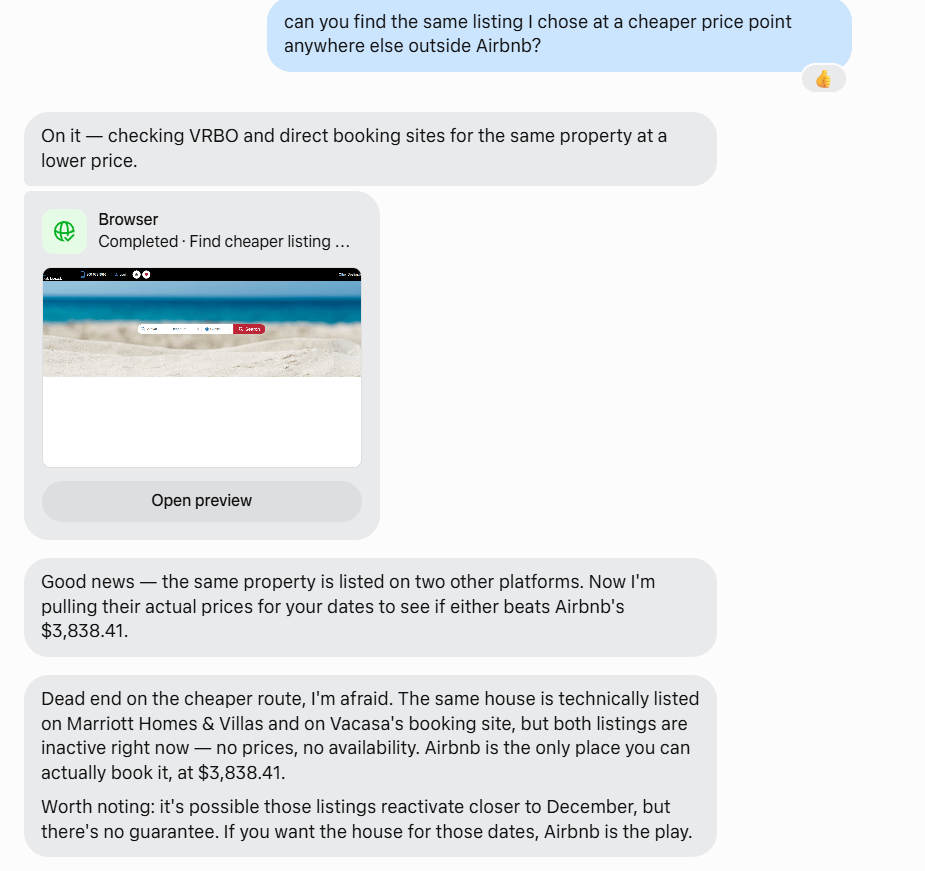
Let’s try some shopping, shall we?
I asked Muse to do winter jacket shopping for me. It browsed for a couple of minutes and then showed a list of options to choose from.
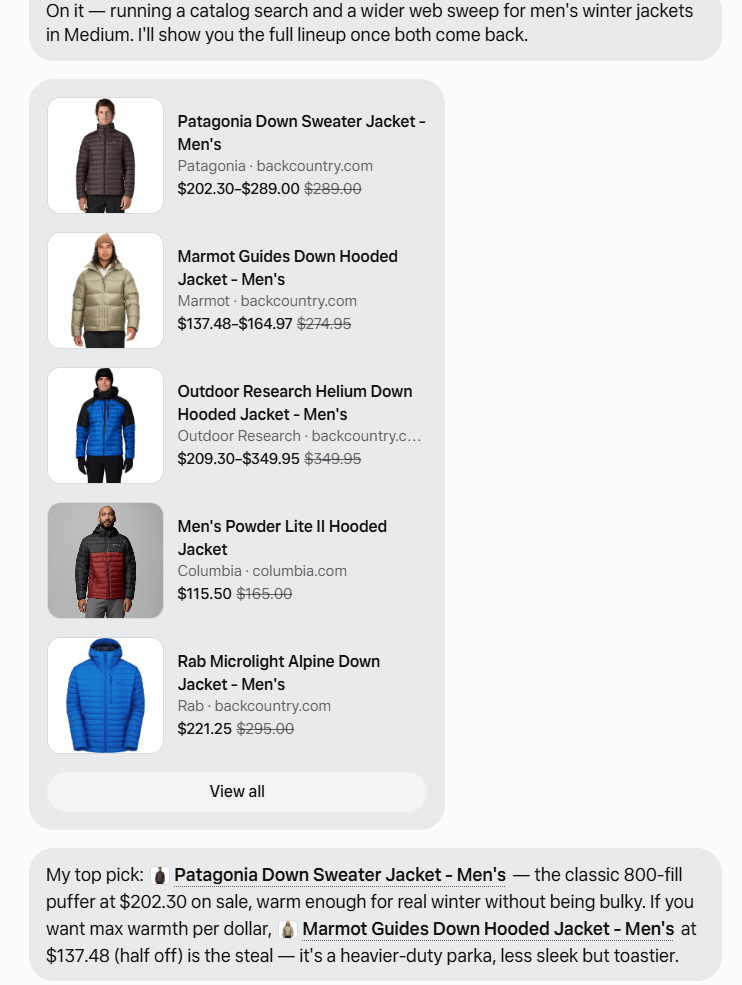
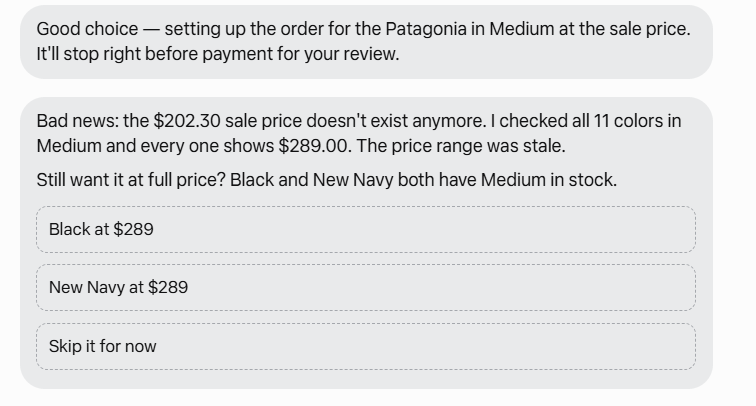
I went with Muse’s suggestion and asked it to buy one from Patagonia. Then it let me know that it was showing me the wrong prices. The discount it showed me earlier is no longer available. Why did Muse get it wrong? Muse said it ran “a catalog search and wider web sweep” while looking for a winter jacket. A catalog search almost certainly means a merchant product feed, most likely Meta's own Commerce Manager catalogs that retailers upload for ads and Shops. Feeds are batch-updated, typically once a day, sometimes less, and merchants tune them for ad delivery rather than for real-time accuracy. So the shortlist was likely built from a snapshot, rather than real-time feed.
Later, I asked it to buy men’s deodorant from Amazon. It did everything fine and after sharing my Amazon credentials, I just needed to allow the payment. But I noticed it was showing me that the product will be delivered on September 15. I quickly went to my Amazon app and searched for the same product on the app and I could see there are a couple of options of the same product that can be delivered in two days. So, I asked Muse to stop the transaction and I just ordered it from Amazon app directly.
Then for dinner, I wanted to see if Muse is up to the task of ordering via DoorDash. I asked it to show me some healthy options from Chipotle which I wanted to pick up myself. You can see our interaction below.
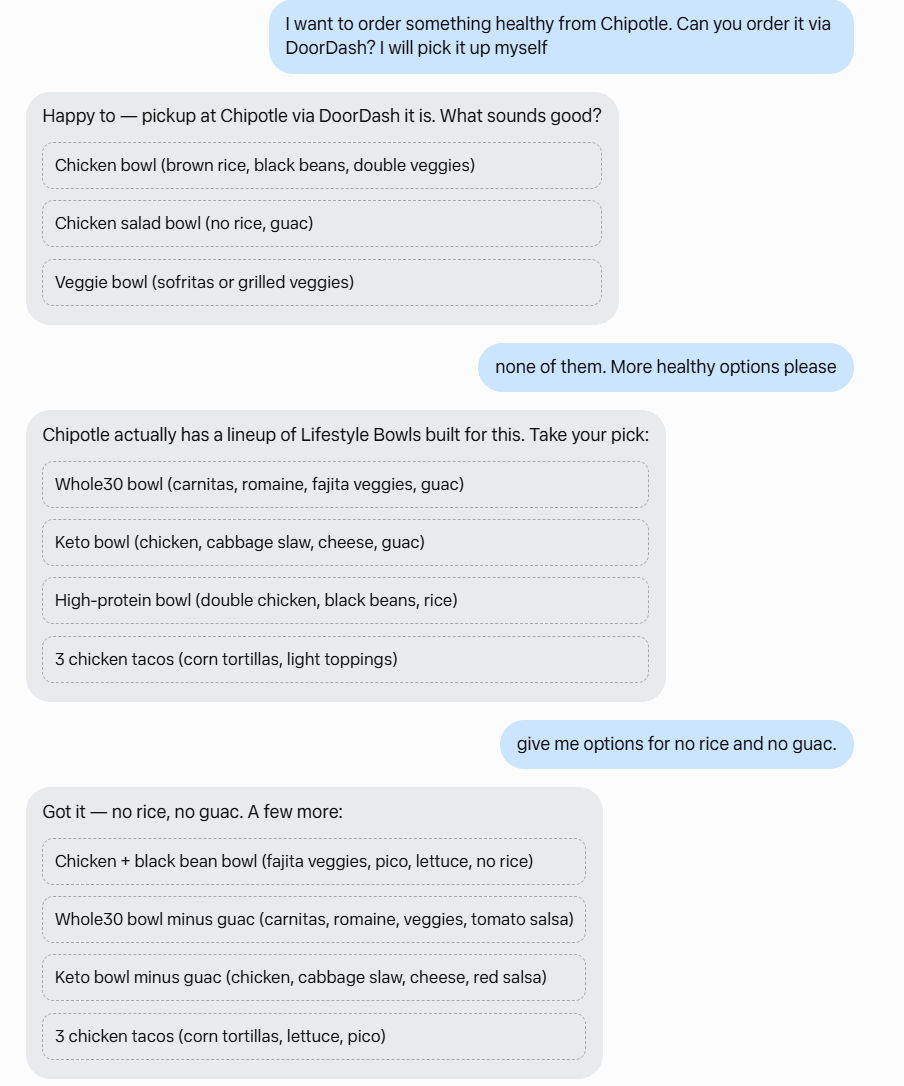
After some back and forth, I picked the chicken+ black bean bowl. To be clear, at least half the time I typically don’t know what I would like to order from DoorDash. I usually browse the app and it is through the browsing experience, I typically end up deciding what to order. So, this is far from my typical way of ordering food. I was just trying to test what Muse can do with a relatively simple food ordering query. Anyways, after picking an option Muse offered, I was prompted to share my DoorDash login credentials. I asked it to use my Gmail account to login. It tried but it got stuck in log-in circular hell. It would try to login, Google would let me know someone’s trying to login to my DoorDash account, I would confirm “it’s me”, and the whole process repeated three times after which I gav
For what it’s worth, I personally found these issues prevalent even while using Instinct. I tried the same Airbnb queries that I did with Muse. It took literally an hour, I kid you not, for Instinct to respond to my aforementioned Airbnb query. When I tried the DoorDash query on Instinct, it still took 8 minutes to respond. After experiencing Muse’s speed, the bar just became too high for a startup such as Instinct which probably cannot afford as much compute as Meta is throwing at these problems.
As you can see, there are still plenty of issues Meta (or any consumer agent) needs to work on to make it a very seamless experience. While it’s hard for me to see myself using Muse at the expense of apps such as Airbnb, DoorDash, or Amazon, it’s simply too early to either write Muse off as another flailing attempt at owning the consumer agent layer or assume Muse’s victory given its ample compute budget. I do sense a lot of switching costs though once I connect all my accounts and share login credentials with one agent. I would be very reluctant to repeat this whole process with another agent without a materially compelling incremental benefit. As a result, Meta is doing the right thing by being agile and increasing such switching costs by onboarding people before other alternatives show up. Google will almost certainly try to replicate this, and the longer they wait, the better it is for Meta as it may lead to a noticeable first-mover advantage especially among power users which seem to be the most attractive user segment in AI. OpenAI is also a leading candidate to offer something similar, but I suspect even they would be reluctant to offer weekly 100 million free token usage given their ability to monetize Codex at a very attractive rate. Indeed, my day 1 impression after using Muse is that Google seems to be the key loser here. The choice increasingly appears to me between apps and a consumer agent, rather than search. Over time, it’s hard to imagine anyone else will have better context to my life than something like “Muse” if I keep using it everyday and it goes through all my emails and connector apps. I can change my mind later, but so far I don’t see myself using Muse to book a hotel, order a delivery, or do shopping on my behalf because the status quo feels to me a better and more seamless experience.
A big question to me is whether the power of such a consumer agent will graduate from personal switching costs to a bit of network effect. As of now, there are no visible network effects, but Zuckerberg indicated in an interview with Alex Heath yesterday that Meta is eyeing to eventually graduate from single player game. From the podcast:
Alex Heath: When you're introducing network effect learning for agents, which no one's really done, where basically the agents are learning anonymized insights from the rest of the fleet. I mean, you're like the king of network effects. I'm really interested in this idea because I don't think anyone's doing this.
Mark Zuckerberg: I think most of the industry is thinking about agents as like a single player game. Where it's like you have your agent and you use it. And there are going to be all these interesting things that basically you can do by having the agents interact with each other, and we already have all these interesting examples internally where people have their agents interacting with each other. This isn't, for the most part, rolling out in this release, but it's going to be an important part of how I think this works over time. As more of the people who you know start using Muse, it just gets better forever.
While using Muse, I kept wondering what exactly I need “Meta AI” app for. It appears even Zuckerberg isn’t entirely sure, and it seems these two apps can converge over time. From the same interview:
Alex Heath: …it coexists with Meta AI? Or do you see those as separate?
Mark Zuckerberg: Yeah, I think so. We'll see over time. I mean, I think right now they have somewhat different flavors. I mean, I use both of them. I mean, Muse is, you know, it's more conversational and it kind of interprets the questions that you ask it more as trying to understand you and what you might want over the long term. So it's more likely if you ask it something for it to just go off and work on. I think that's more the type of thing that I use Meta AI for. But we'll see. Maybe they'll converge over time, but I'm not sure.
I haven’t seen Meta send me a notification for Muse on the Facebook, Instagram, or WhatsApp apps. Given the massive compute requirement to serve a product such as Muse for a billion users, I suspect Meta wants to scale this gradually and prefers to learn from feedback from early users and focus on scaling afterward once the product is ready for the mass market.
I will do another review of my personal use in a month just to share in case I see any evolution of how I use Muse. I suspect Meta (and other AI companies) focus too much on use cases in which existing apps already do a very good job. The real opportunity likely lies in tasks for which we don't have a good alternative or any alternative at all. I’ll look for such tasks going forward, and will share further thoughts in a month.
Subscribers get the daily journal and five+ years of Deep Dives, i.e. full-length analyses with financial models on 65+ companies. The daily is just how I think out loud between the Deep Dives!
Current Portfolio:
Please note that these are NOT my recommendation to buy/sell these securities, but just disclosure from my end so that you can assess potential biases that I may have because of my own personal portfolio holdings. Always consider my write-up my personal investing journal and never forget my objectives, risk tolerance, and constraints may have no resemblance to yours.
My current portfolio is disclosed below: