Floor & Decor 2Q'26: Tentative Green Shoots
Programming Note: Even though every Sunday I tend to write my personal musings, I’m skipping that this week given I have some earnings coverage left to catch up.
For the first time in more than a year, Floor & Decor (FND) reported a quarter and did not cut its annual guidance. FY25 was guided down at every revision i.e. three consecutive cuts across the four reports in 2025, and 2026 started with yet another cut in 1Q, so much so that I wrote last quarter I was a bit surprised they hadn’t given up on providing annual guidance altogether. Well, this time they got to keep it. The comp outlook was maintained at flat to -4%, adjusted EBITDA was nudged up to $550-$585 million from $545-$580 million, and adjusted EPS was raised to $1.88-$2.13 on the back of the 2Q beat and a greater expected contribution from buybacks. Management went out of their way to say they have “high confidence” in hitting the midpoint of the comp guide. Holding a guide is admittedly a low bar to celebrate, but given the last two years, it’s not nothing.
The headline comp itself was hardly inspiring: -2.1%, which makes it 13 negative quarters out of the last 14. As I mentioned in my 1Q recap, this one was near certain to be negative since April was already tracking -4.5% when they reported. What was much more encouraging is the cadence within the quarter: April ended at -5.1%, May improved to -1.3%, and June was almost flat at -0.3%. Transactions remain the primary culprit, but even that improved to -2.9% from -5.5% in 1Q, and average ticket grew +0.8% despite lapping last year’s strongest quarterly ticket growth of +3.8%.
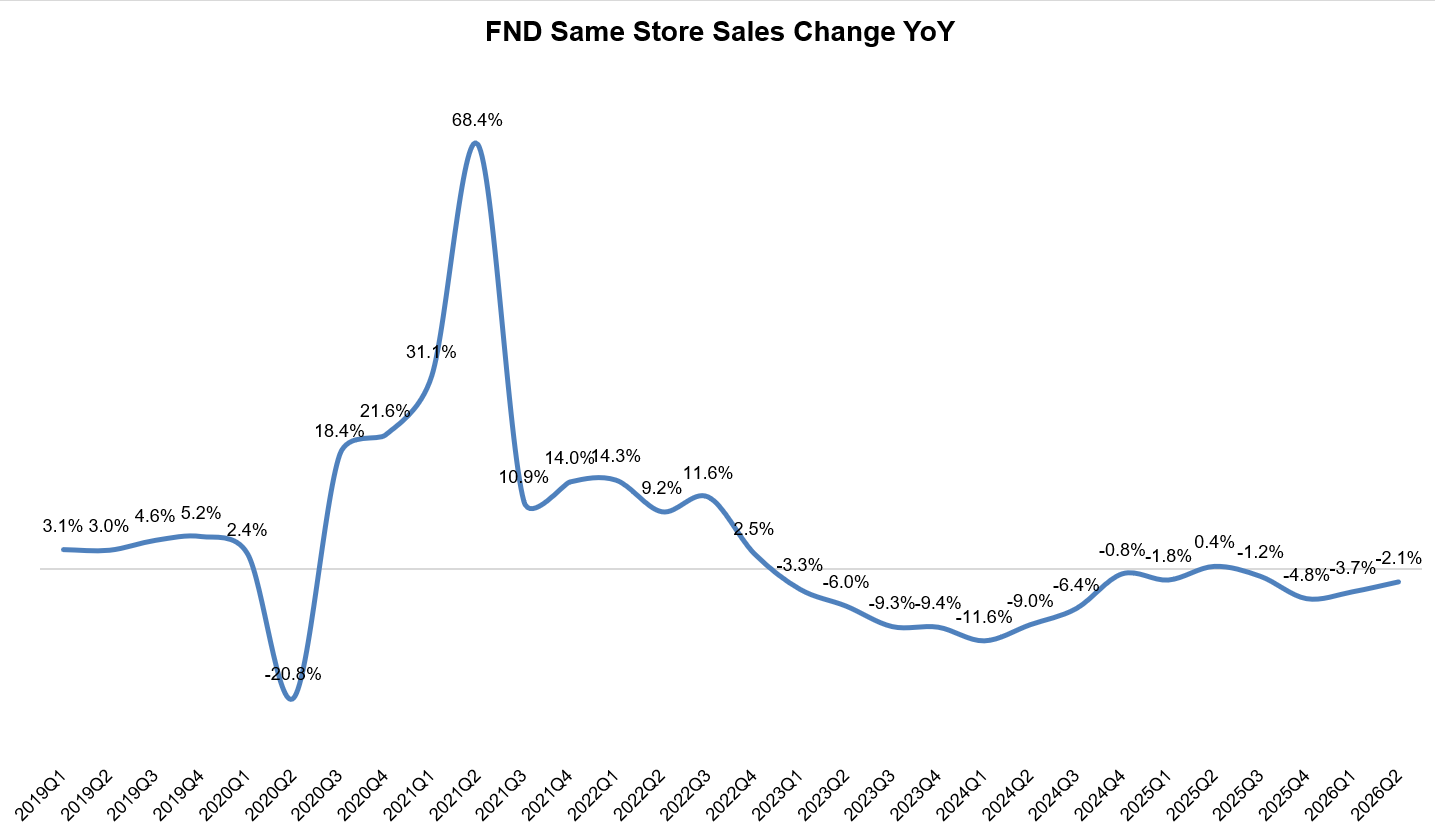
Just as I was wondering things may finally be turning a bit, it turns out July was a bit of a head-scratcher. Management mentioned “some pretty ugly days” around the July 4th holiday that they hadn’t seen in a while, before the business returned to the May/June run rate in late July and into August. 3Q-to-date comp stood at -2.2%. Importantly, none of this sequential improvement can be attributed to macro since US existing home sales (EHS) were still hovering around ~4 million annualized units in June, near historically low levels. Despite such subdued macro, two of FND’s three regions (West and now East) posted positive comps excluding cannibalization, and 8 of their 16 districts were positive on that basis.
Within different customer segments, the Pro market is the more attractive one, and thankfully, the Pro mix shift continued its steady march in 2Q’26. Pro sales grew ~4% YoY against a company that grew 3% and now account for ~55% of sales, up from half last quarter and only 35% in 2021. The new pro app launching next year, which will pull purchasing, loyalty rewards, pricing, and project management into one place, suggests the mix shift may not have peaked. Alongside that, online penetration reached 20.3% of sales (from 18.6% a year ago), and the company kicked off an 18-24 month digital transformation. None of this will move the near-term numbers much, but these are the kinds of investments that will be far more visible in the P&L once EHS normalizes.
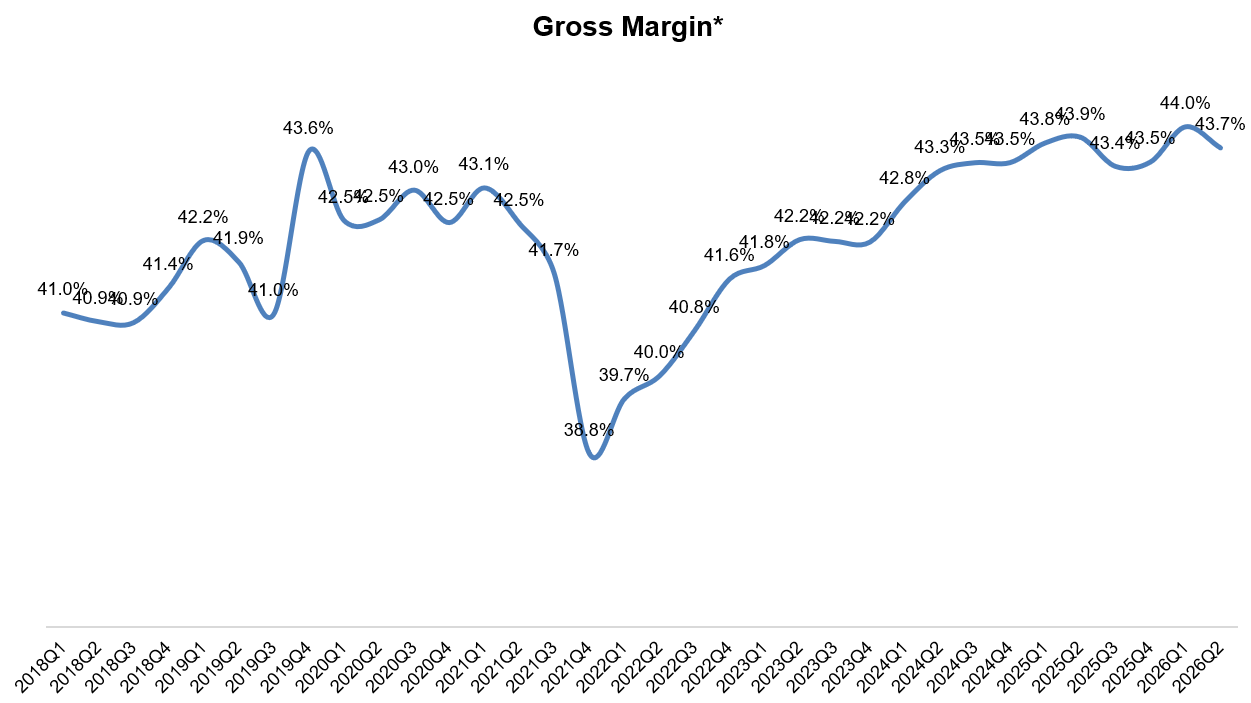
The GAAP optics this quarter were almost comically good: 48.2% gross margin (+430 bps YoY) and $0.89 diluted EPS (+53%), but almost all of that is the tariff refunds. I do want to note that these tariff refunds will keep affecting the P&L through the back half of this year. Adjusting for the refund, the underlying quarter was okay rather than spectacular: adjusted gross margin of 43.7% was down 20 bps YoY.
What I found most interesting from this call is what management intends to do with the tariff refunds. They laid out three buckets: offset the inflationary pressures they were otherwise bracing for (oil earlier in the year, and now rising domestic trucking rates), selectively invest in price where they see elasticity to drive share gains, and then the usual capital allocation waterfall. The competitive kicker here is that most independent flooring retailers source through two-step distribution and are not the importer of record, which means they will likely never see a tariff refund check. From the call:
“…when you think about tariff refunds, because they’re not the importer of record, unlikely that they’re going to get those tariff refunds and be able to reinvest into their business, which because of that, I think would prevent them from getting too aggressive around price or promotion in the second half of the year. Everything that we have seen, generally speaking, has been prices going up and certainly not going down.”
As I mentioned in the past, one of the core parts of my FND thesis was that “FND may even look at this period a decade from now as a blessing in disguise since this severe softness in existing home sales may be contributing much more to eliminate competition than investors are appreciating”. The tariff episode looks like yet another asymmetric blow: FND absorbed the tariffs with scale, got the money back with interest, and can now reinvest it in price especially where independents cannot follow. The longer this cycle drags, the more lopsided the eventual competitive landscape becomes.
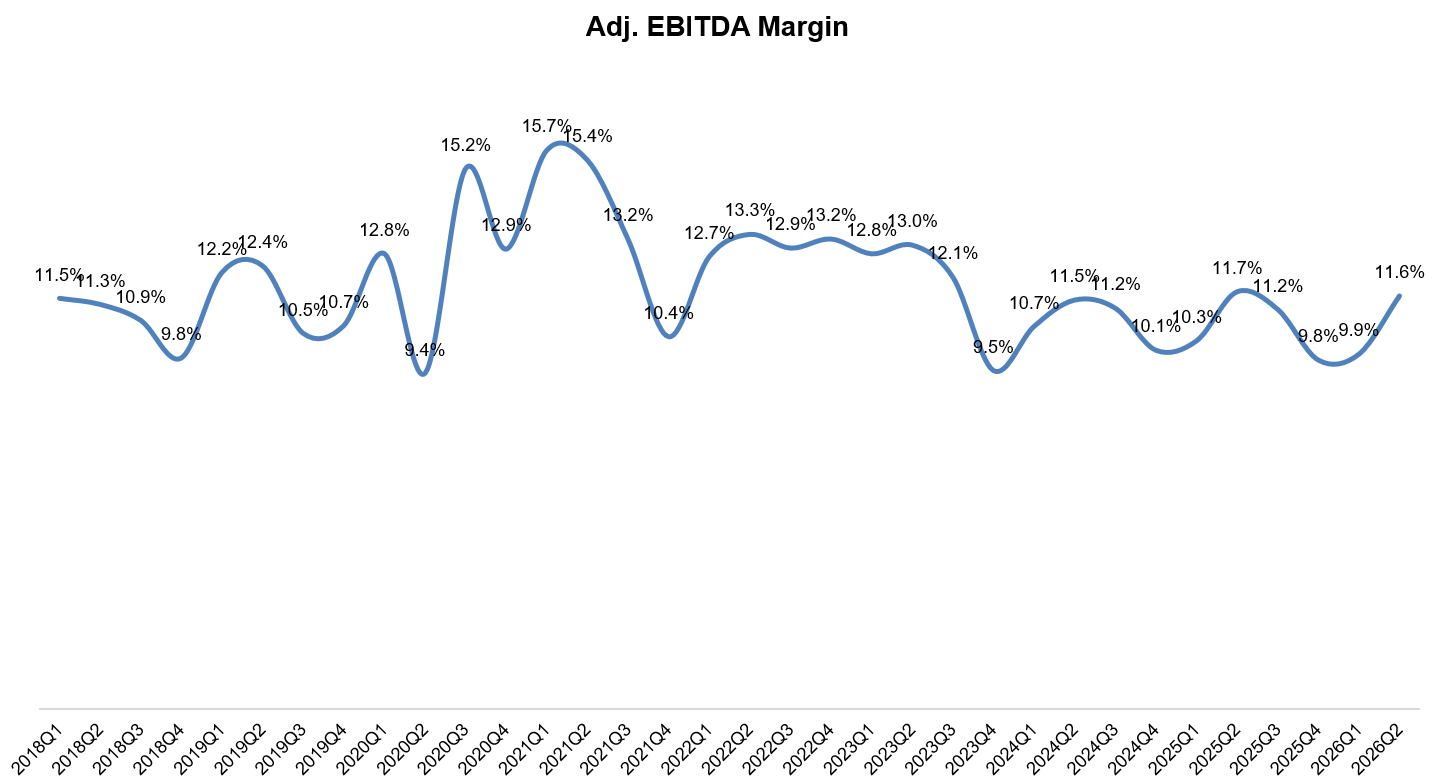
Like gross margin, adjusted EBITDA margin also went down slightly. Please note while management’s adjusted EBITDA definition adds back SBC, I do not. In some sense, I do find it rather impressive that despite posting 13 of the last 14 quarters negative comp, the company has been largely able to maintain double digit EBITDA margin. If FND can navigate one of the worst EHS trends in decades while maintaining double digit EBITDA margin, it bodes well for the future margin once the cycle turns.
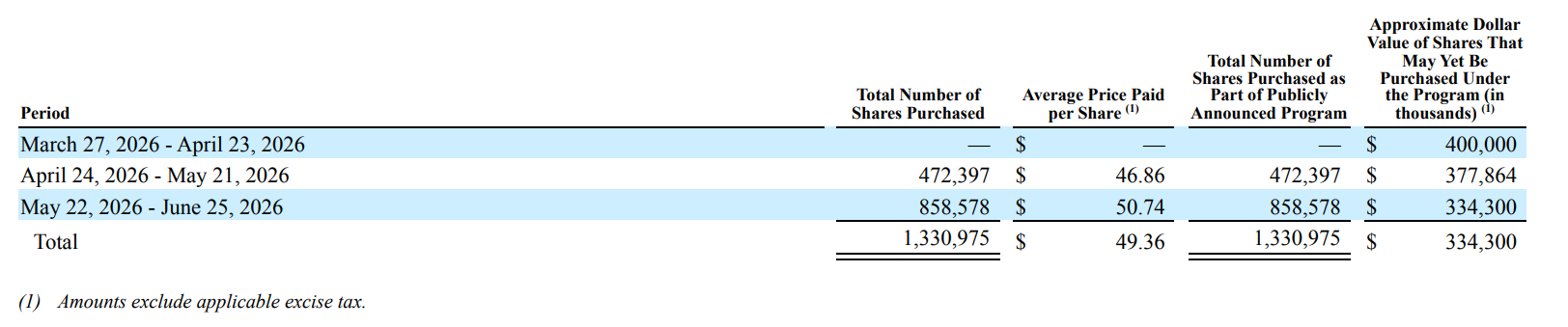
Inventory was up just 0.7% vs year-end. More importantly, in 1H’26, FND generated $278 million of operating cash flow (vs $155 million in 1H’25), and that was despite the ~$90 million tariff refund receivable that only converted to cash after quarter end. So 2H cash flow will get that boost too. FND also began executing the $400 million buyback announced last quarter: in 2Q’26, they repurchased ~1.3 million shares (~1.2% of shares outstanding) at $49.36/share. I believe buyback at these prices will prove to be excellent capital allocation decision over the long-term. The full-year capex guide was also trimmed to $240-$275 million.
Stepping back, my thesis for FND never required 2026 to be a good year, but it does require FND to keep taking share while the cycle grinds down its competitors and to be positioned for the other side whenever EHS mean-reverts, the timing of which remains way above my paygrade. On that note, this quarter was a bit encouraging: positive comps ex-cannibalization in two of three regions with EHS still stuck at ~4 million units, and a tariff windfall that landed asymmetrically in FND’s favor.
When an analyst pressed on whether this is finally the inflection, the new CEO Bradley Paulsen’s answer was, “I’m going to be really careful here because I don’t want to be the initiator of a false start.” Indeed, I have no idea whether the June exit rate marks the trough or just another head-fake in a cycle full of them, but the improving competitive positioning, Pro mix, and respectable margins even at cyclical lows keeps me comfortable that the downside is limited and the eventual upside skew is intact.
Subscribers get the daily journal and five+ years of Deep Dives, i.e. full-length analyses with financial models on 65+ companies. The daily is just how I think out loud between the Deep Dives!
Current Portfolio:
Please note that these are NOT my recommendation to buy/sell these securities, but just disclosure from my end so that you can assess potential biases that I may have because of my own personal portfolio holdings. Always consider my write-up my personal investing journal and never forget my objectives, risk tolerance, and constraints may have no resemblance to yours.
My current portfolio is disclosed below: