DoorDash’s FBA Moment
In my DoorDash 3Q'26 piece, I said I wanted to think more about the DashMart angle of the Instacart deal. I don't think DashMart is the main reason DoorDash is paying ~$17 billion for Instacart.
In my DoorDash 3Q'26 piece, I said I wanted to think more about the DashMart angle of the Instacart deal. I don't think DashMart is the main reason DoorDash is paying ~$17 billion for Instacart. On the 3Q'26 call, the CFO's list of synergies started with cross-listing (DoorDash's restaurants on Instacart) and advertising, and the letter said the denser grocery network should help from day one after close. But the shareholder letter also described the scale DashMart's warehouses need as one of the reasons DoorDash was attracted to Instacart, so I have been wondering whether DashMart can turn out to be something more substantial than what most investors imagine today.
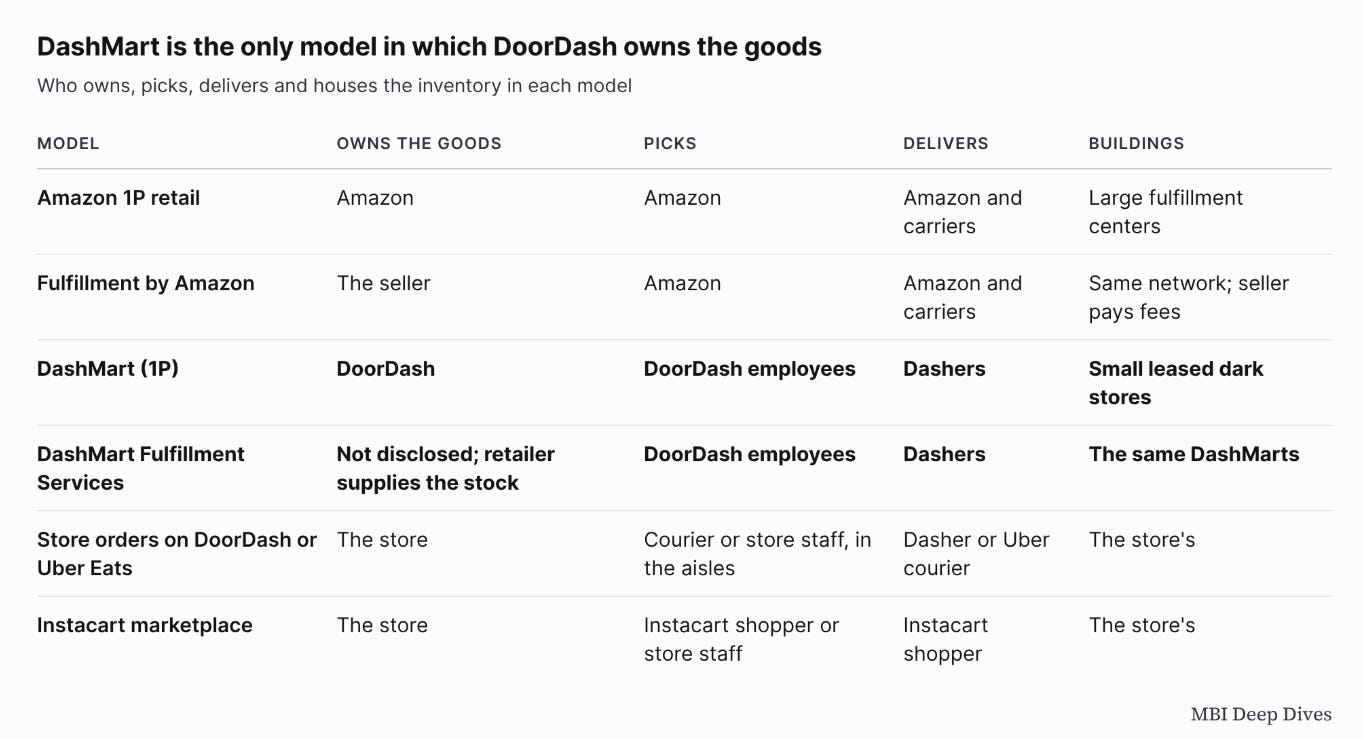
DashMart is DoorDash acting as the retailer. Since August 2020, DoorDash has leased small warehouses that are closed to the public, stocked them with everyday items it buys itself (~2,000 per site at launch), and had its own employees pick each order before a Dasher collects the bag. In the US, it is the only part of DoorDash that owns what it sells.
In September 2025, DoorDash opened the same buildings to other retailers through DashMart Fulfillment Services. The retailer supplies the products, and DoorDash stores them, keeps count of them, picks the orders and delivers them. CVS and Party City came first, and DoorDash now says it manages “thousands of high-quality products from Giant Eagle, Albertsons, and others.”
Why would an asset-light marketplace want warehouses? Because the store-based version of grocery delivery has a problem that better logistics alone hasn’t fixed. Here is Tony Xu on the 2Q’26 call:
“One of the things that we learned five years ago when we launched our grocery business, even though it’s going so well and we’re helping lots of grocers compete, is that there’s this structural challenge with grocery delivery where grocers don’t know their inventory. In some ways, it’s almost impossible for a whole host of reasons, one of which is because consumers come in and they move things around. It’s a very difficult proposition then to offer customers a use case where you’re asking them to pay a premium for delivery, but they don’t get exactly what they ordered.”
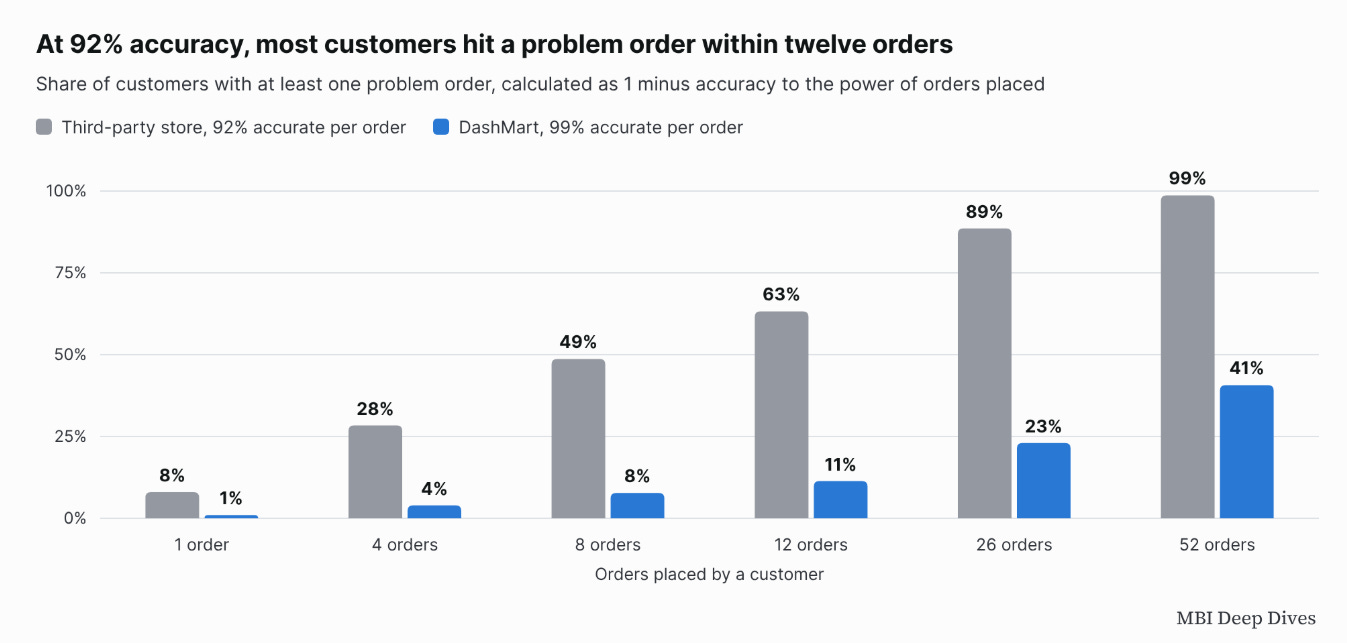
DoorDash was even more specific during the most recent earnings call. Orders fulfilled from DashMarts are 99%+ accurate, while orders shopped from third-party stores are only in the "low 90s," and DashMart orders arrive more than 10 minutes faster on average. A gap of seven or eight points may not sound like much, but grocery is a habit and errors compound across orders, and they compound faster the more often someone orders.
For example, in December 2025, ~10 million customers placed at least one order on Instacart, which did 89.5 million orders in 4Q’25, so an active customer orders about three times a month. If each order has a 92% chance of arriving exactly right, ~63% of customers will have hit at least one problem order within twelve orders. At that pace, about half of active customers would run into a problem order every quarter, which is certainly…not ideal! However, at 99% accuracy, that falls to only ~9% of active customers a quarter (the math assumes errors are independent from one order to the next, which is a simplification).
This is obviously not just a DoorDash problem. Instacart, which has spent 14 years getting good at shopping other people’s stores, said on its 4Q’24 call that it made 300 million replacements in 2024. It did 294 million orders that year, so that is almost one replacement for every order. If DoorDash wants the weekly basket it is buying with Instacart to become a habit, it probably needs to know what is on the shelf.
The second reason is that picking online orders inside a store may be running out of room. In McKinsey's State of Grocery report from June, the grocers it surveyed said 57% of their e-commerce fulfillment is store-based, 26% goes through third parties (which I assume mostly means a gig shopper in the same aisles) and only 17% runs through a centralized site or dark store. Only 46% of them said e-commerce is profitable today. McKinsey also argued that manual picking in stores "tends to hit a ceiling at around 12 to 15 percent online penetration," and that the next wave of online orders may not be absorbed by adding more pickers to already congested stores.
Several grocers that tried to build the warehouses themselves have pulled back, and Kroger is the clearest case. Last November, it said its network of automated fulfillment centers had not met financial expectations, closed three of them, took a ~$2.6 billion charge and expanded its relationship with Instacart as its primary delivery fulfillment provider. The reason Kroger gave is the more interesting part. On its September call, Kroger's CEO had said facilities in high-density areas “deliver better results than those facilities where density is lower and customer adoption has been slower,” and in December he said Kroger would use automated fulfillment "in geographies where customer demand supports it." If one of the three largest grocers in the US could not fill some of its warehouses with its own orders, I suspect most grocers would find it harder still. That is the opening for a warehouse shared by many retailers and fed by more than one source of orders, which is what DoorDash is trying to build.
Running a warehouse, however, changes the nature of the cost. A shopper is paid per order, so the cost only shows up when an order does. A DashMart comes with rent, staff and inventory whether or not the orders show up, so it swaps a variable cost for a fixed one. DoorDash felt the weight of that in 2022, after it had expanded the network. On the 2Q'22 call, the CFO attributed about half of the YoY rise in cost of sales (as a share of order value) to DashMarts, and said DoorDash would alter the pace of investment if unit economics, retention and order frequency didn't keep improving. By 4Q'23 the CFO said DoorDash was happy with the footprint and that its priority was “to continue to keep the existing footprint while increasing volume”. DoorDash mentioned in 3Q’25 that it had more than 100 DashMarts. The 3Q'26 letter, however, highlighted the importance of scale:
“Managing inventory inside a warehouse is a fixed cost business. Scale is a necessary (though insufficient) input into helping lower costs. This is one of the reasons we’re attracted to Instacart, as it adds scale that is unique to our network.”
So DoorDash seems to have built a more accurate and faster service without enough volume to run through it, especially since its own grocery orders are mostly small fill-in baskets (~$50 by my estimate).
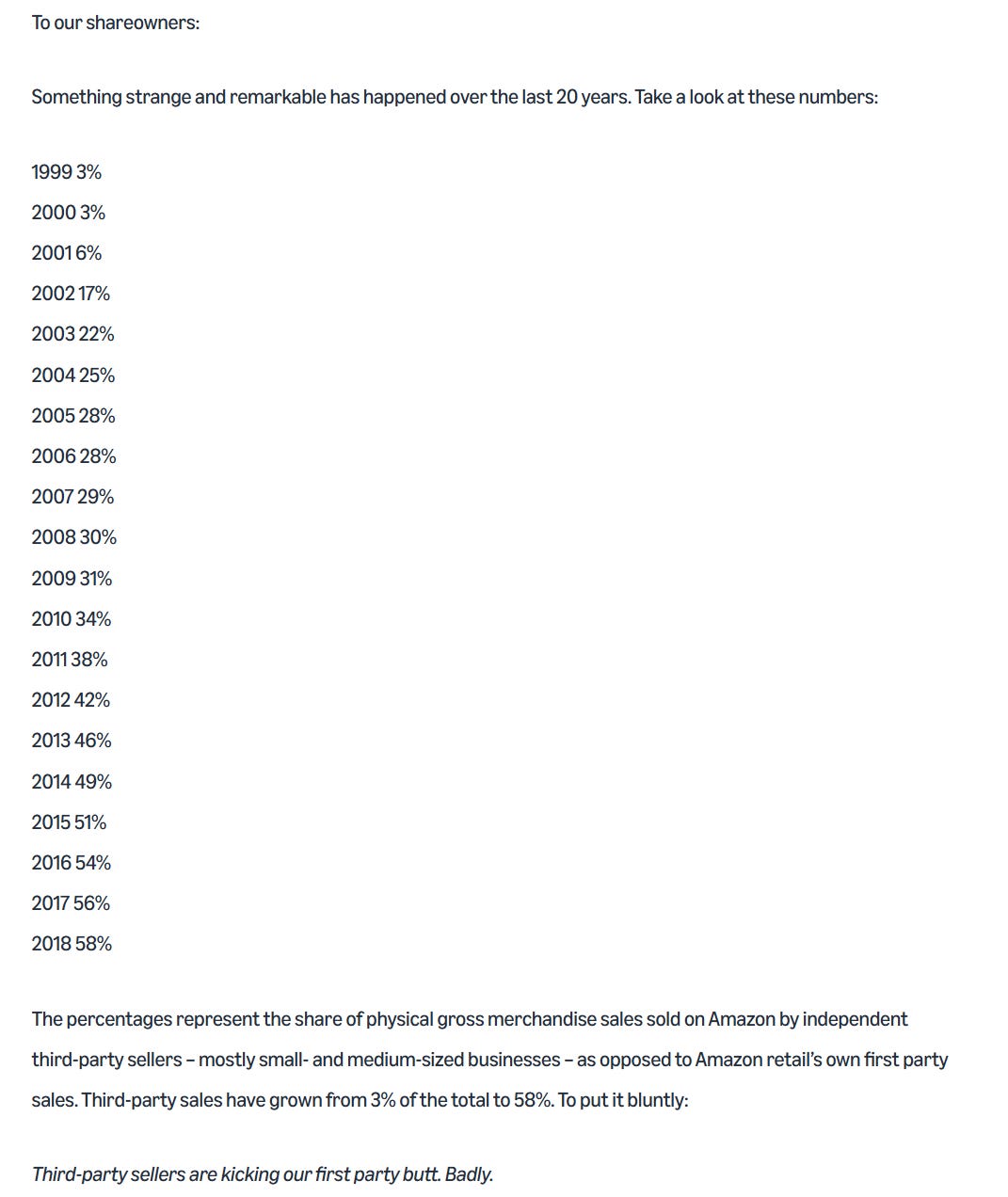
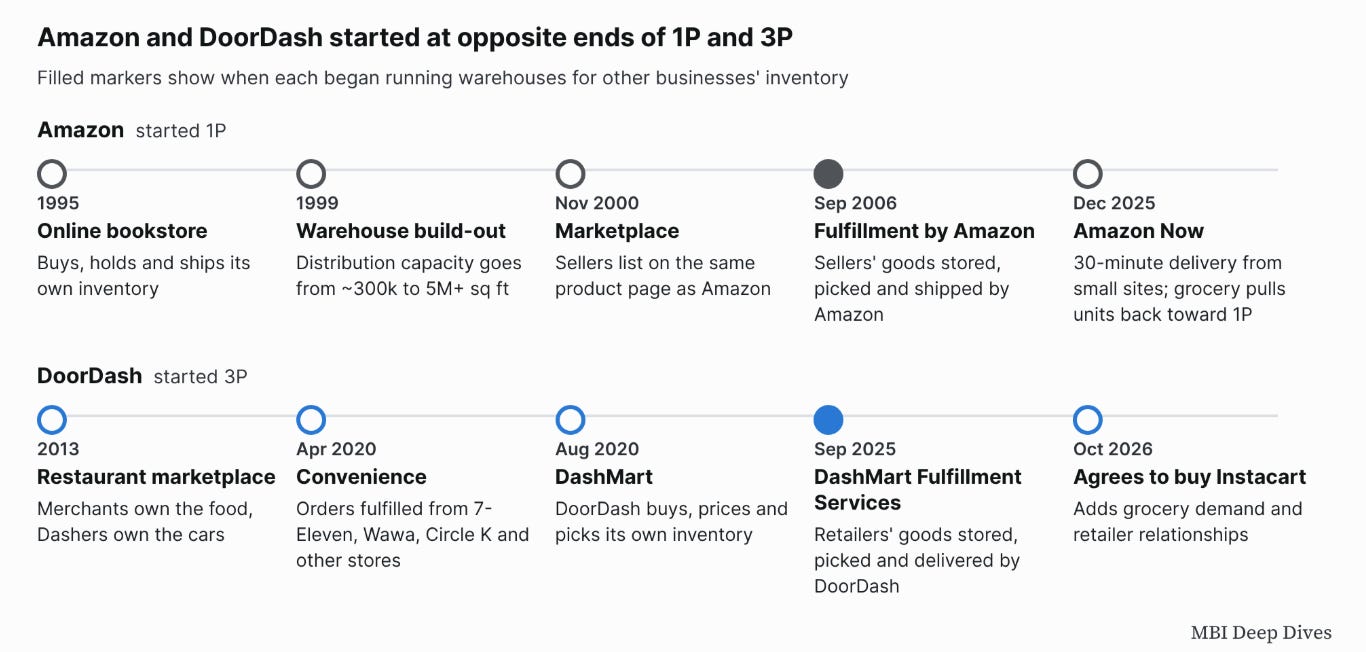
Amazon's history is a useful lens here, because Amazon faced the same fixed-cost problem from the opposite direction. It began in 1995 as a first-party (1P) retailer that owned its inventory, and in 1999 alone it grew its warehouse space from ~300k square feet to over 5 million. It opened its store to third-party (3P) sellers in 2000, and in 2006 it launched Fulfillment by Amazon (FBA), which let those sellers send their goods into the same warehouses for Amazon to store, pick and ship. Other people's inventory helped fill Amazon's buildings, and because an FBA item shipped with Prime, sellers had every reason to join. By 2018, 3P sellers were 58% of Amazon's physical gross merchandise sales, up from just 3% in 1999. Bezos noted in his 2018 letter that their sales had compounded at 52% a year, compared with 20% for eBay, which stayed a pure marketplace over that period.
DoorDash started at the other end. It had the demand and the couriers first, and no warehouses. Owning inventory in DashMarts was the learning step. On the 3Q’24 call, Xu described DashMarts as “an infrastructure in which we can offer retailers to forward deploy their inventory” once DoorDash had proven it could run them. Fulfillment Services is more or less DoorDash’s FBA. When Amazon launched FBA in 2006, it already had the shoppers and sellers to fill its warehouses, which DoorDash is still building toward.
The table below shows who owns, picks and delivers the goods in each model. Fulfillment Services sits where FBA does, with someone else's goods in the platform's building.
This is where Instacart comes in, and the 3Q’26 letter made the link itself (emphasis mine):
“To this end, we see a multi-year path to $500 million or more of annual synergies, net of investments. We expect to invest more than 100% of total synergies in the first year after close, followed by positive net synergies in year two and beyond. However, our initial aims in online grocery with third-party fulfillment won’t be the end state, and Instacart’s scale will benefit us on the journey toward creating a better product experience for grocery delivery. First, the expected efficiencies created can give us the investment capacity to invest further in our fulfillment network. Second, Instacart’s scale will help amortize the fixed cost of managing inventory on behalf of grocers.”
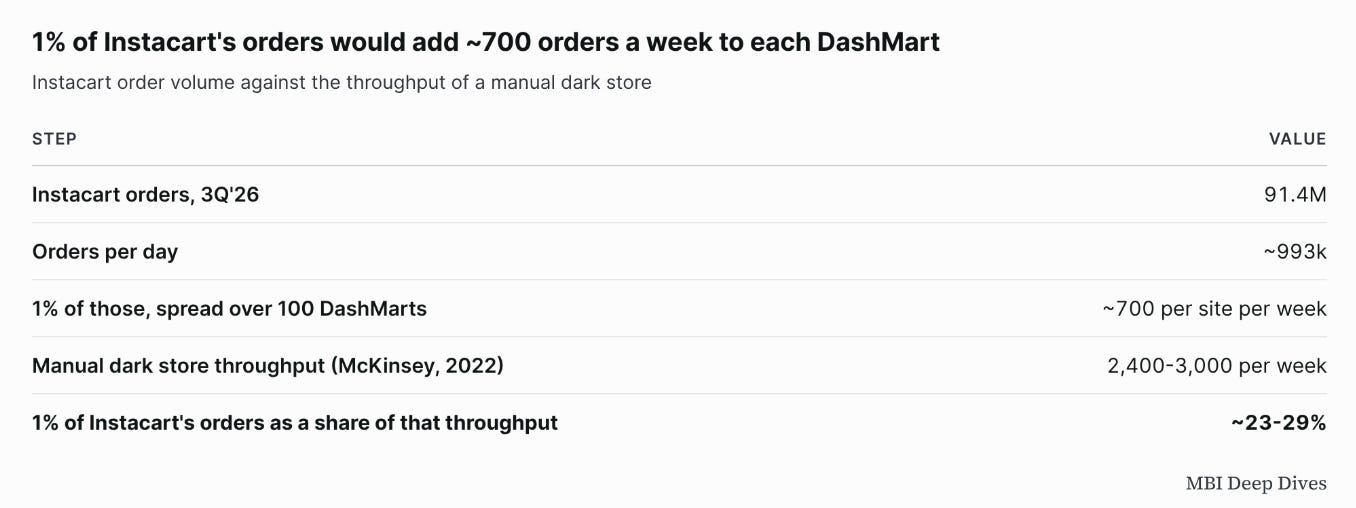
To put Instacart’s scale in perspective, it did 91.4 million orders in 3Q’26, i.e. ~1 million a day at an average basket of ~$115. McKinsey's 2022 benchmark for a manual dark store was 2,400-3,000 orders a week, so if just 1% of Instacart's orders ran through 100 DashMarts, each site would get ~700 more orders a week, which is a quarter of that throughput.
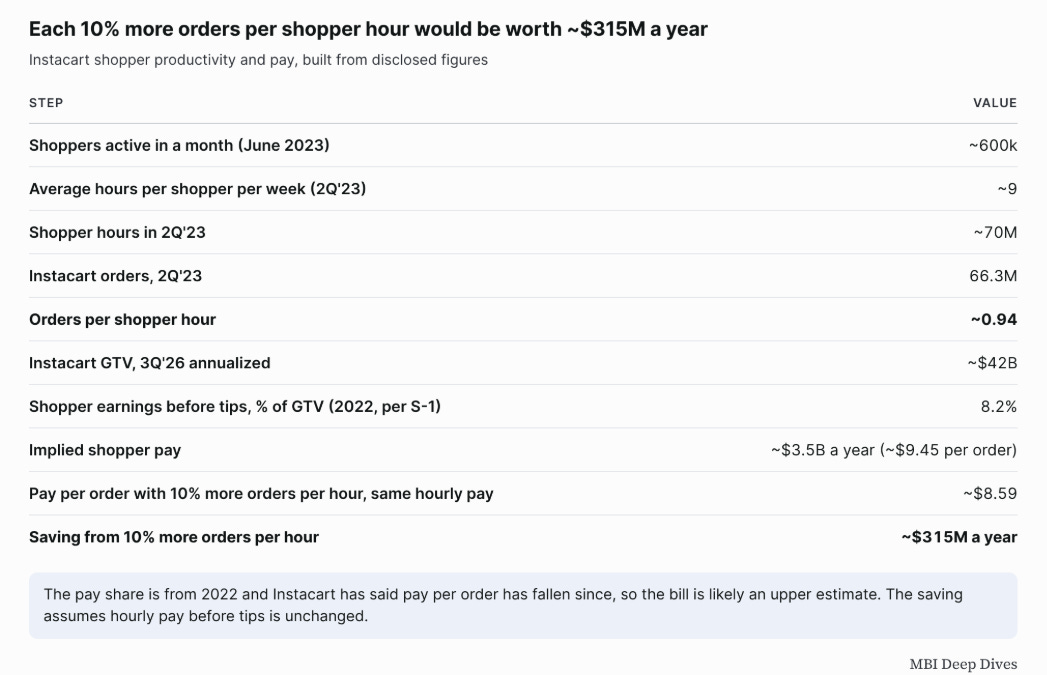
Instacart also pays a lot of people to walk the aisles. As I discussed in my Instacart Deep Dive, its S-1 showed that shoppers earned 8.2% of GTV before tips in 2022. If that share has held (they don’t disclose it anymore), Instacart pays shoppers ~$3.5 billion a year, or ~$9.45 an order, which is more than the ~$8.60 of gross profit it keeps per order. That estimate may be too high since Instacart’s CFO said in 2025 that it had driven “pretty meaningful leverage” on shopper pay over the last few years. The S-1 also counted ~600k shoppers working ~9 hours a week in 2Q'23, a quarter in which Instacart did 66.3 million orders. That works out to about only one order per shopper hour.
Now assume shoppers keep earning the same amount per hour. If they completed 10% more orders in those hours, the same pay would cover 10% more orders, and Instacart’s shopper pay per order would fall by ~9%. On a ~$3.5 billion shopper bill, that is ~$315 million a year. A gain of that size has happened before, as Instacart said its batch rate (orders per batch) rose 11% year over year in 4Q’23.
I see two ways DoorDash could get there. The first is density, since after the deal DoorDash and Instacart orders from the same store could go to the same shopper. The second is DashMart. The S-1 said nearly half of a shopper’s time is spent shopping in the store rather than driving, which works out to ~30 minutes in the aisles for every order, and a warehouse built for picking cuts that time directly.
Instacart also brings the sellers. It works with more than 2,200 retail banners across nearly 100,000 stores, and the CFO listed offering Fulfillment Services to more retailers across both platforms among the deal’s synergies.
There is an obvious mismatch, though. A DashMart carries a few thousand items, while Instacart’s management has talked about more than 22 million unique items across its marketplace, so today’s DashMarts cannot serve a weekly shop. Xu’s answer on the 3Q’26 call was that much of the square footage already exists:
“There are hundreds of thousands of grocery stores available that carry these millions of items that you are already talking about. The real question is whether or not all of that square footage and all of that shelf space is being utilized in the most productive way. None of these stores, as you probably know, are built for delivery. They were effectively built for browsing. [...] The question is: How do we allow those stores to shine as the showrooms, and how do we actually build the correct square footage as the warehouse or the back-of-house infrastructure, such that we can offer fast delivery at attractive prices to compete against the world’s biggest companies? That is the vision of DashMart, but it is a sequencing process.”
So the end state may look less like thousands of DoorDash-owned dark stores and more like DoorDash running the inventory and the picking inside part of a grocer’s own footprint, which would likely need much less capital than Amazon’s version did. Of course, there is a lot we don’t quite know about DashMart’s economics.
Still, I think DashMart is a very interesting angle of this deal. Instacart could bring the orders and the grocers that DashMart has been missing. What makes it particularly interesting is Uber has nothing like it in the US. On its 3Q’26 call, Uber’s CFO said dark stores are “a fit-for-purpose sort of solution” and that “we do not want to get into this business everywhere.” It is obviously too early to know whether DoorDash can make the fixed costs work, even with Instacart. But if it can, grocers may get what FBA gave Amazon’s sellers, someone else storing, picking and delivering their goods better than they could on their own. Amazon’s sellers went on to grow much faster than eBay’s.
Subscribers get the daily journal and five+ years of Deep Dives, i.e. full-length analyses with financial models on 70+ companies. The daily is just how I think out loud between the Deep Dives!
Current Portfolio:
Please note that these are NOT my recommendation to buy/sell these securities, but just disclosure from my end so that you can assess potential biases that I may have because of my own personal portfolio holdings. Always consider my write-up my personal investing journal and never forget my objectives, risk tolerance, and constraints may have no resemblance to yours.
My current portfolio is disclosed below: