Constellation Software 3Q'26: Organic Growth Recovers, but Still Below Its Old Pace
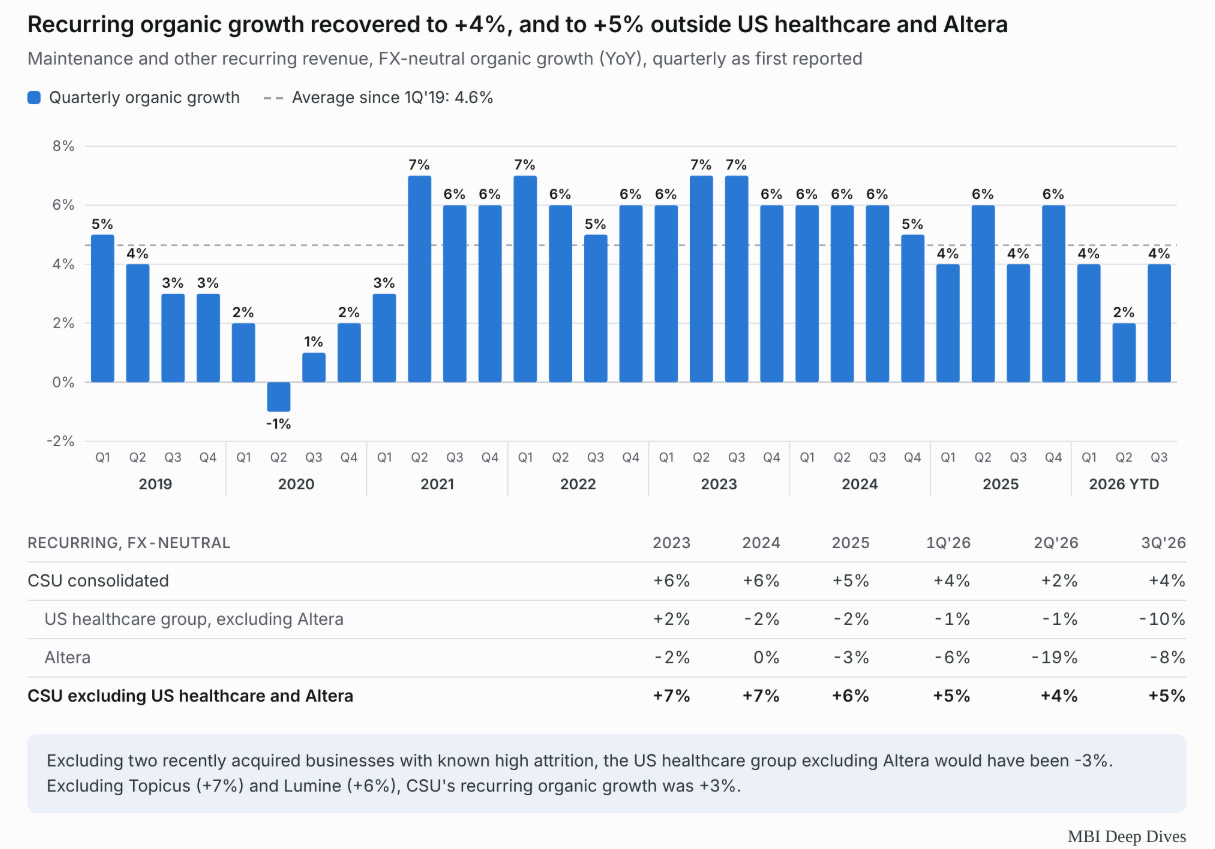
Constellation Software's (CSU) organic growth bounced back from its 2Q'26 trough. Maintenance and other recurring revenue, which is ~77% of total revenue, grew +4% (FXN) organically, up from +2% last quarter.
Constellation Software's (CSU) organic growth bounced back from its 2Q'26 trough. Maintenance and other recurring revenue, which is ~77% of total revenue, grew +4% (FXN) organically, up from +2% last quarter. That is still below what used to be routine recurring organic growth of 5-6% in every year from 2021 to 2025, and it is only 3% so far this year.
Much of the gap is explained by US healthcare. Altera’s decline eased to -8% from -19% in Q2, which was mostly a tough IFRS comp, while the rest of the US healthcare group went from -1% to -10%. Management put this on two recently acquired businesses that CSU knew were losing customers when it bought them. Both deals were modeled that way and are still expected to meet the IRR hurdle. The longer-running drag is hospitals and physician practices consolidating onto Epic and the other large systems, which management expects to continue for the foreseeable future.
The problem is even if you adjust all these things, organic growth is clearly slower these days. CSU excluding the US healthcare group and Altera grew +5% this quarter, which Mark Miller described as a normal quarter within the 5-7% that part of the business has delivered since 2016. Well, it is the bottom of that range; the same measure ran at 6-7% every year from 2021 to 2025 and is 4-5% so far this year. And excluding Topicus (+7%) and Lumine (+6%), CSU’s own recurring organic growth was +3%. Whichever way you cut it, organic growth this year has been on the slower side.
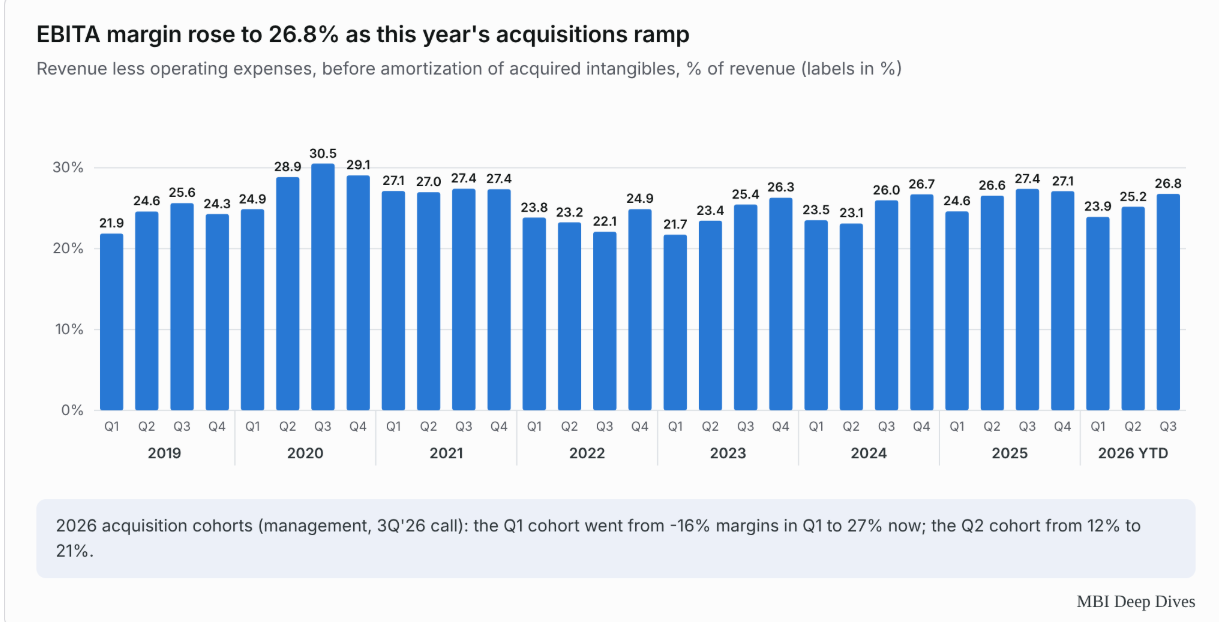
EBITA margin was +26.8%, up ~161 bps sequentially but ~60 bps below 3Q'25. Most of the improvement is this year's acquisitions ramping. Management said the Q1 cohort has gone from -16% margins to +27% and the Q2 cohort from +12% to +21%, which is the usual pattern, except that CSU is buying so much that the newest cohorts still weigh on the consolidated number.
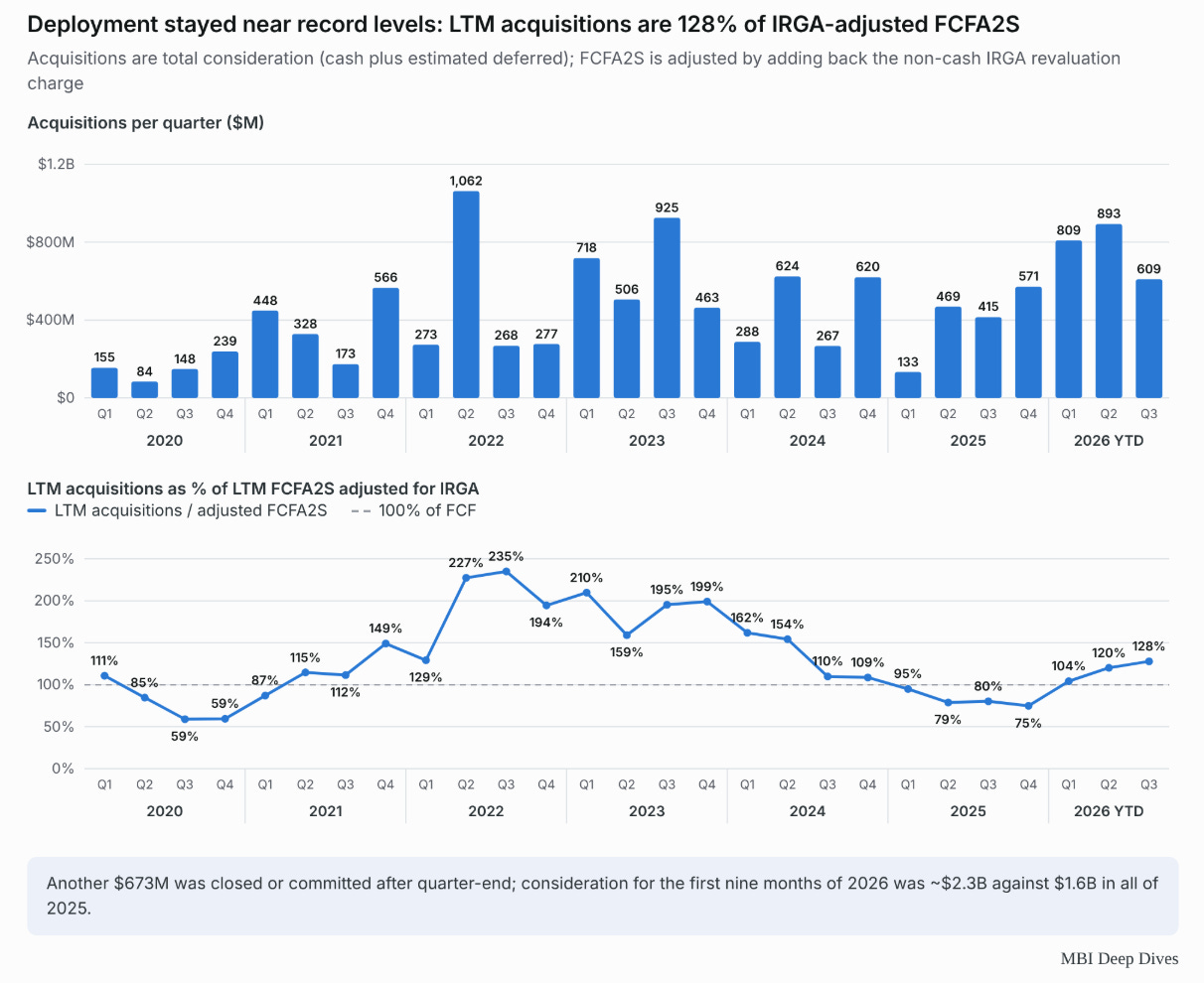
CSU deployed $609 million in Q3 and has closed or committed another $673 million since quarter-end, bringing nine-month consideration to ~$2.3B against $1.6B for all of 2025. LTM acquisitions are 128% of FCFA2S adjusted for the non-cash IRGA charge.
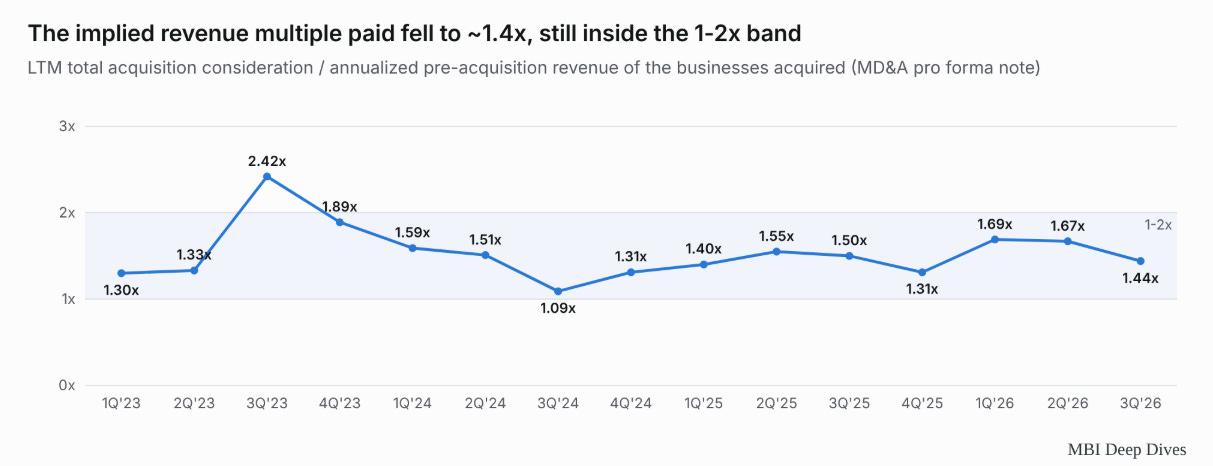
The implied revenue multiple on the last twelve months of deals fell to ~1.4x from ~1.7x, but it’s probably due to mix rather than cheaper deals. During the call, management said private equity is still competing for tuck-ins and private-market prices have not come down much.
Mark Miller had an interesting remark on the call about deal size:
“I really think we have built better muscle to do larger transactions as well. We wouldn’t have had that capacity in like a decade ago... We have a good team who are able to make these fairly large, complicated transactions happen. At least we can be in the game and on the field, and we might win one of those that we maybe wouldn’t have had the capacity to do previously.”
As CSU's FCF compounds, so does the amount it needs to deploy every year, which makes more deals outside its core VMS niches close to inevitable. So it was useful to hear how CSU underwrites them:
“as you know, we do build 4 scenario models. And any time we go outside of our little patch of VMS, we build more dispersion in the models. So your wipe out is going to be a lot worse. Your winner is going to be a bit better. And we use that with the probability-weighted model to figure out what price to pay. And we believe that the models or the scenarios capture the upside and the downside. And where we're less comfortable, we make the lower cases just a bit worse.”
FCFA2S fell 16% to $443 million, but that is almost entirely the IRGA revaluation charge. Adjusting for such things, FCFA2S grew ~3%. As I have written before, I add the charge back since the liability is very likely to prove to be an asset.
Most CSU shareholders care less about any single quarter than about whether the company can keep deploying ever larger amounts of capital at attractive returns. I will discuss ROIC trends, including incremental ROIC, as well as CSU’s valuation behind the paywall.
Subscribers get the daily journal and five+ years of Deep Dives, i.e. full-length analyses with financial models on 70+ companies. The daily is just how I think out loud between the Deep Dives!