Airbnb's bet on anti-trend
A programming note: I will publish my Deep Dive on Instacart tomorrow. As a reminder, I only send one email per day; therefore, on the day I publish my Deep Dive on a company, I won’t publish anything else.
Airbnb typically releases product updates twice a year (May and October each year). They just released their winter product updates a couple of days ago. One of the key features that they launched this year is “Connections”. Everyone who you have traveled with or booked an experience or service on Airbnb, they will show up on your “Connections” tab on the app.

While this is clearly a “social” feature, Airbnb isn’t trying to reinvent another messaging app, rather they are trying to lead the “touch grass” movement. Travel, experiences, or services all are intertwined with real life experiences beyond your digital screen. Airbnb is just trying to be the connective tissue as you transition from digital to real world every once in a while. While time spent on digital screen has been a secular one-way trend, Chesky believes we may yearn for more real experiences in reaction to that as he explained in TBPN:
“I like to say you want to ride a trend or ride the opposite trend. And so if we’re basically creating this fantasy digital realm that is highly artificial, I think in reaction to that, people want what’s real.
This is not an anti-phone rant. This is not an anti-AI thing. It’s just about the fact that we need to have a balance. Do you ever notice that devices and screens aren’t usually in your dreams? There’s something about the digital realm that doesn’t quite stick in your memory the way physical experiences do. And I think increasingly if AI frees up more of more of our time, hopefully that time can be spent in the real world having meaningful experiences with people we care about. And to me, that’s what life is really going to be about. And I want to be a part of that.”
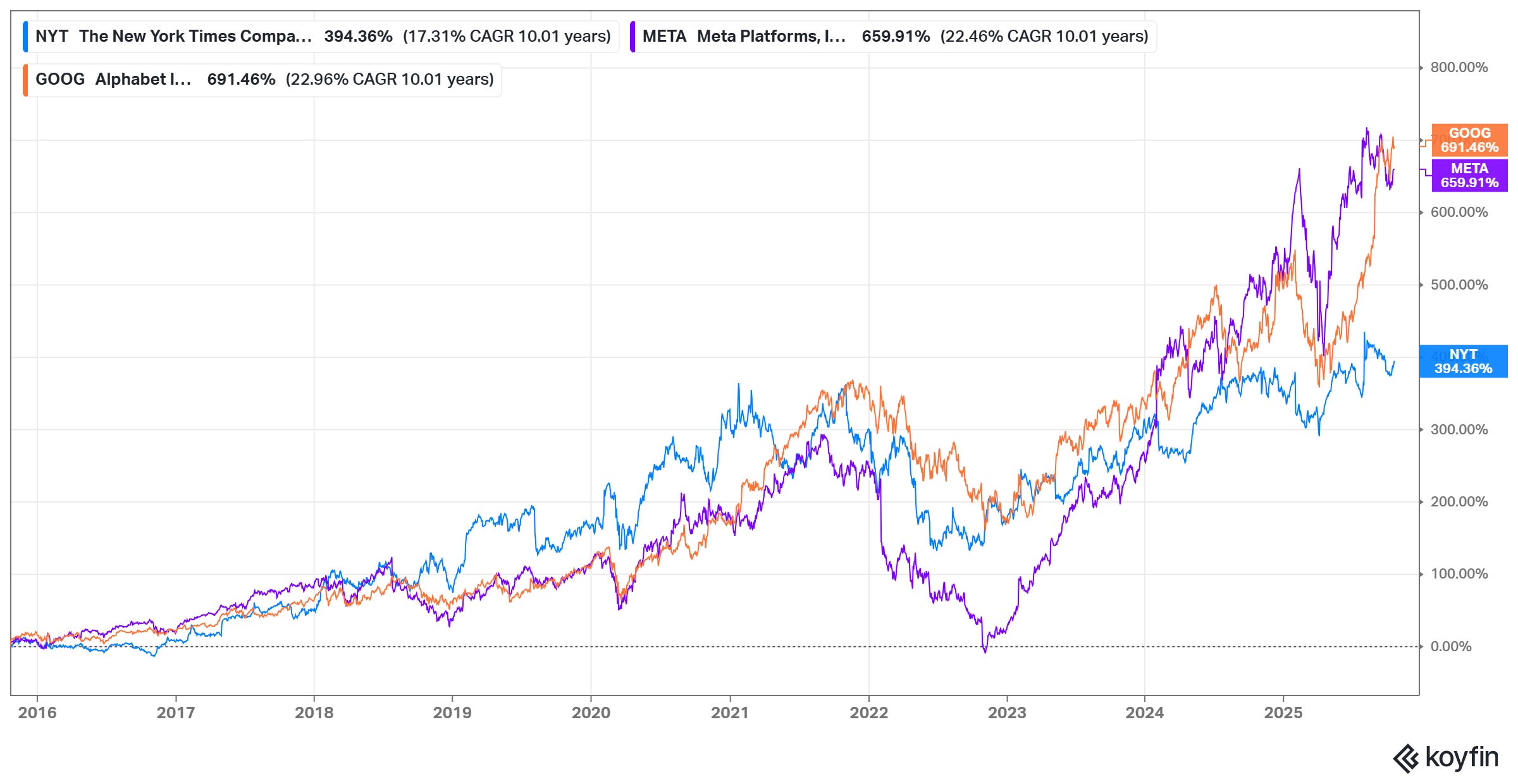
It’s a a bit counterintuitive thought whether betting on both the secular trend and anti-trend indeed can work at the same time. The New York Times is perhaps a good example here to make Chesky’s point. While traditional news organizations have largely been hollowed out in the age of Google and Meta, the NYT stock actually did pretty well as their subscale competitors fell off the charts and they themselves did a reasonable job in transitioning to subscriptions. It is remarkable that despite being in the eye of the storm, NYT stock almost matched Meta and Google’s last 10-year performance post-liberation day drawdown in the market. Of course, as the big tech recovered since then, the performance gap widened but NYT still did a very respectable ~17% CAGR in the last 10 years.
It’s not the only anti-trend Airbnb is betting on. While Airbnb’s competitors such as Booking.com or Expedia are integrating with ChatGPT, Airbnb has been strangely missing from these integrations. It’s particularly odd given that Brian Chesky and Sam Altman are good friends, so Airbnb clearly consciously decided not to integrate with ChatGPT. Despite being friends with Altman, Chesky doesn’t seem to be “AGI-pilled” and he also doesn’t seem to have “short timelines” to AGI. Chesky actually makes the case there’s no way one company can entirely run the economy and the model companies need to have a much more performant software development kit (SDK) before Airbnb will think about integrating with them. From Chesky:
“Imagine as a thought experiment. this is not a perfect analogy it’s a little bit flawed in some ways. but imagine you replace AI with electricity and it was like a 100 years ago and three companies had electricity and no other company had electricity.
Suddenly these electric companies would have a huge advantage but we have this mental model as if these companies are the only ones with electricity. Every company’s going to have the access to all the same models unless companies start limiting their models only to their applications.
But then other competing models would then get more widely adopted because they will have an API. So you have to make a choice. Do you want to limit your model or do you want to be like AWS?
…you’re going to see a huge change where on the one hand we all have to decide how to participate with platforms like ChatGPT and I think if they build a really great SDK and we can still own the customer relationship, there’s probably not a huge problem. It has to just be integrated correctly.
At the same time, you have to remember we’re also going to have nearly as good a AI via the fact that even if we don’t produce our own models, there will be an entire economy that will allow those models to be accessible via APIs. There may be some advantages to the companies that build apps within. Do you want to go to one destination that then is like a macro agent that connects to all other agents or do you use different apps and those become different agents? So now we’re starting to debate these mental models and there’s a trade-off. The trade-off is the advantage of going just o ChatGPT is now one agent can kind of cross-pollinate and organize everything.
But then if the SDK is limited, it will be not as powerful as going direct to the app that is an AI app that can go really really deep and do your job really well. And so this is the balance. And where do I think this lands? Where I think it goes is I think ChatGPT has to build an SDK that’s really robust and it will be just a channel. That’s my guess, but we’ll see.
Given Airbnb’s organic demand and unique supply on its marketplace, it is definitely a non-starter for them to not own the customer relationship. Chesky also made the case that it is going to be near impossible for ChatGPT to do everything on its own if it doesn’t empower others to build on top of it. The diffusion of the use cases of these models will be slower if it’s largely self-contained within the models. Again, from Chesky in the TBPN interview:
I’m on the board of Y Combinator. Almost all the startups we are seeing are enterprise. There is not a lot of companies doing consumer. There’s a couple reasons why. Number one, I think some people are nervous about ChatGPT killing their startup. I think they’re too worried. I think companies are too worried. I keep telling people, and I told this to Sam Altman, one of my best friends, that no one company can run the entire economy. First of all, governments won’t allow that. But second of all, it’s just too much bureaucracy in a company to do that. And there’s a reason that when Apple created that the iPhone, they didn’t make every app in the app store because can you imagine how big of a bureaucracy that would have had to be for Apple to build Airbnb and Uber and Instacart and Instagram. So there’s going to be a whole series of companies, but they’re going to take time. My prediction is that in the next three to five years, not in the next year, you’re going to see a huge boom in the consumer space of AI.
One other takeaway from the interview was Chesky seems well aware of the disintermediation risk Airbnb faces as it embarks on services. If someone books a recurring service from the same serviceperson, what is the compelling reason for you to pay the middleman (Airbnb) a fee? Chesky seems to realize for recurring services, they need to charge a lower take rate.
I personally think he’s not being aggressive enough. The take rate for services should be near zero (maybe charge enough just to cover the payment processing fees). Services is going to be excruciatingly challenging to take off on Airbnb, and they are perhaps not being radical enough to propel people (both demand and supply) give services a shot on Airbnb.
Chesky briefly hinted about loyalty membership program; while I’m not sure how serious he is about such a program, that indeed sounds like a much better idea to incentivize people avail experiences and services on Airbnb. If I get 50 points by booking a $50 service on Airbnb which I can use to pay for booking a home on Airbnb when I am traveling, I will have a much higher incentive for paying the service person via Airbnb than venmo-ing the person directly, especially if the service take rate is also near zero (which would also not incentivize the serviceperson to ask me to pay him or her directly).
If Airbnb does that, what’s the business case for services if take rate for recurring services is almost zero? Airbnb deserves a cut anytime they are connecting the customer and the serviceperson for the first time. For the recurring services, I should just receive points and Airbnb takes almost no cash for itself but those points will almost certainly incrementally increase “loyalty” for the customer to Airbnb. From an overall Airbnb “ecosystem” perspective (home, experiences, and services), I think the unit economics can make a lot of sense even if just services itself may have lackluster unit economics. Unfortunately, in the last 5 months since Airbnb launched experiences and services, I haven’t quite noticed anything radical about it. It just feels similar version of approaches others already took to serve these markets. Airbnb has an opportunity to be more aggressive here, but they haven’t taken that opportunity yet.
One of the complaints from investors about Airbnb that I have noticed is that Airbnb doesn’t move fast enough. For a founder led company, such complaints should perhaps bother Chesky a bit. He has been talking for a while about how suppliers are currently under-monetized or how sponsored listings make a lot of sense on Airbnb, but he hasn’t translated these musings into actual monetizable product yet. Perhaps he can borrow a page from his friend Altman and learn to move a little faster and be a more radical while pursuing more ambitious projects!
In addition to “Daily Dose” (yes, DAILY) like this, MBI Deep Dives publishes one Deep Dive on a publicly listed company every month. You can find all the 63 Deep Dives here.
Current Portfolio:
Please note that these are NOT my recommendation to buy/sell these securities, but just disclosure from my end so that you can assess potential biases that I may have because of my own personal portfolio holdings. Always consider my write-up my personal investing journal and never forget my objectives, risk tolerance, and constraints may have no resemblance to yours.
I have made a slight change in my portfolio which I will discuss behind the paywall.