Stripe’s “Singularity” and the Divergence from Adyen
Last week, Stripe announced their acquisition of OpenRouter, the AI model gateway and routing platform. Ben Thompson had an interesting take on Stripe’s OpenRouter deal, so I won’t repeat the potential strategic reasons to pursue such an acquisition. I do want to focus a bit more on the letter Stripe wrote to its investors.
Thanks to being the payment partner of choice for much of Silicon Valley, Collison brothers are almost always in the tech zeitgeist and hence, the way they speak or write very much assumes a tech forward audience. But perhaps most people still raised their eyebrows when they read the following in Stripe’s investor letter:
“It’s a fuzzy and perhaps already overworked term, but we decided that January 1st marked the beginning of the singularity, and we have since been operating on that basis. The singularity is often invoked alongside millenarian forecasts, but, in our case, we simply saw a large inflection in long-run trends (for example, a huge increase in the rate of new firm creation), and we decided that we ought to take the phase change seriously.”
If you take “singularity” literally, it hardly makes sense as pointed out by François Chollet.
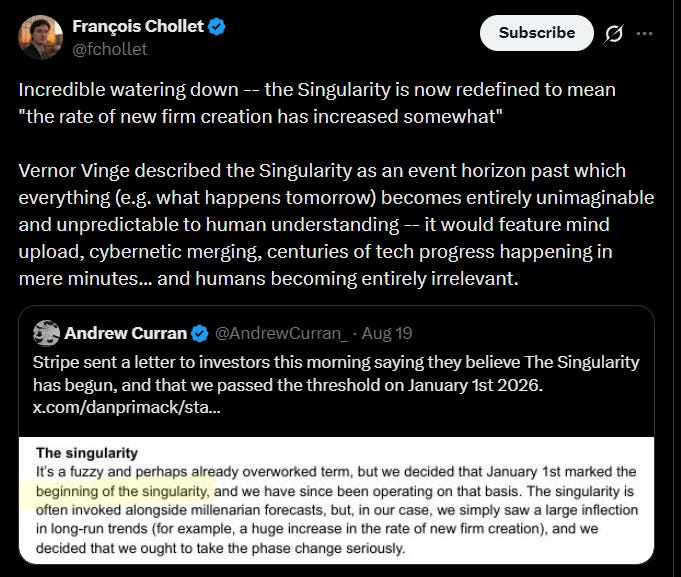
But if you do not take such “singularity” literally, rather the spirit which Stripe was getting at, it still seems a tad bit presumptuous. I would imagine we should at least experience 5% real GDP growth while invoking “singularity” to explain a technological revolution. Perhaps Stripe should contact CBO so that CBO updates their GDP projections which forecast GDP growth to stay below 2% as far as eyes can see.

To be quite frank, if CBO is ballpark accurate about such uninspiring GDP growth in the next few years, we may have bigger things to worry about than haggling Stripe for invoking singularity.
Stripe also encouraged everyone to dream the dream of a world economy that’s 10x larger than it is today and they showed their “math” how we could get there. From Stripe’s letter:
“We continue to believe that there is no ceiling on the size of the global economy (somewhat larger than $100T today). Implausible though it might sound on first blush, we think that it’s useful to contemplate the quadrillion-dollar world and to enumerate the relevant bottlenecks to bringing it about. (If global GDP per capita matched that of every Irish person—around $100,000—we’d be 80% of the way there.)”
Some people understandably took issue with using Ireland as an example. The Irish Times explained back in 2018 why Ireland’s GDP strains credulity:
“Nobody believes our GDP numbers any more, not after a 26 per cent jump in 2015, which was famously derided as “leprechaun economics”. Even the CSO cautions against viewing last year’s 7.8 per cent jump as a reflection of real economic activity.
There are several reasons for this but perhaps the biggest issue stems from multinationals moving intellectual property assets such as copyrights, patents and trademarks here – a move that seems to have been prompted by a global clampdown on tax avoidance.
The numbers involved are so large that they distort our national accounts, mangling our headline growth figures in the process.”
Byrne Hobart, however, had a very witty take to justify why Ireland may actually a better representative of our collective AI future:
“I choose to read this as a subtle allusion to the version of the future where AI does most of the work, but you have humans in the loop specifically so there’s somebody to sue. In that world, we are all economically equivalent to the Irish, taking a small cut of a big number.”
I do think Collison brothers are well aware of GDP being a very imperfect metric for Ireland and they were likely indeed alluding to such quixotic economy of the future without laying it out in full detail.
One of the reasons Stripe is so willing to depict the future, especially its own in such rosy terms is they really need to create more and more distance from the European payment company named Adyen. From 2018 to 2024, Stripe and Adyen were essentially neck on neck in terms of total payment volume (TPV) which inherently attracts comparison between these two companies. However, 2025 was the first year Stripe truly threatened to run away from Adyen’s TPV trajectory. While the investor letter didn’t mention TPV growth, it highlighted that Stripe’s net revenue increased by 41% in 1H’26 (vs 21% for Adyen FX-adjusted). So, instead of 2025 growth differential of these two companies being an anomaly, it is accelerating so far in 2026.
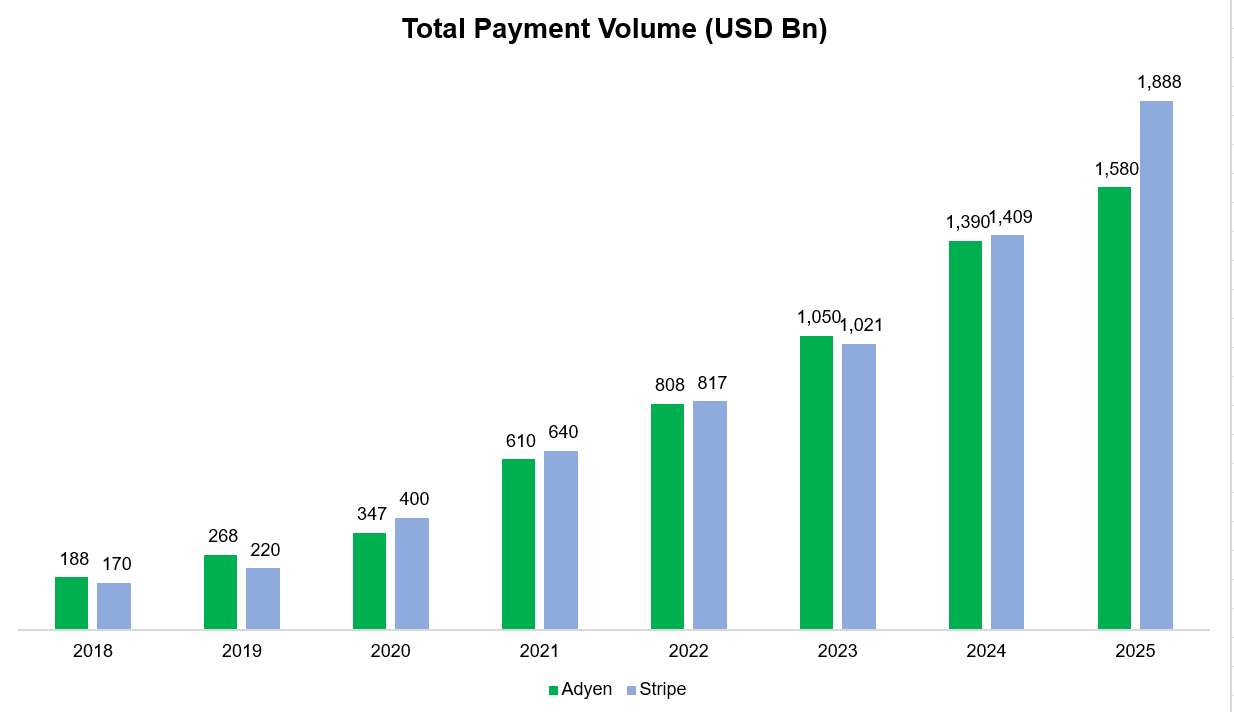
Stripe is disproportionately exposed to the fastest-growing part of the internet economy right now i.e. AI-native companies and startups. Stripe acquired Metronome in early 2026, which powers usage-based billing for OpenAI, Anthropic, Confluent, and Nvidia. They also sit at the company formation layer: Stripe Atlas now handles over a quarter of all Delaware incorporations, so the AI-driven surge in new company creation flows straight into their funnel. When AI application-layer revenue is inflecting, Stripe basically clips a coupon on it the day it’s earned. Adyen, by contrast, is structurally levered to established enterprise commerce which grows at GDP-plus-wallet-share, and their own land-and-expand math means new wins take relatively longer to show up in the P&L. Moreover, changes to US tariffs weighed on online retail, particularly large-volume merchants headquartered in APAC (Temu/Shein de minimis exposure) in 2025.
What’s telling is that Adyen now also seems to be chasing the same pool. In the 1H’26 earnings call, Adyen management mentioned that they won OpenAI as both an Adyen Agentic partner and a payments customer, and acquired Orb, extending into usage-based billing, that expected to add 2 points to 2H’26 revenue growth. Orb is essentially their answer to Metronome. Adyen management believes Orb will let them onboard AI-native companies earlier in their journey by combining billing and payments.
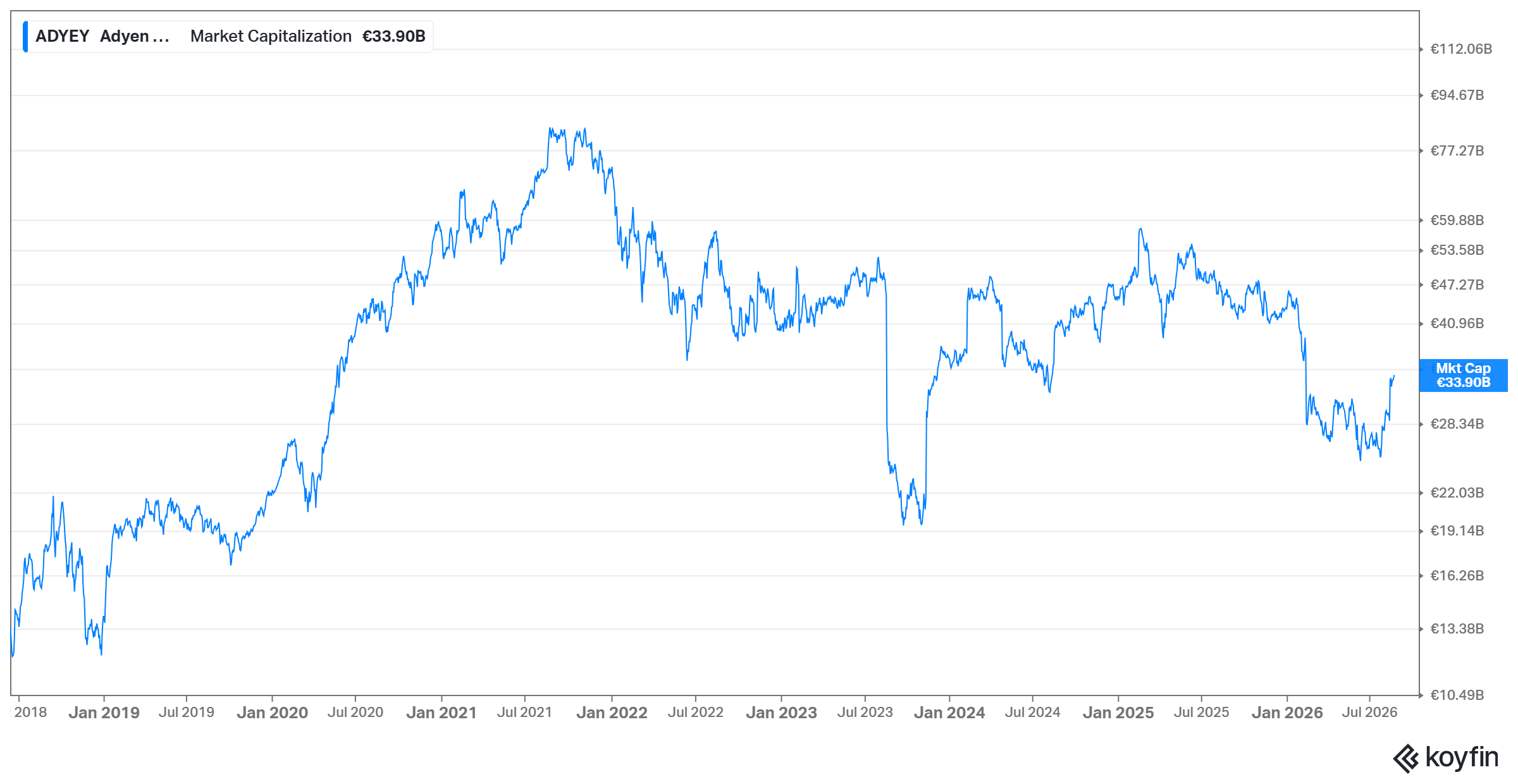
As Adyen is clearly playing bit of a catch up here and Orb’s 2-point contribution to revenue growth is hardly inspiring, Stripe’s investors may be feeling a little less discomfort about Stripe’s towering valuation compared to Adyen’s. While Adyen’s market cap is hovering around ~$40 Billion, Stripe’s valuation went from $91.5 Billion in February 2025, $106 Billion in September 2025, then $159 Billion in February 2026.
Given Stripe is a private company, it is always hard to pinpoint source of growth. Was the growth in 2025 and 2026 YTD largely organic or recent acquisitions such as Bridge, Privy, and Metronome are the major reasons for growth divergence between these two companies? While such questions can be quite relevant for investors of both Adyen and Stripe, Stripe is quite eager in pointing out their valuation based on private market has handily beaten S&P 500:
“Even while undertaking significant organizational investment and M&A, Stripe’s share count is lower today than three years ago. Stripe’s share price has compounded at 31% since our Series D fundraise 10 years ago, versus 14% for the S&P 500 and 18% for the Nasdaq over that same period.”
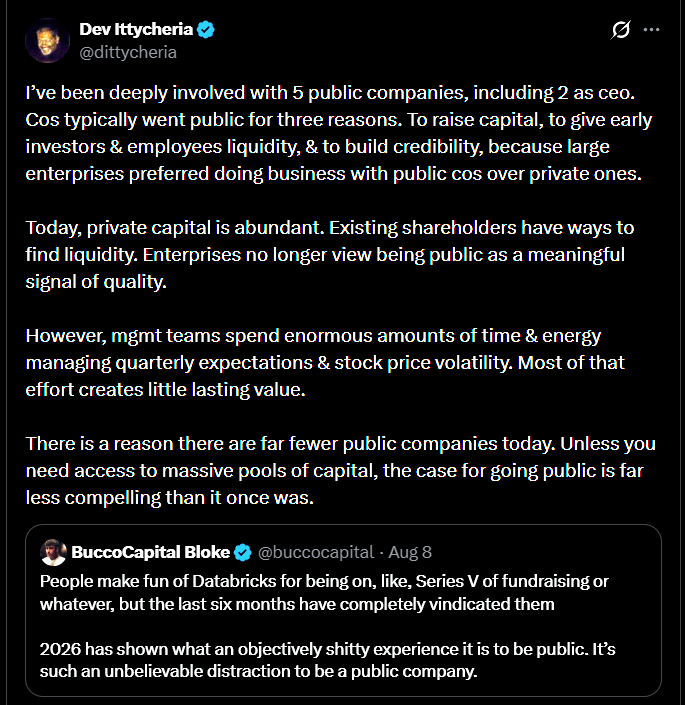
For the privilege of being a private company, Stripe is blissfully unaware of any volatility that comes with being a public company. Of course, volatility doesn’t evaporate even if it doesn’t show up on a day to day basis. Every autocratic regime usually feels very stable up until the moment it gets toppled whereas most democratic regime feels lot more chaotic and unstable. But such instability is what is usually required to create a more stable system over the long term. While I hold this framework in my mind while looking at private vs public market valuation, admittedly I too have started to find it difficult to hold any grudge against a company such as Stripe for being private. Dev Ittycheria, former CEO of MongoDB, recently posted why he believes the case for being public is lot less appealing today than it once was. As a public market investor, I worry about such a trend but find it increasingly hard to argue against.
Subscribers get the daily journal and five+ years of Deep Dives, i.e. full-length analyses with financial models on 65+ companies. The daily is just how I think out loud between the Deep Dives!
Current Portfolio:
Please note that these are NOT my recommendation to buy/sell these securities, but just disclosure from my end so that you can assess potential biases that I may have because of my own personal portfolio holdings. Always consider my write-up my personal investing journal and never forget my objectives, risk tolerance, and constraints may have no resemblance to yours.
My current portfolio is disclosed below: