Big Tech Off-Balance Sheet Concerns
A couple of weeks ago, WSJ published a piece titled “Why Big Tech’s AI Spending Is $3 Trillion Higher Than It Seems”. Some excerpt from the piece:
“Each quarter, big tech companies disclose their massive capital expenditures on artificial-intelligence infrastructure, from data centers to chips.
But those figures don’t come close to expressing the full extent of future spending to which Google parent Alphabet, Meta Platforms, Oracle and many others have committed. That is because a huge swath of their coming financial obligations aren’t reflected on their balance sheets.
Nine top tech companies had some $3 trillion of off-balance-sheet commitments mostly related to AI, according to a Wall Street Journal analysis of footnotes in their most recent securities filings. Those obligations are growing faster than traditional “capex,” which totaled about $600 billion over the past year they reported, and were about triple what the companies owe under their outstanding leases and long-term borrowings.”
WSJ also included a more memorable “iceberg” that showed big tech’s on and off balance sheet items. It’s not just WSJ, Financial Times also have been covering big tech’s growing affinity towards off-balance sheet financing in recent weeks. This podcast with FT’s Robin Wigglesworth is also a good listen if you want to get up to speed on this topic.
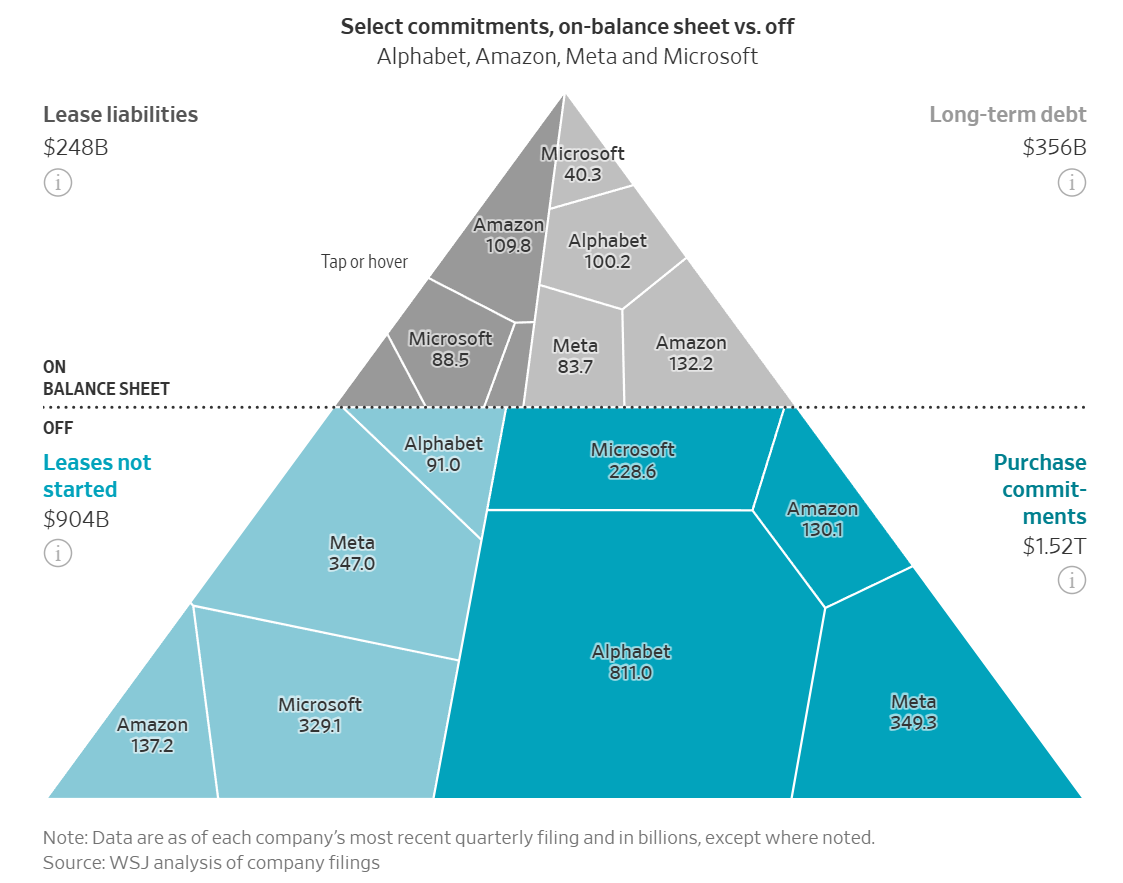
I actually wrote a piece titled “The coming debt deluge” last year which sort of foreshadowed some of these recent developments but admittedly I too am a bit surprised by the scale of these off-balance sheet items. Yesterday, Olga Usvyatsky wrote a good piece on her Substack about this topic. While she shares concerns that such large off-balance sheet items can be potential source of problems if AI fails to deliver, she also pointed out that there is nothing nefarious going on here in terms of disclosures. From her piece:
Off-balance-sheet does not mean that the accounting is wrong or violates GAAP. Many commitments are kept off the balance sheet because accounting rules do not require companies to record them as liabilities until certain conditions are met — for example, until a lease begins or goods or services are delivered. Nor are these obligations necessarily hidden. After all, the WSJ was able to compile the data from the companies’ own SEC filings, where the commitments are clearly disclosed in the footnotes or MD&A section.
Moreover, WSJ’s aforementioned iceberg compares present-value lease liabilities on the balance sheet against undiscounted future payments for un-commenced leases. Those are different measurements, so the present value of such future payments is lower than what WSJ implied. Again, from Usvyatsky’s piece:
“…the present value of existing lease obligations is about 20% below their undiscounted future payments. Applying that same relationship simply as an illustration to the $904 billion of the off the balance sheet leases in the Journal’s analysis would produce a lease liability of roughly $723 billion — about $181 billion below the amount shown in the visualization. This is not an estimate of what the companies will ultimately record: the actual liability will depend on when individual leases commence, their payment schedules, lease terms and the discount rates at commencement. But it illustrates why undiscounted future payments and present-value lease liabilities should not be treated as equivalent amounts.”
That is exactly right! But it is important to keep in mind she mentioned that the 20% discount factor for undiscounted future payments is “simply an illustration” since that 20% is derived from commenced leases, which include a lot of short-remaining-term stuff. A lot of un-commenced data center leases will start in 2028-29 and run 15-20 years, so the discount on those should be meaningfully larger. As a result, even Usvyatsky’s $723bn is probably still the high end of the eventual recorded liability.
Let me drive this point home by going through Amazon’s total commitments. Amazon is currently the only company that actually discloses all its commitments in each of the next five years as well as the commitments beyond 2030. Such disclosure used to be commonplace since until 2021, SEC rules required a standardized contractual obligations table in every 10-K. The SEC eliminated it in the November 2020 MD&A “modernization”, replacing it with principles-based "material cash requirements" discussion. Amazon voluntarily kept reporting its purchase commitment table, Microsoft kept a stub, but Alphabet and Meta went fully narrative.
So, what did I see when I dug into Amazon’s total commitments? Almost ~60% of its total $650 Billion commitments are after 2030! So, while the aggregate number looks a bit scary, it looks quite manageable when you look at their commitment on an annual basis in the next five years. Of course, we do not quite know what the annual number looks like beyond 2030 but given the long-term nature of much of these commitments, I won’t be surprised if such commitments run well into 2050s.

As alluded earlier, Microsoft’s disclosure around its total commitments is less comprehensive than Amazon’s. Microsoft just discloses its obligations due in FY 2027 and thereafter i.e. FY 2028 onwards. Microsoft’s obligations are more front loaded than Amazon’s since ~68% of its ~$502 Billion total commitments are beyond FY’27 (vs ~83% for Amazon).

Like I said, Alphabet and Meta went fully narrative and neither of them provides disclosure such as Microsoft and Amazon. This is what Alphabet disclosed in their 2Q’26 filing:
As of June 30, 2026, we had material purchase commitments and other contractual obligations totaling $811.0 billion, of which $200.7 billion was short-term. These purchase commitments primarily relate to costs for technical infrastructure and inventory through long-term supply agreements and open purchase orders.
As you can see, Alphabet’s commitments are the largest and while it is also a bit frontloaded i.e. ~25% of the commitments are due in the next 12 months, the rest of the commitments is beyond 12 months. In another part of their 10-Q, Alphabet mentioned the following:
As of June 30, 2026, expected future fixed or guaranteed commitments under these agreements were $707.0 billion, the significant majority of which related to long-term supply agreements.
We expect contractual commitments under the long-term supply agreements and content licenses to generally be fulfilled through 2030. The energy service agreements include terms ranging from two to 26 years, with obligations through 2054, and generally include take-or-pay provisions for minimum quantities of energy supply and substantive termination fees.
The $811.0 Billion mentioned earlier is under the "material cash requirements" standard i.e. the kind of commitment table Amazon discloses. Everything in the $707bn and open purchase orders i.e. equipment already ordered but not delivered, which are commitments but not multi-year agreements and whatever else falls under "other contractual obligations." Alphabet provides no bridge between the two numbers. but since open purchase orders are inherently near-term, the gap between these two numbers is presumably concentrated in the $200.7bn short-term bucket.
What does Meta report? Again, as mentioned earlier, Meta too only provides narrative instead of granular year-by-year details. From Meta’s 10-Q:
As of June 30, 2026, we had $349.31 billion of non-cancelable contractual commitments, comprising both short-term and long-term arrangements. These commitments mostly relate to third-party cloud capacity arrangements and investments in servers and network infrastructure, data centers, and consumer hardware products in Reality Labs, with approximately $53.52 billion and $81.65 billion due in 2026 and 2027, respectively.
So, ~15% and ~23% of their total non-cancellable contractual commitments is due in 2H’26 and 2027. Here too the commitments are a bit more frontloaded but majority of these commitments will be after 2027. As mentioned earlier, we do not have visibility of the cadence of commitments beyond 2027, but my best guess is everyone’s cadence is more or less similar. As a result, significant portion of the overall commitments is well into 2030s (and possibly beyond).
Given these contexts, I do not think big tech investors need to suffer from insomnia after looking at such gigantic off-balance sheet commitments. Presumably they own the stock because they’re broadly optimistic about their investments in AI and unless returns from such investments spectacularly disappoint, we probably do not need to worry about existential questions. One challenge, however, is that these numbers are only snapshot as of 1H’26 and if recent quarters are any indication, these numbers seem to be going in only one direction: up and to the right. There is almost bit of a “FOMO” approach to these commitments and if they keep doing it and obligations become larger and larger over time, I may need to re-assess to what extent I can exhibit a bit of nonchalance to off-balance sheet exposure. I’m not there yet, but it’s something I will keep track and update after every quarter.
Subscribers get the daily journal and five+ years of Deep Dives, i.e. full-length analyses with financial models on 65+ companies. The daily is just how I think out loud between the Deep Dives!
Current Portfolio:
Please note that these are NOT my recommendation to buy/sell these securities, but just disclosure from my end so that you can assess potential biases that I may have because of my own personal portfolio holdings. Always consider my write-up my personal investing journal and never forget my objectives, risk tolerance, and constraints may have no resemblance to yours.
My current portfolio is disclosed below: