What Makes Us Rich
Programming Note: As a reminder, every Sunday, I write pieces that are predominantly based on personal experiences which may or may not be loosely connected with investing. If you are reading MBI Deep Dives everyday, I think it would be rather useful for my readers to understand my personal lens a bit better since that presumably affects (at least in some capacity) the way I analyze businesses as well.
When I was dealing with the transfer saga i.e. moving ~85% of my portfolio from Canada to the US, my wife could perhaps sense how stressful it was for me. So, after I mentioned to her that I might need to go to Canada for a few days to deal with it, she suggested that she, along with our son, travel with me. While finalizing the travel plan, it suddenly occurred to us that we should perhaps make lemonade out of the lemons life seems to be throwing at us. We decided to go for a road trip in Canada. After crossing the border via Washington State, we drove through British Columbia (BC) to all the way to Banff!
Right after crossing the border, I went to one of the branches of TD Bank in Canada and initiated the wire transfer to my bank account in the US. Everything went smoothly and I had a huge sigh of relief thinking I will get to enjoy the rest of the trip. I drove for almost seven hours on the first day in our trip, but the drive through BC was so beautiful that I didn’t get exhausted at all. The real estate prices in BC almost started to make sense to me!
We booked an Airbnb right in the middle between BC and Banff. After spending the night there, we drove for another five hours to Banff the next day. I have across pictures of Banff from friends who visited the place and frankly speaking, one of the “complaints” I had about Banff before visiting the place is the pictures look so incredibly beautiful that they appear to be almost AI-generated! However, while driving to Banff, I could soak in the natural beauty and appreciate the very real landscape in front of me! (see video captured through my Glasses)
After waking up the next morning, I went out in the backyard of our Airbnb at Banff and almost uttered “Hallelujah” while looking at the mountains!
Then I decided to open my phone and buyback the stocks I sold. It didn’t take too long for my face to turn pale once I realized for some indiscernible reasons, all the stocks I sold started rallying. I could hardly see any beauty around me after noticing that since internally I was basically like Michael Scott screaming “Noooo, God, Please Nooo”! If you’re not quite following what happened, I don’t want to repeat the story and you can read it here.

Since I paid close attention to daily stock price movements during those couple of weeks of transfer saga, I started noticing some really strange aspects of market these days that I didn’t quite appreciate before. For example, I noticed the iShares Semiconductor ETF: SOXX routinely goes up or down 4% on many days without much of a concrete news flow. One would imagine an index would not act so volatile, but that’s clearly not the case. Even more perplexingly, if someone told me what SOXX was doing on a particular day, there was a very good chance I could guess what stocks in very different sectors are doing on that day. The day to day trading perhaps was always somewhat incomprehensible, but staring at the daily stock prices reminded me of the privilege of being long-term investors who can choose not to go through these whipsaws on such regular basis. In fact, I think no matter how wealthy I may become, if my strategy depends on looking at stock prices on a daily basis, I am not sure I could ever quite enjoy the fruits of such wealth. Moreover, if your mood swings too much based on short-term stock prices, I think it’s going to be increasingly more and more difficult to be public equities investor. Charlie Munger used to preach about the importance of equanimity for any investor and I suspect the importance of such equanimity and emotionally stable frame of mind will be of paramount importance to survive in the market over the long term. I would like to carry this newfound appreciation for long-term investing with me even though I fully acknowledge the challenges associated with such a strategy given the lengthy feedback loop.
Of course, even though daily volatility has reached somewhat incomprehensible territory, most investors will never quite give up the idea that they know why XYZ stock is going up or down. Perhaps we are “designed” to be incapable of sitting with the discomfort of admitting to ourselves “I don’t know”. It reminds me of the following excerpt from the book “The Blank Slate” that often reminds me how easy it is to fool ourselves:
“One of the most dramatic demonstrations of the illusion of the unified self comes from the neuroscientists Michael Gazzaniga and Roger Sperry, who showed that when surgeons cut the corpus callosum joining the cerebral hemispheres, they literally cut the self in two, and each hemisphere can exercise free will without the other one’s advice or consent. Even more disconcertingly, the left hemisphere constantly weaves a coherent but false account of the behavior chosen without its knowledge by the right. For example, if an experimenter flashes the command “WALK” to the right hemisphere (by keeping it in the part of the visual field that only the right hemisphere can see), the person will comply with the request and begin to walk out of the room. But when the person (specifically, the person’s left hemisphere) is asked why he just got up, he will say, in all sincerity, “To get a” “Coke”—rather than “I don’t really know” or “The urge just came over me” or “You’ve been testing me for years since I had the surgery, and sometimes you get me to do things but I don’t know exactly what you asked me to do.” Similarly, if the patient’s left hemisphere is shown a chicken and his right hemisphere is shown a snowfall, and both hemispheres have to select a picture that goes with what they see (each using a different hand), the left hemisphere picks a claw (correctly) and the right picks a shovel (also correctly). But when the left hemisphere is asked why the whole person made those choices, it blithely says, “Oh, that’s simple. The chicken claw goes with the chicken, and you need a shovel to clean out the chicken shed.”
The spooky part is that we have no reason to think that the baloney-generator in the patient’s left hemisphere is behaving any differently from ours as we make sense of the inclinations emanating from the rest of our brains. The conscious mind—the self or soul—is a spin doctor, not the commander in chief. Sigmund Freud immodestly wrote that “humanity has “in the course of time had to endure from the hands of science three great outrages upon its naïve self-love”: the discovery that our world is not the center of the celestial spheres but rather a speck in a vast universe, the discovery that we were not specially created but instead descended from animals, and the discovery that often our conscious minds do not control how we act but merely tell us a story about our actions. He was right about the cumulative impact, but it was cognitive neuroscience rather than psychoanalysis that conclusively delivered the third blow.”
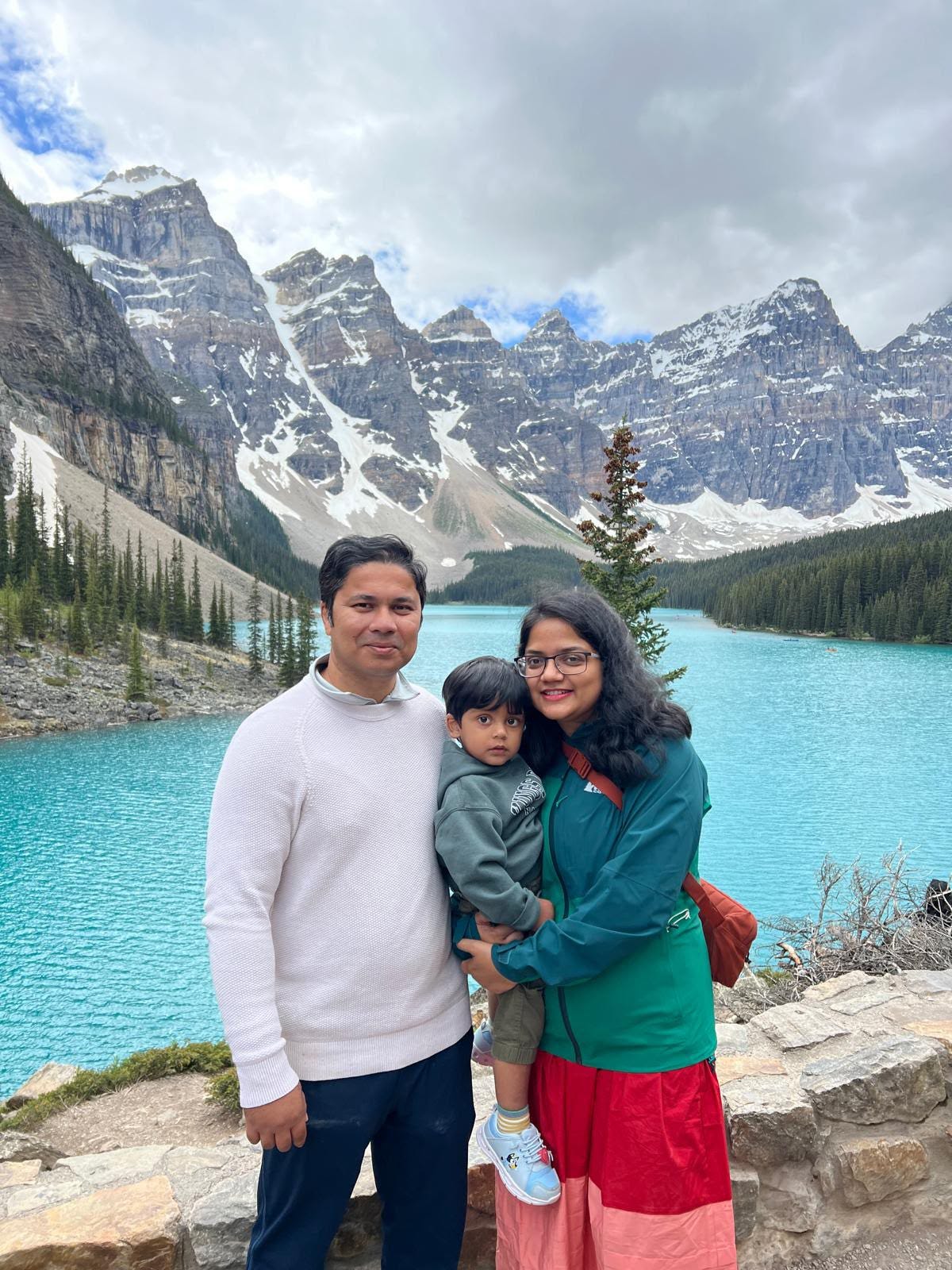
After realizing I don’t want to ruin my holidays by staring at stock prices, I just decided to accept my fate and buyback all the stocks I sold. I felt like 20 lbs lighter after doing that and could again see the beauty right in front of my eyes. While strolling through Moraine Lake with my family later on that day, I almost admonished myself for even entertaining the idea that my fate hasn’t been kind to me.
The highlight of our time at Banff came when we were driving through the Icefields Parkway. I am running out of adjectives to describe that drive, but one broad takeaway from the whole trip was that road trips are perhaps quite underrated. The major highlight during the Icefields Parkway drive happened when we decided to stop at Coleman Creek. As my son and wife were running around the bank of the creek while the sound of the turquoise colored streams soothed our mind, it was impossible to not feel rich!
The funny thing about memory is it is very hard to predict in the moment whether a certain moment will be etched in your memory for decades to come. So, I don’t know if I will remember it vividly, but one of the memories I would indeed like to reminisce in my old age is the laughter of my wife and son while running around Coleman Creek. It is perhaps a good reminder what makes us rich in the first place, and it’s not necessarily always the stock prices going up and to the right!
Subscribers get the daily journal and five+ years of Deep Dives, i.e. full-length analyses with financial models on 65+ companies. The daily is just how I think out loud between the Deep Dives!
Disclaimer: All posts on “MBI Deep Dives” are for informational purposes only. This is NOT a recommendation to buy or sell securities discussed. Please do your own work before investing your money.