Matan on Stitch Fix
Matan Zinger has been writing a very interesting series on Stitch Fix over the last couple of weeks. I typically don’t spend much time on companies with less than a billion dollar market cap, but given the hype this company briefly enjoyed back in 2020-21, I was genuinely curious why the stock crashed by 95%. Matan’s pieces not only covered that question, but also were genuinely reflective of what can potentially lead to such unmitigated business disasters. Sometimes, studying debacles can be more useful than dissecting success stories. In fact, I enjoyed the part-3 of this series so much that I decided to re-print it with his permission. I encourage you to check out part 1 (the rise of Stitch Fix) and part 2 (its bold bet during COVID) before reading the part-3 of this series, but in case you don’t, let me get you up to speed so that you can read part-3 of this series even without all the granular details.
Stitch Fix was that rare 2010s e-commerce company that grew while actually making money. The entire business was built around a single product: the “Fix,” a box of five clothing items curated by human stylists working alongside recommendation algorithms, aimed mostly at busy, suburban millennial women. Founder Katrina Lake raised just $42.5M in venture capital, obsessed over unit economics, and tuned every part of the operation e.g. warehouses, software, inventory, marketing, and thousands of part-time stylists around that five-item box. When COVID crushed brick-and-mortar apparel while Stitch Fix’s growth accelerated, the market re-rated it as “the Netflix of shopping”: the stock ran from a ~$2B valuation to ~$11B in six months, and a nascent “direct buy” channel which let customers shop individual items outside the box fueled predictions that Stitch Fix would disrupt all of apparel retail.
Then came the bet-the-company pivot. In April 2021, Lake abruptly stepped down as CEO, handing the reins to Elizabeth Spaulding, who had joined only 15 months earlier to run direct buy. Spaulding rebranded the channel “Freestyle,” opened it to brand-new customers Stitch Fix had never served and had no data on, and redirected marketing and onboarding toward it in pursuit of the entire women’s apparel market. The rushed rollout cannibalized the core: prospective customers were funneled into an untested Freestyle experience instead of the proven Fix onboarding, net client adds collapsed, active clients began shrinking outright, and less than a year into the pivot Stitch Fix reported the first revenue decline in its history, followed by layoffs. Part 3 picks up from there: how deep the self-inflicted damage ran, and why it proved so hard to reverse. I'll let Matan continue that story below.
What Happened to Stitch Fix? Part 3: Freestyle Freefall
This is part 3 in What Happened To Stitch Fix; for better context, check out part 1 (the rise of Stitch Fix) and part 2 (its bold bet during COVID).
The hasty rollout of Freestyle (discussed in part 2) didn’t happen in a vacuum. In July 2020, Shopify’s Tobi Lütke argued that “2030 has gotten pulled forward into 2020.” A McKinsey report stated in 2021 that the pandemic “accelerated the migration to e-commerce—the expected five-year trajectory happened in a matter of months.” This belief led to an e-commerce investment frenzy.
In that environment, the biggest risk was missing the train by moving too slowly. Racing Freestyle to market made sense.
Except the train never really left the station. Shopify CEO Tobi Lütke wrote in July 2022:
[...] Given what we saw, we placed another bet: We bet that the channel mix - the share of dollars that travel through ecommerce rather than physical retail - would permanently leap ahead by 5 or even 10 years [...]
It’s now clear that bet didn’t pay off.
Meta’s Mark Zuckerberg and Amazon’s Andy Jassy made similar concessions that year. But while these companies could contain their failed bets – by shutting down initiatives meant to serve the demand that never materialized – Stitch Fix kept declining.
The failed bet Stitch Fix had made was much harder to undo.
“A Loss Of Focus”
“There’s some macro headwind, but I’m not willing to accept that it’s all macro,” Katrina Lake insisted on her first earnings call back. Spaulding’s tenure didn’t last long. Seventeen months after handing over the company, Lake returned as Interim CEO at the beginning of 2023. The business was in far worse shape than she’d left it.
Active clients had fallen below 3.4 million and quarterly revenue to $400M — both the lowest since 2019. The pandemic-era gains had fully evaporated. Stitch Fix turned into a money-losing, declining business. The stock traded under $4, down over 96% from its 2021 peak.
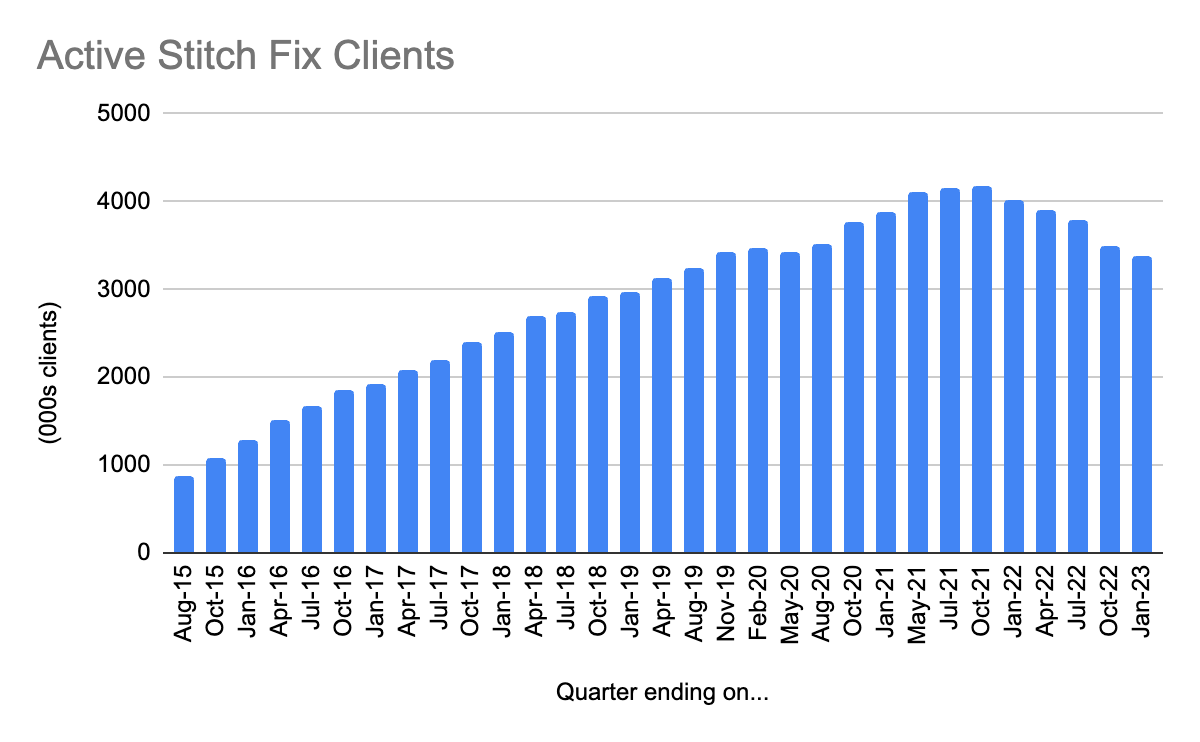

The earnings call marking Lake’s return is one of the most memorable I’ve listened to. She acknowledged the decline in her opening remarks:
[...] We haven’t met recent expectations. Driving towards an ambitious vision has resulted in a loss of focus. We must now more than ever deliver on the client experience, bring focus in our marketing efforts and drive results for our shareholders.
Lake was quite open when asked where Stitch Fix “lost its focus”:
[...] As we thought about expanding the business in a very ambitious way, we took a marketing approach that probably tried to bring people into a variety of different customer segments. And very notably, we spent marketing dollars trying to bring people into a Freestyle-first experience as an example. So that’s a place where not only did we find that that marketing of freestyle first wasn’t as effective as what we had done historically in Fixes. But it also actually made it harder for us to be able to be acquiring people into the Fix channel.
[...] Another one is around inventory. We definitely built up an inventory in anticipation of a Freestyle customer that was a different set of inventory than Fixes and also more unknown, it was a customer we hadn’t served before. It was a channel we hadn’t served before. And so, there was more risk in the inventory.
The word focus — which Lake said more than thirty times on the call — was doing a lot of work1. These examples point to a bigger story: a decade of machinery, built and tuned around the Fix, repurposed to chase Freestyle — hurting the Fix business in the process.
Loss of focus was a generous way to describe what had happened during the previous seventeen months. Stitch Fix didn’t get distracted; it was dismantling the elements that made it unique and successful in the first place.
Unstitching Stitch Fix
Part 1 of this series told the early success story of Stitch Fix: accepting a limited-size market allowed the company to build a differentiated business that – unlike its peers – was profitable and made efficient use of capital. All parts of its operation – the software infrastructure, fulfillment centers, marketing channels, algorithms, and human stylists – were optimized around the Fix concept.
None of them alone was the moat; the way they were stitched together created a unique offering. The algorithm had blind spots, but the stylists learned to work around them. The algorithm and stylists worked around inventory gaps. The warehouse was designed to efficiently pack 5-item boxes, where clothes weren’t folded (since the customer was going to try them on first). Fix customers were motivated to provide item-level feedback – on style, cut, quality, and pricing – thus feeding the algorithm far more data than any retailer ever collected. Marketing was optimized for the type of customers who found those mystery Fix boxes delightful.
The way each part was optimized around the others’ strengths and limits was the moat: competitors may have copied different components, but couldn’t replicate the integration. That moat is why Stitch Fix made money while its box-subscription peers burned cash. It’s also why the business rapidly came apart once the equilibrium was broken.
The story of “Fix Preview” provides a great illustration: Originally, a Fix was a mystery box. Customers didn’t know its content until it arrived. In 2020, the company started2 sending its UK customers an email with the content of an upcoming Fix, allowing them to make modifications. Encouraged by improved keep rates and order values, the company rolled out Fix Previews in the US during 2021.
It backfired, however, when Stitch Fix failed to recognize its own limitations and stretched the feature too far: in many cases the preview was generated by the algorithm, with no human stylist in the loop. The customer was effectively doing the stylist’s job, which was an opportunity for Stitch Fix to save on styling costs. This led to some frustrating experiences – from a 2022 Vice article:
[...] According to stylists, the algorithm often just picks up on keywords in these [customer feedback] sentences without understanding context. If you tell the system that you don’t want jeans, you may very well end up with multiple pairs of jeans in your Fix Preview.
“And sometimes our clients don’t know that the algorithm is picking stuff,” a stylist told Motherboard. “They’ll respond, like, ‘Why did you send me this stuff?’”
“The algorithm was not trained well enough to take into account seasonality or where people live. It would just start pulling out like, a bunch of sweaters for someone who lives in Texas, or like 10 pairs of pants, or like 10 of the exact same shirt, or like 10 backpacks,” [...]
Fix Previews violated the delicate balance: with the stylists removed, customers were directly exposed to algorithm shortcomings and inventory gaps3. And they blamed their stylists.
These complaints didn’t alarm management — there are always customers with grievances, and nothing was showing up in the numbers. Keep rates and order values held. When Lake returned, however, she reported what those metrics had been hiding:
Although at the highest level Fix Preview has demonstrated a positive impact on AOVs, digging into the data, we see a more nuanced story. There absolutely are clients who significantly benefit from Fix Preview. But there are also clients for whom showing a preview actually increases cancellation.
Oops. This is textbook survivorship bias — just like Wald’s bomber planes, which which shot down and never made the stats – customers who canceled weren’t accounted for by the key metrics Stitch Fix was monitoring. You can’t measure the keep rate or the value of an order that didn’t go through. But the damage was real – algorithm-generated previews were repelling customers, even if the dashboards weren’t showing it.

There’s an interesting analogy. Customers were stuck with an algorithm too rigid to understand what they wanted; management was running Stitch Fix on metrics with the same flaw — confident, context-blind. Both these cases needed a human in the loop to catch the miss. The stylists4. It didn’t end there.
The stylists’ job, it turned out, was more than correcting the algorithm’s picks. “Shopping is inherently a personal and human activity,” Lake wrote in 2018, insisting that data science must be combined with human stylists; she explained:
For example, when a client writes in with a very specific request, such as “I need a dress for an outdoor wedding in July,” our stylists immediately know what dress options might work for that event. In addition, our clients often share intimate details of a pregnancy, a major weight loss, or a new job opportunity—all occasions whose importance a machine can’t fully understand. But our stylists know exactly how special such life moments are and can go above and beyond to curate the right look, connect with the clients, and improvise when needed. That creates incredible brand loyalty.
This didn’t show up in a metric, but played a critical role for Stitch Fix.
Things changed the same month Spaulding became CEO. In August 2021, stylists were required to switch to 20-hour weeks, dropping the flexible arrangements — between shifts, after bedtime – that let Stitch Fix rent the judgment of people it could never have hired full-time. Hundreds of experienced stylists opted, instead, to take $1,000 and walk away. For those who stayed, a new points system roughly doubled the expected pace. Stylists were measured on efficiency – required to style a Fix within five to fifteen minutes5 – and on keep rates.
These incentives may have looked good on paper, but turned out to be perverse. In the old days, a stylist might spend fifteen or twenty unmeasured minutes drilling down into a client’s previous notes and browsing her Pinterest board and Facebook profile, trying to “crack” the right style. This large upfront effort offered the potential reward of winning over a loyal customer. The new system penalized exactly that: the efficiency hit was immediate, while the potential keep-rate payoff was months away. Hard clients — new, picky, style still unclear — became a losing trade. The system taught stylists to harvest the existing base of established and predictable clients, and let new clients churn.
This was a one-two punch: the company was acquiring fewer customers, due to the abrupt marketing changes (see Part 2); the customers it did acquire were monetized at lower rates due to the degraded service.
Post Mortem
Despite these issues, Lake was optimistic that Stitch Fix could recover by returning to its roots:
[...] In terms of what the customer is looking for, I think that’s really differentiated about our channel relative to others, it’s not necessarily price. It’s not necessarily finding the brand that you love. It is actually around fit [...] It’s about style. It’s about finding things that you love. And in some cases, find things that you love that are surprising to you. And that’s something that really only our channel can deliver on.
[...] Stitch Fix is one that really makes shopping more tenable and makes it easier. It helps people to look their best without spending a lot of effort to do it. And those are really differentiating qualities in our customer that we can build the right assortment to be able to deliver on.
[...] I think just really being able to focus on the things that we already know that we are able to deliver on that we have a business that’s 10-plus-years-old, that has a history of profitability delivering on this business to be able to focus back on the things that we know and know that we can deliver is kind of the core thesis.
That thesis didn’t hold. The decline persisted, bottoming at 2.3 million active customers and $340M of quarterly revenue. Over three years later, Stitch Fix still hasn’t returned to profitability. The stock has been flat for almost four years.
In reality, Stitch Fix’s “differentiating qualities” were already broken. The Fix moat was gone, in a way that wasn’t easily reversed. As we’ve seen before, saying “I no longer want the cheese” doesn’t get the mouse out of the trap.
It’s tempting to conclude that Stitch Fix’s biggest mistake was violating the very aspect Ben Thompson had liked about it when it went public in 2017:
Stitch Fix is a more important company than it may seem at first glance: it proves there is a way to build a venture capital-backed company that is not an aggregator, but still a generator of outsized returns. The keys, though, are positive unit economics from the get-go, and careful attention to profitability. The reason this matters is that these sorts of companies are by far the more likely to be built: Google and Facebook are dominating digital advertising, Amazon is dominating undifferentiated e-commerce [...] To compete with any of them is an incredibly difficult proposition; better to build a real differentiated business from the get-go, and that is exactly what Stitch Fix did.
The COVID e-commerce euphoria pushed Stitch Fix to pursue an aggregator dream – transforming into a personalized apparel marketplace and disrupting all of shopping – which indeed turned out to be “an incredibly difficult proposition.” Stitch Fix abandoned its humble-yet-safe territory, flew too close to the sun, and crashed. Right?
While this is largely true, the actual moral of the story is – like many things in today’s article – much more nuanced.
I like this story from former Amazon executive Dan Rose, about how Jeff Bezos asked Steve Kessel – who was running Amazon’s media e-commerce business – to lead the Kindle initiative:
He said to Steve one day, “Steve, I need you to come over and run this digital business and get this digital book platform started so that we don’t get iPoded out of books.”
And Steve said, “Great, I’ll take one of my best people. We’ll put them on it, and we’ll get a team going, and it will be great.”
[...] And Jeff goes, “No, Steve, let me make this clear.
“As of today, you’re fired from your job.
“Your new job is to kill your old business.
“I want you to put the physical books business out of business by building a digital product that’s so “good that people don’t buy physical books anymore.
“If you run both, you’ll never be motivated to do that.”
Bezos understood The Innovator’s Dilemma very well. In his 1995 HBR6 article about Disruption, Harvard professor Clayton Christensen concluded that responsibility for building a disruptive-technology business must be placed in an independent organization.
Unfortunately for Stitch Fix, even though Katrina Lake attended Harvard Business School, she didn’t follow Christensen’s advice; she handed Elizabeth Spaulding the responsibility for building Freestyle – meant to be a disruptive new business – and at the same time, the responsibility of overseeing the core Fix business.
That’s the most catastrophic part of the story: yes, Freestyle was too ambitious, and failed. But had it been built in a separate organization – akin to Meta’s Reality Labs, or Amazon’s Fire Phone – it wouldn’t have been as consequential. Money would have been lost, but the Fix side of the house wouldn’t have been damaged. In that parallel universe Stitch Fix may have been able to bounce back after COVID, and to remain a profitable, growing business today.
The most incredible thing, though, is that Christensen’s recommendation followed research showing that managers prioritize their existing core business, depriving the potentially disruptive new business of resources needed for it to succeed. An independent organization is, he concluded, the only solution. Which is why Bezos detached Kessel from Amazon’s existing physical books e-commerce business. He wanted a manager fully devoted to building the new digital books business.
But the opposite happened at Stitch Fix: having both Freestyle and Fix under her supervision, Elizabeth Spaulding prioritized the new and uncertain business over the existing successful one. So eager was Stitch Fix to disrupt itself that it didn’t notice it was tearing down the Fix business.
There aren’t many stories like this. I think that even the late Prof. Christensen would have been surprised.
Imagine Bezos telling Kessel “your new job is to kill your old business,” but leaving him in charge of the old business too. The intention, surely, was for him to build a new business so good that it renders the old one obsolete. But there’s a shortcut, the kind that a rigid and unsophisticated algorithm might come up with: just directly kill the old business.
That, tragically, is what happened to Stitch Fix.
For more posts like this, I recommend you subscribe to Matan’s Blog.