Meta On the Offense!
This week has turned out to be a plethora of model launches with SpaceX releasing Grok 4.5 on Wednesday, and Meta and OpenAI releasing Muse Spark 1.1 and GPT-5.6 yesterday. While Meta has been on the news almost on a daily basis these days with admittedly more negative than positive developments, yesterday’s release was indeed a positive surprise. Meta released a multimodal reasoning model built for agentic tasks, with noticeable improvement in tool and computer use, and coding. The reason it was a real surprise even for me is that unlike the likes of Anthropic or OpenAI, I think Meta has been focused on coding only for a short while. The fact that Meta has developed a somewhat competitive model in coding in such a short time bodes very well for the bet Zuckerberg has made over the last year in building MSL. However, it also reiterates one of the points I was making yesterday: it remains fairly challenging to articulate sustainable source of moat in the model layer.
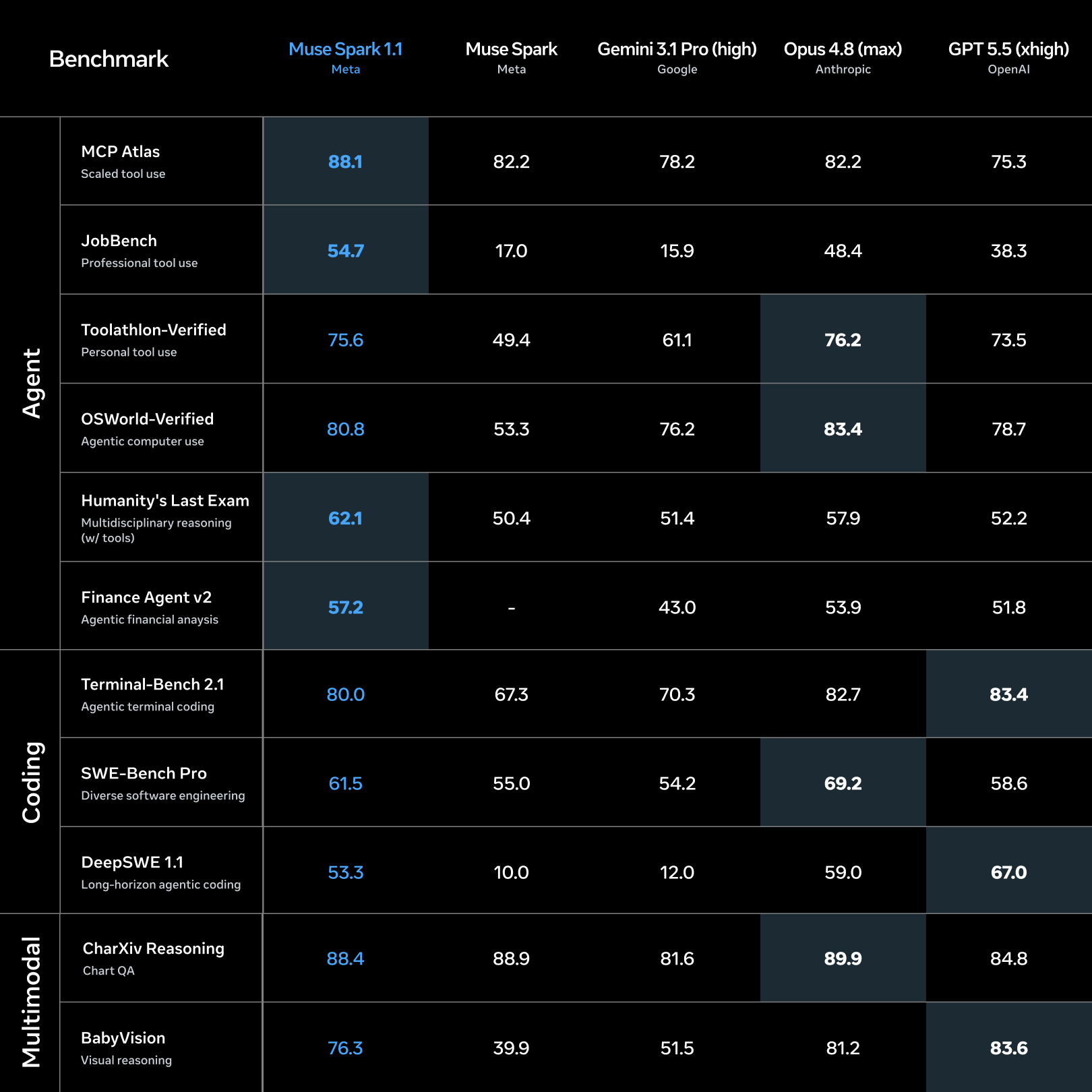
Of course, ever since the Llama 4 debacle, there is a sense of suspicion especially related to Meta whether these benchmark scores reflect the model’s true capability in the wild. Therefore, more than the benchmark scores, I took note of how Box praised the model in their blog yesterday:
Muse Spark 1.1 keeps pace with the leading models across most of the industries we test, and it’s especially at home in structured, procedural work: the professional services, public sector, and industrial tasks where the job is to follow a defined process over a stack of documents and get every step right.
In those categories, it pulls ahead of the top-tier composite by as much as 5 to 6 points. This is the connective tissue of enterprise work — intake, review, reconciliation, reporting — and it’s where Muse Spark 1.1 is most consistently hitting the mark.
Muse Spark 1.1 is also strong on report drafting. Given raw inputs and a format to fill, it produces clean, complete, well-organized deliverables that hold up against what the best models generate. For the day-to-day work of turning data and documents into something a person can act on, Muse Spark 1.1 is a dependable choice.
But how is Meta catching up so fast? I highlighted yesterday how data may prove to be true source of long-term differentiation for AI models. Although Meta has been lambasted both internally and externally for their approach to collecting data from their own employees, Semianalysis yesterday pointed out that even though such decision might be unpopular, it is indeed perhaps the right bet for Meta:
This is quite literally some of the most valuable data in the world today! Of course, it’s also poetically apt that the Scale AI man is the one spearheading the transformation.
Whereas all the data companies are desperately trying to partner with investment banks, law firms, and advertising agencies to record their workflows, Meta is one of the few companies in the world that has a sufficiently large workforce dedicated to each of these industries in-house.
The fact that Meta is still nimble and aggressive enough to do this despite the PR hit and initial employee backlash is already quite impressive. Yes, they’ve since walked it back slightly by strengthening privacy protections and giving employees the option to pause the tracker for 30min, but we think these are very minor concessions.
Furthermore, they took their data efforts to another level in late May by announcing a new “applied AI engineering org” as part of their most recent round of layoffs/restructuring. ~3000 engineers, which includes 70% of their new grads and a significant number of seniors, will now be making RL tasks/environments full-time.
We think this is an extremely underappreciated advantage for MSL
To be clear, Anthropic is still clearly ahead of the pack. In fact, Anthropic’s competitors, including several Meta executives and even Elon Musk almost have a reverential tone to Anthropic’s ability to build superior models:
I was clearly wrong about Anthropic. They are obviously currently the leader in AI. No company has released a model as good as Mythos/Fable and they will undoubtedly have Mythos 2 ready soon.
— Elon Musk (@elonmusk) July 9, 2026
And I would never cut them off in a way that hurt them badly, even as a competitor.…
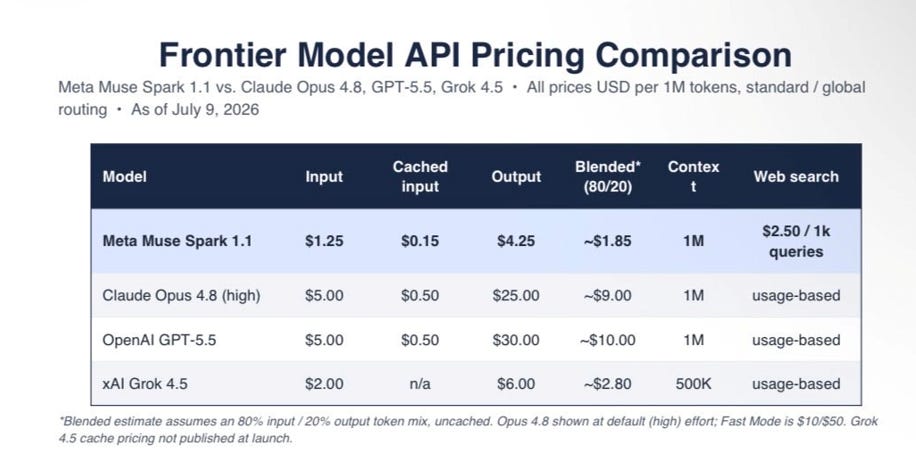
While the rest of the pack is yet to catch up or surpass Anthropic’s lead, Zuckerberg seems determined to attack the profit pool in the model layer. He made his intentions clear in an interview with Bloomberg:
“The pricing from some of the other labs is very extreme and has very high margins,” Zuckerberg said, underscoring that his strategy is to get Meta’s technology in front of as many people as possible. “We think that there’s a real ability to be able to offer frontier or very high-level intelligence at a much more affordable cost.”
Meta can rationally price near serving cost, and every dollar of margin it denies competitors is a dollar removed from their competitors’ training war chest and can become even more reliant on external capital to stay in the race. Remember, Meta mostly doesn’t need to pay margins to other hyperscalers which structurally allows Meta to price more aggressively than OpenAI or Anthropic (I say mostly because Meta started renting some capacity from other hyperscalers and neoclouds as well but the point remains). If “SOTA adjacent” models lose much of their pricing power, Anthropic (and OpenAI) will be even more reliant on pricing SOTA models very, very aggressively which can ultimately lower the TAM for SOTA model.
Moreover, it gives Zuckerberg something Wall Street has been demanding: a revenue line against the capex, plus utilization for a fleet whose worst enemy is idleness. The labs may face a difficult choice: cut price and compress the gross profit that funds training (forcing more external capital at more dilution, right as both approach IPOs), or hold price and cede the highest-volume-growth segment plus the usage data that comes with it.
Releasing Muse Spark 1.1 wasn’t the only news that came to light yesterday; Reuters reported on the same day that Meta “outlined a two-step infrastructure expansion: seven gigawatts of computing capacity coming online in 2026, growing to 14 gigawatts by 2027.” Just for context, Andy Jassy during 4Q’25 call mentioned that AWS added ~4 GW of capacity in 2025. That probably puts things into perspective how large Meta’s capacity additions are in 2026 and 2027. Given the size of the expansion, there is perhaps a non-negligible probability that they might overbuild compared to their internal needs. I suspect Meta’s internal estimates for their own compute needs has a wide range to it, and they’re trying to build for the bull case rather than base case scenario. Given that context, it makes sense that Meta likely intends to develop their muscle of selling compute to 3P customers in case the bull scenario doesn’t pan out. And in case it does, Meta should structure the 3P compute deals in a way that allows them to re-allocate the compute capacity back to internal teams.
I do want to note that while the pace of MSL seems quite encouraging, we need to see more consistent shipping throughout this year before heaping any further praise to Meta. Google too appeared to have found their mojo in late 2025 and they increasingly appear haphazard in the model layer so far in 2026. If MSL can maintain their shipping cadence for the next 6 months, Zuckerberg’s “Hail Mary” bet on building MSL last year will prove to be quite prescient.
Subscribers get the daily journal and five+ years of Deep Dives, i.e. full-length analyses with financial models on 65+ companies. The daily is just how I think out loud between the Deep Dives!
Current Portfolio
Please note that these are NOT my recommendation to buy/sell these securities, but just disclosure from my end so that you can assess potential biases that I may have because of my own personal portfolio holdings. Always consider my write-up my personal investing journal and never forget my objectives, risk tolerance, and constraints may have no resemblance to yours.
I made a slight change to the portfolio yesterday.