Nvidia Climbing the Wall of Worries
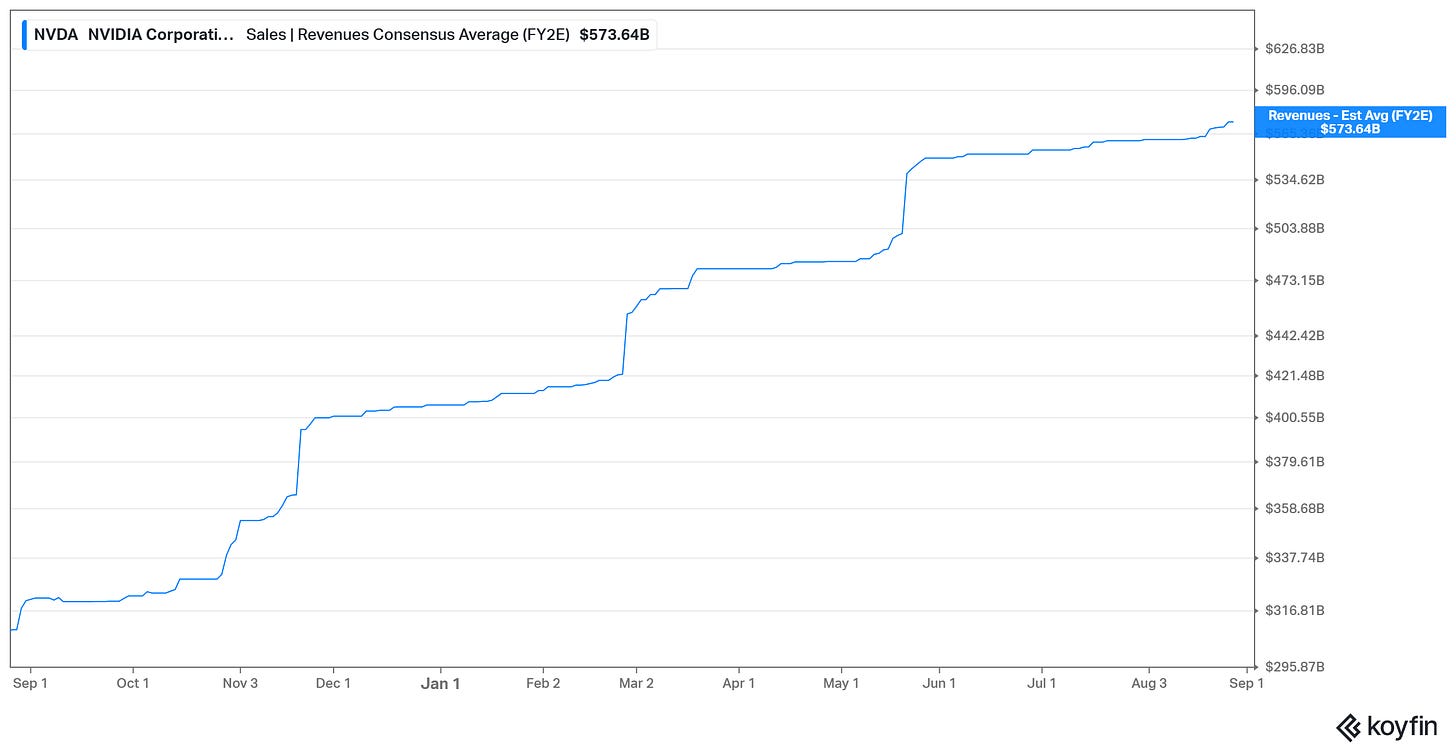
A year ago, the average sell-side consensus estimates for Nvidia’s FY 2028 (which is essentially CY 2027) revenue was ~$310 Billion. But yesterday, Nvidia guided for ~70% revenue growth in FY’28 which translates to approaching ~$700 Billion revenue next year! That means Nvidia’s FY’28 revenue estimates was wrong by ~$400 Billion just a year ago! Even before the call, analysts were estimating ~$574 Billion revenue next year. So even though analysts kept updating the estimates throughout last year, they were still short by ~$125 Billion! If that wasn’t enough, Nvidia repeatedly mentioned during the call that this growth outlook is supply constrained and they could probably double the revenue next year if that weren’t the case. Given their tone during the call, I think it’s fair to say ~70% revenue growth may be a floor for next year. It’s a cliche to say it these days, but I have never seen anything like it!
Perhaps equally perplexingly, just when Nvidia was making mockery of analyst estimates over the last year, the stock has barely outperformed S&P 500 and actually underperformed both QQQ and semiconductor ETF. In case you needed another reminder why investing is hard, I’m happy to help.
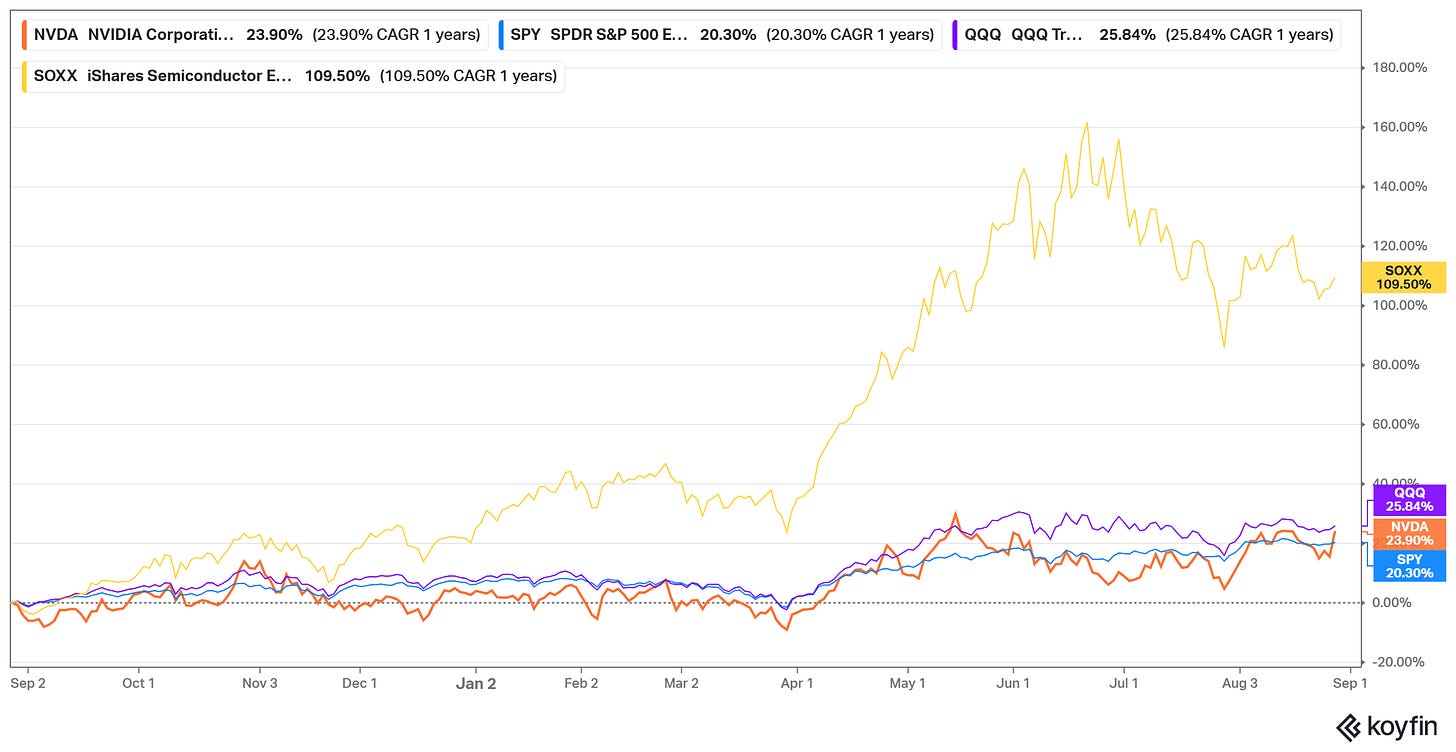
Such relatively muted stock performance compared to Nvidia’s operating performance is a confirmation that buy-side likely have a materially different estimates compared to sell-side. Even though sell-side estimates show Nvidia will keep growing revenue with operating margins at mid to high 60s, Nvidia’s current earnings multiple likely implies that buy-side is far more skeptical about that. This doesn’t mean buy-side is necessarily right, but an indication that Nvidia will have to climb such wall of worries in the coming years.
Nvidia’s revenue mix also shows what they’re trying to execute to climb the wall of worries. While revenue from hyperscalers doubled YoY, revenue from AI Clouds, Industrial, & Enterprise (AICE) segment grew by ~140% YoY! Nvidia mentioned they now expect neoclouds will exit the year with 8 GW of installed capacity in 2026, up from only ~3 GW capacity in 2025.
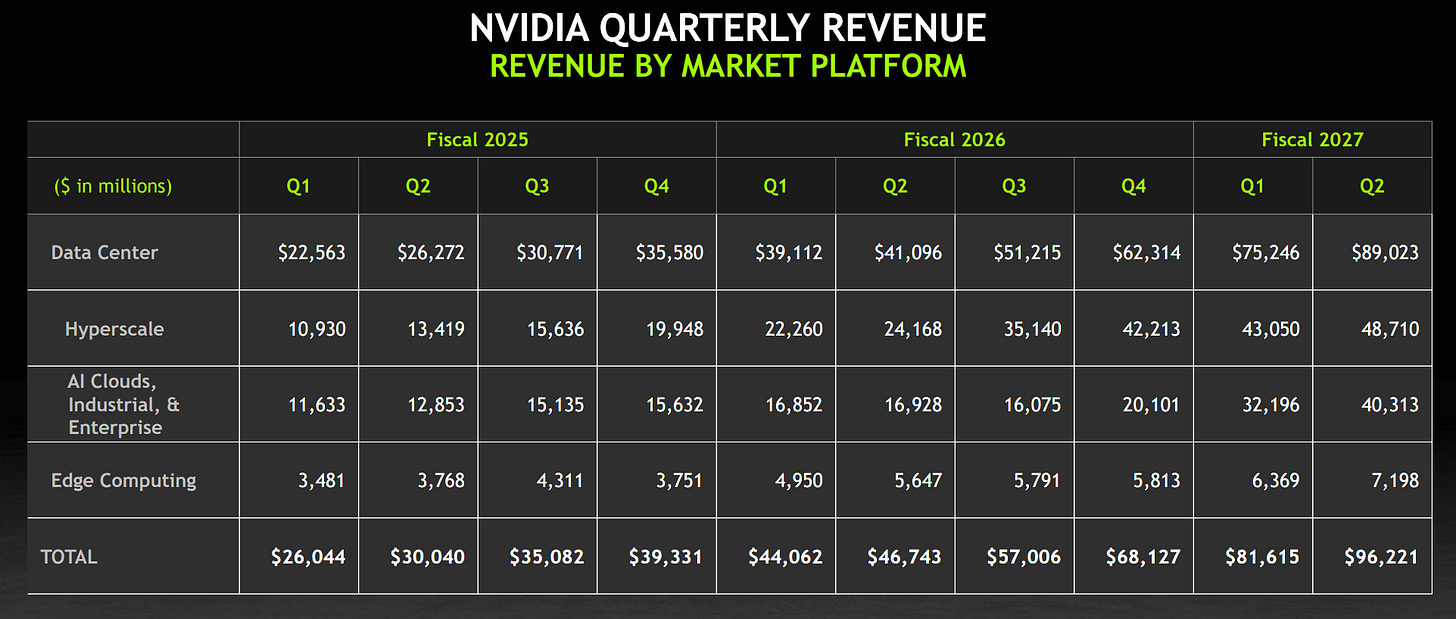
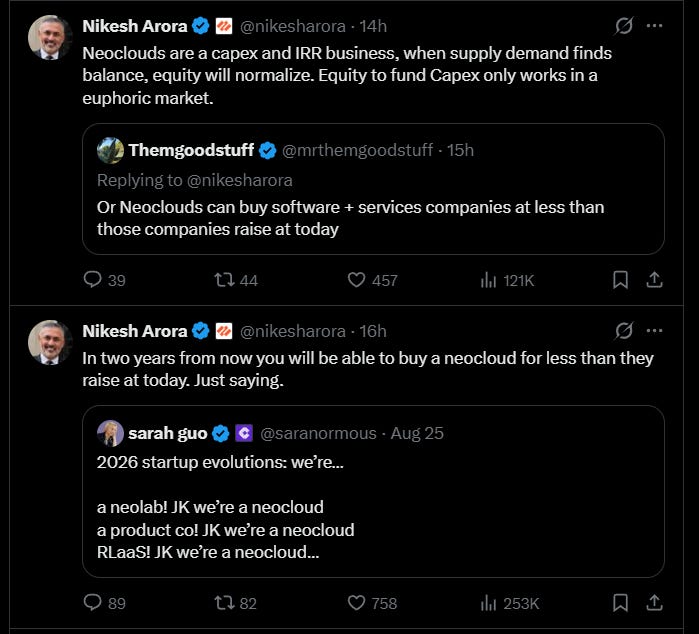
To contextualize the neoclouds capacity, let me mention that AWS, the largest hyperscaler in the world, only had an estimated ~15 GW capacity in 2025. Since Amazon mentioned that they expect to double their capacity from 2025 to 2027, let’s assume they’ll add 7-8 GW capacity this year which implies neoclouds in aggregate will add ~60-70% of AWS incremental capacity this year. Since the neoclouds are almost all exclusively buying Nvidia GPUs, the rise of neoclouds is a massive boon for Nvidia. Of course, the rise of neoclouds is also very much direct consequence of Nvidia’s deep desire to commoditize the hyperscalers while hyperscalers are busy trying to commoditize the chip layer. At the same time, let me repeat what I mentioned yesterday, who exactly are in the backlog of these neoclouds? It’s the same hyperscalers! So the biggest question here is what will happen to these neoclouds if hyperscalers manage to bring capacity closer to the demand curve over time. Nikesh Arora, CEO of Palo Alto Network, captures the skepticism many investors hold about most neoclouds’ future:
Beyond the hyperscaler vs neoclouds debate, the other vector of concern is whether much of the incremental compute demand is going to be dominated by just a couple of frontier labs such as OpenAI and Anthropic. Both the labs have made it abundantly clear so far that they intend to have heterogenous compute fleet and do not want to exclusively use Nvidia’s GPUs (I guess they can change their mind if Nvidia provides them the funding to buy the GPUs). Nvidia highlighted yesterday that OpenAI’s existing and planned commitments represent 12 GW of Nvidia compute. Interestingly, OpenAI already signed a 6 GW compute deal with AMD, 10 GW with Broadcom, and 2 GW with Amazon. As a result, Nvidia’s share in OpenAI’s commitments is only ~40%. However, much of these commitments are likely to be frontloaded in Nvidia’s chips but that is expected to flip to non-Nvidia chips over the medium to long term.
Anthropic is on the opposite spectrum. Their compute commitment so far is roughly half of OpenAI’s: 5 GW with Amazon, 2 GW with AMD, ~1 GW with Google Cloud, ~3.5 GW with Broadcom+ Google, and likely 3 GW with Nvidia. So, Nvidia has only ~20% share in Anthropic’s commitments. Nvidia probably would love to grow their share in Anthropic in the future, especially when they may start losing share in OpenAI’s compute footprint, but you can imagine Amazon and Alphabet will be ready to sweeten the deal to sell incremental chips to Anthropic. You may argue at the rate Anthropic is growing, they may not need such circular funding sweeteners but in that case, who do you think hold the negotiating leverage if four different companies are trying to cajole one company to buy their silicon?
This is why having any concentrated compute demand will likely prove to be quite destabilizing for the long-term economics for both the silicon layer and hyperscalers. Such dynamic is perhaps why buy-side is less comfortable in underwriting higher multiple in Nvidia’s earnings power despite eye-watering growth.
To be clear, Jensen Huang is very, very clear-eyed about the risks here. Even when he’s providing backstop or financing to AI labs, he does not want to see massive concentration in compute demand in the medium to long term. That explains why Nvidia is going to acquire Hugging Face. As “Modest Proposal” wittily put it, Nvidia wants to commoditize both its competitors and customers so that Nvidia remains the King! Indeed, AI is increasingly the game of Kings and while everyone appears to be friendly with each other, they are also very much wary of defending their thrones! It’s hard to know how the battle lines will be ultimately drawn. Given that context, perhaps we should wonder less about Nvidia’s anemic earnings multiple and question more why other AI beneficiaries deserve lofty multiples.
Subscribers get the daily journal and five+ years of Deep Dives, i.e. full-length analyses with financial models on 65+ companies. The daily is just how I think out loud between the Deep Dives!
Current Portfolio:
Please note that these are NOT my recommendation to buy/sell these securities, but just disclosure from my end so that you can assess potential biases that I may have because of my own personal portfolio holdings. Always consider my write-up my personal investing journal and never forget my objectives, risk tolerance, and constraints may have no resemblance to yours.
My current portfolio is disclosed below: