Meta Buys Away its Distraction at Minimal Cost
A couple of days ago, Meta reached an agreement with 52 attorneys general across US states to settle their lawsuit alleging that it knowingly designed addictive platforms that harmed young people’s mental health. As part of the settlement, Meta will pay a cumulative $18 Billion over 10-year period, 30% ($5.3 Billion) of which is contingent on two specific conditions: a) both YouTube and TikTok also agree to implement similar measures as Meta, and b) YouTube and TikTok both match half of the $5.3 Billion payment each.
When these lawsuits attracted attention in the media, I specifically highlighted why Meta cannot solve the problem at hand alone in the reality of a competitive market environment:
“Even if a company such as Meta decides to avoid any engagement tricks for minors but their competitors relentlessly pursue it, it is very difficult for Meta to watch its competitors building competing networks of young users that can hurt its competitiveness in the long term. This is precisely why despite Meta generating only 1% of its revenue from teens, it cannot willingly cede this market to its competitors. To the extent the courts force all the companies to make the apps boring for minors, it may end up narrowing the path of future competitors for incumbent social networks such as Meta.”
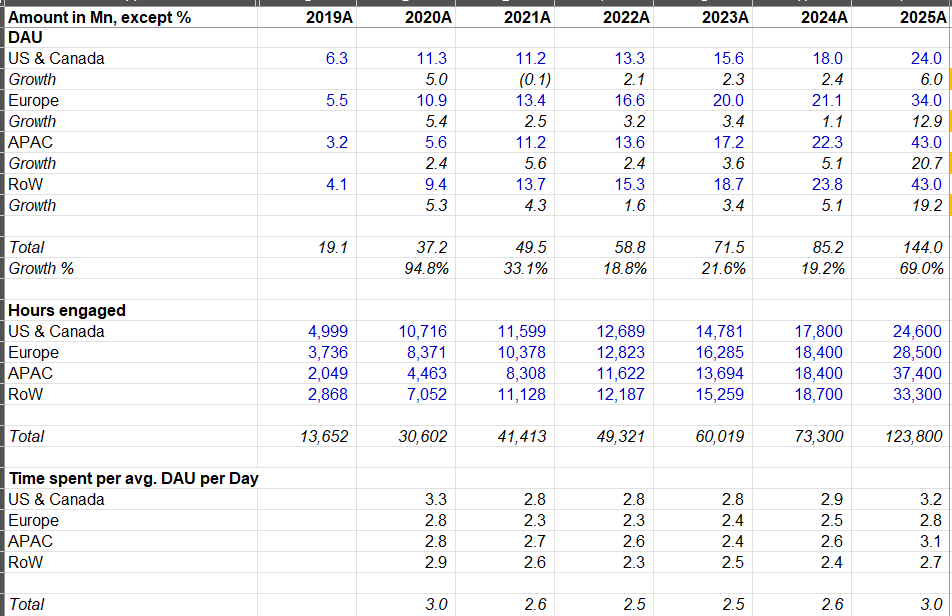
I am glad to see Meta insisting that its major competitors are all playing by the same rules since that is indeed the only way the measures to limit teen usage of these apps can be effective. I wouldn’t assume apps not named YouTube and TikTok are outside of the purview of these measures. Sure, other companies won’t have to chip in to pay for the liabilities for now, but Meta’s settlement will set a strong precedent that “excessive” usage of any app can be deemed as a long-term risk for any digital company. The company that popped on my mind that can face damaging consequences for such precedent is Roblox. The majority of Daily Active Users (DAU) are minors and as Roblox publicly reports, the average time spent per DAU on its platform is three hours per day! Since it’s only average, I suspect the top 20% DAU (who may drive majority of the bookings) may actually spend noticeably more than three hours per day. If concerned parents end up suing Roblox and demanding it implement the time limit Meta agreed to, the consequences could be far more damaging for a company like Roblox.
Meta is also trying to be a bit opportunistic in exerting pressure on competing apps and creating more awareness around it by putting full-page advertisement on national newspapers as well as on Facebook and Instagram to US users.
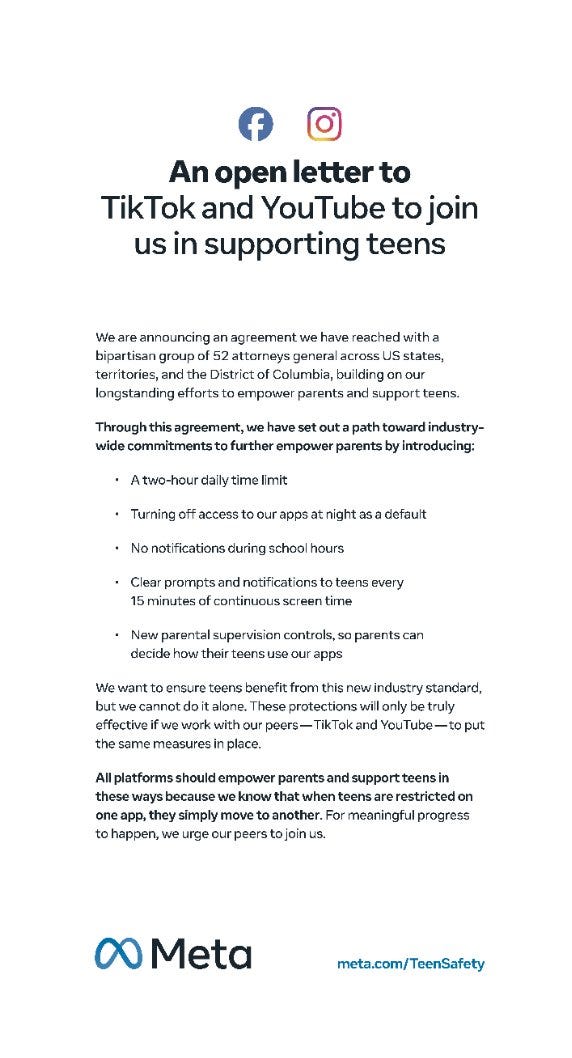
I have noticed some people found it rather distasteful that Meta used the settlement as a pressure tactic on competitors. I am, frankly speaking, quite bamboozled by such accusation; if you really care about the potential negative effect of these apps on teens, why wouldn’t you want these measures to be industry standard and how does it help if Meta is the only company subjected to onerous usage limit while teens can use other apps as much as they want?
However, I do think Meta’s lawyers were able to extract a much better deal than even Meta bulls likely hoped. Every state except New Mexico and Florida joined this agreement which means possibility of the most draconian penalties is clearly off the table. Florida and New Mexico are absent because each pursued its own separate path against Meta. New Mexico had already taken Meta to trial in state court and won which Meta is currently appealing. Florida, meanwhile, simply refused to sign on because it viewed the terms as too lenient. If you believe what these states were alleging Meta did to mental health of our teens, it’s indeed hard not to think this whole settlement was rather a slap on Meta’s wrist.
Take, for example, what is excluded from the time limit, school mode, or night mode restrictions Meta agreed with: Direct Messaging (DM). Three years ago, Instagram Head Adam Mosseri said that if you look at how teens spend their time on Instagram, they spend more time in DMs than in Stories, and more time in Stories than in Feed. He added further in the same interview that all of Instagram’s sharing growth over the prior five years had been in Stories and DMs, and that Feed is at best the third or fourth most important surface. The fact that YouTube or TikTok don’t have a popular DM surface may mean a time restriction on those apps may lead teens to spend more time on Meta’s DM surfaces in IG, WhatsApp, and Messenger! Given that context, I am not confident that time spent by teens on Meta’s apps will even go down after these restrictions are implemented when you include the time spent on DMs.
Since 30% of the full settlement is contingent on YouTube and TikTok joining the agreement, the guaranteed cash expense for this settlement is only ~$1.2 Billion per year which is less than 1% of Meta’s opex base for this year. Meta may have paid more to hire a handful of AI researchers last summer than settling a lawsuit with such damning allegations! Zuckerberg should consider setting aside some bonuses for his lawyers this year.
Meta is, however, not quite out of the woods yet. Even after the AG settlement, Meta faces hundreds of pending suits from individuals, families, and school districts over youth harms (the California JCCP and federal MDL). I will also be shocked if EU and perhaps India and Brazil also don’t sue Meta on the same teen mental health issue in the hope to receive at least similar settlement. So, my guess is the eventual recurring liability from this settlement may be close to double the amount once you consider the other pending and future lawsuits. Even if you assume $2 Billion recurring eventual liability from this settlement, it’s basically ~1.2% of Meta’s operating expense this year. Of course, given opex will keep increasing, the impact of this settlement will be de minimis in 5-10 years. Ultimately, the settlement may be worth more to Meta than ~1% of its opex because it allows them to move forward from this distraction and focus on what will dictate the company’s long-term future: AI! Meta’s lawyers may have done their job to keep the downside in check, but the upside needs to be unlocked by its AI talent!
Subscribers get the daily journal and five+ years of Deep Dives, i.e. full-length analyses with financial models on 65+ companies. The daily is just how I think out loud between the Deep Dives!
Current Portfolio:
Please note that these are NOT my recommendation to buy/sell these securities, but just disclosure from my end so that you can assess potential biases that I may have because of my own personal portfolio holdings. Always consider my write-up my personal investing journal and never forget my objectives, risk tolerance, and constraints may have no resemblance to yours.
My current portfolio is disclosed below: