Music's AI Mess: Part 2
Just as I have highlighted in Music’s AI Mess, people seem to find it very hard to differentiate between AI-generated music and human-made music. Deezer/Ipsos recently did a survey in which they asked people to listen to three tracks and determine whether or not they were fully AI-generated. 97% couldn’t differentiate them and 52% of them felt uncomfortable for their inability to do so, perhaps indicating they expected them to be able to spot the difference.
As you can tell, even if AI generated music flooded the music scene, almost all of us would have hard time spotting it without proper disclosure. In fact, Deezer mentioned that AI-generated tracks are already 34% of music uploaded everyday. Even Spotify recently mentioned that they removed over 75 million spammy tracks which are largely created by generative AI tools. While there is a Cambrian explosion of AI-generated music, Deezer also mentioned that it only accounts for 0.5% of total streams on their platform.
I started appreciating the scale of the AI-generated music explosion when I came across the recent Billboard piece on Suno:
Every two weeks, users on the AI music platform Suno create as much music as what is currently available on Spotify, according to Suno investor presentation materials obtained by Billboard. Those users are primarily male, aged 25-34, and spend an average of 20 minutes creating the some 7 million songs produced on the platform daily, according to the documents and additional sources.
Suno recently raised $250 million at a $2.5 Billion valuation. Suno already has 1 million subscribers, which grew 300% YoY although they have only 25% retention rate after 30 days. So, a lot of people seem to want to experiment with the tool and then quickly churn. However, Suno claimed they were able to “reactivate” a lot of these churned subscribers later. It’s possible that many music enthusiasts do not feel the need to have access to Suno on an ongoing basis, but may just use it for inspiration or on an ad hoc basis.
Their “Pro” Plan charges only $8/month which is lower than any music streaming app. In October, The Information reported that Suno currently has $150 Million ARR. The company mentioned they expect to generate $1 Billion revenue by 2028 before considering “monetizing consumption”.

The number of uploaders on Spotify in 2025 was 12 million. If half of them subscribe to Suno by 2028, you can get to $600 Million ARR assuming $100 ARPU. Of course, the number of uploaders on Spotify is perhaps a very limiting view of the possible size of the market here. While the internet made it possible to any musician to upload their music for anyone to listen to, Suno is making it feasible for ANYONE to create music. So, it may not be non-sensical to imagine a multiple of Spotify uploaders as Suno’s TAM.
Of course, Suno is far from a monopoly. There’s Udio. And then there’s SOTA model developers such as OpenAI who itself already expressed interest in getting into this business. So, I am lot less concerned about the size of the opportunity here, but do wonder about anyone’s ability to generate sustained profit here given that tech itself may not be a differentiator here.
Suno likely senses that too, and hence they mentioned even though they can reach $1 Billion revenue just by selling the music generation tool, they do have a much broader ambition as their goal is to create “high-value, high-intent music discovery” and “artist-fan interaction.”
While DSPs such as Spotify initially seemed out of Suno’s crosshair, Suno seems to have a different idea. I don’t quite think Spotify shareholders need to lose their sleep over it. Why doesn’t Spotify itself build these tools and make it available for the creators? I wouldn’t rule this out, especially now that labels seem to be changing their tunes a bit about Suno. While all the major labels sued these AI-generated music creation platforms, they have started settling these lawsuits and Warner Music has recently even partnered with Suno. So, I won’t be surprised if Spotify builds on their own or partners with a SOTA model developer and then make the models available to all their creators on the platform.
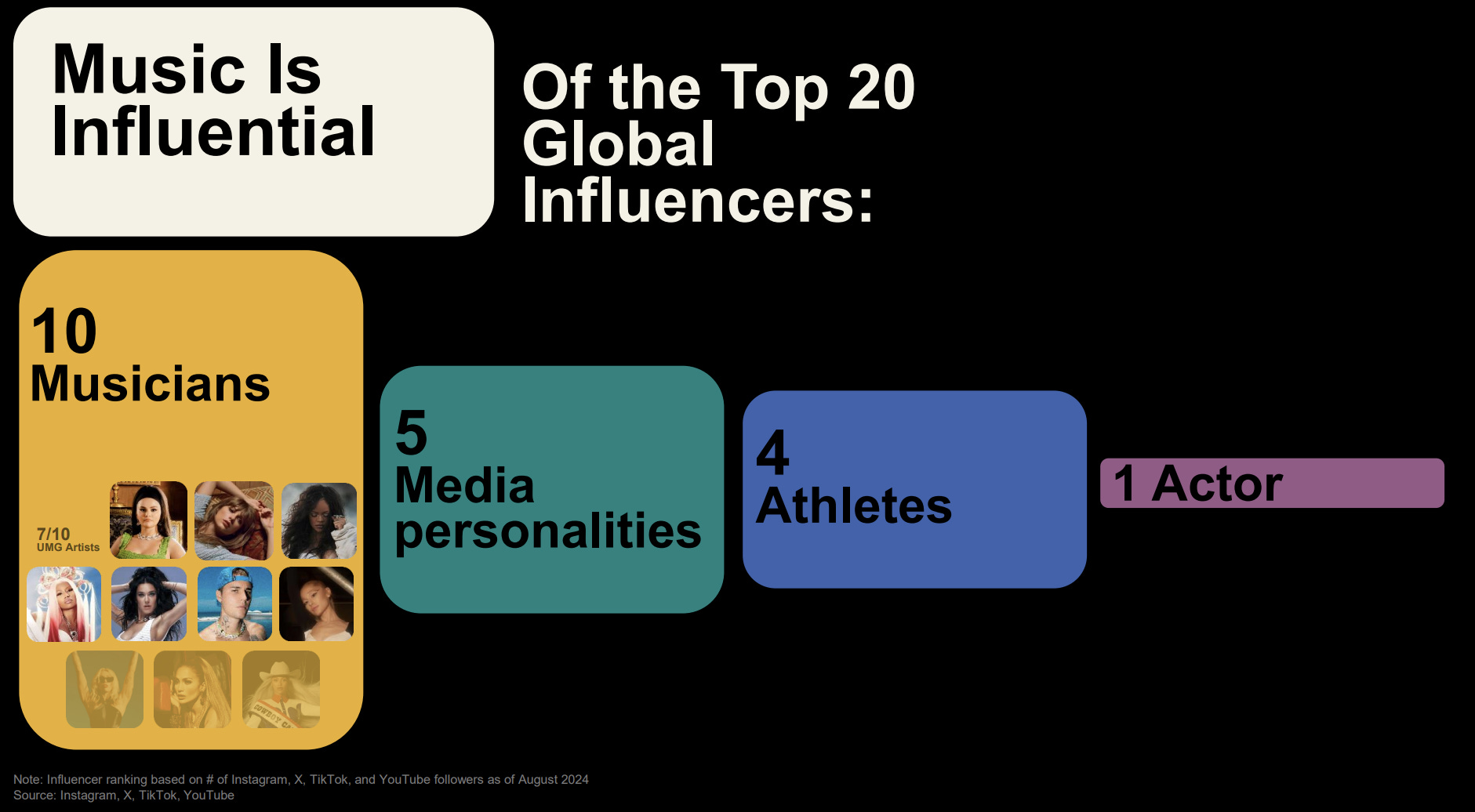
Given the rise of AI generated music, perhaps one of the key stakeholders that may be the biggest loser in the current music value chain is the musicians themselves. If someone with no talent in music can generate a rather catchy tune on their own using these tools, wouldn’t we fundamentally be less impressed with someone’s ability to do so without these AI tools? We may be deeply averse to AI generated music, but the fact that almost every musician will likely use AI in some shape or form within their music may make us less drawn to the artists themselves. That may seem like almost bit of dystopian, but frankly speaking, I was more uncomfortable when I came across this slide in UMG’s investor presentation last year. Is society fundamentally better off when the musicians are some of the most influential people around? If technology commoditizes their raw talent and they lose their gravitas, aura, and appeal to impressionable youth (and old), I cannot say I feel compelled to shed tear over it. Of course, you can have a different opinion and that’s fine.
In addition to “Daily Dose” (yes, DAILY) like this, MBI Deep Dives publishes one Deep Dive on a publicly listed company every month. You can find all the 65 Deep Dives here.
Current Portfolio:
Please note that these are NOT my recommendation to buy/sell these securities, but just disclosure from my end so that you can assess potential biases that I may have because of my own personal portfolio holdings. Always consider my write-up my personal investing journal and never forget my objectives, risk tolerance, and constraints may have no resemblance to yours.
My current portfolio is disclosed below: