Microsoft FY 1Q'27: My Confusion vs. the Market’s Certainty
Microsoft’s quarterly earnings last week was strong, as they were at every hyperscaler this quarter. Azure grew 48%, up from 42% in the June quarter.
Microsoft’s quarterly earnings last week was strong, as they were at every hyperscaler this quarter. Azure grew 48%, up from 42% in the June quarter. The overall company grew revenue by 19% while keeping operating margin at ~50%! It’s hard to complain about such a business.
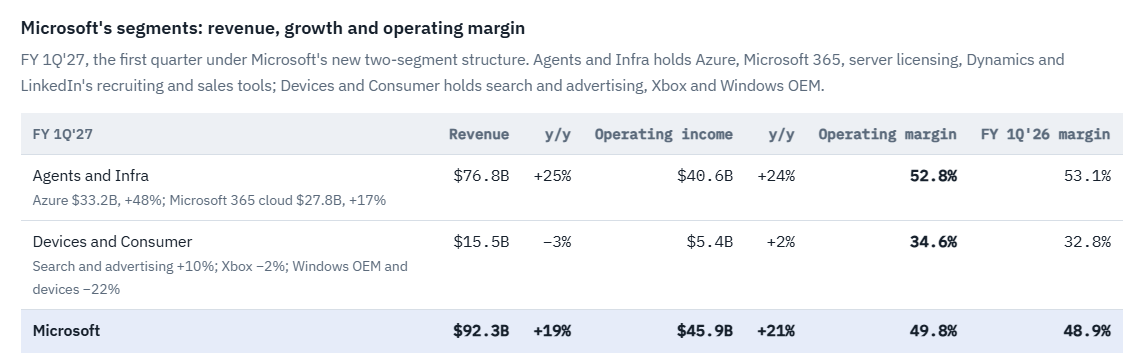
While I too don’t have much complaints about Microsoft’s performance last or even upcoming quarter, it is also perhaps the big tech company that I feel most confused about. In fact, I am quite puzzled by the gap between my own confusion and market’s apparent certainty for the company’s future. The earnings call last week didn’t help much in resolving this tension.
On the call, an analyst asked how much of Azure's AI strength was coming from enterprises versus AI-native companies, now that inference is starting to ramp. Nadella answered with enterprise deployments at Unilever, Rolls-Royce and an Austrian bank, and then made a broader point about what kind of business he wants Azure to be (emphasis mine):
"Finally, it does feel like the enterprise workloads. They feel like to me, like the database applications enterprises built in the past that I grew up with are happening now when it comes to AI. In fact, if anything, some of the shiny object stuff is waning, which is it is not about the next big thing. They are really more about, wow, can I build a system? Can I own the weights? Can I manage my costs? Can I have reliability? What about security? So in that sense, the enterprise breadth motion is starting. But like everything else, the enterprise stuff is not like a quarter-over-quarter. It is a decade-long thing, and that is what I have been waiting for, as opposed to four customers who buy a lot of capacity from you, and you can show a few quarters of growth, and that is not a business as far as I am concerned. So I want the breadth. We are well-positioned on the breadth. We have large customers who want to buy from us, and we are open for business with it. As long as the pricing is right, we may sell them some. If not, we will be patient about building the breadth business."
The ironic thing is I agree with Nadella wholeheartedly. The only problem is it doesn’t quite match with where Azure stands today. Microsoft booked $10 billion of revenue from OpenAI in the September quarter vs $24.1 billion for the whole of FY26. OpenAI is today ~11% of Microsoft’s total revenue and. Not all of it is necessarily Azure though. OpenAI pays Microsoft in two ways: for compute, which is Azure revenue (Microsoft calls OpenAI's purchases "Azure commitments"), and a share of its own revenue, reported at 20%. Microsoft doesn't say where it books the revenue share.
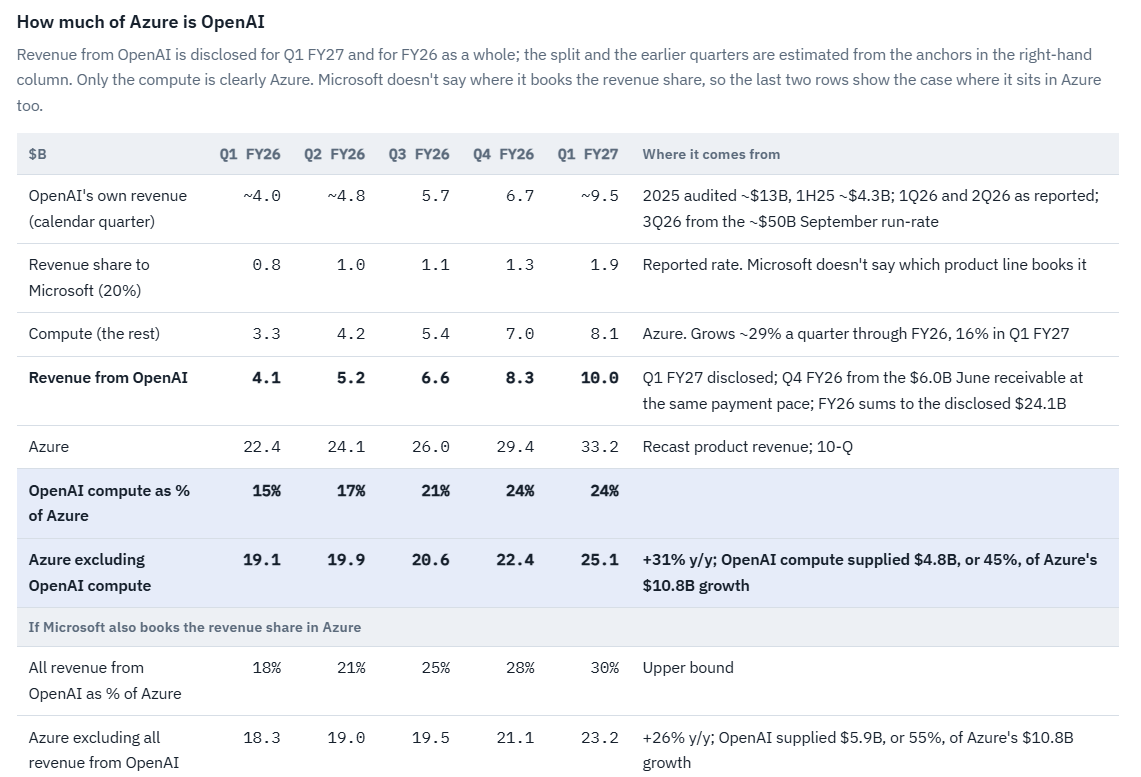
How much of Azure’s growth came from OpenAI? Microsoft doesn’t say how the $24.1 billion was spread across FY26, or how it splits between compute and the revenue share, but both can be worked out reasonably well.
The revenue share follows OpenAI’s revenue, which grew from about $4 billion a quarter in the second half of 2025 to about $9.5 billion in the September quarter, so Microsoft’s 20% rose from about $0.8 billion to $1.9 billion a quarter. For the total, the receivable number disclosed in Microsoft’s filings helps. OpenAI owed Microsoft $7.2 billion at the end of September, about 66 days of the quarter’s $10 billion, and $6.0 billion at the end of June. At the same payment pace, the June quarter was about $8.3 billion, which leaves about $15.8 billion for the three quarters before it.
The result is in the table below. Counting only compute, OpenAI went from ~15% of Azure a year ago to ~24% today. Azure excluding OpenAI's compute grew ~31%, against 48% overall reported, and OpenAI's compute accounted for ~$4.8 billion, or 45%, of Azure's $10.8 billion of growth. If Microsoft books the revenue share in Azure as well, OpenAI is 30% of Azure, and OpenAI would account for 55% of the growth. As you can see, Nadella’s narrative and the actual numbers doesn’t quite sync well.
I have more to say on the narrative and Microsoft’s numbers dislocation which I will elaborate behind the paywall.
Subscribers get the daily journal and five+ years of Deep Dives, i.e. full-length analyses with financial models on 70+ companies. The daily is just how I think out loud between the Deep Dives!