Meta 3Q’26: Healthy Core, But Investors Spooked by Potential Funding Ambitions
Meta has finally joined the “illustrious” Big Tech club of negative free cash flow, whose membership already includes Alphabet and Amazon (perhaps I should add OpenAI and Anthropic to the list as well?).
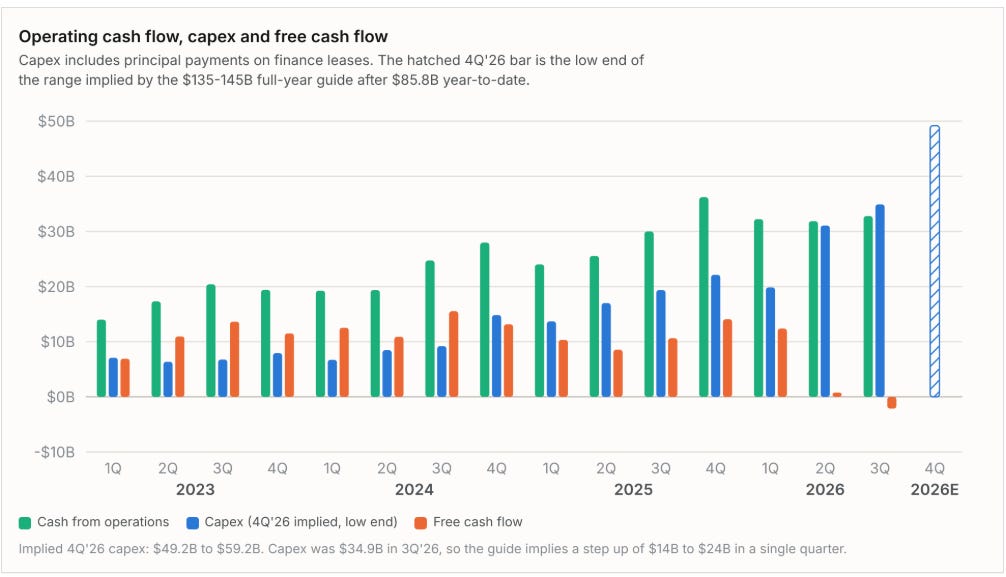
Meta has finally joined the “illustrious” Big Tech club of negative free cash flow, whose membership already includes Alphabet and Amazon (perhaps I should add OpenAI and Anthropic to the list as well?). FCF was -$2.1 billion in the quarter, and with the capex guide implying $49-59 billion of spending in the fourth quarter alone, it will be a good deal more negative three months from now.
This isn’t a complaint about the core business, which remains incredibly healthy: revenue of $64.6 billion grew 26% YoY, and the 4Q’26 guide of $73-76 billion implies ~24% growth at the midpoint. GAAP operating income fell 37% to $13.0 billion, but the entire decline is the $9.9 billion charge for the agreement with 52 state attorneys general that has been known since August; excluding it, operating income grew 11% YoY at a 35% margin. What was new is that Zuckerberg laid out how Muse is supposed to make money, and perhaps more intriguingly, an introduction of a new share class which I suspect has spooked many investors.
I will go through key takeaways from the quarter, earnings call, and follow-up call.
Advertising
Ad revenue grew 26% to $63.1 billion, with impressions up 10% and the average price per ad up 14%. The regional split is where it gets interesting. For the second consecutive quarters, US & Canada was the only region that accelerated in advertising growth whereas every other region decelerated. While Meta didn’t mention this, I wonder if the higher oil price and softer macro have impacted their business outside North America. Europe probably had other reasons (lower personalized ads) beyond macro, but that doesn’t explain the continued growth divergence between North America and APAC and RoW. I find it quite astonishing that North America and RoW are growing at the same rate even though the former is more than 3x the latter.
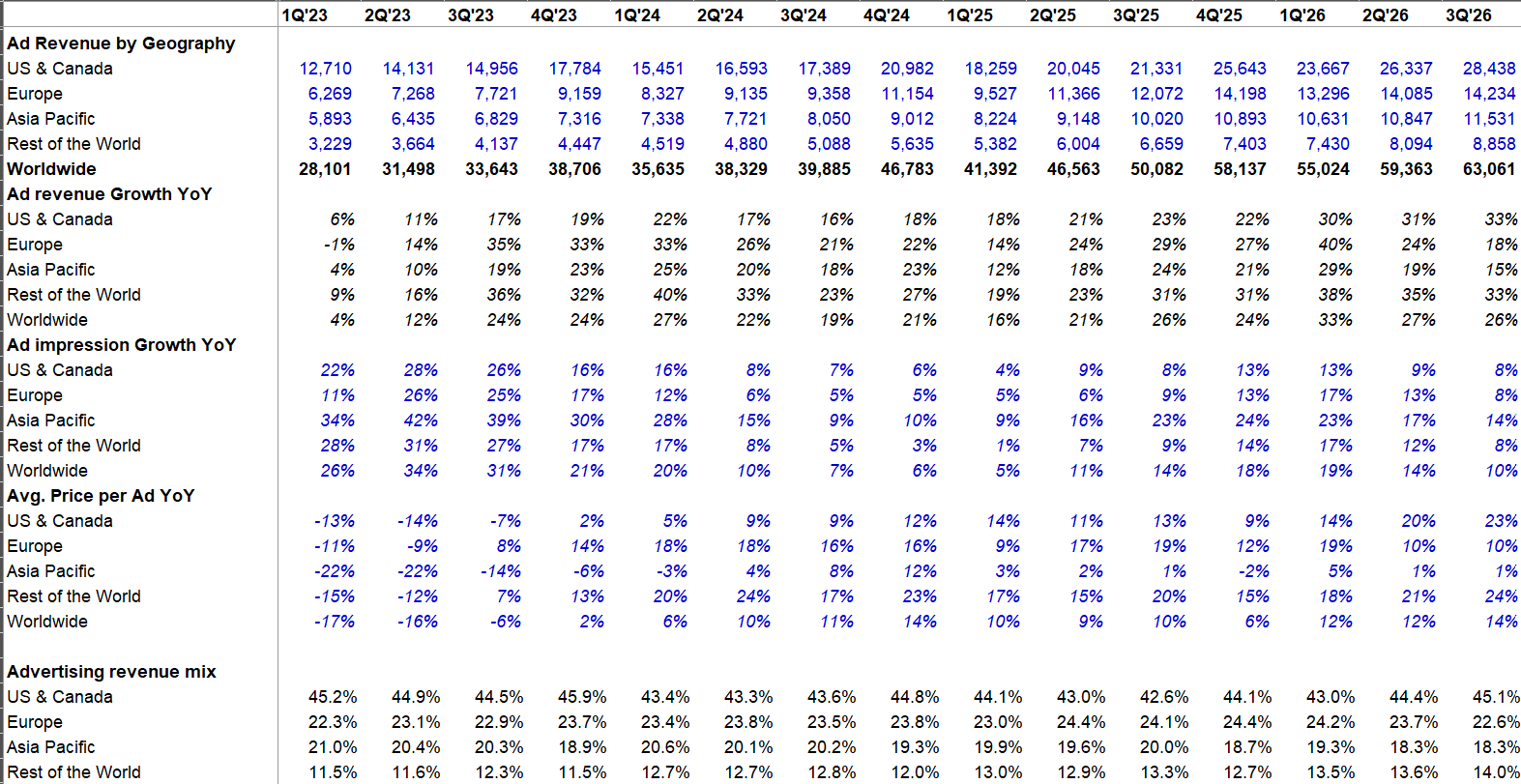
Engagement is still compounding (DAP reached 3.64 billion, Instagram time spent per user hit an all-time high, nearly 45% of recommended Reels are now less than a day old), and partnership ads have surpassed a $15 billion run rate growing ~97%. Meta also began moving its content understanding models onto its own Muse model family, and in offline evaluations those models cut per-unit content processing costs by more than 80%, an interesting example of MSL’s models lowering the core business’s cost to serve rather than lifting engagement.
Segments and Margins
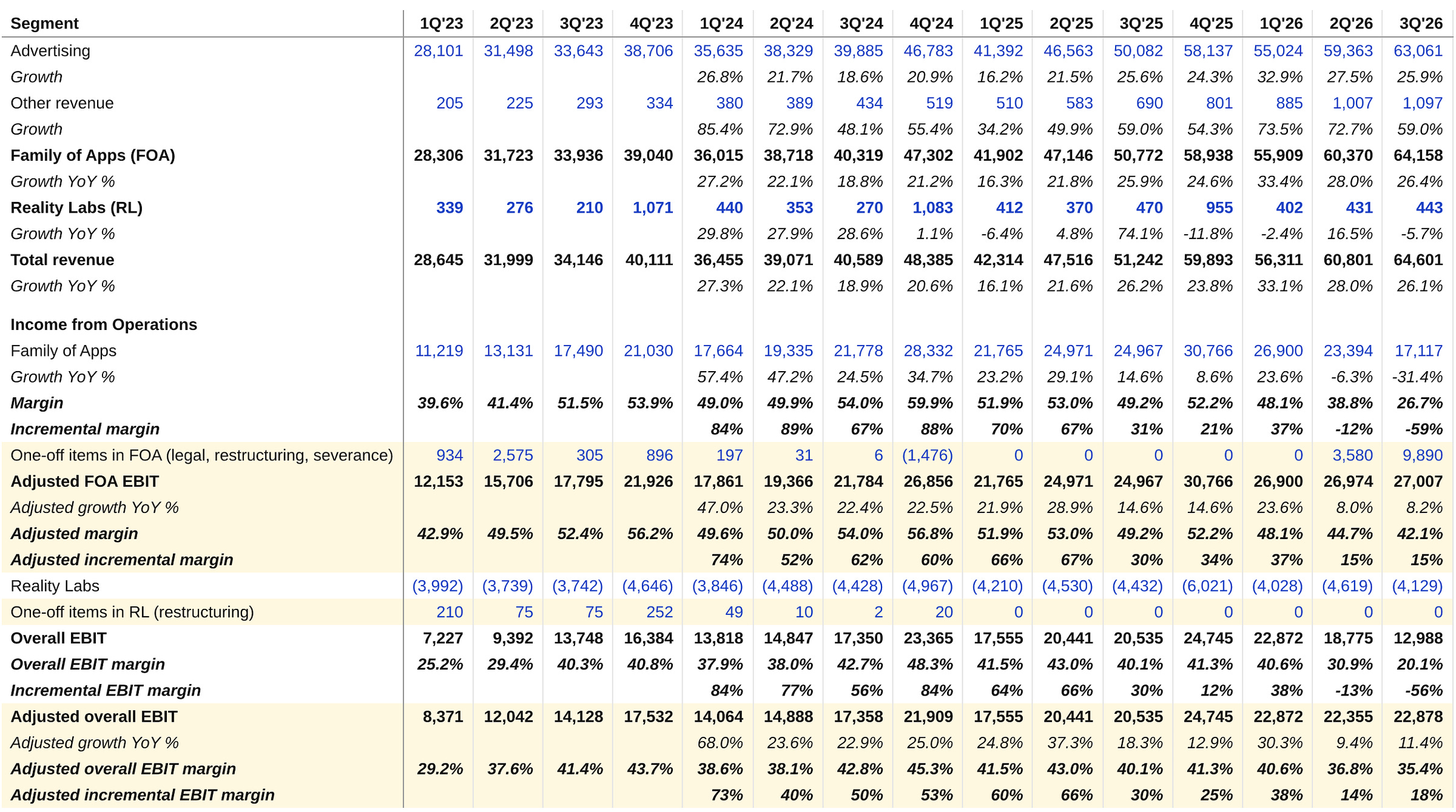
Family of Apps (FOA) operating income was $17.1 billion as reported, but $27.0 billion excluding the $9.9 billion charge, a 42.1% adjusted margin and up 8% YoY. That sounds fine until you look at the incremental margin: FOA added $13.4 billion of revenue YoY and only $2.0 billion of adjusted operating income, an adjusted incremental margin of 15%, the same as in Q2.
Reality Labs lost $4.1 billion on revenue of $443 million, down 6% as Quest declined and glasses grew. Last quarter I wrote that management needed to promise a more concrete path to much lower losses, and this quarter they did: 2026 losses are guided to $18-19 billion (versus $19.2 billion in 2025), 2027 to “around $15 billion,” and “trending towards profitability from there,” with new VR devices only when there is a major breakthrough and Muse (coming to Meta glasses next month) as the software business on top of hardware priced near cost. Almost everyone I know capitalizes Reality Labs losses, so it would be quite helpful if they can get back to breakeven there. $15 Billion losses in 2027 is nothing to celebrate of course, but this is the first quarter that made me optimistic that the losses may indeed be in low single digit billions by 2030.
Separately, “other revenue” grew 59% to $1.1 billion on WhatsApp paid messaging and subscriptions, and Meta One has surpassed 15 million subscriptions and trials.
Total expenses excluding the charge grew 36% against 26% revenue growth. Cost of revenue grew 45% (infrastructure and, new to the list, third-party AI token costs which should go down over time once MSL models are internally used more), depreciation was $7.2 billion, up 44%, R&D grew 32% even as overall company headcount fell 15% YoY, and SBC grew 32% to $7.3 billion. Even excluding the legal charge, G&A was ~$5.0 billion, up 41%.
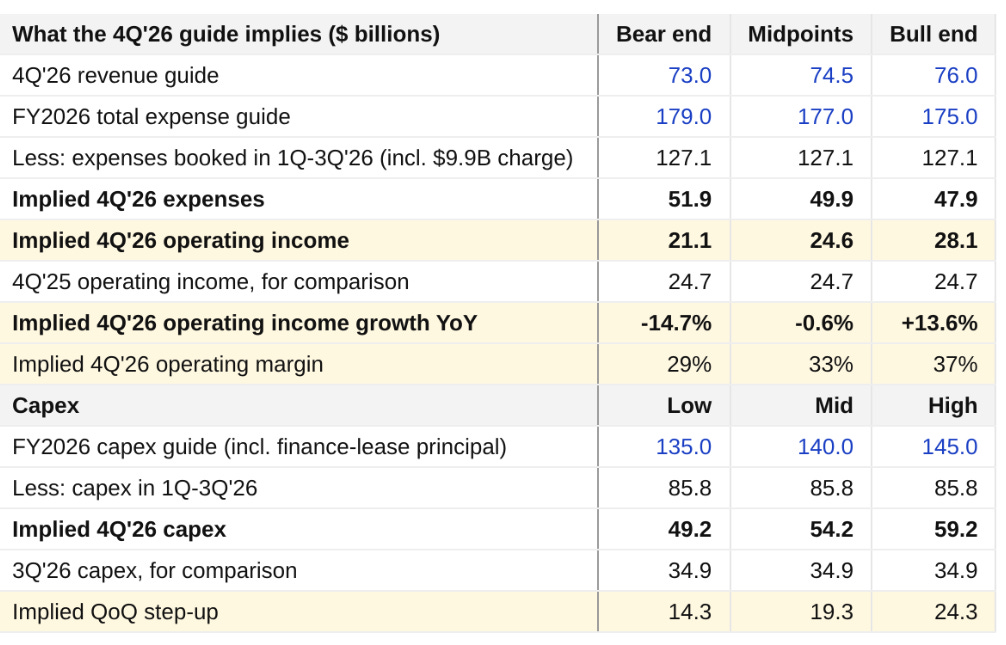
Full-year expenses are now guided to $175-179 billion, raised by basically the size of the legal charge, and capex was narrowed to $135-145 billion. Based on Meta’s Q4 guide range, Q4 operating income lands at ~$24.6 billion at the midpoints, flat against 4Q’25, with the ends of the guide spanning a 15% decline to a 14% increase.
Capex, Cash and the New Share Class
Capex, including finance lease principal, was $34.9 billion against operating cash flow of $32.8 billion, which is how FCF went negative for the first time. The narrowed guide implies $49-59 billion of capex in the fourth quarter alone, a step up of $14-24 billion in one quarter, so Q4 free cash flow will be materially negative, and with $82.4 billion of cash and securities against $83.7 billion of debt, the net cash position is gone.
It actually occurred to me last night that OpenAI and Anthropic will have substantially higher net cash on their balance sheet in a few months if they can IPO compared to big tech such as Meta and Amazon (and possibly, Microsoft and Tesla too). Of course, the AI labs have a much higher burn rate, so they will probably run out of cash soon following the IPO but nonetheless, it’s bit of a crazy turn of events!
In that context, the other announcement of the evening makes sense. Meta is creating a non-voting Class C stock, distributed one-for-one to existing holders (effectively a two-for-one split, trading from late January 2027), which it can use for capital raising, employee compensation and acquisitions without touching the voting structure.
Two things are going on here. The first is Zuckerberg’s own tax situation. Proposition 40, the California wealth tax, is on the November 3 ballot, and according to the filing Zuckerberg told the lead independent director in July that selling enough Class B stock to cover a potential tax bill could cut his voting stake to ~53%, and that he was considering establishing residence outside California. The non-voting class solves that problem: a currency he can sell (20% of his Class C shares immediately, the rest only alongside an equal number of voting shares) without touching his control, in exchange for an eight-year commitment to stay wherever Meta is headquartered. If this was the entire reason for introducing Class C shares, my guess is investors wouldn’t care much.
However, there is a potentially second driver for this share class which likely spooked many investors. The filing says management presented three long-term forecast cases to the board in May, each showing a need to raise hundreds of billions of dollars over several years beginning as early as fall 2026, and that over the summer the committee’s bankers kept pointing to “less favorable debt market conditions for hyperscalers,” tightening credit conditions, and weaker demand for the July bond issued by Meta’s Texas data center joint venture.
Interestingly, on the follow-up call Li walked the big number back: it “was really a theoretical maximum that was basically computed to determine what level of equity financing would trigger a loss of founder control. It is not actually a description of our present equity financing needs or plans.” I wonder if the “hundreds of billions” was built to persuade the committee rather than to describe a plan. But the 10-Q, signed the same day, says in its risk factors that “we expect to use shares of the Class C common stock to conduct equity offerings from time to time in the future”. Add negative FCF, no net cash, $49-59 billion of capex due in one quarter, and Li’s own comment to another question that a strong balance sheet will matter “as the market shakes out in terms of how this all gets funded,” and I put the probability of an equity raise next year at 80%. The money is likely going to scaling Muse, so let’s talk about Muse which I will do behind the paywall.
Subscribers get the daily journal and five+ years of Deep Dives, i.e. full-length analyses with financial models on 70+ companies. The daily is just how I think out loud between the Deep Dives!