Digital Advertising Industry Snapshot 2Q'26
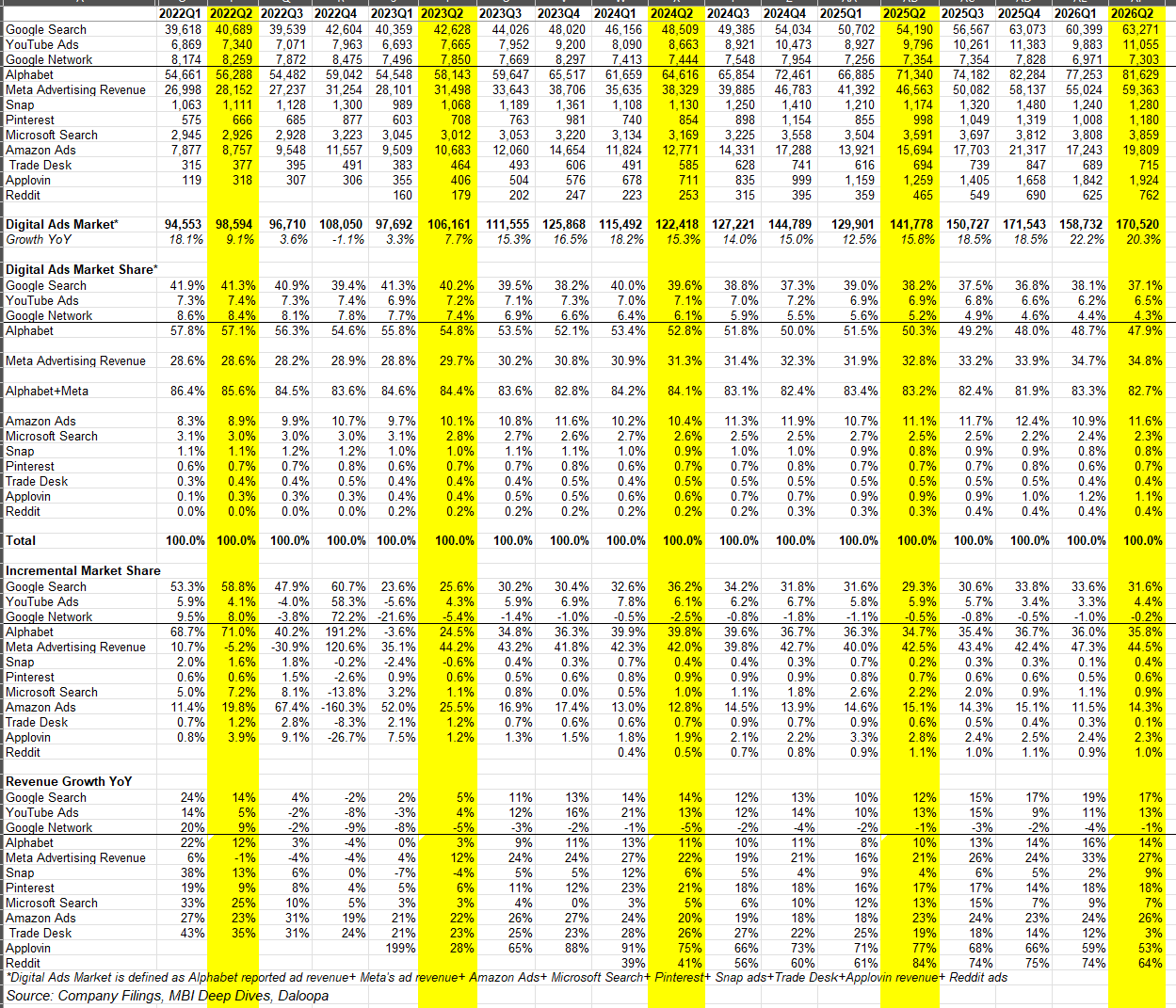
As I do after every quarter, let me share the snapshot of the overall digital advertising industry. Let me first explain some changes for this quarter’s edition.
First of all, digital advertising industry is defined as Alphabet’s advertising revenue+ Meta’s advertising revenue+ Snap’s ad revenue+ Pinterest revenue+ Microsoft Search advertising revenue+ Amazon advertising revenue+ Trade Desk revenue+ AppLovin revenue+ Reddit’s ad revenue. Since Snap started reporting ad revenue separately since 1Q’24, I started including only ad revenues now. However, before 1Q’24, I assumed Snap’s total revenue as their ad revenue which is perhaps closer to reality anyway. Similarly, Reddit’s number has only been included since 1Q’23 since we don’t have their ad revenue numbers in earlier years. Keep these in mind while looking at YoY comparisons in the past. Also note that for visual convenience, I have colored all the Q2 of the last five years.
Obviously, the actual digital advertising industry is larger than this, but this snapshot helps me gauge the broader digital advertising industry’s big picture. TikTok and Walmart advertising are notably missing here. Well, TikTok is a private company and Walmart doesn’t disclose their advertising revenue consistently.
Some key takeaways from 2Q’26:
Digital advertising industry decelerated slightly from 22.2% in 1Q’26 to 20.3% in 2Q’26. We will likely see further deceleration for the next couple of quarters given the tough comps (both 3Q’25 and 4Q’25 grew by 18.5% YoY which were the highest growth quarters last year).
While Meta’s share gain continued, the pace of share gain has moderated a bit in 2Q’26. Given its incremental share of 44.5% is still comfortably ahead of current share of 34.8%, Meta will likely to continue to gain share in the foreseeable future. One challenge with inferring too much based on quarterly snapshot is FX changes likely play a material role in the rate of changes here. Among these companies, Meta likely had the highest mix of revenue coming outside the US and any FX tailwind or headwind would affect Meta’s market share more than others. See more on how FX likely affected Meta’s 2Q’26 ad revenues here.
Over the last five years, Google Network business’ market share has halved from ~8% in 2022 to ~4% in 2026. While Google Search too steadily loses market share, incremental market share has actually improved in 2Q’26 YoY. I am curious to see if search can continue to stabilize around ~30% incremental share or drifts lower to mid to low 20s over the next 24 months. Search seems fine for now, but as OpenAI is likely to ramp up their ad efforts and Meta is under tremendous pressure to grow their ad revenue in order to gain permission from the investors for further capex increases in 2027 (and beyond), there is likely a decent probability that ~30% incremental market share for Google Search may not quite prove to be “steady-state” over the medium term. No strong opinion here, but gun to my head, I suspect we may see mid-20s incremental market share for Search in 2027-28.
Among the sub-scaled ad players, Reddit and Applovin are punching above their weight; look at their current share vs incremental share. TradeDesk has been an unmitigated disaster as growth has fallen off the cliff. Given that the company guided for ~12% revenue decline in 3Q’26, the worst is not behind them. I guess it’s not a surprise that the stock is down ~90% from its December 2024 peak. I haven’t studied Trade Desk closely, so I have no opinion about their future.
I should, however, note that some of the definitions of advertising here are not quite apple to apple as some companies report advertising dollar on a gross and some report on a net basis which is why I like to focus more on incremental share data.
Subscribers get the daily journal and five+ years of Deep Dives, i.e. full-length analyses with financial models on 65+ companies. The daily is just how I think out loud between the Deep Dives!
Current Portfolio:
Please note that these are NOT my recommendation to buy/sell these securities, but just disclosure from my end so that you can assess potential biases that I may have because of my own personal portfolio holdings. Always consider my write-up my personal investing journal and never forget my objectives, risk tolerance, and constraints may have no resemblance to yours.
My current portfolio is disclosed below: