Anthropic S-1: Race, Choice or Flywheel?
Anthropic is about to list at somewhere between $1.5 and $2 trillion valuation. After months of leaks, we finally have an S-1 from Anthropic.
Anthropic is about to list at somewhere between $1.5 and $2 trillion valuation. After months of leaks, we finally have an S-1 from Anthropic. Now that we have audited numbers (and lots of interesting tidbits from the S-1 itself), naturally I have updated my model with my favorite question in mind: what has to be true for a buyer at the IPO to earn 10% IRR if Anthropic is valued at the end of 2030 the way the hyperscalers are valued today?
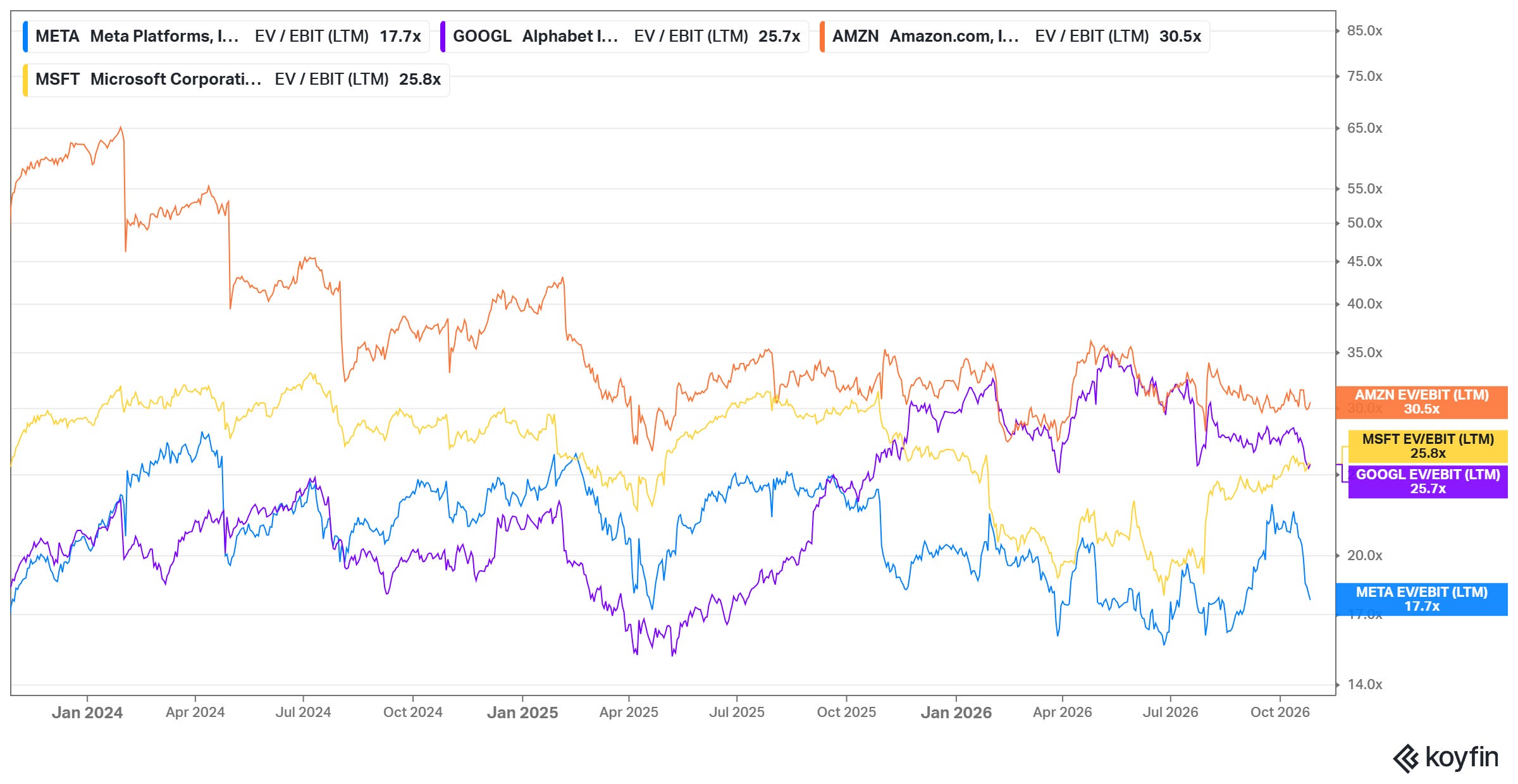
As you can see below, Meta, Alphabet, Microsoft and Amazon trade at ~18x to 30x trailing operating income. Let’s call it ~25x. So my model assumes a 25x exit EBIT multiple in 2030 for Anthropic. While discussing the model, I will incorporate and highlight how the S-1 has informed my views here.
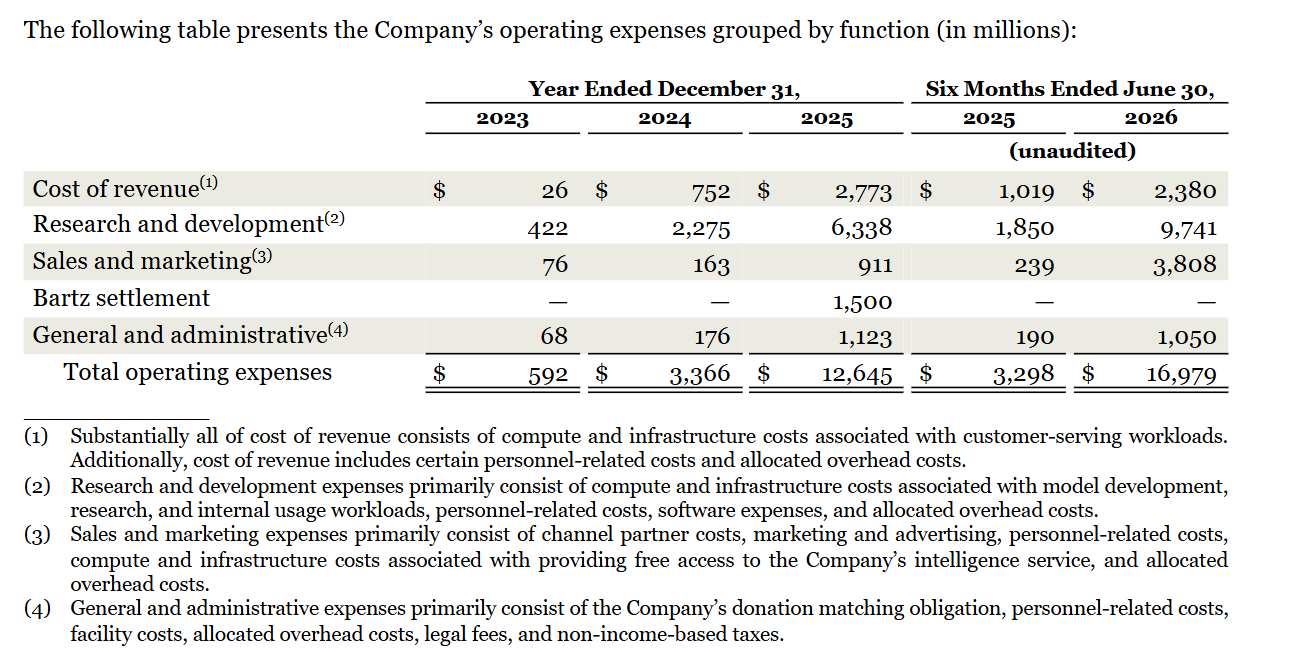
The disclosure that reorganized my model is Note 8, on page F-39. Note 8 recasts Anthropic’s costs by function, and cost of revenue, which the company says is "substantially all" compute serving paying customers, was only 27% of the compute bill in 1H’26. In 1H’25, the serving share peaked at 44%, then fell to 35% in 2H’25, and to 27% 1H’26. This implies three-quarters of the fleet is pointed at research, training and the free tier. So, the share of compute serving paying customers has been falling for the last eighteen months which is perhaps the biggest revelation in the S-1.
Back in July, Ben Thompson wrote in his piece “Who’s Afraid of Chinese Models?”:
“I think the frontier labs are anchored in a world where training costs dominated their financial modeling. As long as training consumed more GPUs than inference, it was critical to maximize inference revenue to help fund the next training run, which meant charging very high prices for inference.
Going forward, however, I expect the inference market to grow much faster than training costs”
It turns out frontier model developers had pretty good reasons to be paranoid about distillation if their tens of billions (and soon likely hundreds of billions) of cumulative R&D investments can be distilled at a fraction of cost by the laggard model developers!
So one material update that I needed to do after reading the S-1 was increase the compute allocation to training! Worked backwards from the question at the top, a 10% IRR from $1.5 trillion needs ~$92 billion of GAAP operating income in 2030 (after taking dilution into account). The rest of this piece is a plausible path to that number: how big the fleet gets, how much of it serves customers and whether that is a choice, what a serving watt earns and what it costs. At each step I will mention what the S-1 told me and what I had to bring in from outside it to build the model.
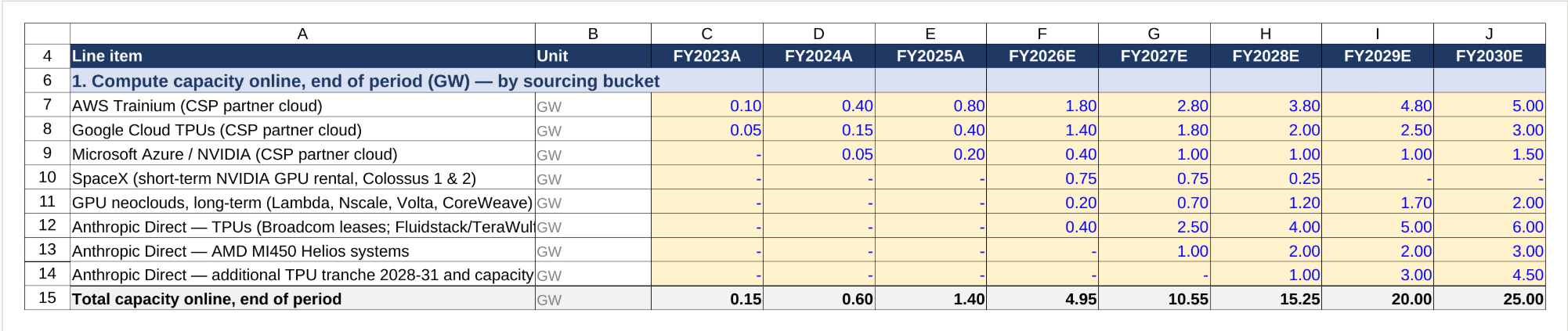
Let’s start with the fleet or the compute capacity of Anthropic. The S-1 discloses ~$800 billion of compute commitments. Translated using the partners’ own announcements, they get Anthropic to ~15 gigawatts by the end of 2028.
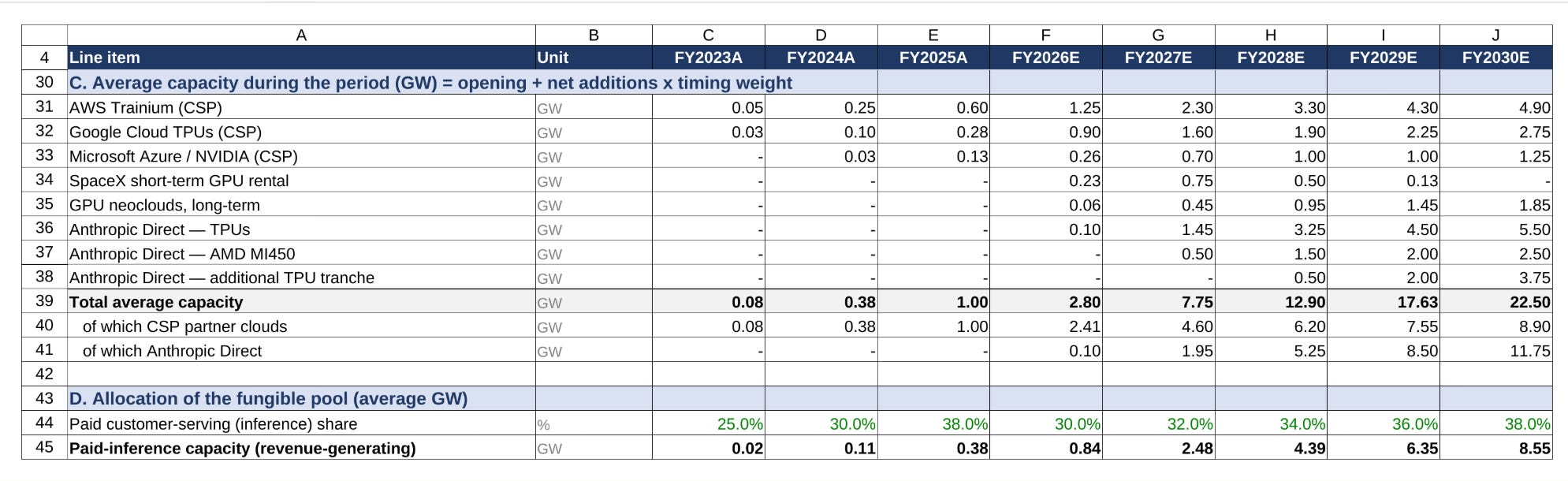
Now let’s talk about how this capacity will likely be used. The aforementioned Ben Thompson quote was actually close to the consensus and admittedly, I too held that view until the S-1 came out. Revenue per dollar of customer-serving compute was $0.51 in 2024, $1.65 in 2025 and $6.84 (!!) in the first half of 2026. So, revenue grew 14x year over year in 1H’26 while the compute serving it grew only 2.3x. Inference has a downright obscene margins after all! Serving needed a small fraction of the fleet's growth to produce all of the revenue growth. I had originally let the serving share climb to 45% by 2030. The model now has it at 38% and frankly speaking, I’m wondering if that’s too high.
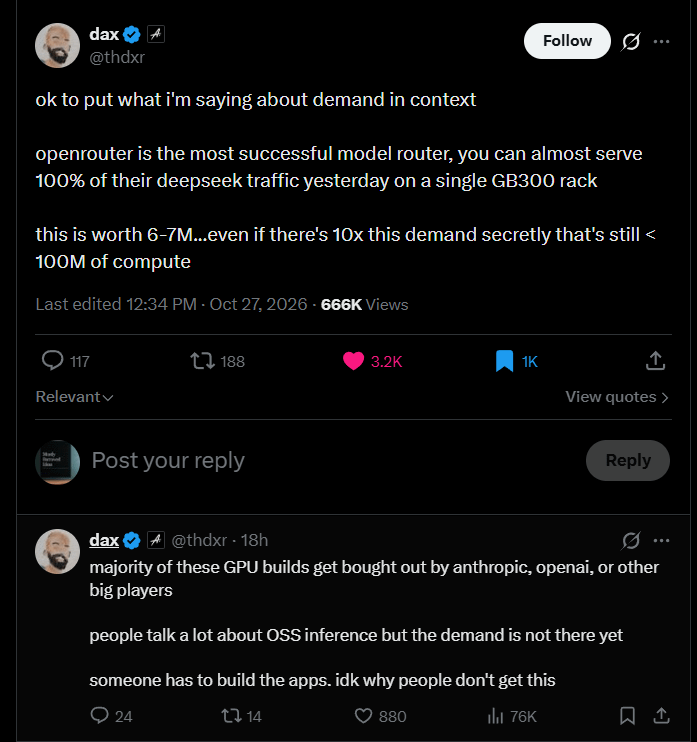
The reason I have been wondering if that’s too high is the below tweet from Dax Raad, Co-Creator of Open Code. Anthropic’s S-1 definitely corroborates to the idea that the demand for compute in this industry is mostly training demand from a handful of labs rather than inference volume from a fragmented customer base which will likely have interesting implications in the rest of the value chain over the long-term.
But if inference is not nearly as compute intensive as we imagined, why is every frontier lab buying compute hand over fist? Bear Force had the most cogent explanation. Basically, the research fleet is not the price of staying in a race but the investment itself: serve inference with a minority of the compute, point the rest at research because each generation makes every existing unit of compute more productive, widen the gap to the labs behind you, earn a higher return on a unit of compute than anyone else and so be able to pay more for it than anyone else, which buys more compute and turns the loop again.
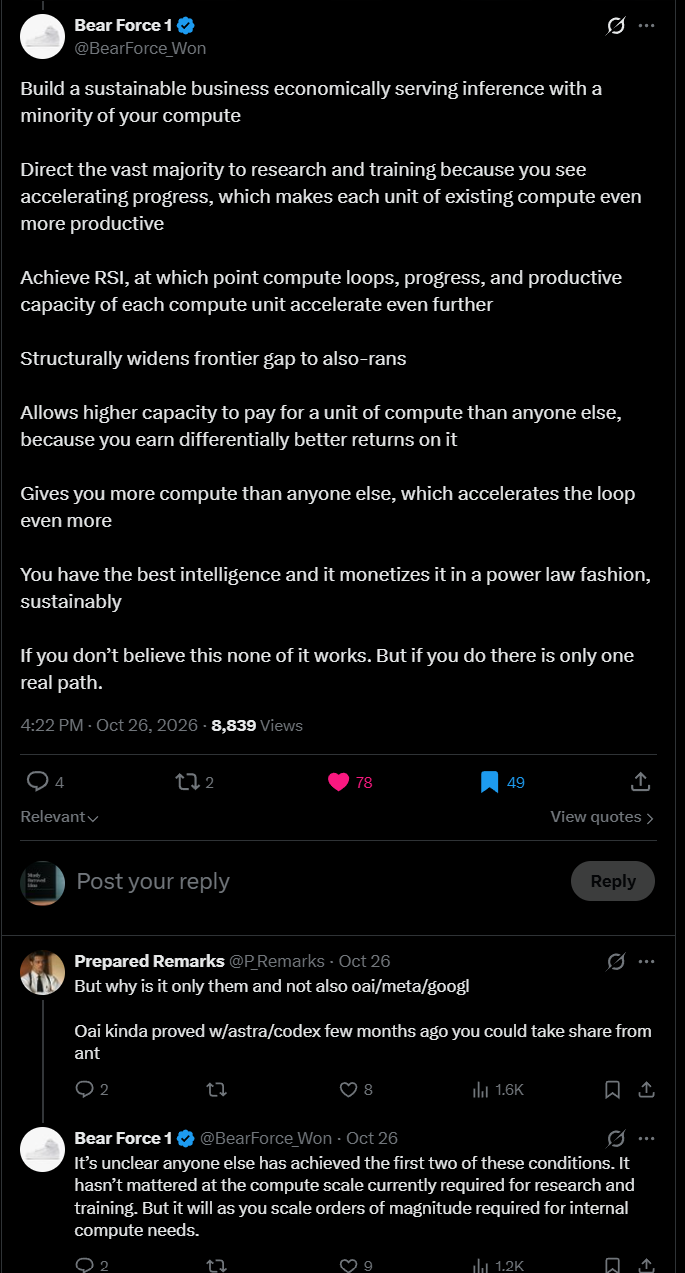
This does explain why every lab is essentially being forced to participate in the red queen’s race of training the next model. If this hypothesis is right, you probably don’t want to stop right before you get to the point of activating this loop.
If you need further convincing why training newer models is of paramount importance for frontier labs, read the below excerpt from S-1 carefully (emphasis mine):
“Customers’ cost per task can decrease for two reasons: newer, more capable model versions can complete tasks more efficiently, and we may reduce the prices we charge for our models. For example, with the release of Claude Fable 5.1 in September 2026, we reduced the cost of typical workloads by approximately 25% compared to Fable 5, with savings of up to 45% for complex coding and highly agentic tasks. Similarly, with the release of Opus 5.5 that same month, we reduced customers’ cost per task by approximately 40% compared to Opus 5. In each case, the reduction was a combination of a lower price and improved efficiency, the contributions of which depend on the task. Because of our compute efficiency, we have been able to make these improvements while preserving our margins.”
There was another sentence in the S-1 that really drove the point home to me about the importance of newer models: “…model versions released in the six months ended September 30, 2026 accounted for over 80% of our revenue for the three months ended September 30, 2026.”
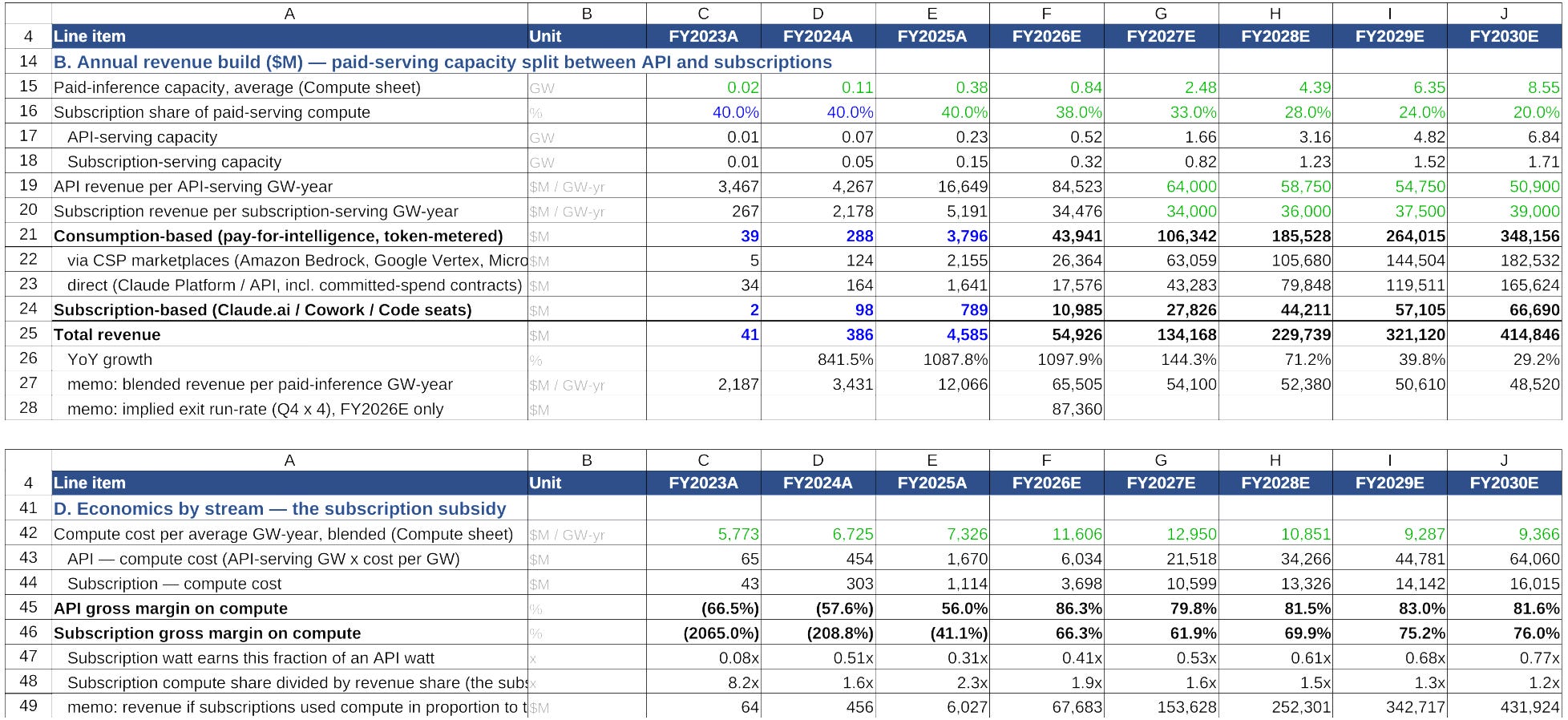
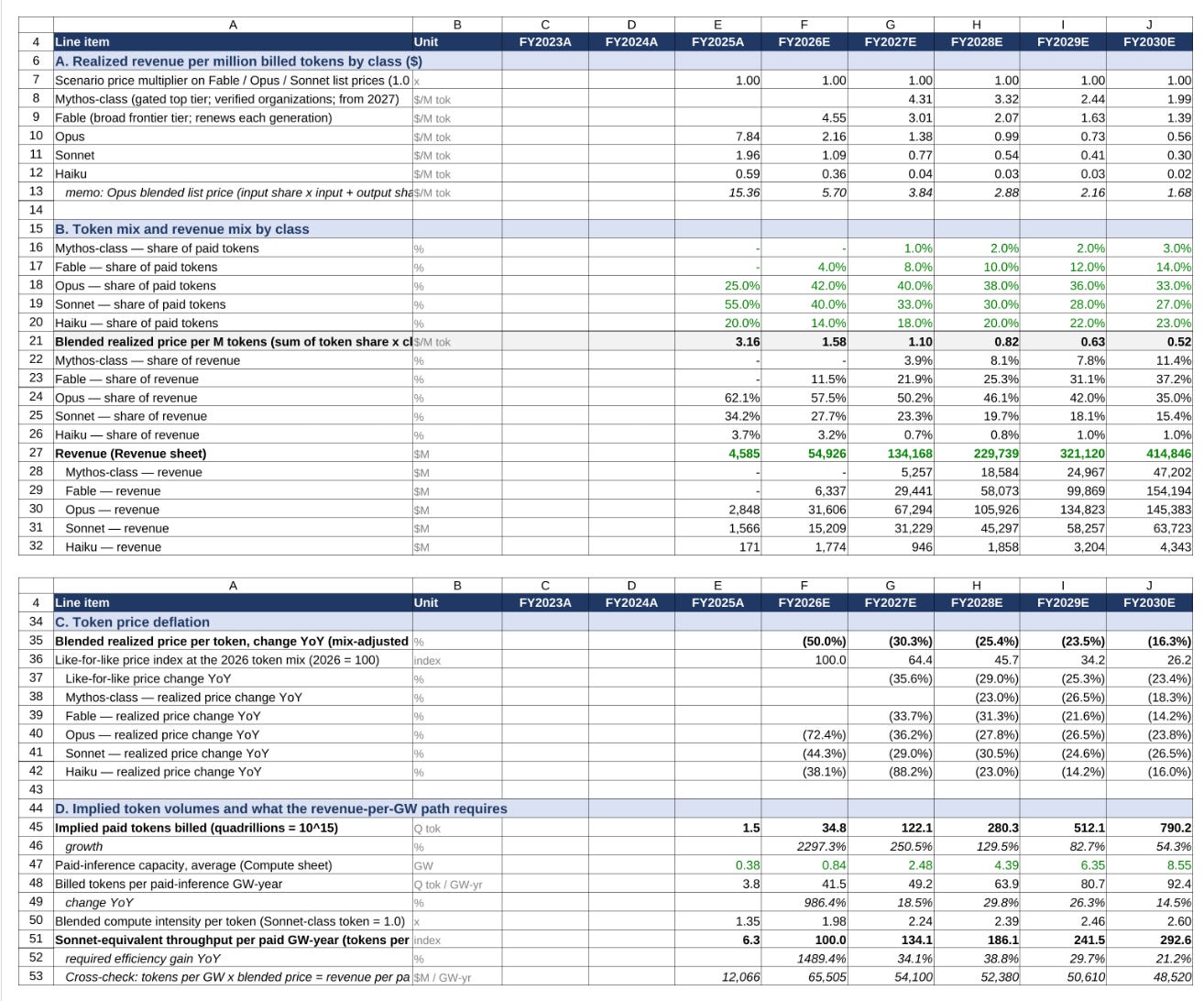
Okay, let’s move to what a serving watt currently earns. Anthropic will likely do ~$55 billion of revenue in 2026 on ~0.84 gigawatts of customer-serving capacity. That is ~$65 billion of revenue per serving gigawatt-year. However, not all of those watts are alike. The S-1 says subscriptions were 20% of 1H’26 revenue, but it doesn’t say anything about how much compute they consume. SemiAnalysis estimates Claude subscriptions take ~40% of serving compute which implies a subscription watt earns only ~40% of what an API watt earns: ~$84 billion per gigawatt-year for the API vs ~$34 billion for subscriptions.
Going forward, I assume the subscription subsidy will shrink. That process already seems underway. Anthropic did not raise Fable limits after its last price cut, and SemiAnalysis models a Fable subscription at ~80% gross margin vs ~6% for Opus, so the subsidy narrows on its own as usage shifts to the premium model. But I also assume an API watt earns ~40% less by 2030 (~$51 billion versus ~$84 billion today). Put together, blended revenue per serving gigawatt goes from ~$65 billion to ~$48 billion. An Anthropic bull can justifiably look at this and assume I’m being rather conservative here. But remember, a revenue-per-gigawatt path is really a price path per model class in disguise, so I wanted to see what is implied in price path per model class if my revenue estimates play out.
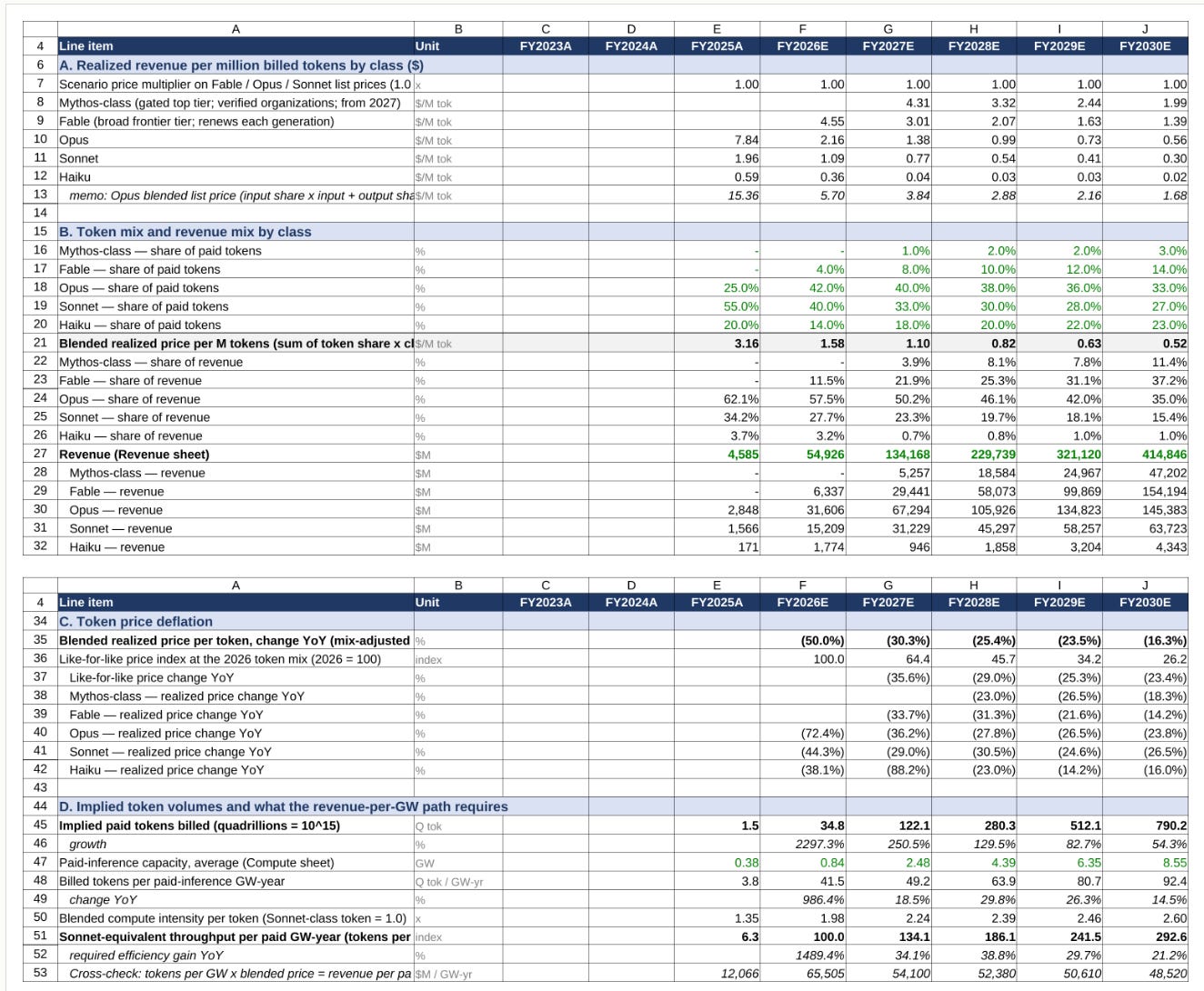
The two S-1 excerpts above shaped this part of the model: customers move to the newest model quickly, and each release cuts the cost per task. What the S-1 does not give is tokens, prices or revenue by model, so this is where I had to bring in some estimates outside the S-1. The public price lists cap every tier: Gemini 4 Argon prices its frontier model at $4/$20 from December against the $10/$50 that Fable 5.1 and GPT-6 Astra share, Meta’s Muse Wonder is priced exactly at Opus parity, and open-weight Kimi K3 is at $3/$15. OpenRouter’s October data on what a billed token actually is (overwhelmingly cached input in agentic work) turns those list prices into realized prices. On those inputs, like-for-like token prices fall almost a quarter a year in my model.
The interesting tension is between token share and revenue share. I treat each tier as a brand that renews every generation, so Fable’s share of tokens rises as its price falls, just as Opus went from a quarter of tokens to 42% in the year its price fell ~60%. Even so, the frontier tiers (Fable and a Mythos-class tier which you can think of proxy for whatever that comes after Fable-class models) carry only about a sixth of tokens by 2030. But because they are priced at ~2.5x Opus, that sixth of the tokens is close to half of the revenue: ~$77 billion in 2028 and ~$200 billion in 2030. In 2028, that covers most of the research compute budget; by 2030, it exceeds it. In other words, a small share of traffic whose buyers pay for being at the frontier must fund the next training run.
That raises the question I find very, very difficult to answer: who pays for ~$200 billion of frontier tokens in 2030, and for what? Today, I suspect a good chunk of frontier spend comes from companies that are actually building their own models: hyperscalers running Claude inside their products, and labs benchmarking against it. Notice the below tweet from “modest proposal”. I’m fairly confident that Anthropic’s largest customer was Meta who will simply not be able to afford to continue paying for Anthropic’s frontier tokens and building their own frontier models simultaneously for too long, certainly not in 2030!
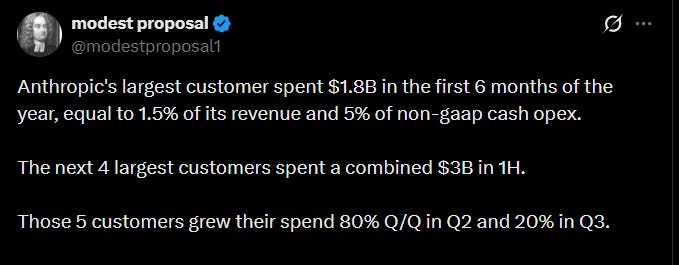
To be fair, the customer base is broadening quickly; 79% of 3Q’26 revenue came from outside the top five customers, up from 64% in 1Q’26. But will those long tail customers need the absolute frontier tokens worth $200 Billion in 2030? Very hard question!
The model cuts Opus and Sonnet prices ~25% a year precisely because the sub-frontier models of 2030 will highly likely do most of today’s coding and knowledge work. So ~$200 billion of frontier revenue in 2030 is, by construction, revenue from work the tier below cannot do or finish. Maybe it is longer and more autonomous agents. Maybe it is what Amjad Masad recently argued is the only thing worth underwriting frontier AI on: new discovery and its applications in medicine, which per-token pricing cannot really capture. Either way, the model assumes the work and revenue shows up, and we do not yet know what it is. So, when we think of underwriting a couple hundred billions in just four years from novel discoveries/applications that we hardly know anything about today, my model may not seem so conservative after all even though inference revenue per gigawatt-year is modeled to be falling.
Now the costs. Here the S-1 was very helpful on the accounting and much less so on unit costs. The unit costs mostly came from outside the S-1: SpaceX’s own prospectus puts Colossus 1 at ~$1.25 billion a month for 300+ megawatts, or ~$50 billion per gigawatt-year; Lambda’s and Nscale’s disclosed sites work out to ~$16.5 billion; and the partner clouds (Trainium, TPUs, Azure) cost ~$8-9 billion, approximately what 2025’s compute bill divided by a gigawatt of average capacity gives you.
Anthropic Direct was bit of a surprise though. I would assume leasing your own chips is cheaper than renting them from a cloud. However, at least within the forecast period, it is not. The $161 billion of Broadcom rent works out to ~$36 billion of hardware per gigawatt; amortized over the five-year leases, plus the facility, power and interest, a Direct gigawatt-year costs ~$10.5 billion, a little more than the hyperscalers charge. The savings the S-1 talks about Anthropic Direct are compared to expensive short-term capacity like SpaceX, and in the years after the leases are paid off which fall beyond 2030. So the cheapest watts in the fleet are still the ones the hyperscalers sell, but please don’t think hyperscalers being too generous to labs here. Nobody is probably making more money from the labs than the hyperscalers.
Part of the reason the rates look cheap is timing. Most of the partner-cloud capacity was negotiated between late 2025 and the spring of 2026 (Microsoft in November, Google in March, Amazon in April), before the shortage got acute enough that Anthropic was paying SpaceX six times the hyperscaler rate for capacity it could use right away. More importantly, the compute bill is only one of four ways the hyperscalers make money from Anthropic:
First, they get paid when Anthropic trains. Amazon, Google and Microsoft have minimum commitments of $110 billion, $114.5 billion and $44.9 billion respectively, and Anthropic pays them “regardless of actual usage.”
Second, they get paid when Anthropic serves customers. 48% of Anthropic’s revenue in 1H’26 was billed through the hyperscalers’ AI platforms (Amazon Bedrock, Google’s Gemini Enterprise Agent Platform and Microsoft Foundry), and the compute that serves those customers is bought from the same clouds.
Third, they take a cut for distribution on top of that. Anthropic books the marketplace revenue gross and pays the cloud a fee, which shows up in sales and marketing rather than compute. That fee is now ~35% of marketplace revenue, up from ~16% in 2025.
Fourth, they own a piece of the upside. Amazon’s convertible notes had $6.2 billion of principal outstanding at the end of June but were carried at $108.6 billion of fair value, and the rise in their value drove most of the $72.4 billion fair-value loss in Anthropic’s 1H’26 income statement. Put differently, the largest line item in Anthropic’s P&L this year is a gain for Amazon. Google, for its part, can own up to 14.99% and has an option to buy another $10 billion of stock at the IPO price.
So the hyperscalers make money on the training, the serving, the distribution and the equity. Hence, Anthropic Direct is at least partly Anthropic’s attempt to reduce how much of its business runs through these hyperscalers.
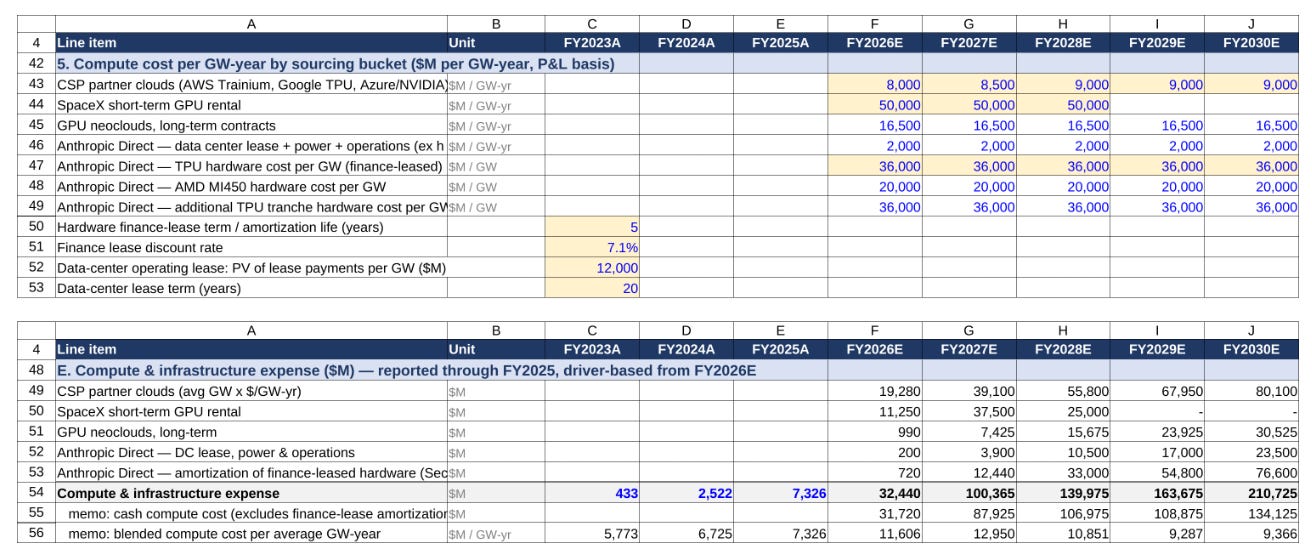
For margins, timing around which capacity comes online matters a lot. Compute is contracted 12-18 months ahead and expensed as it arrives, and 2027 is the year Anthropic pays for both SpaceX and the first ~$96 billion of Direct hardware before most of the revenue they support shows up. That is why management highlighted the impending volatility in margins in the S-1’s MD&A (emphasis mine):
…As significant incremental compute is brought online in future periods, the associated expense will be recognized in advance of the full revenue that the compute will ultimately support, and we expect operating margin and Adjusted Operating Margin may compress in those periods. At our current stage, this cycle is an inherent aspect of our business and will cause operating margins to fluctuate from period to period, at times meaningfully, even if the underlying economics of the business continue to improve.
In my model, I keep SpaceX at full capacity through 2027 and run it off by mid-2028.
Putting it all together, this is what Anthropic’s income statement looks like in my model:
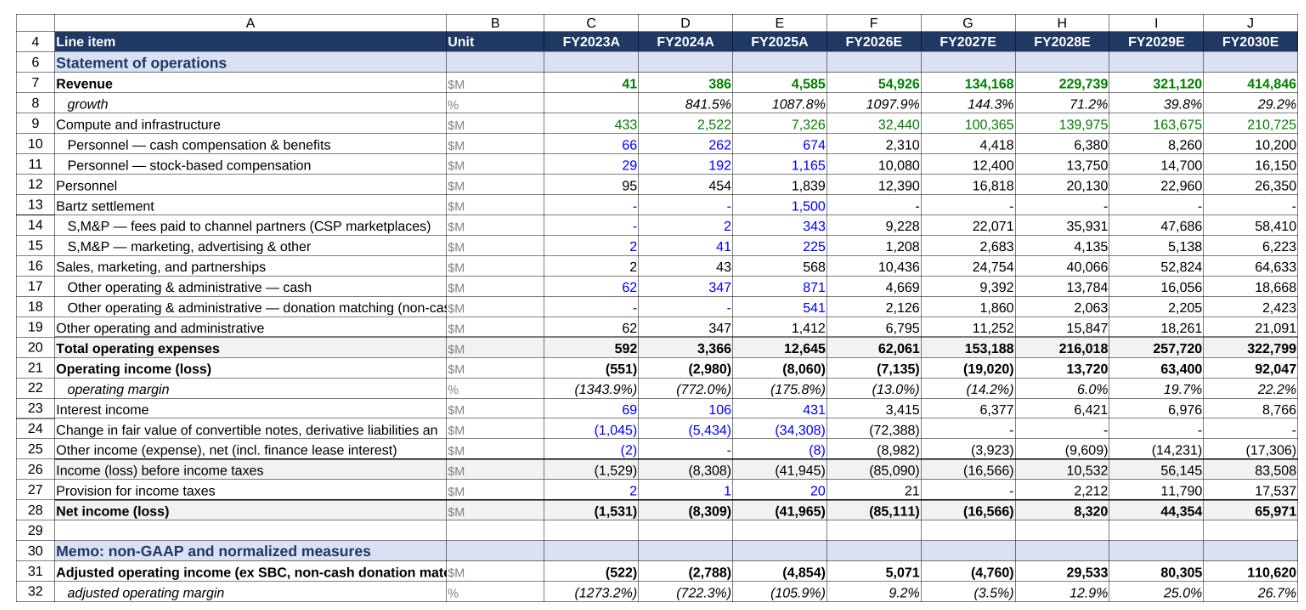
Anthropic is profitable on its own adjusted definition this year, but loses money in 2027 for the reason above, and then earns a 25-27% adjusted operating margin, or 20-22% after taking SBC into account. That is how I can get to ~$92 billion of GAAP operating income in 2030.
Anthropic appears to be a much, much better business than I imagined last year, but after going through the S-1, I came away with two big questions.
First, is the training and research fleet a race, a choice or a flywheel? Depending on the answer, we may end up in a very different world. If it is a choice, the lever to cut it is enormous and can become much more profitable than my model suggests. If it is a red queen’s race, ~$420 billion of non-serving compute between now and 2030 is the price of staying in it without adequate ROIC. And if it is a flywheel (like what “Bear Force” suggested), 25x is clearly the wrong exit multiple as it should be higher.
Second, who is the buyer of frontier tokens in 2030? Remember, if Anthropic is not a monopoly at the frontier in 2030, it is not enough to find $200 Billion worth of frontier token work in 2030 for Anthropic; we also need to find similar ballpark numbers to justify training R&D for OpenAI, Alphabet, and Meta as well (assuming distillation is nearly dead by then which is far from certain).
So, while I came away with a much better appreciation of Anthropic’s business as it stands today, I don’t yet have the conviction I would need to put my own capital into this IPO. That said, there is no company I don’t own that I will be following more closely than Anthropic.
The model spreadsheet is attached along with a guide behind the paywall.
Subscribers get the daily journal and five+ years of Deep Dives, i.e. full-length analyses with financial models on 70+ companies. The daily is just how I think out loud between the Deep Dives!