Intuitive Surgical: The Long Road to Everyday Surgery
Programming Note: MBI Deep Dives will be off tomorrow, but I will be back on Wednesday. I know AI is all the rage these days, but it was a nice break to spend some time studying a business whose customers are hospitals and surgeons.
Programming Note: MBI Deep Dives will be off tomorrow, but I will be back on Wednesday.
I know AI is all the rage these days, but it was a nice break to spend some time studying a business whose customers are hospitals and surgeons. Its story starts, fittingly, in an operating room.
In March 1997, two surgeons named Jacques Himpens and Guy-Bernard Cadière removed a patient’s gallbladder from a console a few feet away, moving two handles while a prototype robot the engineers had nicknamed “Mona” moved the instruments inside the abdomen. It was the first robot-assisted operation on a human being, and the company that built the robot had only a dozen employees. It is bit of an irony that its very first case was a cholecystectomy, the same benign, high-volume, but cost-sensitive procedure that is relevant for its growth debate today.
Almost three decades since that first operation, Intuitive Surgical does over 10,000 procedures a day on more than 12,000 systems.
The technology was born in a government-funded lab. In the 1980s, a biomedical engineer named Philip Green at SRI International in Menlo Park started working on “telepresence” surgery, with the Department of Defense putting up some of the money on the theory that a surgeon in a tent could one day operate on a soldier at the front. Not much came out of the battlefield idea, but by the mid-1990s the lab had a working prototype and no plan to commercialize it. In 1995, a surgeon-entrepreneur named Fred Moll, along with Rob Younge and John Freund, licensed the SRI technology and incorporated Intuitive Surgical. Two of the early engineering hires in 1996 were a Caltech PhD named Gary Guthart, who had worked on the SRI project, and a Stanford mechanical engineer named Dave Rosa, who joined in March 1996 as the company’s ninth employee. Both would later become CEO. Lonnie Smith ran the company from 1997 through 2009, Guthart took over in 2010, and Rosa succeeded him in July 2025.
Back in 1999, Intuitive had only $10.2 Million of revenue and didn’t even have FDA clearance yet. It still filed to go public in 2000, hoping to sell 8 Million shares at $11-13 per share, but the IPO market had soured after the Nasdaq peaked in March, and in May, just as it set that price range, its only robotic rival, Computer Motion, sued it for patent infringement. The IPO was cut to 5 Million shares at just $9 per share. Adjusted for splits, that IPO price was actually $2 per share, so at $452 today an IPO investor has compounded at ~23% a year for the last 26 years.
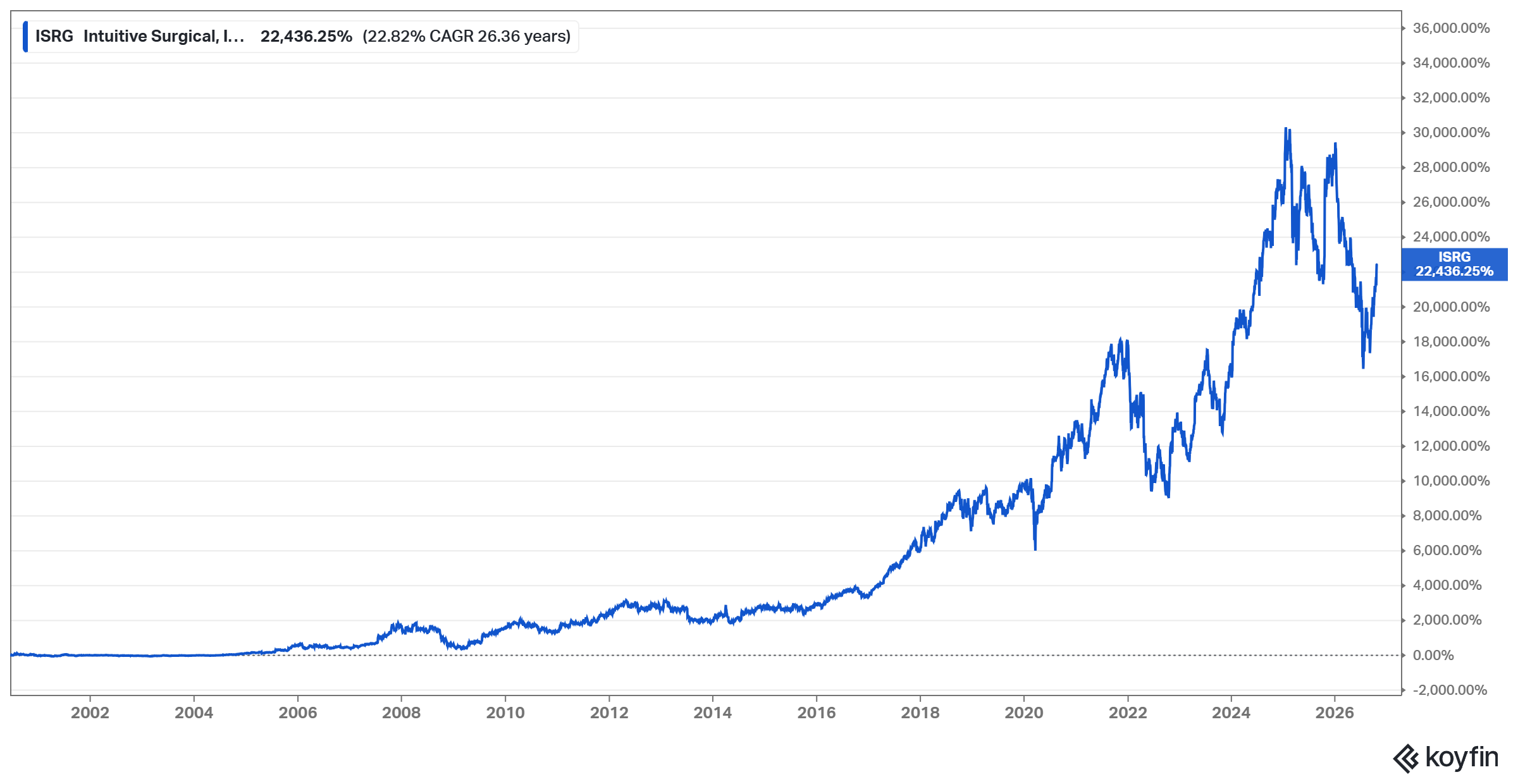
The first pivotal moment was the elimination of that rival. Computer Motion had beaten Intuitive to market with AESOP, a voice-controlled camera holder, and had a competing multi-arm system called ZEUS. The lawsuit it filed just before the IPO turned into three years of the two companies suing each other over patents. After a trial in August 2002, a Delaware jury found that AESOP and ZEUS infringed a patent Intuitive had licensed from IBM, and three months later, with both companies burning cash, they agreed to merge. As a result, the foundational patent estate of surgical robotics ended up in one company. Perhaps not surprisingly, the very next year following the merger in 2004 Intuitive reported its first full year of profit.
What followed was the prostatectomy decade which, in retrospect, may have been a surprise even for Intuitive. Their 2000 prospectus listed gallbladder, hernia, hysterectomy and cardiac as the target procedures and did not even mention the prostate once. The robot’s real selling point turned out to be not dexterity over laparoscopy but less trauma than open surgery. Laparoscopy is the “keyhole” approach, in which the surgeon operates through a few small incisions with long, rigid instruments while watching a camera feed on a screen. I will come back to how it compares with the robot later. Prostatectomy, deep in the pelvis where those rigid instruments struggle, was the operation where open surgery hurt the most. Urologists adopted da Vinci for it faster than any procedure before or since, taking its share of US prostatectomies from near zero to north of 80% within a decade, and gynecology followed.
Guthart became CEO in early 2010. Then came the second pivotal moment, and this time, it was a bad one for Intuitive. In February 2013, a JAMA study of 264,000 hysterectomies found robotic surgery cost $2,189 more per case than laparoscopy with no difference in complications; in March, the president of the American College of Obstetricians and Gynecologists put out a statement telling patients to “separate the marketing hype from the reality”; in July, the FDA issued a warning letter over adverse-event reporting. Benign gynecology growth stalled, and system sales fell following these controversies. Investors also started wondering whether the robot was worth what hospitals were paying for it.
Intuitive’s answer was to keep shipping product: the fourth-generation da Vinci Xi in 2014, which reopened multi-quadrant general surgery; the single-port da Vinci SP in 2018; and Ion, a robotic bronchoscope for lung biopsy, in 2019. In 2016 many investors worried about a “patent cliff” as the original patents expired and a dozen challengers announced robots. However, a decade later most of those challengers are now gone. The pandemic cut procedure growth to just 1% in 2020, but then growth came roaring back.
In mid-2025, Rosa became only the third CEO in Intuitive’s history. Intuitive will do ~$12 Billion of revenue this year, 84% of which is recurring, at a non-GAAP operating margin of ~40% which is the kind of margin profile appropriate for a company as dominant as Intuitive is in its lane!
In the rest of this Deep Dive, I will start with a Business Overview, in which I explain how one da Vinci system turns into three revenue streams and what the unit economics look like from both Intuitive’s and the hospital’s side of the table.
Then I walk through the TAM, and how Intuitive’s own “23 Million, 20 Million, 9 Million” framing maps to a bottom-up build of the procedure pools.
The third section covers competitive dynamics: how Intuitive became a de facto monopoly, what the moat consists of, where the holes are, and whether competitive intensity is rising.
Then I cover management, capital allocation and incentives. And finally, as usual, I finish with the model and the valuation, with my usual question: what has to be true for me to earn ~10% IRR? This time I have built the model around that question in a slightly different way, which I explain there.
The rest of this Deep Dive will be behind the paywall.
Subscribers get the daily journal and five+ years of Deep Dives, i.e. full-length analyses with financial models on 70+ companies. The daily is just how I think out loud between the Deep Dives!