Walmart’s Evolution
After posting 4%+ same store sales growth in the US for eight consecutive quarters, Walmart’s comp numbers last quarter surprised investors a bit as it came to be only 2.6% in Q2 FY27. During the call, management flagged their health & wellness (H&W) segment as the primary culprit for the poor comp. One of the key reasons for the underperformance in H&W segment is MFP.
What exactly is MFP? MFP is the “Maximum Fair Price” that comes out of the Medicare drug price negotiation program created by the Inflation Reduction Act in 2022. For the first time, CMS was authorized to directly negotiate prices with manufacturers for a selected list of high-spend drugs covered by Medicare. The first cohort of drugs had prices announced in August 2024 that took effect January 1, 2026, which is why Walmart's fiscal 2027 (Feb 2026–Jan 2027) is “the first year of Maximum Fair Price regulation.” The negotiated prices were cut 40–80% below list depending on the drug. Moreover, the list expands annually: a second round of 15 drugs takes effect January 2027.
When the government administratively cuts the price of the highest-dollar drugs that Medicare seniors fill, revenue per script drops even as script volumes keep growing. That's why management insisted the impact is top-line only. The economics of dispensing i.e. the spread and fees Walmart earns per script aren't damaged proportionally to the revenue decline, and generic conversion can actually improve margin rate. Meanwhile, the strategic value of the pharmacy is the traffic and attachment. Walmart management shared that the H&W customer spends ~3x the average Walmart customer, and it doubles again when those customers sign up for pharmacy delivery. So you get the odd optical situation of SSS drag on reported Walmart US comps while the profit contribution of the category is fine and prescription volumes keep growing with share gains.
Walmart had quantified the MFP headwind early this year, but never the GLP-1 tailwind or the ex-health-&-wellness comp view. The 100bps MFP headwind first appeared on the Q4 FY26 call in February 2026 during Q&A, and by the Q1 FY27 call in May it had graduated to management’s prepared remarks. Yesterday’s call made these headwinds more clear than it was before: the MFP headwind estimate was raised to 125bps for both Q2 and the full year, the GLP-1 tailwind was quantified retroactively for the first time (~100bps in each of FY25 and FY26, fading to roughly half that in FY27), and then explicitly showed core comps ex-H&W running a steady 3–4% for the last two and half years.
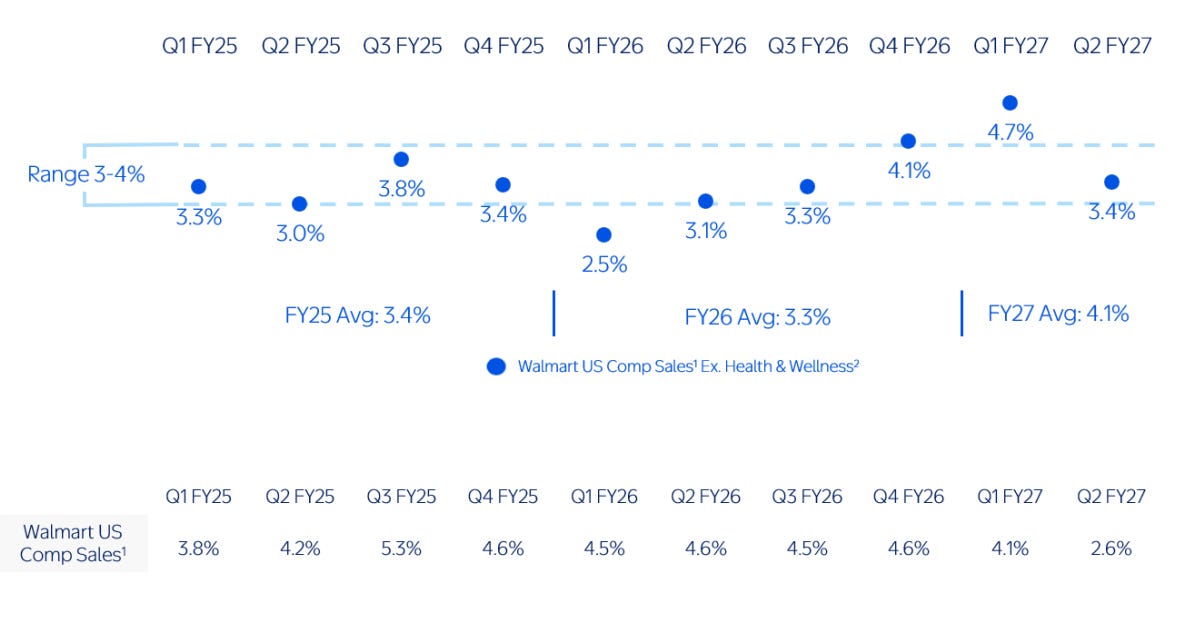
Look, I don’t have a problem with these adjustments especially given the impact seems to be largely confined to topline without commensurate impact on bottom line. But the asymmetry of the disclosure should be really annoying for the shareholders. Where was this comp view ex H&W segment when GLP-1 was a tailwind? Management seems very willing to have their cake and eat it too.
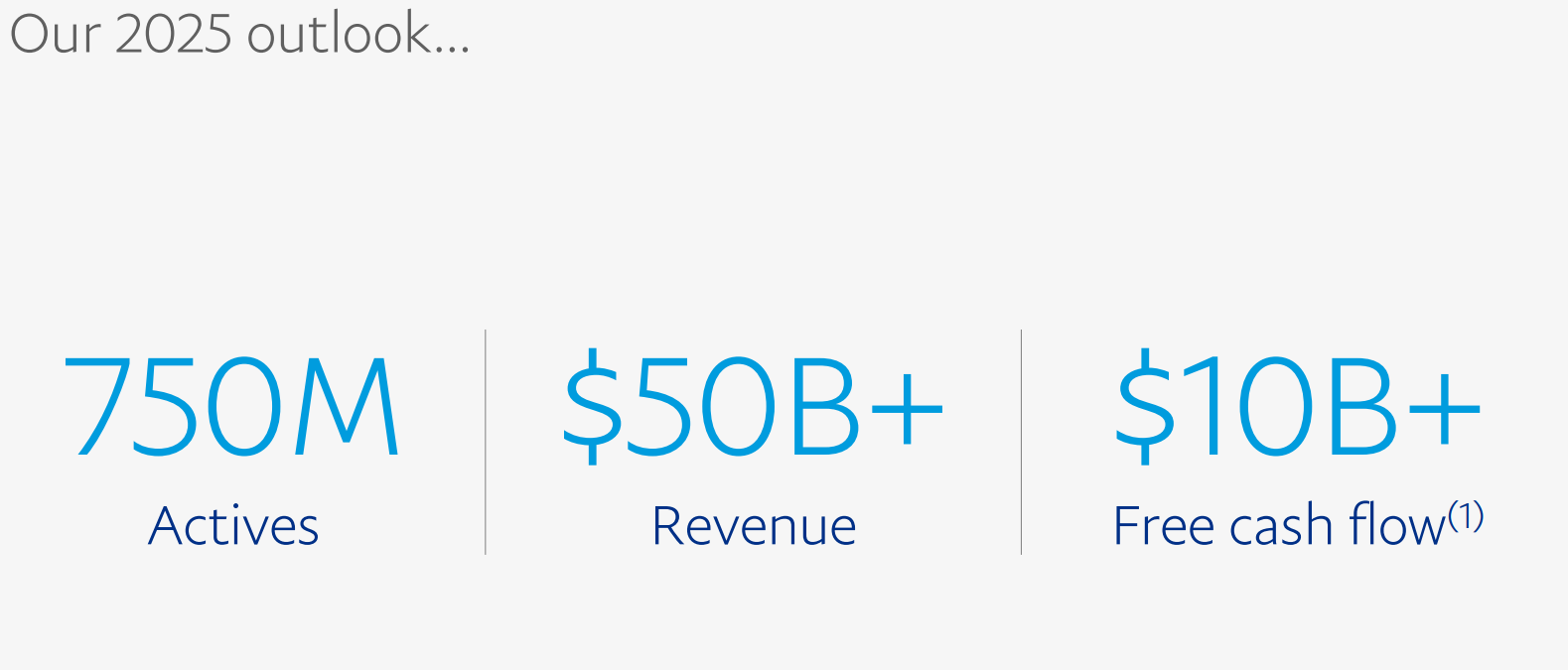
To be quite frank, I’m also quite careful about any explanation coming out of Walmart’s CFO John Rainey who doesn’t really have the best reputation in my mind. For context, before becoming Walmart’s CFO in 2022, he used to be CFO at PayPal. He had this “bright” idea of sharing a medium term outlook for PayPal that in retrospect appears to be borderline absurd. As you can see below, during the 2021 PayPal Investor Day, Rainey outlined monthly active of 750 million, revenue of $50+ Billion, and FCF of $10+ Billion in 2025. After providing such rosy outlook for PayPal, Rainey moved to Walmart. What did PayPal actually do in 2025? Their monthly active was 439 million, revenue was $33.2 Billion, and FCF was $5.6 Billion. You can argue that Rainey shouldn’t be held responsible since he wasn’t really there to execute on his plan, but given how far the company fell short on his outlook, I am not willing to be so charitable in this case.
Anyways, while the US comp was a negative surprise for the investors, yesterday’s call also really made it clear the extent of Walmart’s evolution from merely brick-and-mortar presence to increasingly perhaps the only truly omnichannel retailer in the US which I will discuss behind the paywall.
Subscribers get the daily journal and five+ years of Deep Dives, i.e. full-length analyses with financial models on 65+ companies. The daily is just how I think out loud between the Deep Dives!