The Social Media Ban Wagon
A programming note: I hope to publish my Deep Dive on Figma tomorrow. Next month, following the big tech’s earnings I will review Meta, Amazon, and Alphabet’s 10-Ks and update my models. As it’s been the case for the last couple of years, I won’t publish a new company Deep Dive in February, but will work on a new Deep Dive in March.
In “Zero to One”, Peter Thiel mentioned a question that he likes to ask: “What important truth do very few people agree with you on?”
By now, perhaps everyone reading this has heard this question, and yet, this question likely remains surprisingly difficult to answer for everyone. Not only the question demands something that is already difficult enough: you have to be contrarian AND right, it also has to be something that is deemed to be “important truth”. For example, while applying for Thiel Fellowship, Dylan Field, one of the co-founders of Figma, wrote that he finds chocolates repulsive. That is indeed something very few people would agree with him (I certainly wouldn’t), but I’m not sure that quite qualifies as “important truth”.
What is my answer to this question?
We have far from conclusive evidence whether social media is bad for kids. This may seem tame at first glance, but think about the statement which I would consider opposite of what I’m saying: “the effect of social media on kids is decisively bad”. If I pick random 100 people from any part of the Western hemisphere and poll how many people would agree with that “opposite” statement, I believe every time supermajority of people would agree with this “opposite” statement. So my position here is clearly quite contrarian even if it may sound a bit evasive at first.
Like everyone else, I have read fair bit of essays and think pieces that make the case that we need to save our kids from social media. The conventional wisdom of how the mental health crisis in the West can be directly tied to the rise of social media has led to ban social media in Australia for under 16 years old. Given the near consensus that I see among almost everyone (even among many Meta shareholders I personally know), it would hardly surprise me if such ban will eventually spread towards other countries in the West, if not the entire world over time. A consequential policy imposed on a section of society who really have no say on such policy despite very scant evidence to support the ban is why I think it qualifies as “important truth”.
One of the things that convinced me to dig more into this is when I listened to Tyler Cowen explaining his own skepticism on this topic. Some excerpt from that conversation:
“There’s a lot of meta studies that look at the correlation between individual happiness and social media usage, and those correlations are very, very weak. I think they’re stronger for girls in the age range of something like 12 to 14…But to blame societal pessimism on social media usage, I don’t see that supported by the data.
What I observe in broader history is you have very large social mood swings, such as before World War I that do not seem to have obvious causes. So if today’s does not have an obvious cause, of course that’s a puzzle, but in a way, it’s the kind of puzzle we should have been expecting.
I see a lot of people my age or older who watch a great deal of cable TV and they become negative from that. So, no, I’m not convinced it’s social media. I don’t see that in the data”
The unfortunate reality is while adults have reached the consensus that social media is bad for kids and are enacting laws based on such belief, the kids have, by and large, positive perception about social media.
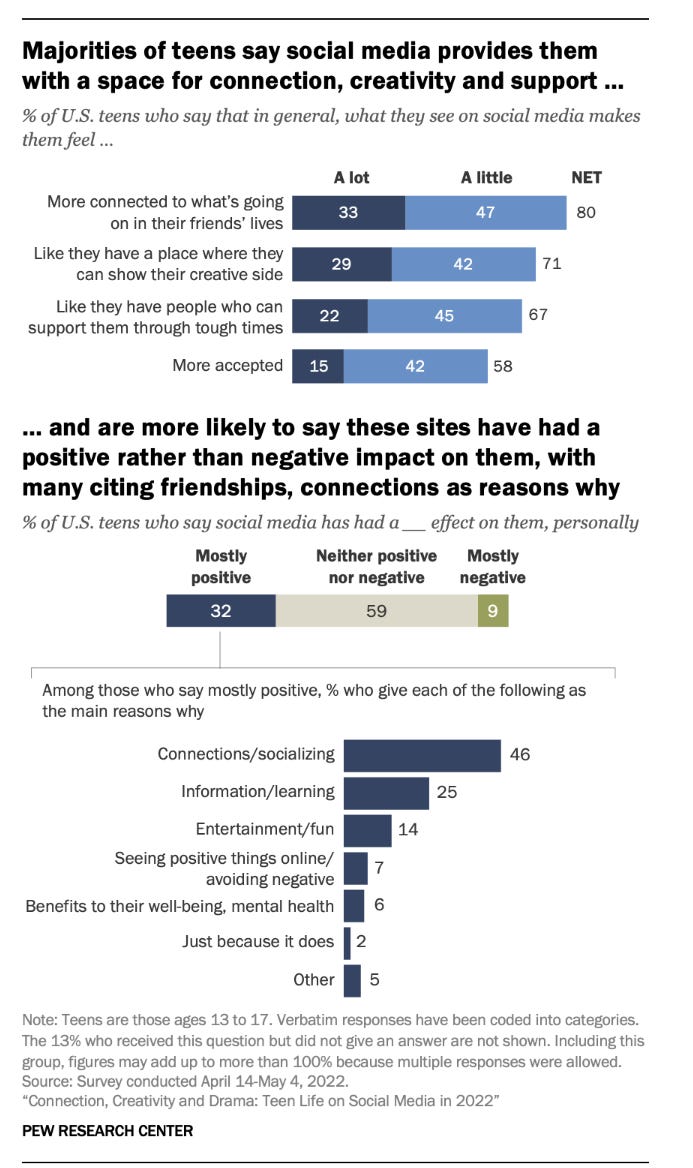
You may argue that of course, a few decades ago teens also likely had “positive perception” about smoking, but that doesn’t mean we should have let them smoke. Well, unlike smoking, research shows that zero use of social media is not quite optimal for kids. Just a couple of weeks ago, JAMA published a research after studying 100,991 Australian adolescents (grades 4-12) for three years and came to the following conclusion:
“A U-shaped association emerged where moderate social media use was associated with the best well-being outcomes, while both no use and highest use were associated with poorer well-being. For girls, moderate use became most favorable from middle adolescence onward, while for boys, no use became increasingly problematic from mid adolescence, exceeding risks of high use by late adolescence.
Social media’s association with adolescent well-being is complex and nonlinear, suggesting that both abstinence and excessive use can be problematic depending on developmental stage and sex.”
I am not holding my breath that Australian government will promptly change their mind and cancel their ban based on these findings.
Remember what Tyler Cowen said about how the data barely shows anything about the impact of social media on kids’ mental health? This Substack named “Mike’s Substack” looked at some of these studies and carefully jotted down their findings:
“…social media’s association with teenagers’ mental health) is various levels of nothing.
The standard Cohen’s d-statistic (a common measure of “effect size”) shows:
Ferguson et al’s two analyses: d < 0.08. Zero effect.
Rausch/Haidt’s reanalysis: maximum d = 0.17 to 0.20. Trivial.
Twenge/Haidt’s estimate for girls: maximum d = 0.20. Trivial.
Stein’s reanalysis: maximum d = 0.20. Trivial.
Jané’s initial re-analysis: d < 0.09, nothing.”
While it’s much easier to rally around the big, bad social media companies, it can be quite uncomfortable when we try to see eye-to-eye to the variables that do show strong association with the falling mental health of kids. From the same Substack:
“Compare the nothing-values found for social media effects with the powerful d-values from the 2023 CDC survey for the effects of troubled parenting on teenagers:
Teen’s depression and parent-inflicted emotional abuse: d = 0.88, very strong
Teens’ depression and parents’ depression: d = 0.73, strong
Teens’ depression and parents’ domestic violence: d = 0.66, strong.”
While mental health can be challenging to standardize just by surveying people, nothing is more black and white than looking at suicide rates to gauge the sign of mental health of the population at large. The rising teen suicide rate in 2010s, which coincided with the rising penetration of social media, seems to bolster the critics of social media at first glance, but again, this misses important drivers not named “social media companies”. From a different piece by the Mike’s Substack
“Teen suicide rates rose in tandem with parents’ suicide rates from 2007 to 2017, then both leveled off and fell from 2017 through 2024. That teen suicide rates have been falling for 7 years during the height of the social media era wasn’t supposed to happen, so of course it is being ignored.
In the early 1990s, parent-age suicide rates were just 23% higher than teen rates, but by 2024 had risen to 60% higher. But because in Haidt’s, Twenge’s, and authorities’ fantasy, only teens commit suicide, never grownups, these crucial trends offering insights into real causes and prevention are being swept aside.”
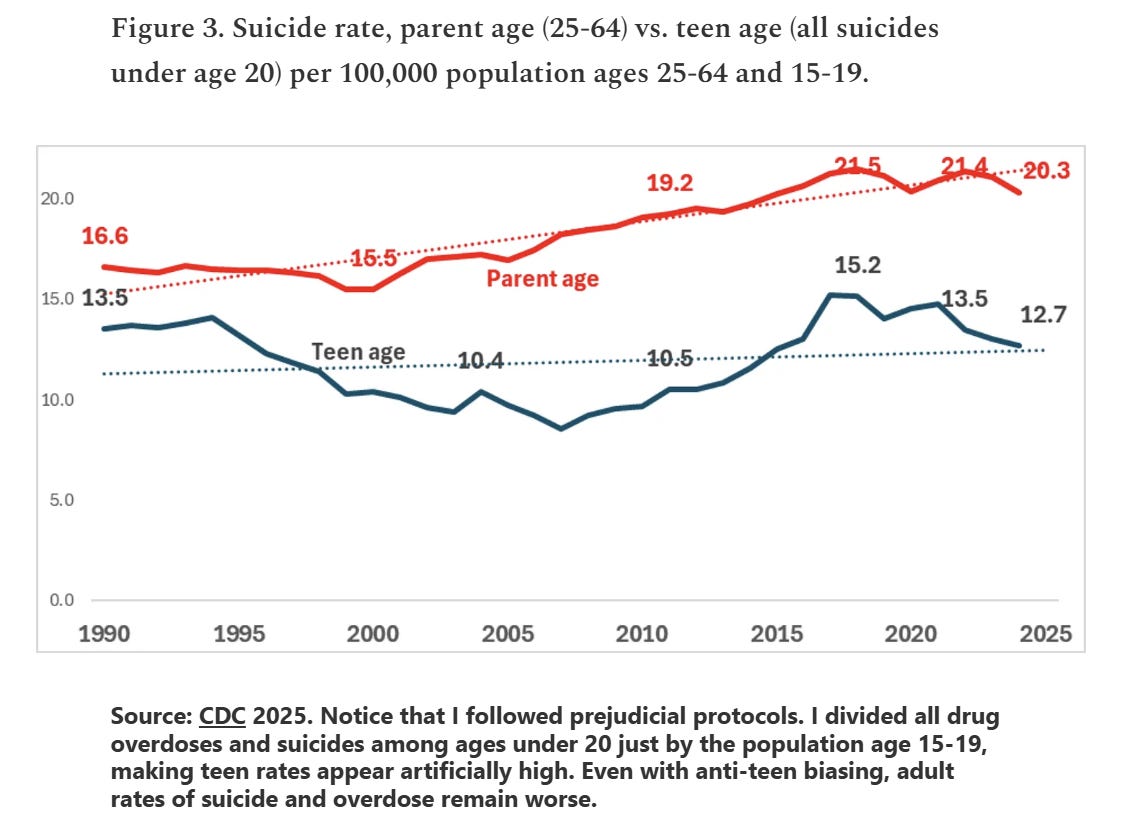
I read that paragraph and looked at the chart, and I chuckled to myself “don’t give them ideas. Maybe they’ll try to ban social media for adults as well”! Thankfully, unlike kids, we can vote.
I’m actually surprised that my seemingly tame position would be considered contrarian given even the American Psychological Association (APA) says the following:
“Using social media is not inherently beneficial or harmful to young people. Adolescents’ lives online both reflect and impact their offline lives. In most cases, the effects of social media are dependent on adolescents’ own personal and psychological characteristics and social circumstances—intersecting with the specific content, features, or functions that are afforded within many social media platforms.
Given the consensus, banning social media for kids would make us likely temporarily feel good about ourselves as society, but don’t be surprised if the problems remain weirdly persistent.
In addition to “Daily Dose” (yes, DAILY) like this, MBI Deep Dives publishes one Deep Dive on a publicly listed company every month. You can find all the 65 Deep Dives here
Current Portfolio:
Please note that these are NOT my recommendation to buy/sell these securities, but just disclosure from my end so that you can assess potential biases that I may have because of my own personal portfolio holdings. Always consider my write-up my personal investing journal and never forget my objectives, risk tolerance, and constraints may have no resemblance to yours.
My current portfolio is disclosed below: