Ryan Specialty: The Unconflicted Middleman
Programming Note: I will take the next two days off. MBI Deep Dives will be back on Monday next week.
You can listen to the Deep Dive here
Pat Ryan, currently 88-year old, is a living legend in the insurance industry. Soon after graduating from college, he entered insurance industry as a life insurance agent, but quickly pivoted into an idea he brought to an insurer: selling insurance coverage through auto dealerships. In 1964, at just the age of 26, he formalized that instinct into his own firm: Pat Ryan & Associates. This was the first glimpse of a recurring thesis: find a distribution flow others underestimate, then professionalize it with talent and capital. By 1968, his firm was already writing $15 million premium, and in 1971 he took it public to fund a broader ambition: move from a single product idea into a multi-line platform.
A consequential moment arrived in 1982 when his brokerage merged with the Combined Insurance Company of America. This laid the foundation for Aon Corporation, an entity Ryan would ultimately build into the second largest insurance brokerage in the world.
However, in the 1990s, prevailing industry sentiment held that the rapid rise of the internet and direct market access would inevitably render reinsurance brokers obsolete. Does that sound familiar? All the AI related disintermediation fears in insurance brokerage industry were very much alive back in the 1990s. Ryan bet against that conventional wisdom and recalled the grim sentiment around brokers in the 1990s in this piece published back in 2010:
“Many observers thought that reinsurance brokers would be replaced by the direct market and the Internet…People were looking at the reinsurance brokerage business saying it’s done. They were wrong”
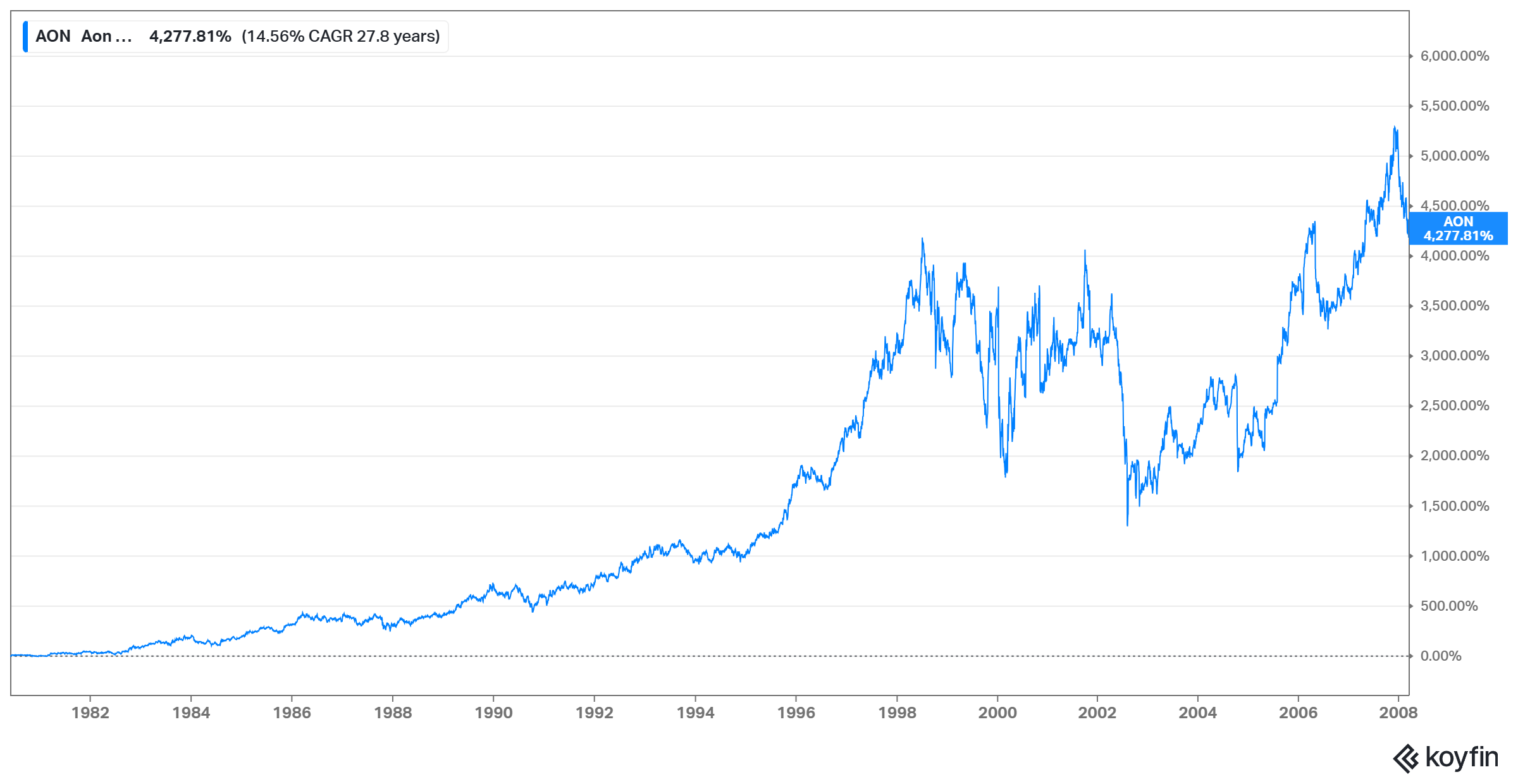
Indeed, the conventional wisdom couldn’t possibly be more wrong as Aon’s $10 million reinsurance brokerage in 1988 ended up becoming the largest reinsurance broker by 1998. Another decade later in 2008, Ryan decided to retire from the CEO role at the age of 71 in March 2008. I couldn’t get the data from their IPO in 1971, but I could find Aon’s performance data from 1980 on KoyFin. It appears Pat Ryan led Aon and compounded shareholder return at mid-teen rate for almost four decades in the public market before calling it a day at Aon!
In your 70s, more mere mortals would probably just want to enjoy the rest of their lives reminiscing the good old days. Ryan, on the other hand, conjured up vigor and vitality to start a new company: Ryan Specialty Group!
In a Business Insurance interview around the launch of his new venture, Ryan said that even though he had retired from active involvement at Aon in 2008, he never intended to fully retire from the insurance industry. He, however, did not want a sequel that competed with Aon head-on. He described a deliberate boundary: the new company would not operate in retail brokerage, reinsurance brokerage, or human resource consulting, and it would avoid overlapping with Aon’s existing managing general underwriter activity. Instead, he wanted to build a specialty wholesale company aimed at new and emerging needs to skate to “where the puck is going”.
As someone who built Aon from the ground up, Ryan was intimately aware that industry’s most durable profit pools may end up sitting in the more awkward spaces: risks too complex for standard processes, and distribution relationships that need technical judgment. He saw several emerging trends: demand rising for specialists as risks became larger and more complex (cyber, climate change etc.), retail brokers narrowing their wholesale relationships, and consolidation among retail brokers accelerating which only feeds further to the earlier point. If Aon was built as a broad global intermediary that could touch most major lanes of risk, then the founding thesis of Ryan Specialty was about building a purpose-built specialist broker where technical underwriting and specialist distribution matter most while keeping the mandate tight enough that it is clearly additive to the ecosystem.
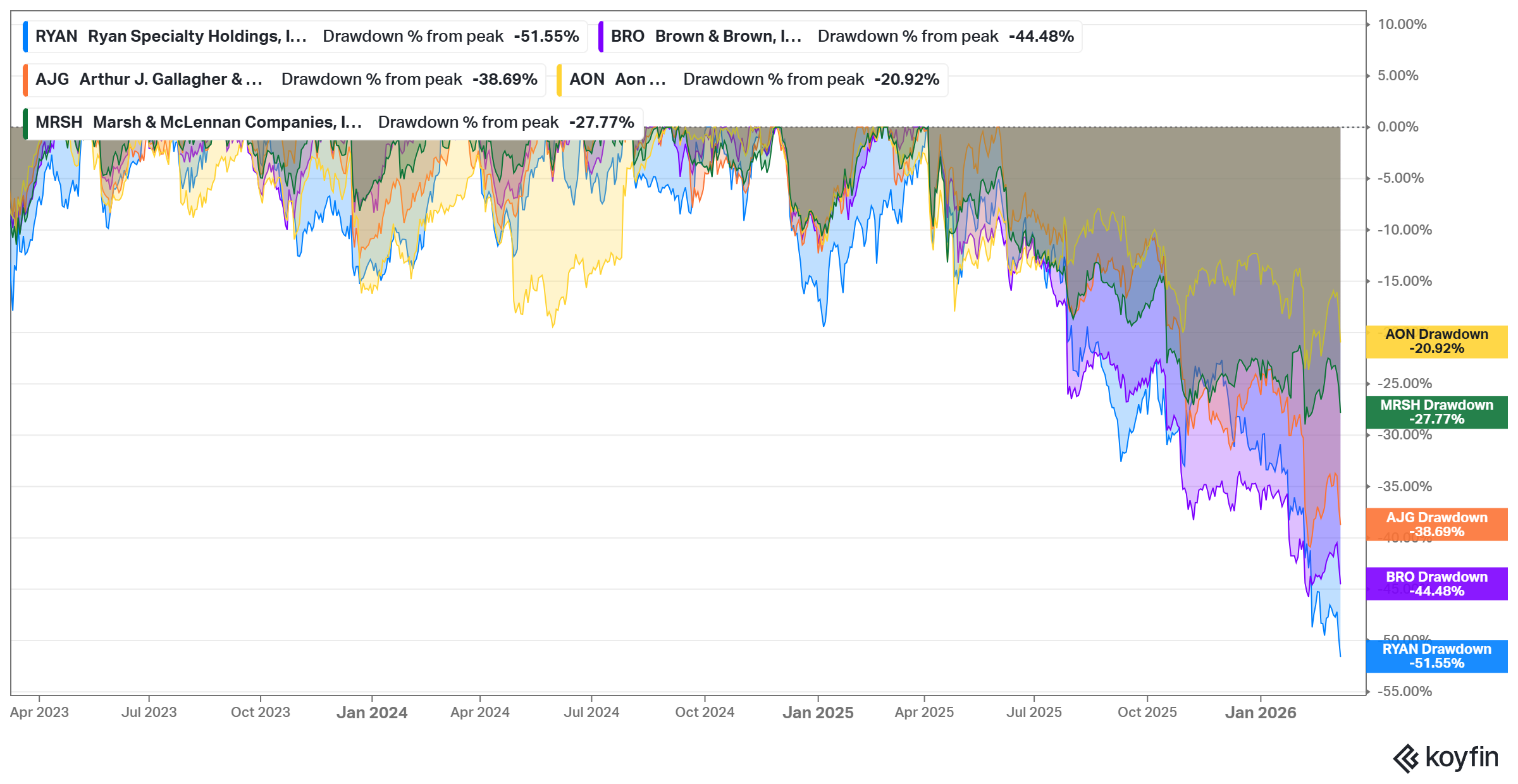
It was not until June 2018, eight years since its founding, that Ryan Specialty Group sought external institutional backing. The firm secured a strategic investment from Onex Corporation which injected $175 million into the business, split between $150 million in preferred equity and $25 million in common equity. This capital infusion accelerated M&A and revenue surpassed $1 Billion in 2020. The very next year, RYAN came to IPO at ~$7 Billion valuation. At its peak in April 2025, RYAN’s market cap reached almost $20 Billion, but then the stock has been cut in half. While other brokers also have been going through material drawdown thanks to property insurance hard market ending, RYAN has been the affected the most. More on this later.
In the meantime, Pat Ryan retired from the CEO role at Ryan in October 2024. I wouldn’t worry about Ryan starting a different company though. As I said earlier, he is 88 years old, but that’s perhaps not as reassuring as it would be about most people. More importantly, he not only remains Executive Chairman of Ryan, but also appears to be quite intimately involved with the company despite retiring from the CEO role as he still shows up in the company’s earnings calls. So, the legend is still definitely very much engaged in RYAN.
The person who succeeded Pat Ryan as CEO is Timothy Turner. RYAN was actually sued by CRC, one of their closest competitor in wholesale insurance brokerage today, back in 2010 when RYAN poached 10% of CRC employees. Turner was one of those poached employees. In fact, RYAN’s wholesale specialty division was always called “RT Specialty”. The “T” stands for Turner. As you can imagine, while Pat Ryan understandably consumes all the limelight here, Turner is effectively a a co-founder of RYAN.
But what exactly is wholesale insurance brokerage business about? Why does it need to exist? Let me now get into these more fundamental questions. I will discuss that as well as the broader industry context, business overview, competitive dynamics, capital allocation, management incentives, and valuation behind the paywall. Subscribe to read the rest of the Deep Dive as well as any of the 66 Deep Dives published earlier.