Roblox: Aggregating the Attention of Next Generation
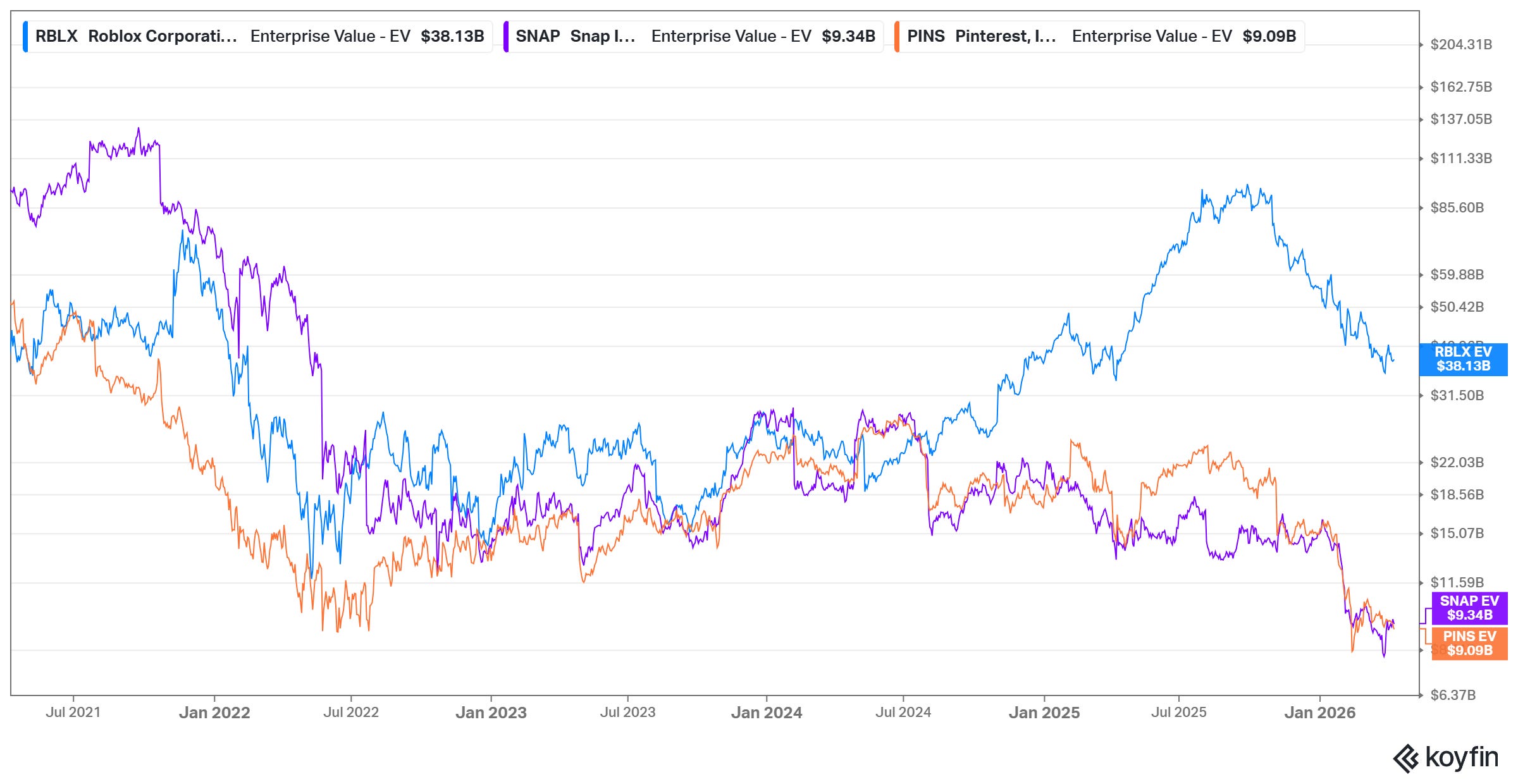
I was a tad bit surprised to learn that Roblox was founded the same year Facebook was: 2004! Roblox, however, wasn’t quite the rocket ship Facebook was, but at $40 Billion current Enterprise Value (EV), Roblox is currently worth more than twice of Snap and Pinterest combined!
I was a tad bit surprised to learn that Roblox was founded the same year Facebook was: 2004! Roblox, however, wasn’t quite the rocket ship Facebook was, but at $40 Billion current Enterprise Value (EV), Roblox is currently worth more than twice of Snap and Pinterest combined!
By the time David Baszucki decided to start Roblox, he was actually already reasonably successful. Back in 1989, Baszucki cofounded “Knowledge Revolution”, a software development company focused on educational simulation technology. Their flagship product was a program called “Interactive Physics”. It was designed strictly as an academic supplement to help students model two dimensional mechanical problems and visualize textbook equations.
Human behavior quickly subverted the software's academic intent. Baszucki observed that instead of diligently solving physics homework, children were utilizing the engine to construct elaborate virtual contraptions. From Roblox’s S-1 filing in 2020:
“The story of Roblox began in 1989 when our founders, David Baszucki and Erik Cassel, programmed a 2D simulated physics lab called Interactive Physics, which would later go on to influence our approach to building the groundwork for Roblox. Students across the world used Interactive Physics to see how two cars would crash, or how they could build destructible houses. In starting Roblox in 2004, we wanted to replicate the inspiration of imagination and creativity we saw in Interactive Physics on a much grander scale.”
Knowledge Revolution proved moderately successful and was acquired by MSC Software in December 1998 for ~$20 million dollars. Baszucki spent a few years as a Vice President at MSC before departing to manage an angel investment firm, where he actually provided early seed funding to the pioneering social network: Friendster.
In 2003, he reconnected with Cassel, the former lead engineer from Knowledge Revolution. Together, they set out to actualize the vision sparked by those early educational simulations. They wanted to build a platform that married rigid mechanical physics with limitless user generated creativity. Development began under the working title eBlocks, which was soon changed to DynaBlocks to reflect the dynamic nature of the physics engine. They envisioned a digital realm governed by the laws of gravity and momentum, yet entirely moldable by its inhabitants. By early 2004, recognizing that DynaBlocks was somewhat cumbersome for a younger demographic to remember, they merged the concepts of robots and blocks to officially call the platform Roblox. After over two years of intensive coding to build out the foundational architecture, user interface, and community tools, Roblox officially launched to the public on September 1, 2006.
At launch, Roblox was pretty basic. It included games such as paintball games, haunted houses, model trains. But the real surprise came from the users as Baszucki recalled:
"The biggest surprise is the quality and ingenuity of the users. When we launched, the team literally put up one prototype game that they made. The second they allowed the users to make games, the quality surpassed what they had done almost immediately."
In its first few years, the platform functioned primarily as a niche community for dedicated tinkerers and amateur programmers. But a major shift occurred in late 2012 with the launch of Roblox Mobile. Porting an intricate, physics heavy desktop game engine to the iOS ecosystem was a monumental engineering gamble. It required unifying the rendering, physics, and web teams to create a native application that did not compromise the established desktop user experience. By removing the friction of desktop exclusivity, Roblox tapped directly into a younger, mobile first generation.
If the mobile launch provided the sheer volume of audience, the introduction of the Developer Exchange (DevEx) program in 2013 provided the platform's economic engine. DevEx allowed creators to convert their earned in game virtual currency Robux into real world fiat money.
Before DevEx, developing games on Roblox was a passionate hobby. After DevEx, it became a potentially lucrative career path. The more engaging the games the community built, the more players arrived to spend money, and the more capital the developers earned. This economic architecture catalyzed a gold rush of a better quality content, effectively outsourcing the traditional game development studio model to a much more decentralized crowd.
Of course, once Covid happened, Roblox exploded during the pandemic. Daily Active Users (DAU) increased from ~19 million in 2019 to ~37 million in 2020. After such a massive year, Baszucki decided it was time to go public. First Round’s Chris Fralic recalled in this podcast that while the journey to IPO was anything but smooth for Roblox, Baszucki appeared to have a deep conviction on the long-term success of Roblox. From the podcast (emphasis mine):
“…as the company was going public, I was going back and looking through some notes of my takeaways from board meetings and just general updates, and there were periods of big misses on the financial side. There were key hires that weren't working out as hoped, needed to be replaced, and in particular, like we went out for a fundraise and couldn't get anybody interested. So that was a tough period, but again it never seemed to overly phase Dave. And he had complete conviction on what Roblox could be in spite of all those facts, and never stopped, and then the numbers caught up. And the reality caught up. And the world started to get a sense of what Roblox really, really was.”
The big question, however, was whether the pandemic driven boost in user metrics and engagement was just a temporary fad. Now that it’s five years since Covid, we can answer more definitively that Roblox was no pandemic fad. To contextualize, Roblox’s DAU in 2025 was almost ~4x the number of its DAU in 2020! In fact, one of the key reasons I have decided to spend more time in studying Roblox was when I listened Matthew Ball mentioning the following in his recent Stratechery interview:
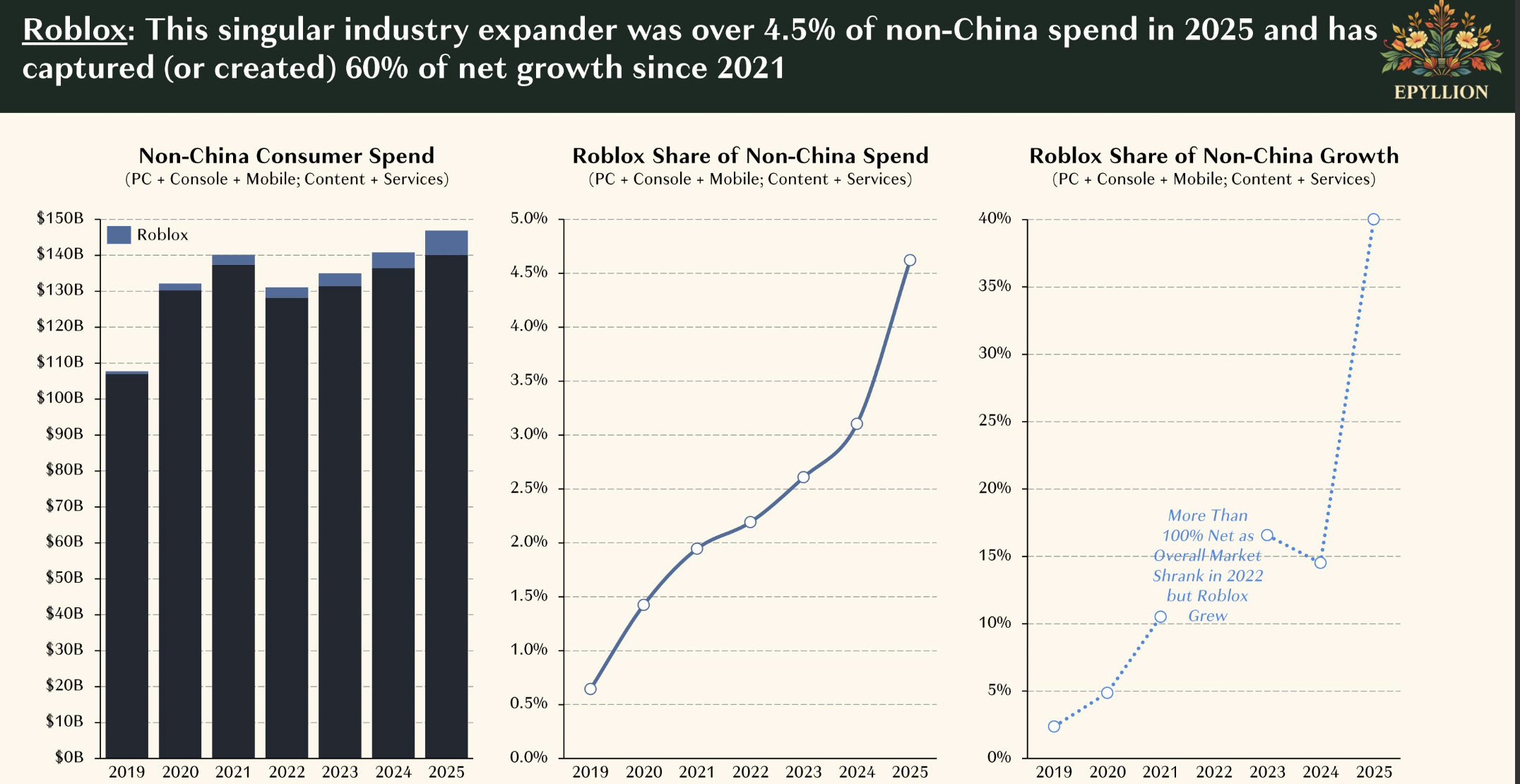
“…If you can believe 60% of net growth outside of China since 2021 went to Roblox, 67% of global non-China spending growth last year, 67% went to Roblox. In effect, if you say the gaming industry had a great year last year and you net out Roblox as the sole participant, no, gaming did not have a great consumer spend year.”
For the more visually inclined, here are the relevant charts from Ball’s presentation on the state of video gaming in 2025:
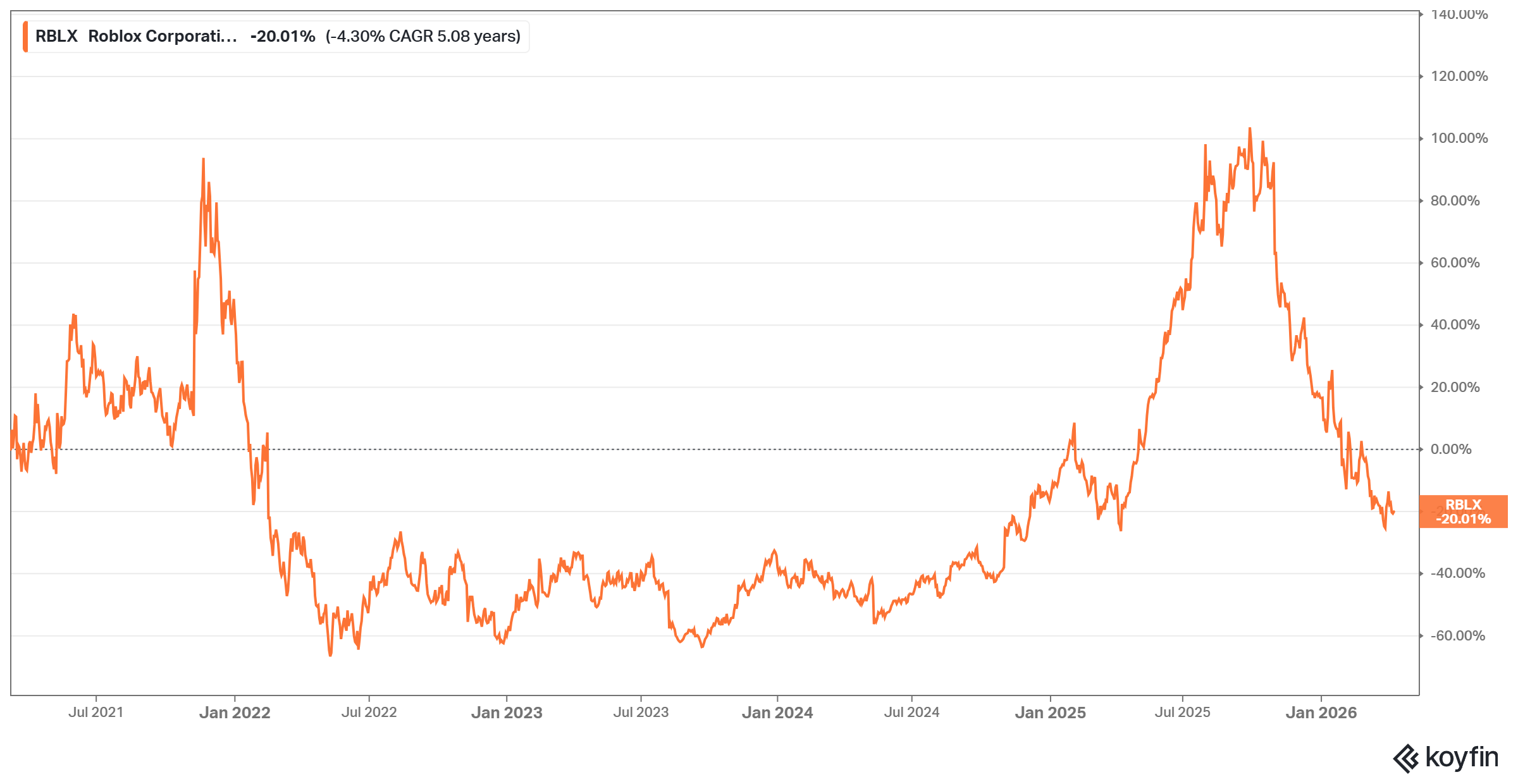
If you don’t have a young kid at home, I suspect you may not quite grasp the popularity of Roblox among kids. In fact, whenever we invite guests at our place and if they have young kids, I have seen almost 100% of these kids play Roblox while their parents are socializing. This was also another sign that I really should follow Roblox more closely. I also noticed that the stock basically went nowhere since the IPO despite revenue became more than 5x since IPO!
In the rest of this Deep Dive, I will first discuss Roblox the product as well as the business. I will then elaborate on its moats as well as broader competitive dynamics and risks the company faces. I will then talk about management incentives and explore what is currently being priced in Roblox’s valuation. Subscribe to read the rest of this Deep Dive.