Figma: The Design OS at the AI Crossroads
You can listen to the Deep Dive here
Back in 2011, Dylan Field, then a 18-year old intern at the social magazine startup Flipboard, found himself wrestling with clunky design software. He was frustrated by Adobe Fireworks and wondered aloud why designing on a computer couldn’t be as seamless and collaborative as writing in Google Docs. This simple question perhaps planted a seed on his mind. Field wasn’t even a Design major (he was a computer science student at Brown University), but he sensed an opportunity. If documents and spreadsheets had moved to the cloud, why not design?
While at Brown, Field met Evan Wallace who was apparently nick named “CJ” (stands for “Computer Jesus”). Wallace was teaching assistant (TA) in one of the courses Field took and they got to know each other. Wallace interned at Pixar and Microsoft and while he did get return offers, he also realized that he wouldn’t really feel “challenged” in those companies. So, when Field asked Wallace whether the “Computer Jesus” would like to start a company with him, Wallace was quite enthusiastic about that. The only problem is they still didn’t know what they would build together. Field’s grand idea was basically just build “something” with Wallace at this point.
That conviction proved stronger than any fully baked business plan. With backing from the Thiel Fellowship and a seed check from Index Ventures whose partner Danny Rimer had been tipped off by LinkedIn’s CEO saying, “We have this incredible intern I’m trying to hold onto, but the kid wants to start his own company. It sounds interesting. You should talk to him.”
Once Field and Wallace narrowed their business idea to an online, collaborative design tool, turning that into reality proved to be an uphill technical battle. For the first few years, the team operated in stealth mode, quietly building and rebuilding their prototype while many wondered what they were up to. It even became a running joke at Index venture, as recalled in this blog: “When’s the product launching?” And every time, Field would respond enthusiastically, “Next year! We want to get it just right.”
Behind the scenes, there were moments of doubt and even downright weird detours. In one comical episode, Field temporarily convinced himself that the killer application of their WebGL technology was… a meme generator. For five strange days, the duo actually explored making a tool to create internet memes, until they realized this was “the darkest week of Figma” and promptly steered back to more serious, productive endeavor.
Through countless whiteboard sessions and late-night coding marathons, they zeroed in on the biggest pain point designers faced: collaboration. At the time, design files were passed around like homework assignments i.e. emailed, versioned, and often out of sync. Field and Wallace envisioned a world where multiple people could jump into the same design file at once, edit in real-time, and leave behind the mess of exporting and emailing. By late 2015, after three long years, they felt ready to show their work to the world.
Figma’s public debut came with a blog post in December 2015 titled “Design: Meet the Internet”:
“Ever since Writely (now called Google Docs) launched ten years ago, I’ve believed that all software should be online, real-time and collaborative. Creative tools haven’t made the leap because the browser has not been powerful enough. Now, with WebGL, everything has changed.
I first glimpsed the power of WebGL in April 2011. My classmate, Evan Wallace, had just returned to the Brown CS lab after a weekend hackathon. He pulled me aside and showed me how he had re-implemented a server side image processing API in WebGL. “You know,” said Evan, “we could use this thing to build creative tools in the browser.”
Designers, despite being stuck using desktop-bound tools from the Adobe suite, weren’t quite banging the door for something radically new. Figma’s beta product (released as a free-to-use tool in early 2016) initially received, to put it mildly, a mixed reaction. Field recalled in “How I built this” podcast:
“…a lot of designers at that point were coming from an agency culture where you know you go explore, you come up with a few solutions for the client, you present three solutions, and then you have a grand reveal of like here is the big amazing thing that you should obviously do. And that's just not the way that product development should work on a team internally. Instead, you know, there's a wide range of things you consider. You collaboratively need to work through them. But people were so used to that agency method of working that some of the initial comments in the launch were stuff like, "If this is the future of design, I'm changing careers." This is 2015, I mean that this idea that design being a collaborative thing was not a thing necessarily. Like one comment was "A camel is a horse designed by committee.”
I think that was maybe the the mainstream view of the design culture then. But there were also a lot of people that signed up for the waitlist. And then we started to every week let more people off the waitlist into the product and we saw right away that people were using it. Even without everything we knew that they needed. And then every time we added additional functionality to the product, we saw that conversion of people going from "Okay, you're off the waitlist" to "You're actually using it," it would go up.”
After designers understood the essence of Figma, designers around the globe began to adopt it; finally, designers got a graphics editor that felt as fluid as a web app and as social as a Google Doc. More than half of Figma’s users would soon come from outside the US, validating Field’s hunch that great design is a global need.
By the time Figma introduced a paid professional plan, it wasn’t a hard sell. If anything, some of their largest users were begging Figma to mature their enterprise sales motion. Claire Butler, Figma’s first GTM hire, recalled in a podcast how Microsoft almost forced Figma to grow some enterprise sales muscle:
“…we’ve never gone through Microsoft procurement, Microsoft security. It just started popping up throughout the organization. And we have these really cool Node graphs that show this too, where you’d have these little pockets of people and then it would jump to another, like they’d have one more collaborator and then jump from another pocket. There were these really cool maps of how that spread within the organization. And eventually, we got to the point where that was a very comprehensive Node graph that had this massive thing of all of these people from Microsoft using the product.
But still, it was only on credit cards. I don’t think we even had an enterprise product at this point, and so there was no salesperson for them to talk to. And Microsoft was like, “Wait a minute. We need to organize this. We need security. We need account management. We need procurement involved.”
They wanted to pay for it and they wanted us to have this enterprise product, because they had these requirements and they wanted to have a better control over it, because it was just popping up within the organization without their control.
And so that’s probably a good example of what that looked like as this bottoms in motion just spread to a really large organization.”
Always a good sign when your customers want you to get things in order just so that they can use your product!
As you almost certainly know by now, Figma’s rise did not go unnoticed by the industry’s incumbent behemoth: Adobe. In September 2022, Adobe made a eyebrow raising ~$20 billion bid to acquire Figma. However, over the next year, the acquisition ran into regulatory hurdle. The “innovation” of just licensing the product and “acquihire” a bunch of top leaders wasn’t quite normalized in Silicon Valley yet. So, by December 2023, the deal fell through, forcing Adobe to abandon the takeover. Field encapsulated the state of his mind during this saga in a podcast with Jack Altman:
“At the start, it was kind of like, ‘Oh, 95% certainty it’ll go through, no worries.’ But every time we checked in, the certainty went down. Eventually, at the end, it was maybe a 5% chance.
Somewhere in that arc, we realized quickly: this is not a sure thing. Keep the foot on the gas, keep building. That’s the best outcome whether we join Adobe or we’re independent. You can’t be in this constant state of ‘we’re so back’ and ‘it’s so over.’ Rapid cycling through that makes your brain fall apart and turn to mush, in my opinion.
So, the word of the year for me was equanimity. I think I said equanimity more times that year than I ever will for the rest of my life. It’s just: how do you find peace in every option and know that everything’s going to be okay? We’re building a great company for amazing customers and we have a lot of stuff to do. Let’s go do it.
Whatever happens, we’re going to put our best foot forward. We signed a contract with Adobe, and we’re going to make sure that we do everything we can to close this. If it doesn’t work out, we’ll have a great independent path.
When you get to the end of it, the relief the team felt at knowing an answer—and having that superpositional state collapse into ‘Okay, we know we’re going to be independent’—that was real relief.”
The entire saga turned out to be much more ironic for Adobe than Figma. I wrote in a piece back in June, 2023:
“…Figma raised $333 Mn over seven funding rounds. If the deal with Adobe doesn't go through, Figma will receive $1 Bn breakup fee. So, effectively Adobe shareholders will pay ~3x money that Figma raised over its entire life to receive exactly 0% ownership of Figma. To put it differently, Adobe shareholders will be giving $1 Bn charity to Figma to potentially compete much more directly with Adobe in the medium term.”
Indeed, rather than seeing it as a setback, Figma’s leadership rallied. The company refocused on its independence with renewed energy, rolling out an ambitious slate of new features and even entire new products (to be discussed later) in the following year. By mid-2025, Figma had channeled that momentum into an IPO.
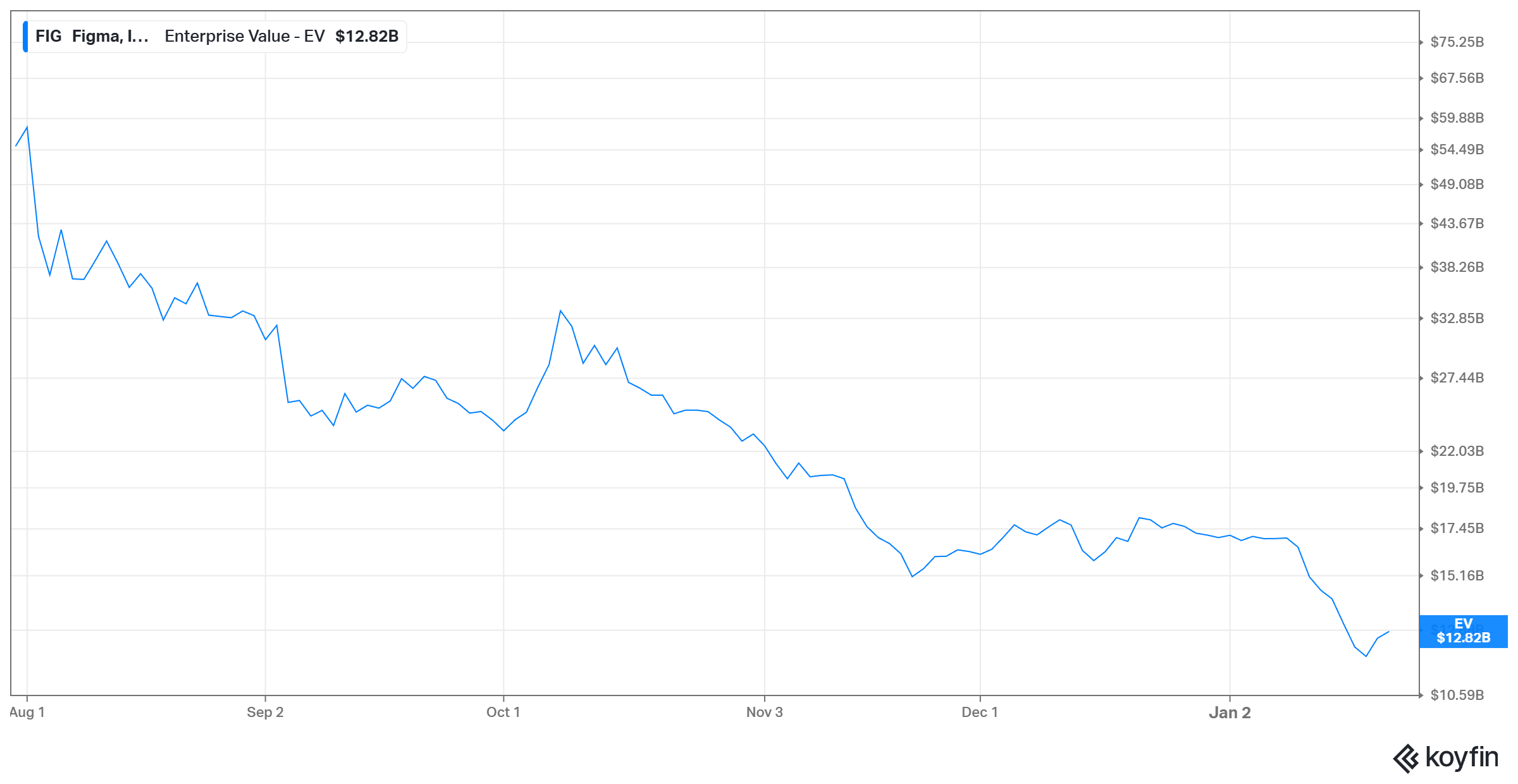
While Adobe offered ~$20 Billion to Figma back in 2022, Figma IPO-ed at $19 Billion valuation in July, 2025. Following the IPO, the stock reached a stratospheric valuation of as high as ~$70 Billion at the peak, but then went onto plummet to only ~$13 Billion current Enterprise Value (EV).
In the next section, I’ll discuss Figma’s products as well as key metrics related to the business. Then I will look into its competitive dynamics, management incentives, and dig into valuation assumptions. Subscribe to read the rest of the Deep Dive as well as any of the 65 Deep Dives published earlier.