The AI Compute Squeeze
Programming Note: MBI Deep Dives will be off during the weekend and I will resume the daily posting cadence from Monday next week.
If you followed hyperscalers earnings, you probably already knew that the neoclouds would repeat some version of “demand for compute is outstripping supply” in their earnings calls. And of course, they did. However, there were some useful nuggets in CoreWeave and Nebius’ earnings calls that seem to be further shaping the narrative around the compute price environment.
The quote that was highlighted perhaps the most by investors who are bullish on the business of selling compute was CoreWeave management pointing out the ever extending useful life of previous generation of GPUs. From CoreWeave’s call (emphasis mine):
“What we are seeing today is that the upside of re-contracting is real as we remain largely sold out of prior generations of NVIDIA GPUs in addition to the current SKUs. So as our earlier generation fleets roll off their original contract, they offer the potential to deliver strong returns in the subsequent years. We are seeing this across our Ampere and Hopper fleet.
As an example, we recently signed an A100 contract that extends into 2029 at an attractive price. As a reminder, this SKU was introduced in 2020. Clusters of prior generations of architecture offer installed, energized production-grade compute already running at scale. They come with a proven ROI for customers. In a market where new capacity is supply constrained and costs are rising, AI cloud infrastructure and production is a scarce, valuable asset. While we have built a business whose economics do not rely on re-contracting after initial customer term. Increasingly, we are seeing longer utilization at higher prices, offering the potential for significant further upside.”
The bull case is rather obvious from that aforementioned quote. If GPUs of previous generation can be sold at higher prices and the useful lives are longer than assumed, the earnings are currently understated.
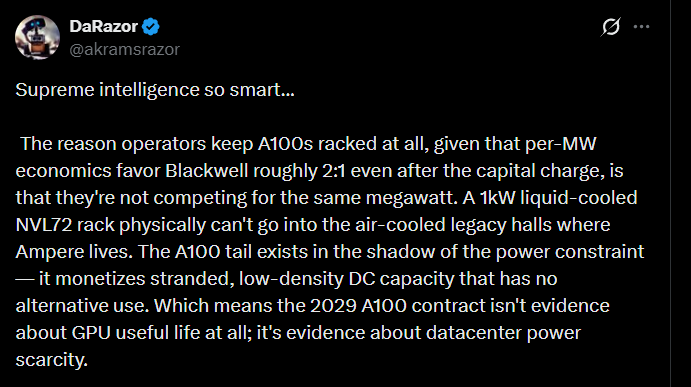
I do, however, suspect there might be some real holes in such convenient takeaways. DaRazor pointed out an alternative interpretation which makes more intuitive sense to me. (in case you’re wondering, “supreme intelligence” here is AI)
Later, DaRazor had another intriguing take by pointing out the possibility that the type of customer who would be interested in A100 chips today:

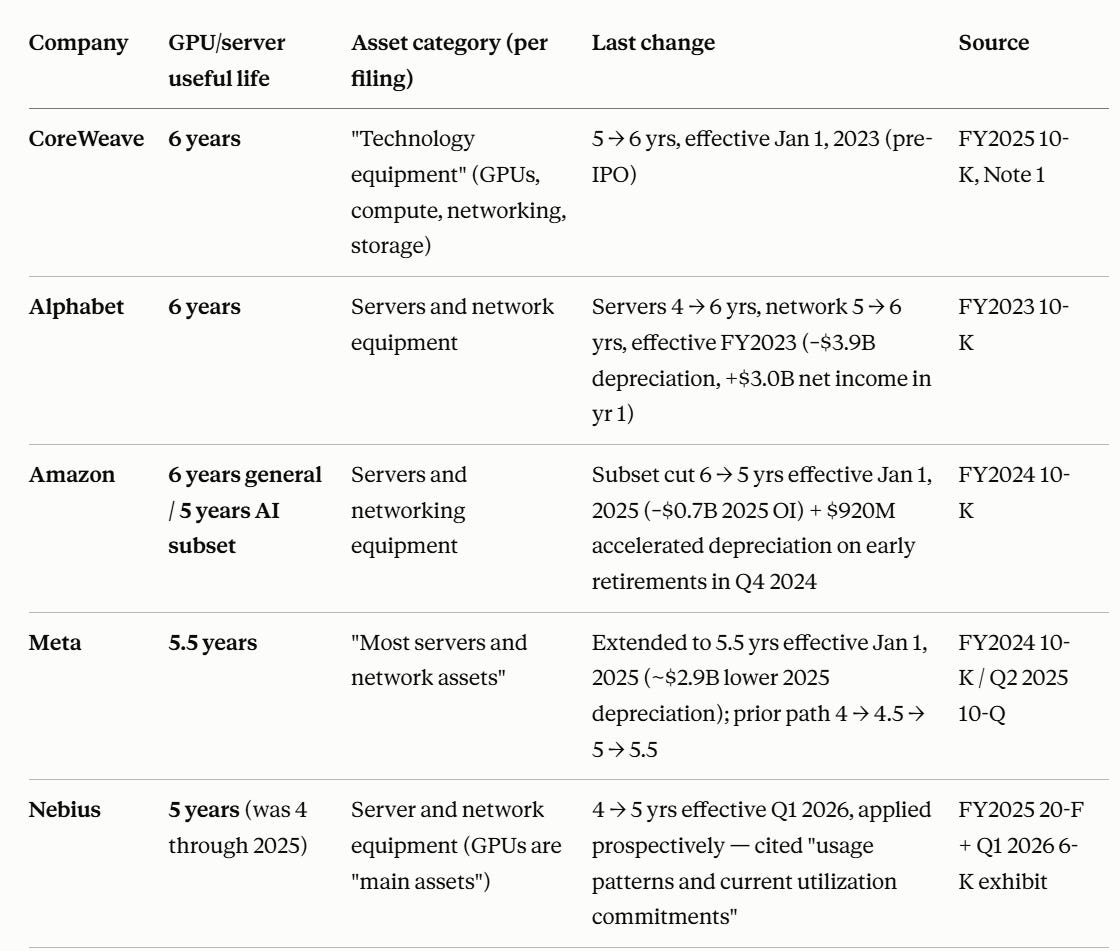
As you can see, there is a real possibility that we may not actually infer much from that CoreWeave quote. Nonetheless, if you still want to assume the useful lives of GPUs are actually longer than assumed, you can make an argument that it is perhaps Amazon, Meta, and Nebius that are under-reporting their earnings much more than CoreWeave and Alphabet. I would, however, caution to make such leap as I suspect depreciation rate may not prove to be the same across the board. Even when they are buying the same generation of GPUs from Nvidia, the actual depreciation rate can depend on variety of factors such as utilization intensity, power scarcity, workload cascade depth (to what extent an operator with a deep bench of lower-intensity workloads can demote chips from training to inference to batch/internal workloads etc.
Gavin Baker also made the argument in his recent podcast appearance at “Invest Like the Best” that revenue estimates for hyperscalers are currently underestimated given the exceptionally strong demand environment. From Gavin Baker (emphasis mine):
If you model it out, if you look at the amount of gigawatts that are supposed to come on, and consensus estimates for hyperscalers, they’re effectively modeled — and these are gigawatts of Blackwell and Rubin. Rubin being Nvidia’s next chip, Blackwell being the current chip. They are modeled to monetize roughly at the rate of Ampere, which is two generations behind — not at Hopper, but Ampere. So there’s $1.3 to $1.4 trillion in hyperscaler operating cash flow. If you just assume, I think it’s very unlikely they monetize at the rate of Ampere. We could go into why. Some of it comes from seeing what is happening on the ground with demand here from real quantitative metrics.
But let’s say they monetize at a discount to current Blackwells — then it’s more like $2 trillion of operating cash flow. And that takes $700 billion of credit demand out. Ironically, as that improves all the credit ratios, as these installed bases of compute reprice, we’re going to continue accelerating. Consensus is modeling in a deceleration, which I think is unlikely. Then the credit metrics look better, and then all of a sudden it gets easier to finance with credit. Now, whether they choose to do that or not, we’ll see.
Indeed, listening to Nebius call made me think that in case demand remains just as strong when 3P hyperscalers are going to renew their contracts and bring new capacity online, they may end up generating materially higher revenue per MW than their older contracts. Let me highlight what Nebius management said on how they’re pricing the compute deals in current market (emphasis mine):
“We choose when to sell, to whom we sell and on what terms, and how we finance everything. This flexibility allows us to meet the needs of independent AI builders and to support an open, diverse and competitive market. We address customer needs with 3 types of deals. Each has a different duration, pricing and role in our business.
First, for our core AI cloud business. We have midterm contracts of 1 to 3 years with the world’s most ambitious AI companies. This quarter alone, we closed 4 landmark deals, with Reflection, Cohere as well as with a scaled U.S. new lab and a large U.S.-based quant trading firm. These deals were for an average of more than $1 billion each. They represent a yield of $20 million to $25 million per megawatt, with upfront payments that cover 50%, 60% of the associated CapEx. But most importantly, we could sell today our entire 2027 capacity on these terms if we wanted to. But we are not doing this. We see that we can achieve higher value by retaining some capacity to serve shorter-term and immediate client needs.
And here we come to the second type of deal, this is shorter-duration capacity, typically for up to 6 months for customers with an immediate time-bounded needs with high-value requirements. For this, they are ready to pay a significant premium. We’re negotiating deals for $40 million to $50 million per megawatt range, and sometimes above, under this model. One of such deals has been signed just recently by the way.
The third deal type, as we noted many times in the past, is our long-term contracts with investment-grade customers. They serve an important purpose. They help us to finance our build-out faster and more efficiently. The secured debt facility we raised in July was on the back of one of these deals. And with $40 billion in contracted backlog, we will do more of this.”
Just to put these numbers in perspective, Meta signed a $12 Billion, 5-year deal with Nebius in March 2026 which will come online early next year. While the company hasn’t explicitly disclosed this, it likely implies $10-13 million per MW pricing range. When Meta builds their own data centers, obviously their internal cost per MW is likely even lower than that. When Meta mentioned in their earnings call that they are getting offer for their compute that are “multiples” of what they paid for, you can sense that the multiple could potentially be ~5x of what it costs Meta! Of course, the math is likely similar for 3P hyperscalers as well. The demand for compute is truly at stratospheric level which is leading to somewhat obscene margins for compute sellers.
One may wonder given how the number of neoclouds have mushroomed over the years and there seems to be more and more entrants to compute seller market, why on earth such obscene margins are being kept by this increasingly fragmented market? Or to say it differently, why on earth Nvidia is not capturing more of this economics? Indeed, I suspect the only reason Jensen Huang hasn’t pressed the pricing accelerator too much is capital has become the key bottleneck in AI. That perhaps explains at least partly why Nvidia is partnering with Apollo, BlackRock, Blackstone, Brookfield, Goldman Sachs and KKR for the $500 Billion AI infrastructure bonanza. Once capital is not the bottleneck anymore and the compute seller layer becomes more fragmented over time, Nvidia will be happy to raise price on their GPUs to capture lion’s share of “excess profits”. Nvidia may not need to explicitly raise price and as the recent media reports suggest, they will simply ask for revenue share if, for example, compute price per MW exceeds certain threshold.
My friend Liberty had an interesting take on Nvidia’s plan to solve the capital bottleneck:
“Nvidia has a large information advantage over the banks: Jensen knows the roadmap (he’s the one writing it ✍️). So they should also have a better idea of what today’s GPUs will still be worth a few years from now. Of course, it’s about as far from a neutral appraiser as you can get, but that doesn’t mean it can’t pull this off.
The irony here is that nobody is working harder to make today’s Nvidia GPUs obsolete than Nvidia itself”
I actually think Liberty may have inadvertently explained why Jensen’s “information advantage” is worth very little in determining the residual value of GPUs. Jensen Huang, as he likes to call himself “Chief Revenue Destroyer”, is running so fast to launch newer generation of GPUs not out of mere whims. Huang knows it very well that several well-capitalized competitors are very much deeply invested in commoditizing the chip layer if Nvidia ever lags behind or stops leading the performance frontier. As a result, the value of GPUs is not necessarily solely dictated by Nvidia’s own trajectory, rather also driven by both its own plans as well as the competing alternatives. Nvidia may have an outsized share in the chip layer today, but it is certainly not the only game in town.
Perhaps even more importantly, almost everything in the compute value chain will ultimately be decided by compute demand on which Jensen Huang or the banks have no control. The companies who are really leading and pushing the demand frontier are frontier AI labs. If AI labs revenue fails to meet expectation in the next couple of year, my best wishes to anyone selling compute if they’re hoping compute pricing won’t feel a jolt.
The good news for compute sellers is that there is really no tangible indication that things are slowing down for frontier labs. Given how aggressively they are buying compute and how much they are willing to pay for compute, I actually suspect they might be closer to a new inflection point for which they suspect they will need abundant compute. Since both the frontier AI labs will likely be public by 2027, they may look pretty foolish for signing such expensive compute deals if revenue starts decelerating and costs start accelerating while reporting on a quarterly basis. But their behavior would seem quite rational if the labs are close to crack something substantial….maybe continual learning?
Subscribers get the daily journal and five+ years of Deep Dives, i.e. full-length analyses with financial models on 65+ companies. The daily is just how I think out loud between the Deep Dives!
Current Portfolio:
Please note that these are NOT my recommendation to buy/sell these securities, but just disclosure from my end so that you can assess potential biases that I may have because of my own personal portfolio holdings. Always consider my write-up my personal investing journal and never forget my objectives, risk tolerance, and constraints may have no resemblance to yours.