Anthropic vs Meta: Room to Be Wrong
Anthropic is expected to go public at ~$1.5 trillion, although some investors are now reportedly pushing for something closer to $1 trillion after last week’s AI selloff. As it turns out, Meta’s enterprise value is also ~$1.5 trillion.
Anthropic is expected to go public at ~$1.5 trillion, although some investors are now reportedly pushing for something closer to $1 trillion after last week’s AI selloff. As it turns out, Meta’s enterprise value is also ~$1.5 trillion. So I had been thinking about these two businesses which have taken very different routes to the same valuation. Each has a core business that already makes money AND a bet on what comes next. At Meta, the core is advertising and the bet is MSL; at Anthropic, the core is a fast-growing API and the bet is a set of first-party products, many of which have yet to launch. I wanted to understand that split better: what the core is worth on its own at each company, and how much of the price is really riding on the bet.
Meta plans to spend $135 to $145 billion of capex this year, which is ~3.5x of what it spent in 2024. Meta does not disclose how much of its capex goes to Meta Superintelligence Labs (MSL) and its other AI work rather than the core ads business, so I estimated it two ways (shown below). Both put the bet at ~60% of capex this year, and two-thirds of the ~$212 billion consensus capex next year on MSL and AI.
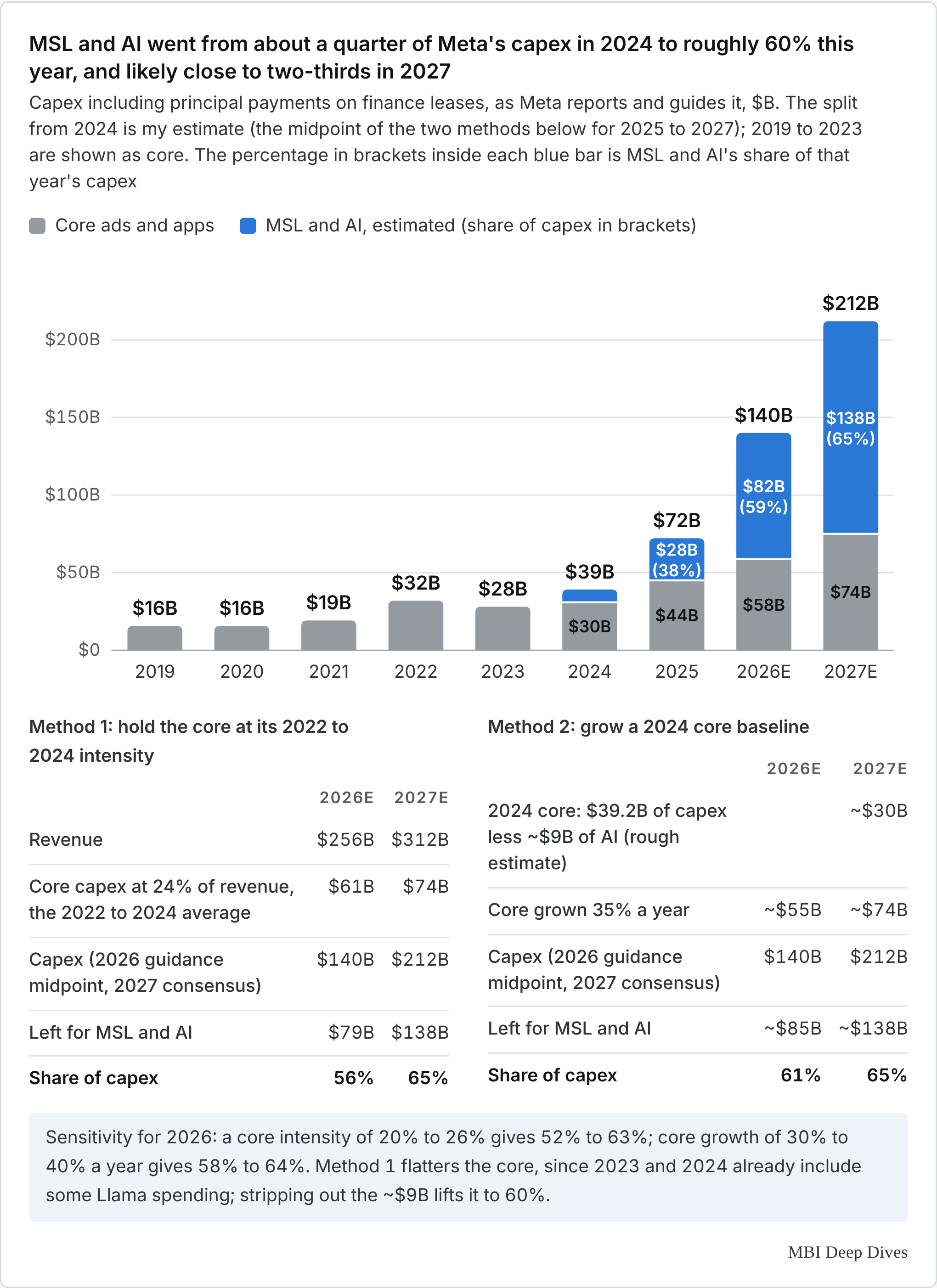
I, however, admit that the line between MSL and the core is getting blurrier. Meta says its capacity can shift between model training, the core business and new products, and MSL's models are already being put to work in the core, from content understanding to ranking research and ad creative tools, so some of what I am calling the bet will likely show up as better ads rather than as Muse. Capex is not the whole bill either: the Hyperion data center JV and Meta's third-party cloud contracts aren't considered here, and I suspect most of that capacity serves MSL too. Still, much of the return on all this spending depends on Muse, Meta Enterprise Platform, or other new products and services. Meta hasn't quite nailed the business model for Muse yet, and Zuckerberg also said Muse needs to become more than 10x cheaper to run before it can be profitable at scale.
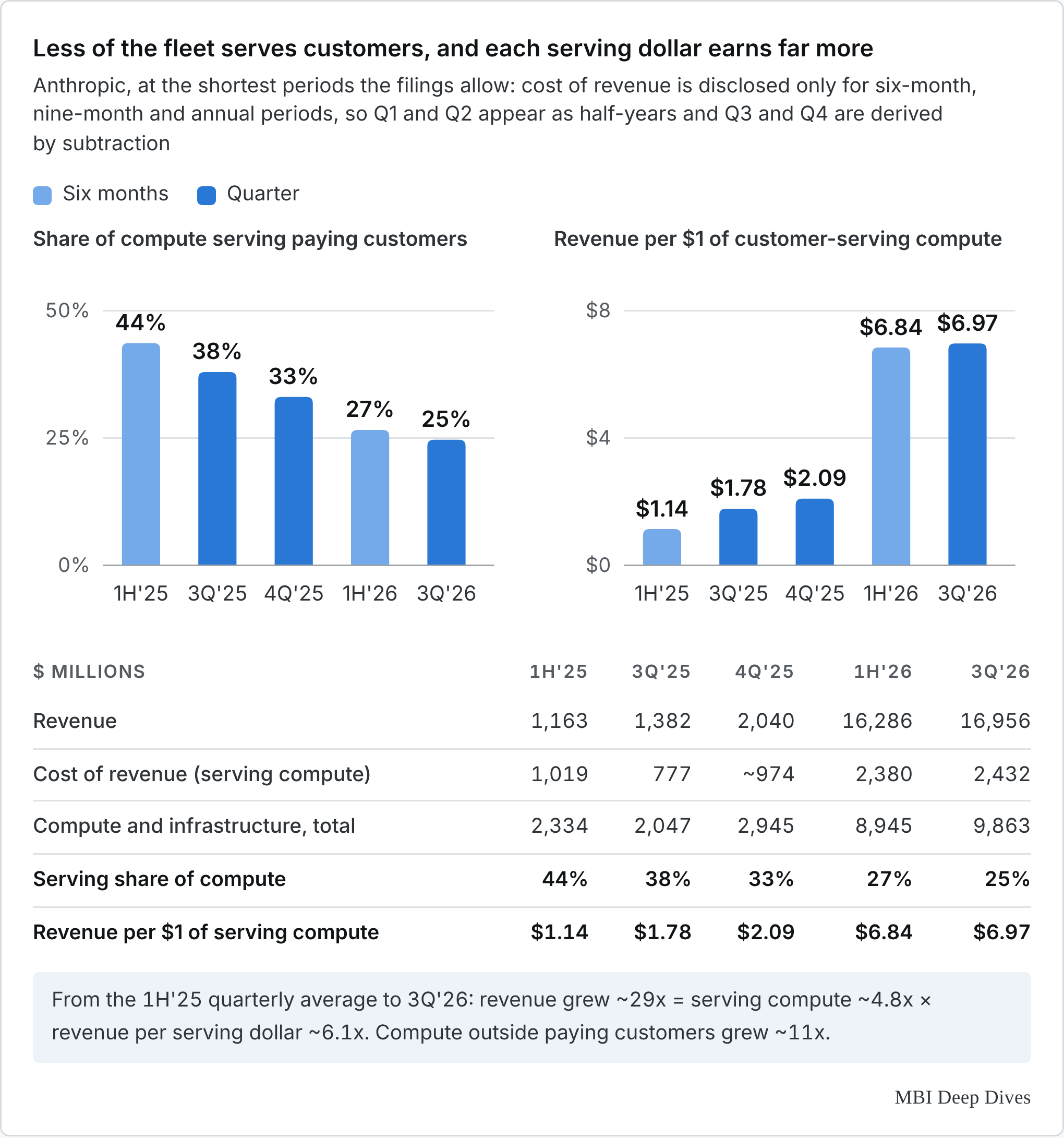
So ~60% of Meta's capex this year, and about two-thirds next year, is going to products that either haven't nailed their economics or haven't properly launched, which can make the whole program look quite speculative. Anthropic's spending has a lot of speculation embedded in it too; it just runs through the income statement instead of the balance sheet. The share of its compute serving paying customers fell from 44% in the first half of 2025 to ~25% in 3Q’26 (the rest goes to research, training and the free tier), even though Anthropic says demand exceeds the compute available to it and it took delivery of $5 billion of short-term compute from SpaceX that costs significantly more than its multi-year contracts. A company in that position that still shrinks the share serving customers is betting that compute earns more in research and training over the long term than in serving the customers in the near term, and I think that is really two bets. The first is that research makes serving much cheaper, and so far it visibly has: quarterly revenue grew ~29x over that stretch while the compute serving paying customers grew about 5x, so each serving dollar earned six times more. The second is that the models keep getting better, which is what Anthropic needs to launch the first-party products it will eventually have to lean on.
Part of the reason every major AI labs are leaning in this hard may be early signs that AI is speeding up AI research. Last week METR published an outside assessment after eleven weeks inside Anthropic. It found that Anthropic's models gained ~15 points a year on its capability index before October 2025 and about 29 since, a 1.9x acceleration, and that ~80% of it is likely attributable to AI rather than faster growth in training compute. Anthropic's amended S-1 also warned that it may soon meet its own definition of "dramatically accelerated progress attributable to AI."
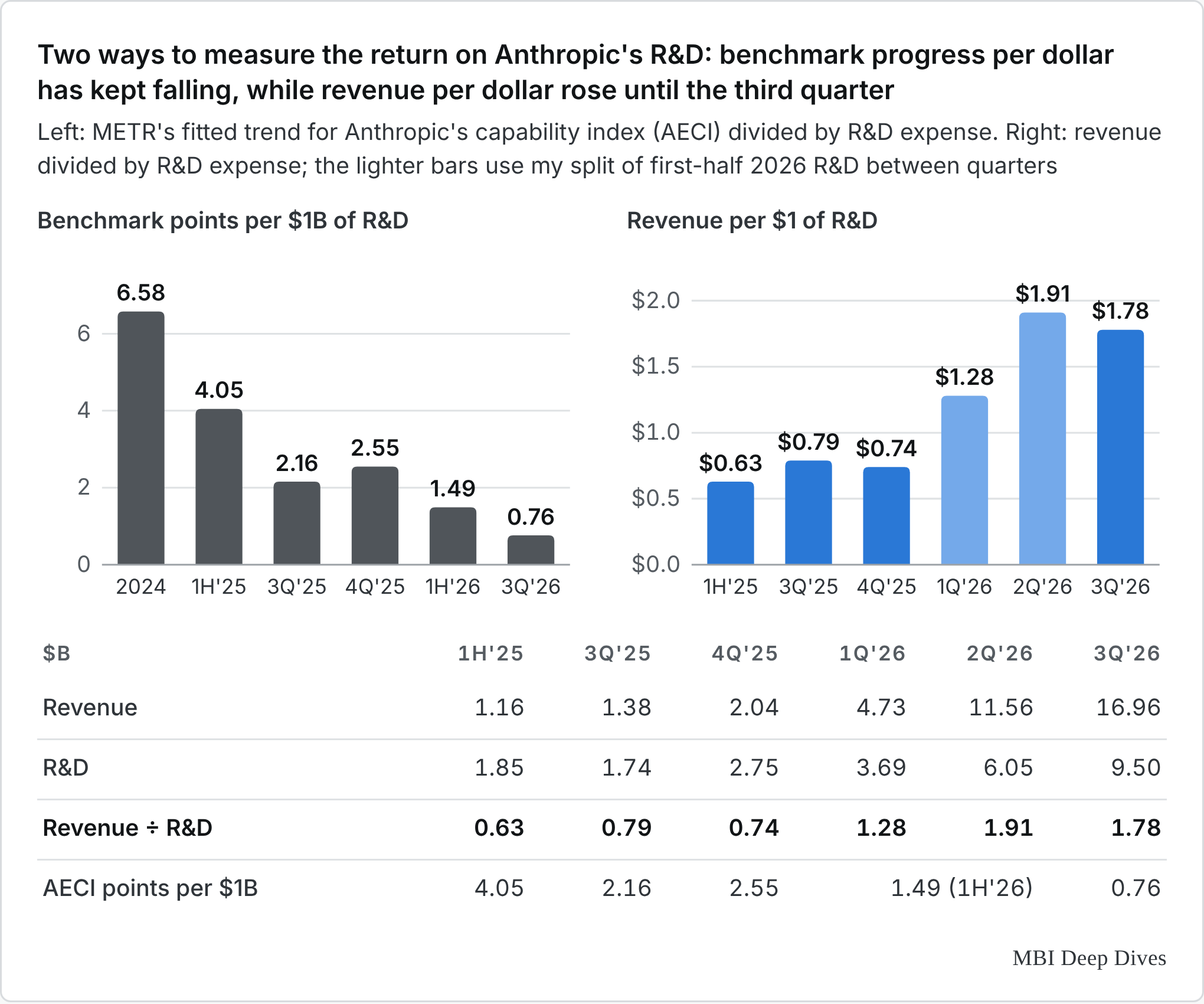
That acceleration has not come cheap, though, as Michael Wiebe and Séb Krier pointed out. Anthropic's R&D expense rose from ~$1.9 billion in the first half of 2025 to ~$9.7 billion a year later, so benchmark progress per R&D dollar fell by ~60% even as progress per year doubled, and it almost halved again in the third quarter. Revenue per R&D dollar is a better test of whether the research pays for itself. On that measure, it climbed from $0.74 in 4Q’25 to $1.91 in 2Q’26, even as R&D was ramping, then slipped to $1.78 in 3Q’26 as R&D rose faster than revenue. Some of that is the expensive short-term capacity Anthropic has been adding. Paying up for compute is fine if the returns rise with it, but in 3Q’26 they did not, and with more of that capacity still to come, the ratio could keep slipping.
There is, of course, a simpler reason to keep spending: most of Anthropic's revenue comes from its newest models, so staying at the frontier pays today. But if the gains start to plateau, the compute may be forced to shift toward inference.
Staying at the frontier matters more than it might seem, because a lead in models can compound. Imagine two labs with the same amount of compute, one of which has the better model. Customers pay more for the better model, so the leader needs a smaller share of its fleet to earn the same revenue and can point the rest at training. That makes its next model better still, and the gap widens. The lab that falls behind faces the opposite squeeze, unless it doesn't need inference revenue to pay for training at all, which is exactly what Meta's ads business provides. So far, though, having the most compute has not been enough to produce the best model.
John Hempton made this point on Joe Walker's podcast which I strongly recommend. He noted that Anthropic has spent just under $20 billion on compute in its entire history (against his estimates of $45 to $60 billion at OpenAI and about $60 billion at Google), and only ~$12 billion of it on training, more than half of that this year. Yet the result is, in his words, "clearly at the moment the best model." He had assumed frontier models would cost something like $100 billion to train; instead he reckons Claude is about five times more compute-efficient than its rivals. (His figures run through June, before Anthropic's R&D reached about $9.5 billion in the third quarter alone, but whatever that ramp buys, the models we already have and are using did not cost eye-watering amount)
I am not sure those comparisons are apples to apples, though. OpenAI doesn't file with the SEC, and Google's AI spending is buried inside a much larger business, so the estimates for both are difficult to estimate. Meta is relatively easier to estimate, and arguably a cleaner test since MSL only started in mid-2025, so I made my own estimate.
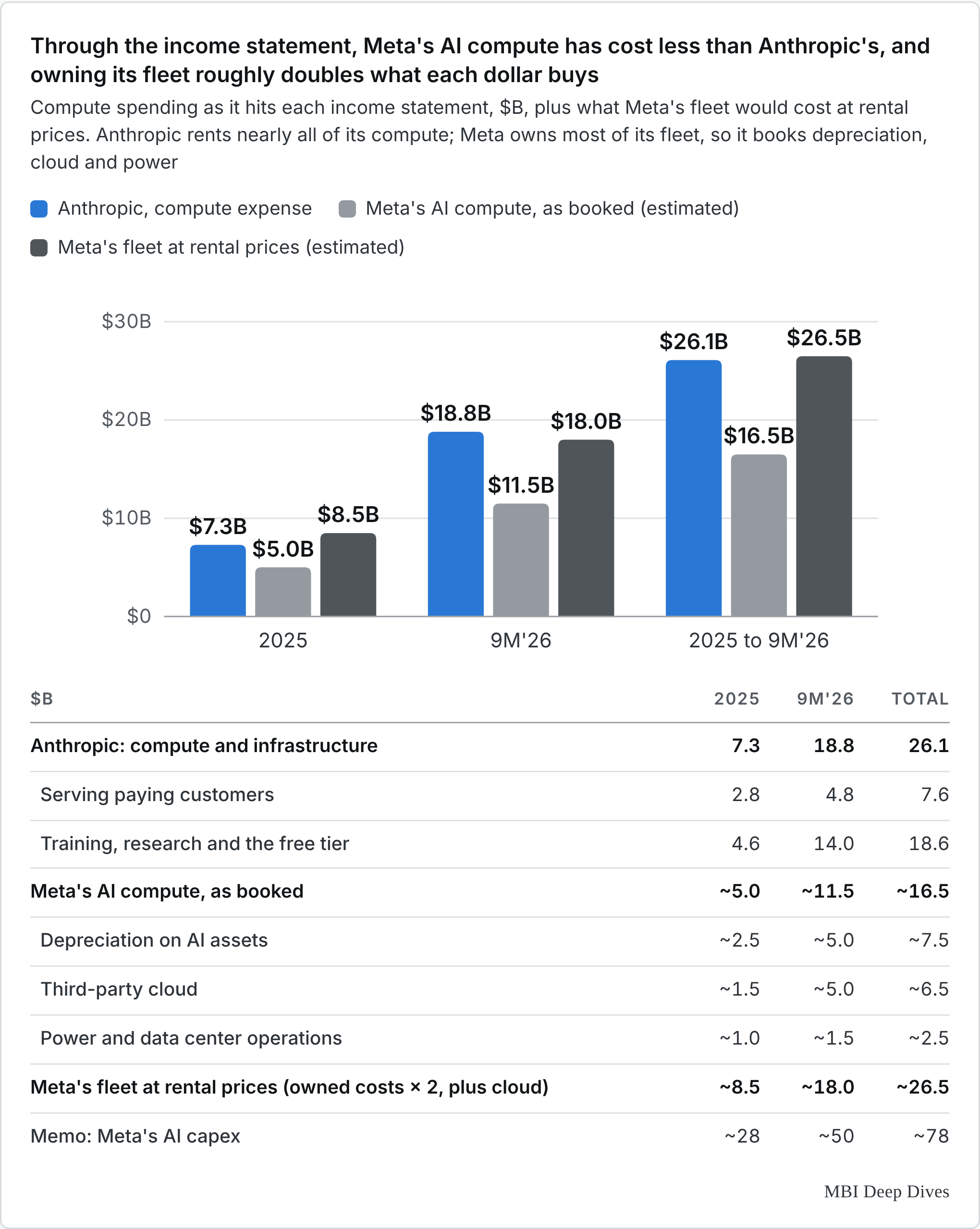
Meta's capex makes it look far less efficient, but most of it buys land, power, buildings and GPUs that will serve for years, while Anthropic rents its compute and runs the bill through its income statement. Counting only what hits each income statement, Anthropic has spent ~$26 billion on compute since the start of 2025, and on my estimates Meta's AI compute has cost it ~$16.5 billion. That is not much for a lab that got to Muse Wonder in about 15 months, even if Muse Wonder still looks about a generation behind the true frontier. The bigger point is that owning the fleet spares Meta a cloud provider's margin and return on capital, so each dollar it books buys almost twice the compute of a rented dollar. At rental prices, Meta's fleet would have cost about $26.5 billion, essentially what Anthropic spent, and far less of it went to serving paying customers. The trade-off is, however, that Meta carries the capital and the risk.
I think of it as two clocks. Anthropic has to turn its model lead into enough revenue and capital to keep buying compute faster than the cash-rich labs (i.e. DeepMind and MSL), and Meta has to close the model gap before a lead that compounds gets too wide to catch.
No one knows yet how those clocks will run, so it is just as important to understand the business each company owns outside the race, the one that keeps earning whichever way they go. For Meta, that is advertising, and Meta’s advertisers pay for outcomes. If Meta’s ranking models get 10x better, advertisers see better returns, Meta’s ad prices go up, and no advertiser can swap in a cheaper open-weight model to run Meta’s auction for it. The ads business doesn’t need the race, but it gains when Meta does well in it; as mentioned in 3Q’26 call, Meta’s Muse models cut per-unit content processing costs by more than 80% in offline tests.
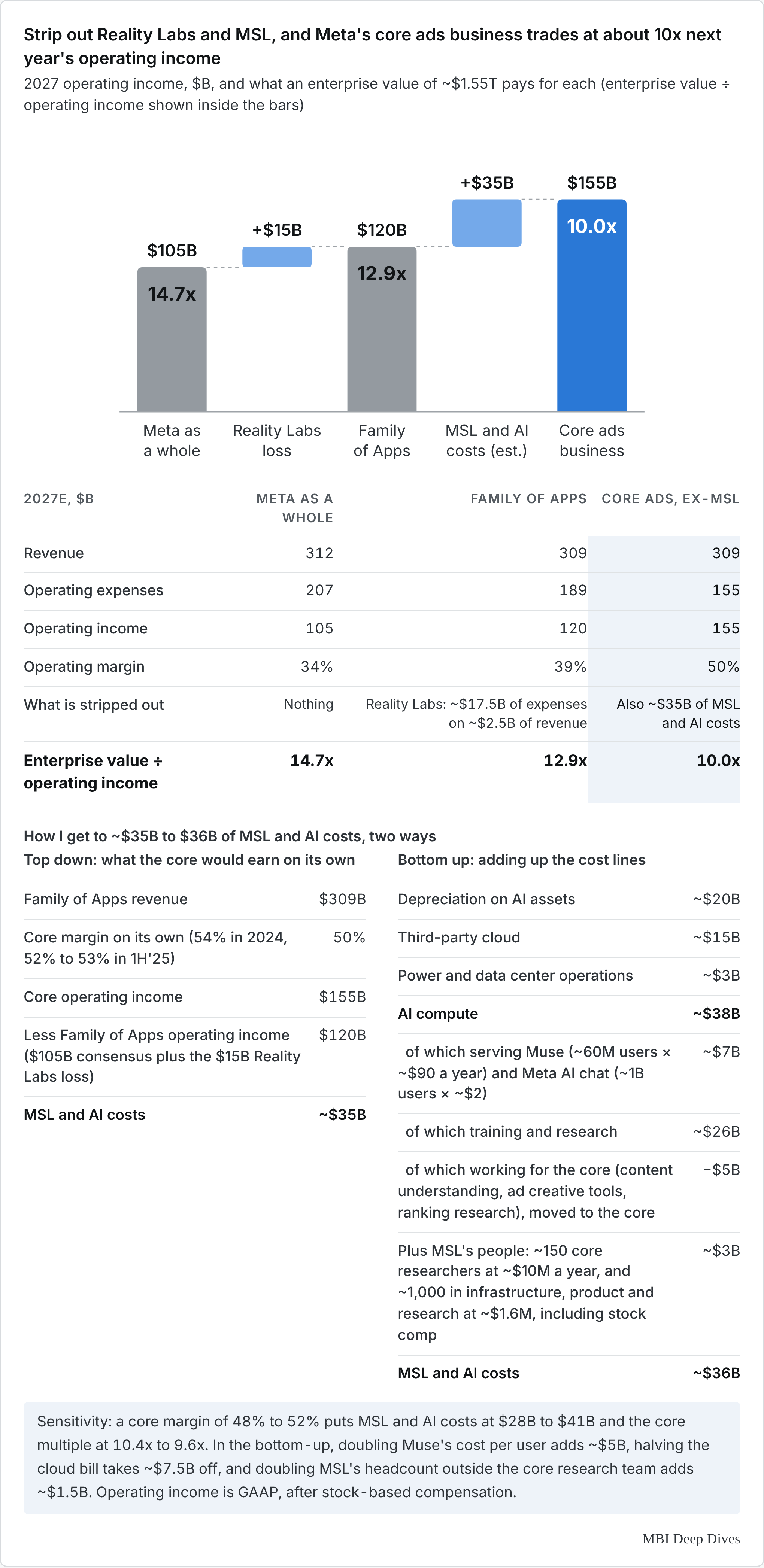
It is worth asking what the market is paying for that floor alone. Consensus EBIT for 2027 is ~$105 billion. Add back the ~$15 billion Reality Labs is guided to lose and ~$35 billion of MSL and AI costs, and the core ads business would earn something like $155 billion, implying just 10x EV to EBIT multiple for the core business. Meta does not disclose MSL’s costs, so I estimated them two ways below, and they land at ~$35 to $36 billion. These are, of course, rough estimates, but useful to think through how much conservatism is embedded into the stock price.
Just as advertising is Meta’s floor, Anthropic’s floor is the API business, but I increasingly see it as a lower quality revenue stream. Subscriptions were ~20% of revenue in the first half of 2026, and most of the rest is billed by usage. A meter invites the customer to optimize against it, and Anthropic’s largest customers are doing just that. DoorDash co-founder Andy Fang said on No Priors that DoorDash’s AI spend rose 20x from January to June before flattening, and in a more recent clip he said he and Tony Xu keep asking, “If we’re seeing ROI from the spend, wouldn’t we want to spend more?” A good return does not remove the incentive to cut the bill, though: if a cheaper model, or one DoorDash owns, does the job nearly as well, the return only goes up. Presumably that is why it built its own benchmark and worked with Applied Compute to train its own models. On Microsoft's FY27 Q1 call, Nadella said customers are asking, "Can I own the weights? Can I manage my costs?"
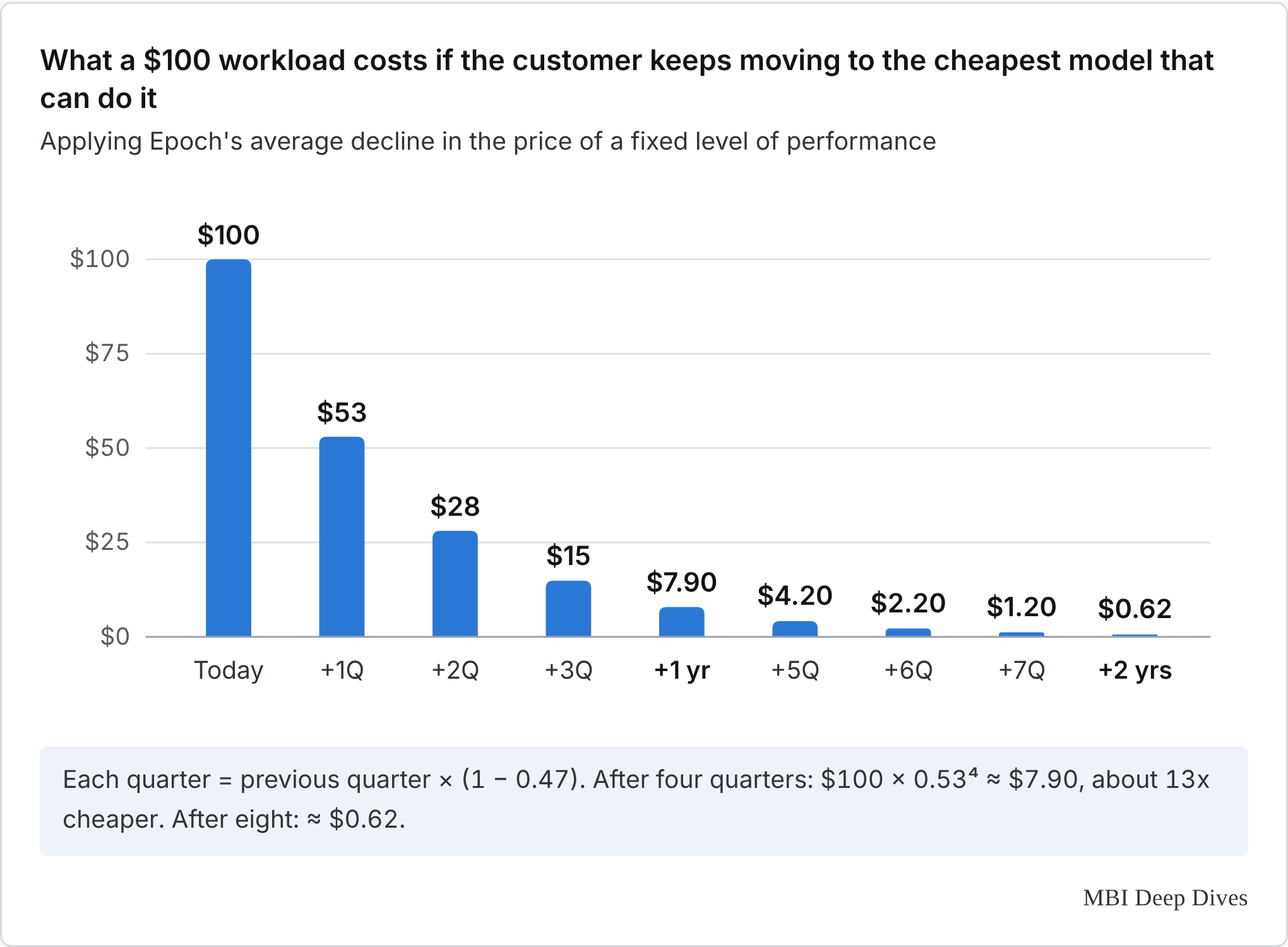
Tokens are, of course, not a commodity, since models use different numbers of tokens for the same job, but buyers running evals on their own workflows can measure cost per task, and Epoch estimates the cost of a fixed level of performance has fallen ~47% a quarter since 2023. Remember, ~44% of Anthropic's revenue through September also came through cloud marketplaces such as Bedrock and Foundry, where swapping models is very easy.
We have seen a version of this with usage-based APIs before. Uber was 14% of Twilio’s revenue in 2016. As its bill grew, Uber moved work in-house and to other vendors, and its spend at Twilio fell from ~$39 million in 2016 to ~$32 million in 2017. Usage-based revenue from the largest, most sophisticated customers is the most likely to be insourced, precisely because the bill eventually gets big enough to justify a team to replace it.
To be fair, Anthropic is not Twilio. Its customer base is broadening quickly, which is also how Twilio got past its Uber problem. And if the frontier moves faster, new jobs that only the frontier can do may arrive faster than customers can distill the old ones. But that is also what makes the revenue hard to capitalize. Models released in the six months to September 30 made up more than 80% of third-quarter revenue, and it is interesting that Anthropic mentioned $600 million of price reductions and contractual discounts for 3Q'26 in their amended S-1.
I think the API business has problems that compound. Metering itself is not the key issue here; AWS meters compute too, but leaving AWS is costly, and people often say moving off a hyperscaler is like changing the engine of a plane while it is still flying. The API business has, however, at least five problems:
a) spend a sophisticated buyer can break down into cost per task,
b) drop-in rivals that are often a one-line change away,
c) a substitute that gets ridiculously cheaper every year,
d) a bill big enough for a CFO to notice, and
e) a buyer increasingly able to build the substitute.
More importantly, these challenges feed on each other: a bill that size gets scrutinized, cost per task shows when a cheaper model is good enough, and moving to it takes a line of code. Meta's core advertising business is largely immune from these challenges.
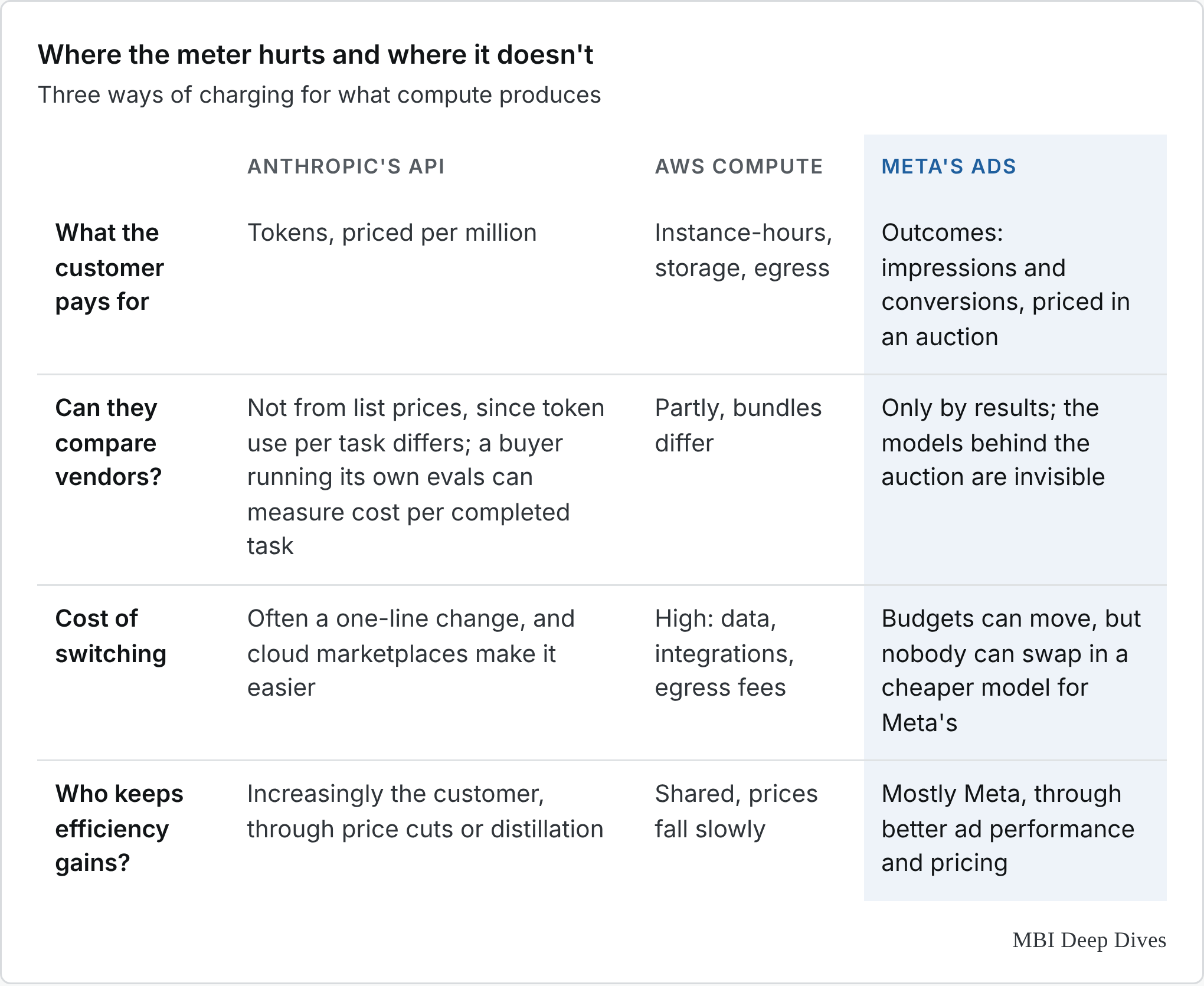
Hempton also offered a useful parable here in that interview mentioned earlier. At one end of the chemicals industry are giant plants turning natural gas into plastic pellets, whose high capital cost, low marginal cost and competition he reckons make about the worst business there is. At the other end are enzyme makers like Novozymes, whose small dose makes an enormous process run better, so they can charge a small slice of a very large pie. Selling tokens looks like the pellet plant to me: training costs a fortune, serving paying customers costs relatively little which I don't think was clear until the S-1, and the industry looks likely to stay competitive. Meta's ads are closer to the enzyme since it is priced on results and a small slice of the commerce they help drive. Interestingly, Muse is pitched the same way. Muse has no model picker at all. The focus is distinctly just on the product or what it can do, rather than what models they are using to drive that outcome. Prosumers such as me or large enterprises obviously like to have model pickers or pricing by the token meter, but most Muse users probably won’t care which model answered, so Meta can swap in cheaper ones and keep the savings.
Put together, the payoffs look quite different. If MSL disappoints, a Meta shareholder still owns an ads business priced at ~10x 2027 EBIT, and the damage is the capex. That is painful but bounded. If Anthropic’s bet disappoints, the shareholder owns an API whose value depends on staying meaningfully ahead, so the floor itself is built out of the bet.
My sense is that within five years Anthropic’s non-metered revenue will have to overtake its metered revenue, which is of course a massive shift from today’s 80/20 split. Given where subscription vs API stands today, even if usage-billed revenue only doubles from here, everything else would need to grow ~8x to overtake it in 5 years. The trouble is how little we know about what those products will be or how they will be distributed, when much of Anthropic’s distribution today runs through clouds that compete with it.
Anthropic’s S-1 itself illuminated so much about the AI economics that I am praying that the IPO goes through even though I don’t intend to put my capital at $1.5 trillion valuation. It will be very, very useful to see and track the economics closely every quarter. After the IPO, I will watch three numbers very closely. The first is the share of its compute serving paying customers. If that keeps falling while revenue per serving dollar keeps rising, Anthropic is earning more from every unit of compute it sells and pointing the rest at the next model, which means the loop may be working. The second is revenue per R&D dollar, which slipped in the third quarter after peaking in the second; I want to see it rising again, because that is the best possible sign the research is paying for itself. The third is the share of revenue from subscriptions, which will tell me whether Anthropic is building a floor that does not depend on staying ahead.
For Meta, the question is whether Muse finds a business model and gets cheap enough to run, but even if it never does, shareholders still own an ads business at about 10x. If the gap between Anthropic’s models and the next best narrows, or customers decide the best model is more than most of their work needs, I suspect the API underneath it would be worth far less than it is today.
At similar valuations, only one of these lets me be wrong about the bet, which is why I remain comfortable owning Meta while still lacking the conviction to buy the Anthropic IPO. That said, investors’ biggest complaint about Meta, and about Zuckerberg, may be the shadow of Reality Labs. Meta has spent more than $100 billion there with no sign yet that the economics will turn positive, so whenever it places another speculative bet, investors understandably ask: is this another Reality Labs?
Subscribers get the daily journal and five+ years of Deep Dives, i.e. full-length analyses with financial models on 70+ companies. The daily is just how I think out loud between the Deep Dives!
Current Portfolio:
Please note that these are NOT my recommendation to buy/sell these securities, but just disclosure from my end so that you can assess potential biases that I may have because of my own personal portfolio holdings. Always consider my write-up my personal investing journal and never forget my objectives, risk tolerance, and constraints may have no resemblance to yours.
My current portfolio is disclosed below: