When the Ads Come to the Data
Last week, I wrote why Muse may never need ads. That piece traveled quite a bit, and interestingly, while I received glowing praise from some readers, I have also heard from people who vehemently disagreed with the word “never”. After pondering this a little more, I actually came to agree with my critics.
The core argument that I laid out in my piece wasn’t incorrect, but assuming Meta will NEVER show ads on Muse is likely a bridge too far. In fact, while discussing this topic with several people (public market investors, VCs, advertisers, and big tech employees) over the last few days, I realized I was a bit shortsighted in assuming a “no ads” future for Muse. The fact that Muse’s own browsing activities can inform the ads people see on Facebook and Instagram will help Meta be more patient before turning on the ads spigot, but to capture the full potential of Muse, Meta will almost certainly insert ads.
The reason I was so resistant to ads inside Muse was that if users are handing over their emails, logins and payment credentials, they need to believe Muse is working for them rather than for the highest bidder, and ads inside the agent would undermine that. In retrospect, I wasn’t quite imaginative enough about the ads of the future, which is perhaps a classic fallacy to fall for while navigating a transformative era of technology.
The first internet ads were essentially print ads that moved online i.e. static banners bought by the impression, and it took years before the native form emerged with ads targeted, auctioned and measured in ways print never could be. I suspect we may be at a similar stage with today’s consumer AI agents: a sponsored link inside a chat window is perhaps the banner ad of this era. The native form may instead be something like a personal ad engine, where my own AI looks through every ad and shows me only the one that fits my situation.
Meta has stated (see here, and here) plainly that my conversations and the data in the Virtual Machine (VM) that Muse uses are NOT shared with its ad systems. So any advertising inside Muse would need to work under that constraint: Meta's ad system cannot use what my agent knows about me to decide which ad I see. The only way around it, I think, is to reverse the usual flow: the ads come to my data rather than my data going to the ads, with my AI choosing among them inside the VM, and Meta's ad system learning little more than that a campaign produced a sale.
Let me drive my point home by giving you a few specific examples how this could work while keeping the privacy constraint in mind.
Let’s start with car insurance first, which is perhaps the most telling example because of where the ad dollars go today. My current insurer knows exactly when my policy renews, but it is obviously the one party with little reason to prompt me to shop around. Its rivals cannot see that date. What they can do is wait for me to reveal it i.e. when the renewal notice arrives and I type “cheap car insurance” into Google, that query is the best signal that I am open to switching. This is why insurance keywords have long been among the most expensive in search as several insurers and lead-generation sites bid for my click, often as high as $60-70 per click. I may click three or four, fill in the same form each time, and my details may be sold on to agents who call me for days. Let’s just say that’s not really a great experience to go through. Of course, most of those clicks never become a policy, so the insurer that eventually wins me has in effect paid for the ones it lost which is why acquiring a single customer can cost several hundred dollars. Meta’s role in this market is likely quite modest today.
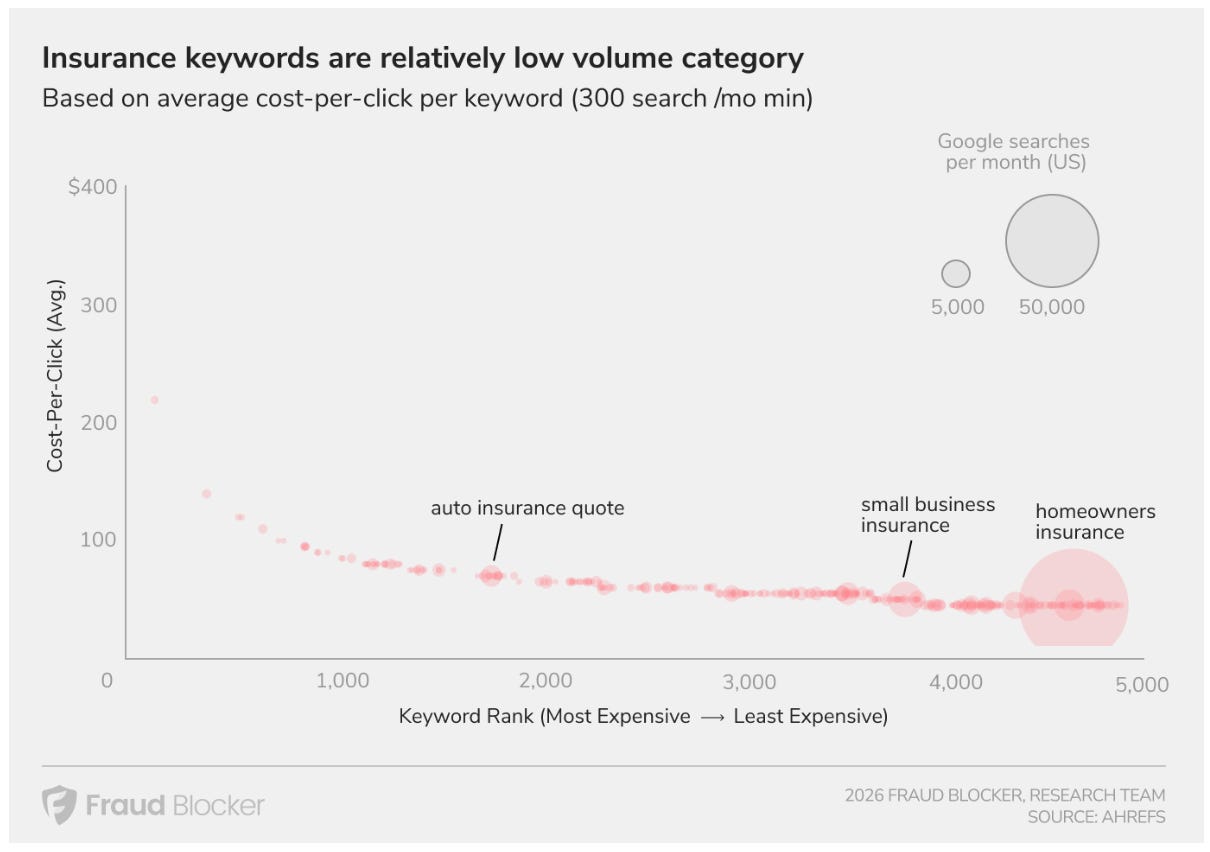
Now consider what the AI in my VM knows today once I connected my emails with Muse. It has the renewal notice that shows my premium is going from $1,480 to $1,720 on November 14, a 16% increase. It also knows that my service receipts suggest I drove only about 6,000 miles this year. Today, Meta’s ad system has to guess which of its ads to show me. In this version the roles are reversed: my AI can look through every ad in Meta’s system i.e. every insurer’s campaign and show me the only one that fits my situation: an insurer with a low-mileage policy. With my permission it can then request a quote: let’s say $1,250 for the same coverage. I say “switch”, and Muse fills in the application and cancels the old policy. In such a world, I never will type the query, so one of the most expensive clicks in search may never need to happen when my personal AI agent will do the work for me. Of course, you don’t need to be a rocket scientist to figure out that an advertiser will be very, very happy to pay Meta to sell that policy to me.
Meta’s advantage is that two things are needed at once, and very few companies currently have both. The first is the context, which sits in the VM. The second is the supply of ads: millions of advertisers already have campaigns, creative, budgets, and billing inside Meta’s system, so the catalog my AI will be able to search is very deep on day one. A startup with a capable agent would have the context but no advertisers. Google is the one company with both since the insurers are its customers, and my renewal notice probably sits in Gmail. However, every purchase its agent completes would likely replace the search auction it monetizes best (more on that later), whereas for Meta, this revenue would be largely new.
What I find most interesting is that Meta can do all of this without breaking its privacy promise. Its ad system will never learn my renewal date, my premium or my mileage. Information travels in one direction: my AI reads the full catalog of ads (the same catalog every other user’s AI can read) and the choice is made inside my VM, where the ad system cannot see which ads were considered or why one was picked. The insurer will receive my details only at the moment I ask for a quote which is no different from filling in the form myself. What comes back to the ad system would need to be little more than the fact that a sale happened: this campaign produced a sale, bill the advertiser. Meta may learn that I bought a policy, but not why. In effect, the ad system no longer needs to know me, because the ads come to my data rather than my data going to the ads.
This is really the crux of what I missed and wasn’t imaginative enough to think through in my earlier piece. Of course, solving the privacy problem doesn't fully solve the trust problem I raised in my earlier piece. My agent is choosing only among the advertisers in Meta's system, so I may never know whether a cheaper insurer that doesn't advertise on Meta existed. But I am not sure there is a compelling alternative. Consumer agents are expensive to run, and it seems unrealistic to expect one to work for free at mass scale: someone must pay for it. Nor is it practical to imagine my agent crawling fifty insurers' websites every time a renewal notice arrives. Agents will optimize, and the most efficient path for Meta's agent is to go straight to the ad system, where the supply is already structured, priced and ready to transact. That works for Meta, which needs to make money; it works for the advertiser, which makes a sale; and it works reasonably well for me because nothing happens without my say. The agent proposes, but I decide whether $1,250 is good enough to switch. Is it the best possible deal? Maybe not. But it is a meaningfully better deal than the one I had, arrived at with far less hassle, and the final call remains mine. It is also worth remembering that the status quo isn't neutral either: when I search for "cheap car insurance" today, the options I see first are the ones that paid to be there.
Since I am in a more imaginative mode today, let me give you another example.
Today, Meta knows I watch running videos on Instagram, and perhaps that I once visited a shoe brand’s website, so brands that want to reach runners bid to show me their ads. The ads are plausibly relevant, but most arrive when I am not in the market, and none can account for what Meta’s ad system cannot see: that my current pair is nearly worn out, that I have a race coming, or that I need a wide fit. The brand obviously ends up paying for a great many impressions to find one buyer.
Now consider what the AI in my VM may know. It has the confirmation email for a half marathon nine weeks away, a receipt showing my current pair is fourteen months old, ~500 miles logged on that pair in the running app I've connected to Muse (or you can create an app for yourself), and my standing instruction to Muse based on an earlier conversation: wide fit, under $160. Instead of Meta’s ad system guessing which ad to show me, my AI can look through every ad in Meta’s system i.e. every shoe brand’s campaign and show me the only one that fits: a Brooks model that comes in wide at $140. It explains why in terms of my own situation: the race is nine weeks out, my current pair has ~500 miles on it, and a new pair is best worn in a few weeks before race day. The ad can appear once, labeled as sponsored and if I say “order it”, Muse completes the purchase. Brooks pays for the sale it made because my agent found the ad from Meta’s ad library.
Unlike insurance, this is Meta’s home turf. Shoe and apparel brands already spend heavily on Instagram, and their campaigns are already in the system. So the advantage here is not taking dollars from Google or anyone else but making Meta’s existing ads far more precise than a rival without the VM context could match. Nonetheless, this is an example where Meta would be partly replacing its own revenue since it sells fewer impressions when the first ad lands. Whether it comes out ahead likely depends on charging per sale, where a brand may pay more for certainty than it does for reach.
The privacy promise holds the same way: my race, receipt and shoe width never leave the VM, Brooks learns only what any retailer learns from an order, and the ad system learns little more than that the campaign produced a sale.
Okay, one more example.
Yesterday, I saved a few Instagram posts about Mexico City restaurants. Meta can tell I am interested in the destination, so for a while I may see ads from airlines, hotels or booking sites. If I later search for flights or hotels on Google, the online travel agencies and hotel chains bid heavily for that query. So the ad dollars are largely split: Meta is paid for sparking the idea, and Google for the moment I act on it. Neither knows when I am actually free to travel or what the trip would cost me.
The AI in my VM may have much richer context. My calendar is open October 23–26, and I have told Muse I like staying somewhere walkable and under $200 a night. My AI can look through every ad in Meta's system i.e. every hotel's and booking site's campaign, along with restaurants promoting their tables and show me the combination that fits: a hotel that is a ten-minute walk from four of the restaurants I saved, at $180 a night, with tables open at two of them on the nights I'm free. I tell Muse to book the hotel and reserve both restaurants. I never searched for anything, so the query Google would have monetized never happened. Again, Meta will get paid by the hotel or OTA advertisers, and perhaps by the restaurants or reservation platforms too.
Meta’s advantage here is that the desire usually starts on its own apps. Until now it had to hand the booking to someone else, but with an agent it can carry me from the saved post to the confirmed reservation. Hotels, booking sites and restaurants already advertise on Meta, so the supply is already in place. And this is spending that would not otherwise have happened which is the kind advertisers tend to value most, so it is more likely to add to Meta’s revenue than to replace it.
The privacy promise holds here too. The posts I saved are activity on Instagram, which Meta’s ad system can already see; my calendar and preferences stay in the VM where the matching happens, and the hotel and restaurants receive only what they would if I booked directly.
Look, perhaps none of these will happen at any discernible scale next year and maybe I am overcompensating for the “lack of imagination” criticism I received due to my earlier piece. But the longer I look forward, the more realistic (and dare I say, inevitable) the contour of the future I have laid out here in the examples shared above.
One of the reasons I am more optimistic about the economics of personal AI agents is that I do not think you will want multiple AI agents going through your emails and ping you about the same insurance renewal. It is more likely that you will have one AI agent in your personal life. So the question of who gets to be your personal AI agent and the competitive dynamics around it is of paramount importance. As indicated in this piece, I do think Meta has some strong competitive advantages here.
The kind of ads I described above need at least four things at once: a capable agent, free access at mass scale, personal context, and a deep catalog of advertisers. I have little doubt that Muse will face lots of competition here, but most potential competitors are likely missing at least one piece of the broader puzzle.
OpenAI has the willingness but perhaps not yet the economics as Dots are currently bundled with a $100-a-month Pro plan. Its ad business is also young, with tens of thousands of advertisers against Meta’s tens of millions, and it has no social graph of its own, so its context must come entirely through connectors. Apple, on the other hand, may have a different set of problems. Siri is nowhere near as capable an agent as Muse or Dots. It also doesn’t have deep advertiser catalog, and an ad engine would cut against the privacy positioning it has spent a decade building. Apple’s deep privacy promise proved to be a masterstroke “strategy credit”, especially in the age of post-Cambridge Analytica mania, but in the era of AI, clinging onto such promise can lead to potentially inferior products. As a result, the “strategy credit” can potentially turn into “strategy tax”. Apple could still offer a compelling ad-free alternative funded by hardware and services margins, but consumer AI agents are expensive enough that it may be challenging even for Apple without a compelling path to monetizing the interactions.
Google is the one I expect to come after Muse with much more vigor because it is perhaps the only company that could assemble everything Meta has without building anything new. Gmail and Calendar already hold much of the context Muse has to ask permission for, and in intent-heavy categories like insurance and travel, its advertiser base is arguably deeper than Meta’s. Its restraint so far looks like a choice rather than a limitation: Google’s personal agent, Spark, remains behind a paywall. The real problem for Google is incentives: every errand an agent finishes may replace a commercial query it sells at auction, and given the kind of advertising Google is best at, cannibalization is a far larger concern for it than for Meta. Given the nature of advertising Google is best at, cannibalization is a larger concern for them. Having said that, Google has moved quickly before once the threat became clear, as it did after ChatGPT, and if Muse keeps gaining traction, the calculus of protecting search may start to look quite different.
Tibo Sottiaux, who leads ChatGPT and Codex at OpenAI, recently said the following on Lenny’s Podcast (emphasis mine):
I think there's so many things that I feel are not yet priced in. I think the majority of actions on the internet will be taken by agents. Models are going to become more cheaper and faster at rates that are quite incredible. We will finally be able to integrate all modalities together in a way that is very seamless.
If we indeed enter a world where majority of actions on the internet will be taken by agents, you can bet the ads will be very different in that world. The “no ads” future may sound enticing or appealing at first, but it will only satisfy a small minority of people at the expense of higher prices for everyone else. If customer acquisition cost skyrockets due to advertisers not being able to reach the customers where they are, “no ads” will turn into more of a nightmare than utopia. So no, I don’t think I was right in saying Muse will never have ads. It almost certainly will, but the indirect monetization I mentioned in my earlier piece will allow Meta to be much more patient and stay razor-focused in aggregating demand.
Subscribers get the daily journal and five+ years of Deep Dives, i.e. full-length analyses with financial models on 70+ companies. The daily is just how I think out loud between the Deep Dives!
Current Portfolio:
Please note that these are NOT my recommendation to buy/sell these securities, but just disclosure from my end so that you can assess potential biases that I may have because of my own personal portfolio holdings. Always consider my write-up my personal investing journal and never forget my objectives, risk tolerance, and constraints may have no resemblance to yours.
My current portfolio is disclosed below: