Airbnb 2Q'26: Widening the Gap with Booking
Airbnb reported an acceleration in nights and seats (N&S) booked, adding 14 million (+10%) N&S YoY which was the highest since 3Q’23. More importantly, Airbnb guided low double digit N&S growth even for 3Q’26 which indicates a likely sustained acceleration in the business. With such double digit N&S and MSD ADR growth, GBV and revenue growth continue to grow at mid-teen rate and are expected to maintain such momentum in 3Q’26.
Since Booking reported its own 2Q’26 a couple of days earlier, I will first go through Airbnb’s quarter through the usual KPIs, then compare and contrast against Booking, and finally discuss some broader takeaways from the calls.
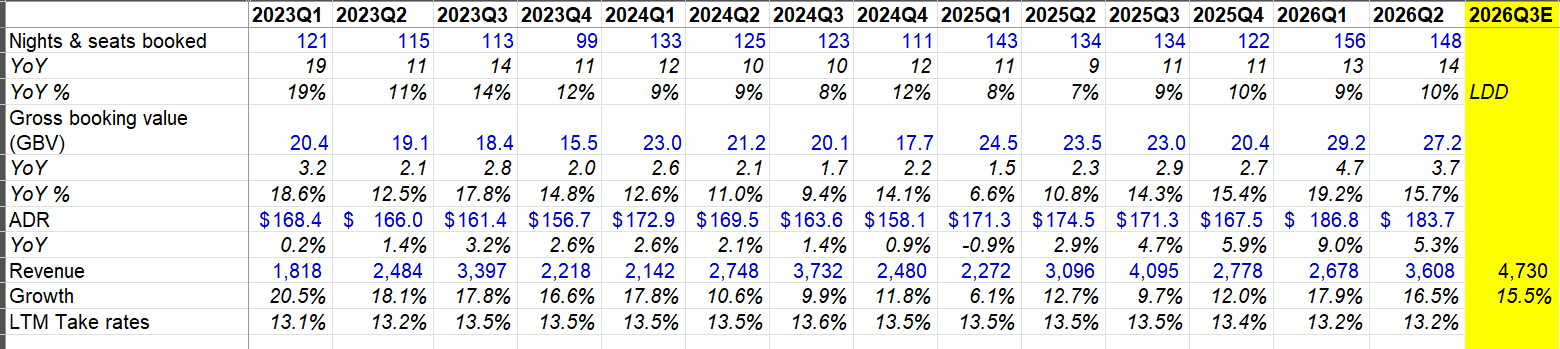
Airbnb’s performance exhibits a lot of what I have been expecting and writing over the last few months, but let me start with something that has been somewhat diverging from my expectations: take rates! LTM take rates actually went down by ~31 bps YoY. Moreover, even though during 1Q’26, management expected full-year take rate to be higher in 2026, they have now guided it to be flat. This is despite the fact that their recent single service fee model is a tailwind to overall take rates AND significant growth in insurance related revenues which was up +45% and +60% in 1Q’26 and 2Q’26 respectively.
So, what explains this divergence? Management cited two primary reasons: a) Reserve-Now-Pay-Later (RNPL) which was ~20% of GBV, and b) higher customer incentives. Airbnb is actually expanding RNPL given the strong results they have seen and they like the fact that RNPL lets host lock in earlier calendar share (vs other OTAs). As a result, RNPL is likely to be a continued headwind to the reported take rates even though it is net positive for the overall business. Similarly, to promote new verticals such as experiences and services as well as hotels, Airbnb is providing “credit” to guests that they can use in the future on Airbnb. So, Airbnb is sacrificing some or lot of the take rates in such GBV to grow the overall marketplace. Both decisions are highly likely to be net positive for the business over the long term even if it lowers the reported take rates in the near term. Once RNPL is more widely rolled out and early investment phase in new verticals are behind us, I still think take rate will go up over the medium to long term. But the pace of such improvement may be more sluggish than I initially expected, especially given Airbnb’s ambition to launch new verticals almost every year which may lead to more sustained investment in customer incentives.
Geographically, the reported revenue growth was quite balanced: North America +15.8%, EMEA +15.6%, LatAm +26.0%, APAC +16.9%. As usual, FX impacts these reported numbers a bit too much to derive useful comparisons, so N&S growth and FXN ADR remain my preferred lens.

The standout on this quarter is North America (NA): after six quarters stuck in LSD-MSD nights growth, NA reached HSD for the second consecutive quarter, with FXN ADR up 7%. EMEA also moved up from MSD to HSD. In other words, the core markets are accelerating. CFO attributed part of the ADR strength to the continued disproportionate popularity of larger homes; bedroom nights grew faster than nights booked and accelerated more on a YoY basis, which frames the ADR appreciation as incremental value delivered rather than pure price inflation. Meanwhile, expansion markets continue to grow about twice as fast as core, first-time bookers accelerated to +11% (the best in four years, with Gen Z the fastest-growing cohort), and app nights grew 23% YoY to 64% of total nights (vs 59% a year ago) which is quite encouraging to see.

I will benchmark Airbnb’s quarter against Booking as well some other key takeaways from the call which will be behind the paywall.
Subscribers get the daily journal and five+ years of Deep Dives, i.e. full-length analyses with financial models on 65+ companies. The daily is just how I think out loud between the Deep Dives!